Sidebar menus for DeepSeek Harness
Show or hide sidebar panel entries and add shortcuts to Settings sections. Existing panels use their actual sidebar names, not the shorter names of their corresponding Settings sections.
Screenshots
Manage visibility
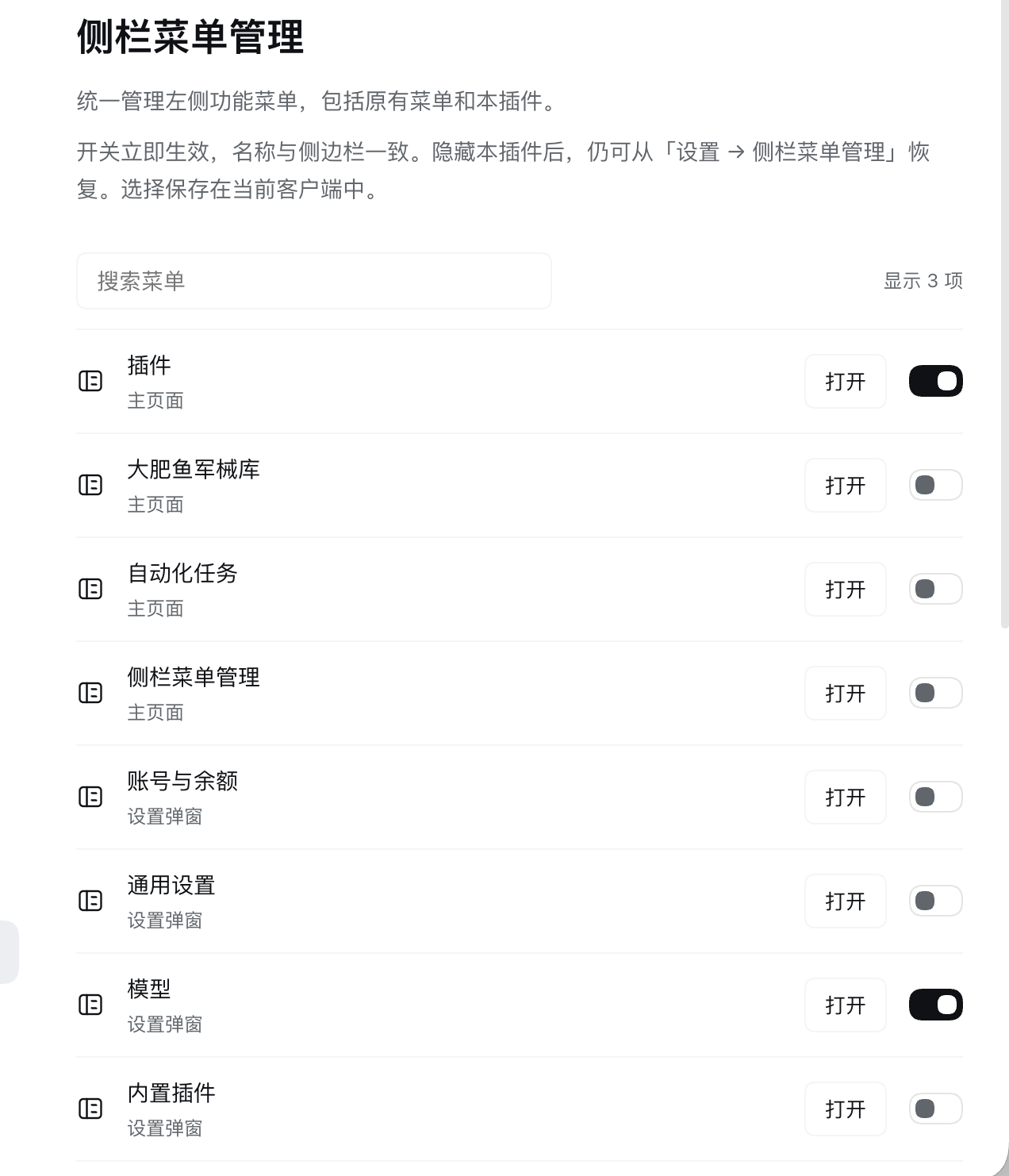
Settings shortcuts in the sidebar
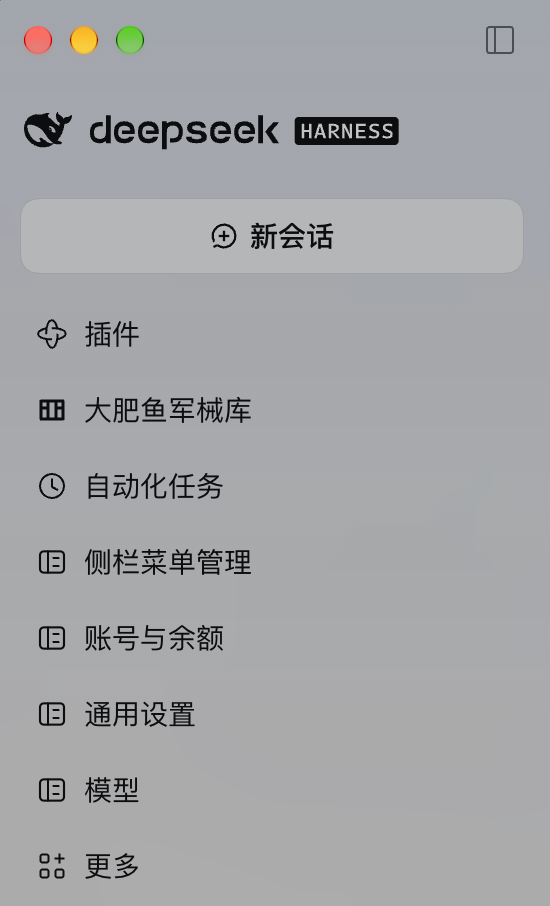
Screenshots show two example configurations. Captured and provided by the plugin author for publication.
Install
Requires DeepSeek Harness Web or Desktop with the sidebar, Settings and layout client APIs. The plugin ships directly loadable JavaScript: no build, install scripts or additional runtime dependencies. React and the client store are supplied by the Harness module loader.
Ask your Harness agent:
Install the GitHub plugin github:zyileven/dsh-settings-sidebar
Or install into your active CLI profile (desktop below is the Desktop profile; substitute your own):
dsh plugin --profile desktop add github:zyileven/dsh-settings-sidebar
Alternatively, download dsh-settings-sidebar.tgz from Releases and run:
dsh plugin --profile desktop add ./dsh-settings-sidebar.tgz
For a pinned version, use github:zyileven/dsh-settings-sidebar#v1.1.1. The package keeps its internal identifier @local/dsh-settings-sidebar; it is distributed through GitHub/tarballs, not npm.
Use
- Open Sidebar menus from the sidebar or Settings.
- Search for a menu and toggle its visibility. Existing panels, More and the manager itself are included.
- If you hide the manager, reopen Settings → Sidebar menus to restore it.
Where a menu opens depends on whether its content has a main page. Entries with their own main-content page open that page in the main content area, exactly as the original sidebar button does; entries that exist only as a Settings section have no main page, so they open the Settings dialog already positioned on that section. Such a dialog does not replace the page you were on: closing it leaves that page selected, and if that page's plugin has been removed the shortcut falls back to the conversation. The Plugins inventory page and the built-in-plugin Settings section are separate entries.
Hiding an entry does not disable its plugin, delete its page or remove its Settings entry. New Session, workspace browsing and account/Settings controls are outside the panel-menu scope; Settings remains available for recovery.
Data and safety
Visibility choices stay in this client's localStorage. No network requests, account/model/Host configuration changes, session-data changes or model tools are added. Preferences do not sync between clients. First-version pins are migrated; failed saves report an error and preserve the current state. Uninstalling removes policy styles and added shortcuts, restoring original panels. Local preferences remain for reinstalls.
Compatibility and limitations
The current host has no public filter for every original sidebar panel. Original entries are hidden by a stylesheet rendered in shell.overlay, scoped to the global navigation and complete button accessibility names. Labels are CSS-string escaped and follow locale changes. The plugin does not read or rewrite other plugins' DOM or replace the sidebar. New Settings shortcuts use ordinary slot registrations and disposers.
- Hiding affects sidebar navigation rows only. More's popup or other locations may still expose the same function.
- Two original entries with exactly the same display name are hidden together.
- The plugin depends on current navigation markup,
layout.panelInfosubscription and the Settings shell's shared StoreopenSectionaction. Host upgrades require revalidation. Settings navigation failures are reported in the manager. - Existing panels default to visible; Settings shortcuts without an existing sidebar entry default to hidden.
The SVG icon is original artwork; the storefront PNG is converted from it. No third-party UI artwork is bundled.
Development and verification
npm test
npm pack --ignore-scripts
Node's built-in tests cover names, original/self visibility, shortcut lifecycle, persistence/migration, failed storage, preserved modal backgrounds and listener disposal. Installed Desktop checks also exercised original-panel hiding, manager recovery through Settings and closing Models Settings back onto the Plugins page. These checks are not a cross-version compatibility guarantee.

No comments yet. Be the first to write one.