jobmatch
A local-first job-hunting workbench for Hong Kong. Paste your CV → scrape a job board → score every posting against you → understand the market.



Most job hunts are: open a board, read 80 postings, forget which ones you already read, and have no idea whether HKD 35k is good for someone with 3 years of experience.
jobmatch is a single Node process that turns that into a local web app:
- parses your CV into a profile (skills / titles / domains / years) — offline, no LLM, nothing leaves the machine;
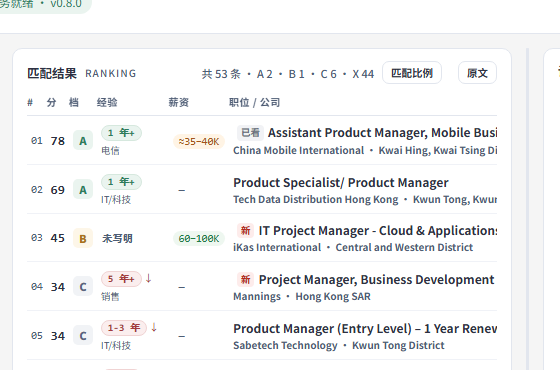
- searches a job board, scores every posting 0–100 against that profile, gates it on experience, and sorts into A / B / C / X tiers;
- fetches the full JD for each posting, extracts the experience requirement, and estimates pay when the employer hid it;
- turns the whole pool into market answers: which capabilities the JDs actually ask for, what they pay at each experience level, and where your CV has gaps.
No npm install. No account. No cloud. The only thing that leaves your machine is the job search query.
 |
 |
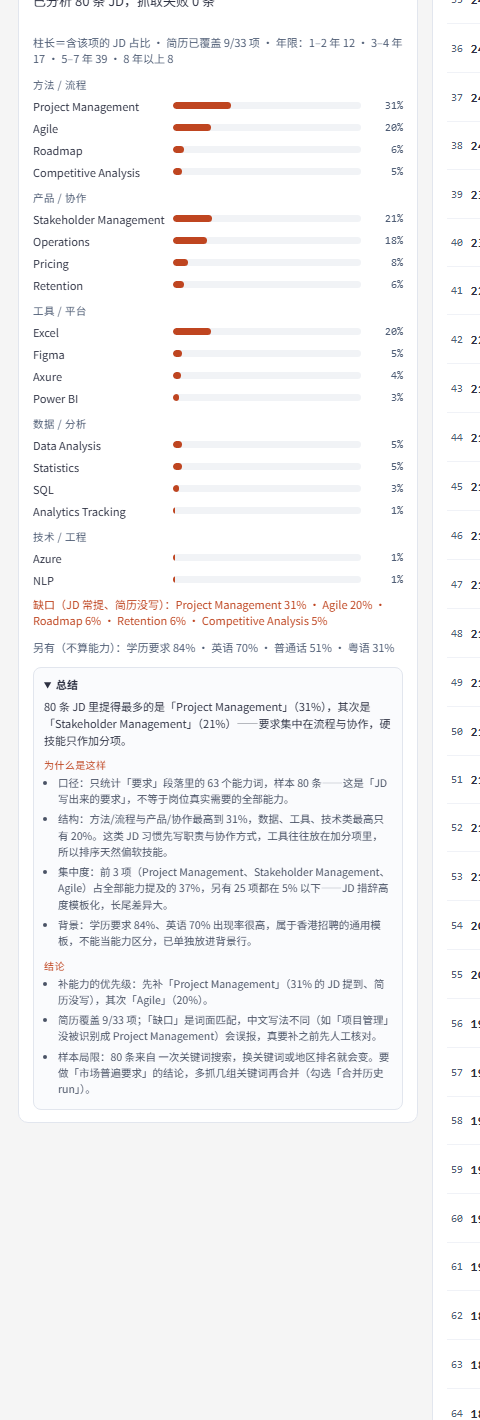 |
| Ranked postings, scored against your CV. 新 = posted in the last 3 days, 已看 = you already opened it. | Median pay per experience bucket, computed from disclosed salaries only, with an inferred fallback column. | What the JDs ask for, grouped by capability, plus a rule-based summary and your gaps. |
Why this exists
Job boards optimise for applications, not decisions. They will happily hand you a long list of postings, none of which tell you:
- Is this actually reachable? — a 10-year role is not a 2-year role, but both sit in the same list.
- What does the market pay at my level? — quoted medians usually mix interns with VPs.
- What am I missing? — "requirements: SQL, Tableau, stakeholder management" is a checklist nobody tallies across 80 postings.
jobmatch answers those three, locally, and keeps the evidence (which JD, which sentence, which salary band) next to every number.
Features
Matching
- CV parsing for PDF / DOCX / TXT, offline (pdf.js-free, hand-rolled extractors + a skill lexicon)
- 7-factor weighted score: skills 30%, experience 20%, title 15%, domain 12%, freshness 10%, location 8%, work type 5%
- Experience gate — if the JD asks for more years than you have, the whole score is multiplied by a penalty (0.5 by default) instead of being silently ignored
- A / B / C / X tiers, per-factor breakdown, live "re-weight and re-rank" without re-scraping
新(posted ≤ 3 days) and已看(you opened it) badges, persisted in the browser
Data
- Full JD text via the board's own API (GraphQL), with graceful fallback to the search teaser when blocked
- Experience requirement parsed from the JD with an explicit "not stated" state — never guessed
- Salary: disclosed ranges first; otherwise a platform salary-filter probe; an experimental exact bisect for logged-in users
- Everything cached on disk (
data/), so re-opening a posting costs nothing
Market insight
- Capability ranking from JD requirement sections, grouped into data / tools / tech / method / product
- Gap analysis against your CV, plus a generated summary explaining why the numbers look like that
- Salary reference bucketed by years of experience, disclosed salaries only, with an
≈inferred column when the disclosed sample is empty - Chinese translations of titles/JDs, cached
- Markdown report export
Quick start
Requirements: Node.js ≥ 22 and a local Edge/Chrome (only needed for the experimental login-based features).
git clone https://github.com/zsw1363574747/hk-jobmatch-ai.git
cd jobmatch
Windows:
start.cmd
macOS / Linux:
./start.sh
Or run it directly:
node web/server.mjs # http://127.0.0.1:7790
Or through the npm scripts (no dependencies, npm install is not needed):
npm start                    # same as node web/server.mjs
npm test                     # both offline test suites
Then, in the browser:
- Drop your CV into the left panel (
.pdf/.docx/.txt/.md) — it is parsed in-process and saved todata/profile.json. - Type a keyword (e.g.
product manager), pick locations, pages and a posting-age window. - 开始匹配 — the list appears, ranked.
- Click any row for the full JD, salary evidence and gap notes. The JD 要求排行 button turns the whole pool into capability stats.
Environment overrides:
| Variable | Default | Meaning |
|---|---|---|
JOBMATCH_PORT |
7790 |
HTTP port (auto-increments if busy) |
JOBMATCH_DATA_DIR |
./data |
All runtime data: profile, runs, caches |
JOBMATCH_BROWSER |
auto-detect | Path to Edge/Chrome for login-based features |
How it works
 resume.pdf ──parse──▶ profile {skills, titles, years}
                              │
 keyword ──search──▶ postings ──score──▶ A/B/C/X ──┬─▶ web UI (list + detail)
                              │                  └─▶ report.md
                              └─fetch JD──▶ experience ──▶ insight / salary
- Search hits the board's JSON API, paginates, dedupes by
source:nativeId, and records per-source counts plus the reason when blocked. - Scoring is deterministic: token/lexicon matching against the profile, then a weighted sum. No LLM in the scoring path, so the same input always produces the same ranking.
- JD fetching dispatches per source adapter (
fetchDetail), records which strategy produced the text (graphql/html/search-api/teaser), and never pretends a teaser is a full JD. - Salary is layered: JD field → platform salary-filter probe (binary search over published bands) → optional exact bisect using the logged-in "salary match" badge.
- Insight aggregates only the requirements section of each JD, so company blurbs and benefits don't inflate the numbers.
Tests (offline, no network):
node bundle/bin/selftest.mjs           # 36 checks: parsers, scoring, insight, salary maths
node bundle/bin/architecture-test.mjs  # 10 checks: data invariants (runs, pages, dedupe)
Add a new job board
Sources are adapters behind one contract — the app, scoring, UI and reports never know which board a job came from.
bundle/lib/sources/
  index.js        # registry + searchAll + fetchDetail dispatch
  jobsdb.js       # enabled: JSON search API + GraphQL JD
  govhk.js        # legacy adapter, kept as a reference implementation
  browser.js      # zero-dependency CDP driver for browser-only boards
  sites.js        # browser-based site configs (CTgoodjobs kept but disabled)
An adapter exports:
export const descriptor = {
  id: 'example',
  label: 'Example Jobs',
  home: 'https://example.com',
  needsBrowser: false,        // true → driven through CDP instead of HTTP
}

export async function search({ keywords, pages }) {
  return { jobs: [...], totalCount: 123, warnings: [] }   // jobs[] use the shared Job shape
}

export async function fetchDetail(job) {
  return { ok: true, detail: { contentText, contentHtml, salary } }
}
Then:
- add it to
CATALOGinbundle/lib/sources/index.js; - add its
idtoENABLED_SOURCE_IDS; - add a fixture + one
selftestcheck so it stays verifiable offline.
See docs/sources.md for the full contract, the browser-source lifecycle (persistent profile, manual challenge pass) and the rate-limit/backoff rules.
Project layout
bundle/
  bin/            CLI entrypoints + offline tests + salary calibration
  data/           lexicon (skills/titles/languages) + offline fixtures
  lib/
    domain/       pure logic: scoring, experience parsing, salary parsing, locations
    sources/      job board adapters (the extension point)
    features/     one folder per capability: search, details, salary, insight, report…
    storage/      run / page stores (atomic writes, guarded projections)
    service.js    the only surface the web layer calls
web/
  server.mjs      static files + JSON routes
  routes/         thin handlers → bundle service
  public/         vanilla HTML/CSS/JS, no build step
docs/             architecture, source contract, salary methodology
start.cmd/.sh     launchers
Privacy
- Your CV, the scraped postings, salary probes and browser profile live in
data/, which is git-ignored. - There is no analytics, no telemetry, no remote service. The app listens on
127.0.0.1only. - The only outbound requests are the job-board queries you explicitly trigger.
Roadmap
- Re-enable CTgoodjobs (needs a manual challenge pass) and add more boards
- Better salary inference for postings without any disclosure
- Aggregate insight/salary across keyword sets and historical runs
- Export to CSV / Notion / Google Sheets
- i18n for the UI (currently Chinese, with an English/Chinese title toggle)
Limitations
- Hong Kong first. All shipped adapters target HK boards; locations, salary periods and language assumptions follow that.
- Scraping is fragile by nature. Selectors and endpoints change; that is why every adapter keeps a fixture and a fallback path.
- Salary data is thin where it matters. Only ~10% of HK postings disclose pay, so per-experience medians often have n = 3–10. The UI shows
nand marks thin buckets instead of hiding them. - The exact-salary bisect is experimental and needs a logged-in session.
Disclaimer
This is a personal job-search tool. It reads publicly visible job postings at a deliberately slow rate (≥1.2 s between requests) and does not bypass authentication. You are responsible for complying with each site's terms of service and robots policy in your jurisdiction, and for not redistributing scraped content. No warranty; use at your own risk.
Credits
Built as a zero-dependency Node project. Interface shapes were informed by public open-source work — see vendor/README.md for the list and what was (and was not) borrowed.
No comments yet. Be the first to write one.