description: "MCP server management for DeepSeek Harness: author composition rows, choose when an allowed server loads, and filter which of its tools a session may call." kind: "plugin-readme"
@zhang-guo-wen/dsh-mcp-manager
中文 | English
What this plugin does
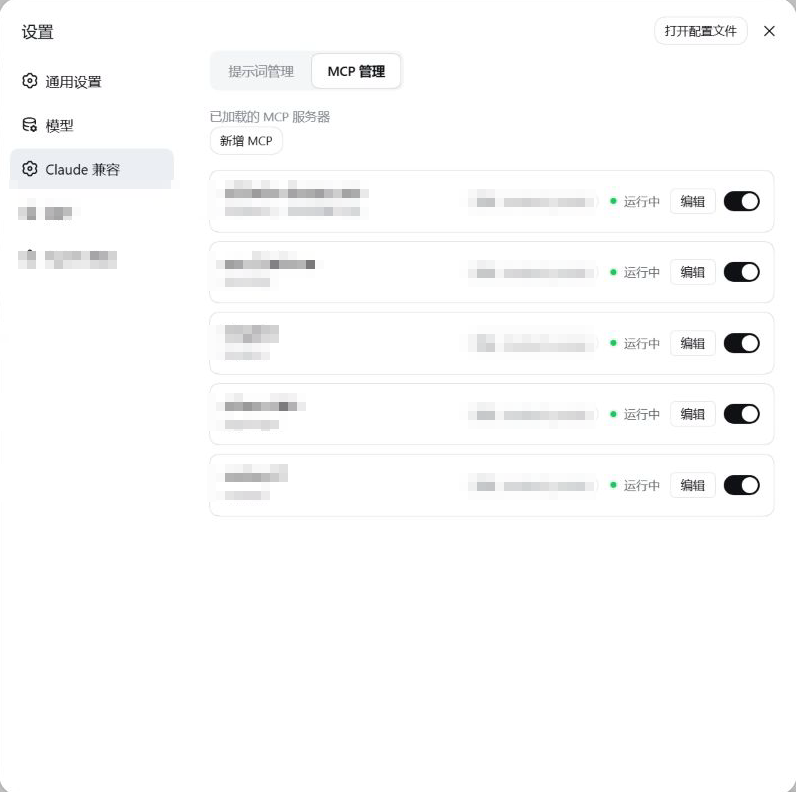
- MCP management. Add, edit, enable, and disable MCP servers from the settings page. Global rows and every preset's
rows are listed with live status. A toggle shows a brief
starting / stoppingstate because the child MCP process has to come up; the list never blocks on it. - On-demand loading. A stopped server costs nothing. The model calls
mcp_list,mcp_load, andmcp_unloadto start a server for the calling session only; loaded tools never leak into another session. Connections are per-session, and a session that ends closes the connections it opened. - MCP tool filters. The edit dialog lists the methods a server publishes with every one checked; an unchecked
method never enters context — neither listed nor callable. Wildcards are available by writing
mcp-manager.toolsyourself.
MCP management was split out of
dsh-claude-compat into its own plugin. The two do not depend on
each other and install separately; with both installed, the settings page shows Claude 兼容 and MCP 管理 as
independent sections.
Screenshots
MCP 管理 — every configured server, live
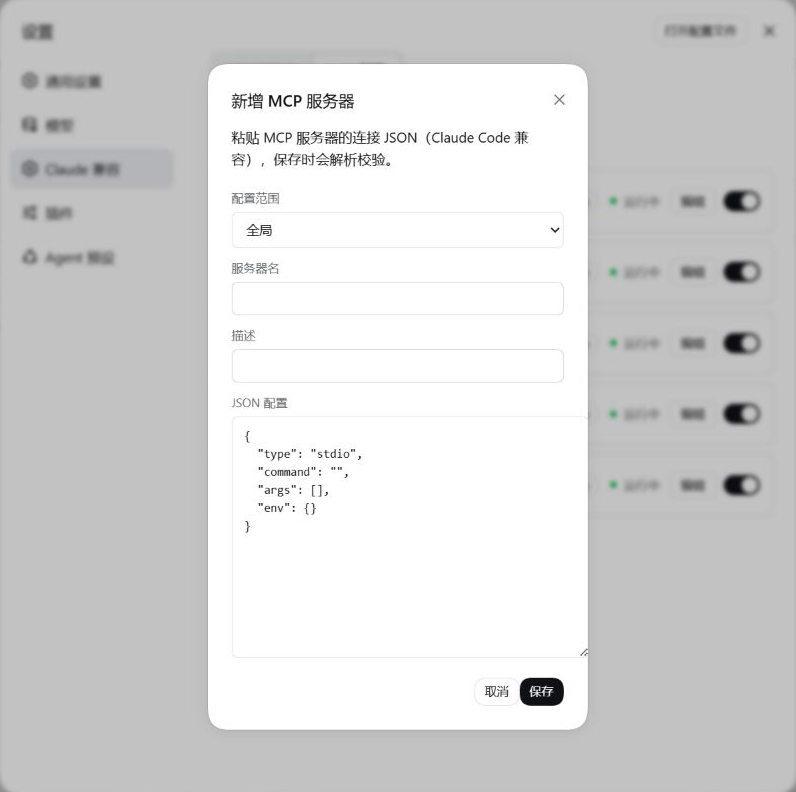
MCP 管理 — add or edit a server, including the tool picker
Install
The built lib/ is committed, so the repository installs and runs directly — no build step on your machine.
# over HTTPS
npx @deepseek-ai/dsh plugin --profile web add git+https://github.com/zhang-guo-wen/dsh-mcp-manager.git

# or over SSH
npx @deepseek-ai/dsh plugin --profile web add git+ssh://git@github.com/zhang-guo-wen/dsh-mcp-manager.git
Pin a release tag so a later work-in-progress commit on the default branch is not picked up:
npx @deepseek-ai/dsh plugin --profile web add "git+ssh://git@github.com/zhang-guo-wen/dsh-mcp-manager.git#v0.1.0"
To develop against a local checkout, install the directory: pnpm links it, so rebuilding lib/ takes effect on the
next start without reinstalling.
npx @deepseek-ai/dsh plugin --profile web add /absolute/path/to/dsh-mcp-manager
Use
MCP loading modes
A row's enable switch and the loading mode answer different questions: the switch says whether a server may be used at all, the mode says when an allowed server enters context.
| Mode | Behavior |
|---|---|
Load all (eager) |
Allowed servers mount at session start; their tools are always in the request |
Dynamic insert (dynamic, default) |
Allowed servers stay unmounted; mcp_load mounts one into the calling session, so its tools join the request — best tool binding, but the tool list changes once per load |
Lazy (lazy) |
Allowed servers stay unmounted; mcp_load connects over the MCP SDK without registering anything and returns the tool schemas, and the model calls them through the fixed mcp_call proxy — the tool list never changes, so the request-cache prefix is never invalidated |
Set it in 设置 → Harness 兼容 → MCP 管理 → MCP 加载方式. The choice is stored in the user's mcp-manager
settings namespace and applies from the next request on, in every session.
Processes and lifetime
Under dynamic / lazy, a server that has not been loaded starts no process at all — MCP is stopped when the
session begins, until some mcp_load.
Once loaded, connections are per-session: a repeated mcp_load in one session reuses the same one, while different
sessions each get their own (for stdio, one child process each); subagents and forked sessions count as separate
sessions. A session that ends closes the connections it opened, with no mcp_unload required. eager is the
opposite — the preset is a standing mount, so one shared instance serves every session.
MCP rows on the global plane (written directly into
cordis.yml) are outside on-demand loading: they always start, as if permanentlyeager. Put a server in a preset to make it on-demand.
MCP tool filters
A server often publishes dozens of tools while a session uses a few. Once filtered, only the tools the rules admit
are handed to the model when the server loads: a hidden tool is absent from the mcp_load result and mcp_call
refuses to invoke it.
In the settings page: Settings → Harness 兼容 → MCP 管理 → a row's Edit → the Tools block at the bottom of the dialog.
Opening it connects to that server once, lists the methods it publishes, and checks every one of them. Unchecking a
method disables it; the change applies on save. The block carries an enabled/total count, Load tools (re-read after
editing the JSON), and All / None.
- Rules are only rewritten when the server actually answered; a failed connection leaves the stored rules untouched.
- Everything checked = no rules for that row, so every published tool stays visible (also the state of a new row).
For wildcards, write them yourself. Rules live in the mcp-manager settings namespace under tools, keyed by the
row key (preset:<preset id>:<serverName>, the same key the description map uses):
| Form | Meaning |
|---|---|
create_workitem, get_workitem |
Allow list: one entry without ! means only matching tools stay visible |
!delete_* |
Deny list: when every entry starts with !, matching tools are hidden and the rest stay |
*, ? |
Wildcards: * matches any run of characters, ? matches exactly one |
What the dialog saves is exactly that deny list, so unchecking delete_workitem writes:
mcp-manager:
  tools:
    "preset:standard-yunxiao:alibaba-devops-mcp":
      - "!delete_workitem"
What to expect:
- Rules are read at load time. A committed change applies to the next
mcp_load; an already-loaded server keeps the tools it was admitted with, andmcp_unloadfollowed bymcp_loadpicks up the new rules. - A filtered row always takes the proxy carrier (
mcp_loadlists,mcp_callinvokes), even under thedynamicmode: native registration publishes every discovered tool and offers no way to hold some back. eagerignores filters, because that mode mounts the whole server through the harness's mcp-client. The plugin warns at startup when rules are configured for it.- A malformed rule set hides nothing: an unparsable value filters nothing, so a typo never empties a server.
Configuration
| Field | Default | Meaning |
|---|---|---|
mcpLoading |
dynamic |
How allowed servers enter context by default; the settings-page choice overrides it |
- name: '@zhang-guo-wen/dsh-mcp-manager'
  config:
    mcpLoading: lazy
Known limitations
- Enabling a server still waits on the child process (
npx -y …/uvx …, usually 1–3 seconds). The UI never blocks; installing the server as a direct executable shortens this noticeably. - Opening the edit dialog connects to that server once (to list its tools), with the same 1–3 second cost.
- Global-plane rows ignore the loading mode: they always mount.
- A preset's first mount starts and then kills each server once. On-demand loading works by unmounting rows at runtime, which cannot beat the child process's spawn, so the first session to use a preset after a host restart pays one short start-up.
Development
Build, Cordis/Typert plugin contract, the traps, and the MCP lifecycle details live in AGENTS.md.
npm run build      # host (tsdown) + client (rolldown ModuleLoader handoff)
npm run typecheck
License
Apache License 2.0 — see LICENSE. This project includes MIT-licensed portions derived from DeepSeek Harness; see NOTICE.
No comments yet. Be the first to write one.