dsh-drawioedit
English | 中文
A plugin for DeepSeek Harness (DSH) that edits .drawio
diagrams in the Web Sidebar with the upstream draw.io editor. Every edit is
written back to the file the tab opened.
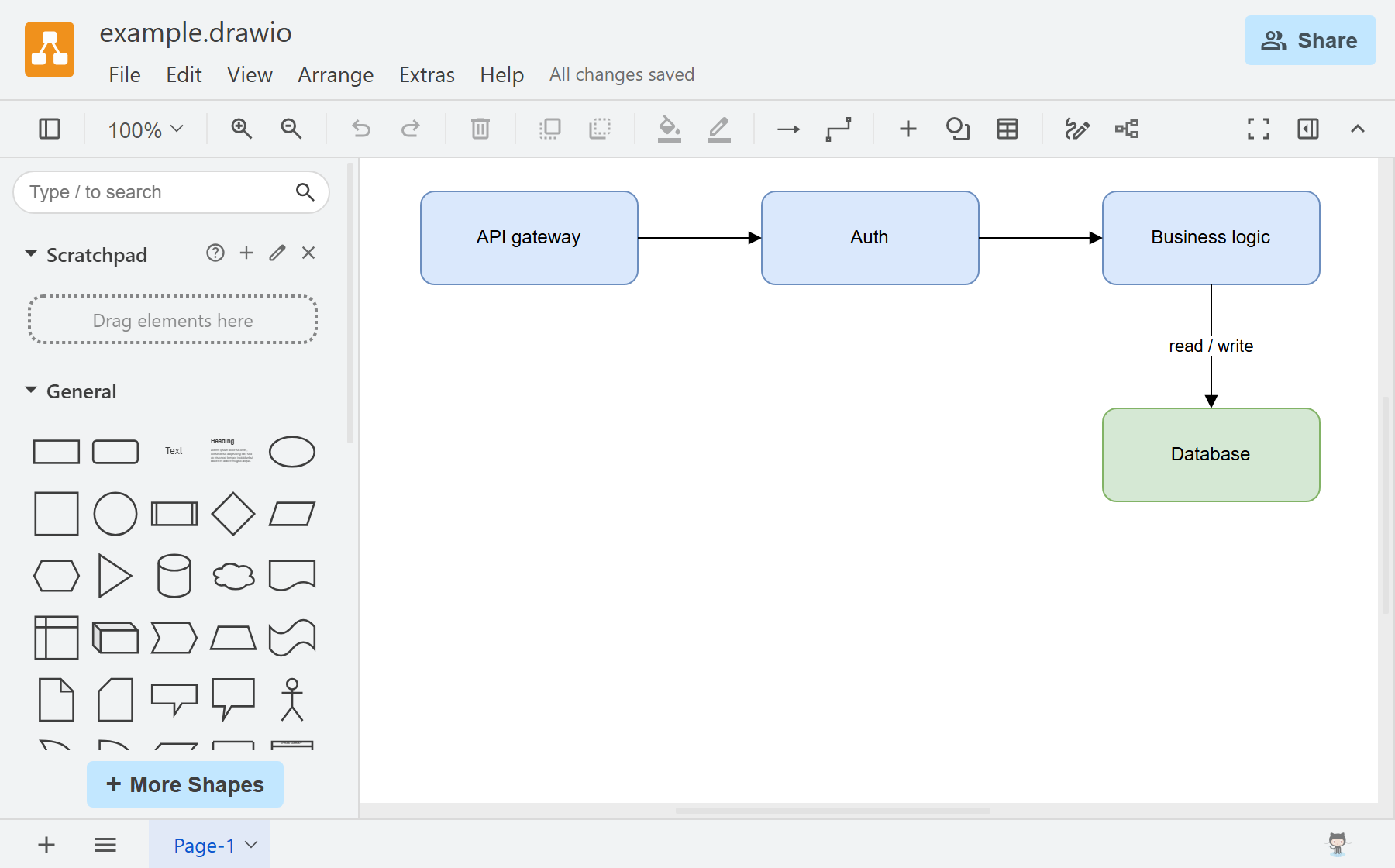
This is the editing companion to dsh-drawio, which previews
.drawio files read-only with maxGraph. The two are independent: install either, or both. Rendering here uses
draw.io's own code, so it matches draw.io exactly; the cost is size — about 119 MB against about 1 MB for the
preview.
Not affiliated with or endorsed by draw.io Ltd. "draw.io" is a trademark of draw.io Ltd. This package embeds their Apache-2.0 licensed editor; see NOTICE.
What it does
- A
.drawiofile opens in a Sidebar tab running the full upstream editor, labelled with the file's name instead of "Untitled Diagram". - Every edit is written back to the same file: on change (within a second), and on Ctrl+S, the toolbar Save button, File → Save / Save As, and the editor's own "Unsaved changes. Click here to save." notice.
- The editor boots without contacting any third-party host, so a diagram never leaves the machine.
Install
The built lib/ is committed, so nothing builds on your machine; the download carries the bundled editor
(~119 MB). dsh plugin adds the dependency and the profile's bundle entry together — do not edit the profile
manifest by hand.
npx @deepseek-ai/dsh plugin --profile web add git+https://github.com/zhang-guo-wen/dsh-drawioedit.git

# a local checkout is linked, so a rebuilt lib/ reaches the host on the next start
npx @deepseek-ai/dsh plugin --profile web add /absolute/path/to/dsh-drawioedit

# restart the host, then confirm the layer landed
npx @deepseek-ai/dsh web
npx @deepseek-ai/dsh --profile web --dump-config | grep -A2 drawioedit
Remove it, dependency and layer together, with
dsh plugin --profile web remove @zhang-guo-wen/dsh-drawioedit.
The profile must compose @deepseek-ai/dsh-client-ui-sidebar-right, which owns the tab registry this plugin
contributes to. Every shipped web profile does.
How the editor is driven
The editor is an application, not a component, so it runs in an iframe served from the application origin. Same-origin is required — a cross-origin parent cannot reach the iframe at all.
Load. drawio's bootstrap reads URL parameters from a #P hash whose JSON may carry the diagram as a hash
field, which it then restores as the real location.hash (#R + encoded XML):
/plugins/dsh-drawioedit/editor/index.html#P{"client":"1","hash":"#R<encoded xml>","dshTitle":"name.drawio"}
A bare #R hash is ignored, so both layers are required. dshTitle carries the file's name for the shim; drawio's
own title parameter is not used for that, because drawio percent-decodes it and a file name may contain a percent
sign.
Save. The shim reports each change as {event:'autosave', xml}, and the tab body POSTs it to
/plugins/dsh-drawioedit/save. That endpoint writes through ctx.fs with the version the read observed as a
freshness guard, so an agent write that landed while the editor was open is refused rather than overwritten. A
confirmed write is sent back into the editor as {action:'saved'}, which is what turns drawio's own "Unsaved
changes" notice into "All changes saved".
Why a shim is needed. drawio's #create= handshake cannot be used from a same-origin iframe — its message
listener returns before doing anything unless evt.source == (window.opener || window.parent) (App.js), an identity
check written for the popup window its embed code opens — and the editor keeps its instance in a closure that no
global exposes. The shim therefore intercepts the assignment of window.EditorUi, captures the instance with a
forwarding Proxy, and owns ui.saveFile, the one method every save command funnels into. It is injected at serve
time between bootstrap.js and main.js, so the vendored editor files stay pristine. This depends on drawio
internals: a drawio upgrade that renames EditorUi, saveFile, or getFileData breaks it, and only
tests/boot.mjs notices, because it asserts the editor's end state in a browser. See src/shim.ts.
Cloud integrations stay off. drawio loads a third-party SDK for each of its cloud integrations unless told
otherwise; every one of them is switched off by name in src/params.ts. The offline suite fails if any remote
host is contacted while the editor boots.
Tests
npm test runs eight keyless suites. Two of them drive a real headless Chrome, which they look for at their
platform's default location; set CHROME_PATH to a Chrome or Chromium executable if it is installed elsewhere.
| Suite | What it proves |
|---|---|
artifact |
both committed bundles are at least as new as their sources |
smoke |
the built client bundle loads with a module table holding only react, and registers its tab type and body |
serve |
the editor route serves real files, rejects traversal, and injects the shim in the right place |
save |
the save endpoint guards writes with replaceIfVersion and refuses malformed requests |
shim |
the shim parses, hooks the editor class, captures an instance, reports edits, and owns the save funnel |
shimdelivery |
the shim reaches the editor through the plugin route, before the script that defines it |
boot |
the editor boots to its canvas, draws the diagram, reports it, names it, and opens a menu at its menu bar |
offline |
the editor boots having contacted no remote host, and every asset it asks for exists |
offline's asset assertion earns its place: editor/mxgraph/css/common.css is the only declaration of
div.mxPopupMenu { position: absolute }, and the editor boots without it — the menus simply flow below the toolbar —
so the 4xx assertion is what catches a missing asset. tests/debug/ holds browser-driving and bundle-scanning tools
used while developing the embed protocol; they are not part of the suite, and scan-assets.mjs is deliberately noisy.
Diagnostics
Open the editor frame in DevTools and read window.__dshShimState:
| Field | Meaning |
|---|---|
revision |
which shim the browser is running; it is host-half code, so this catches a stale host |
hooked / installs |
the class was intercepted and an instance captured (installs ≥ 1) |
reports |
the editor read the diagram and reported it — an edit or a save |
saved |
the host confirmed a write; without it drawio keeps saying "Unsaved changes" |
keys |
the Ctrl+S safety net saw the key |
errors / lastError |
reading the diagram threw, which every caller would otherwise swallow as "nothing changed" |
saveFileOwned |
the shim owns the save funnel; it must be true |
rebound |
what the shim patched: save, saveAs, saveFile, mxUtils.fit |
Build
npm install
npm run build      # host half via tsdown, browser half via build-client.mjs
npm run typecheck  # tsc against the PUBLISHED @deepseek-ai/* packages
npm test           # eight keyless suites, two of which drive a browser
The plugin is two halves that update differently: the client bundle (lib/client.js) is hot-swapped, or needs a
page refresh; the host half (lib/index.mjs) carries the editor route, the save endpoint, and the shim source, and
needs a dsh web restart. Editing src/shim.ts therefore changes nothing until the host restarts. src/ is small
enough to read directly: index.ts
and serve.ts (routing and shim injection), save.ts (the version-guarded write), params.ts (the editor URL),
and client/ (the tab type, the iframe body, the transports).
The harness monorepo builds its client bundles with a script it does not publish, so this repository bundles the
browser half itself. platform: 'browser' is stated explicitly: under rolldown's node platform a dependency
whose exports lists a platform condition before import gets its server entry inlined, and that entry can
require("module") at module scope — a specifier the browser module table cannot answer.
editor/ is trimmed from the upstream webapp by dropping WEB-INF/ (Java jars), js/integrate.min.js, the service
worker, and the legacy unminified mxgraph/src sources — 148.6 MB down to 119.0 MB. mxgraph/css/common.css is
kept, for the reason above.
License
Apache-2.0. The bundled editor is Apache-2.0 with additional terms on its icon sets and stencil libraries; see NOTICE.
No comments yet. Be the first to write one.