dsh-review
English | 中文


Code review as a tool, not a single vendor. Hand your diff to a CLI coding agent, or to a subagent running a model from your DSH configuration — then read one merged report.
What it gives you
- Two kinds of reviewer, both real agents.
codex/claude/gemini/opencode/cursor/ any CLI you template yourself, or a DSH subagent running a model from your DSH configuration. - Several reviewers, one report. They run in parallel; each gets its own section, in the order they were selected.
- Review modes. Name a strength and a prompt once (
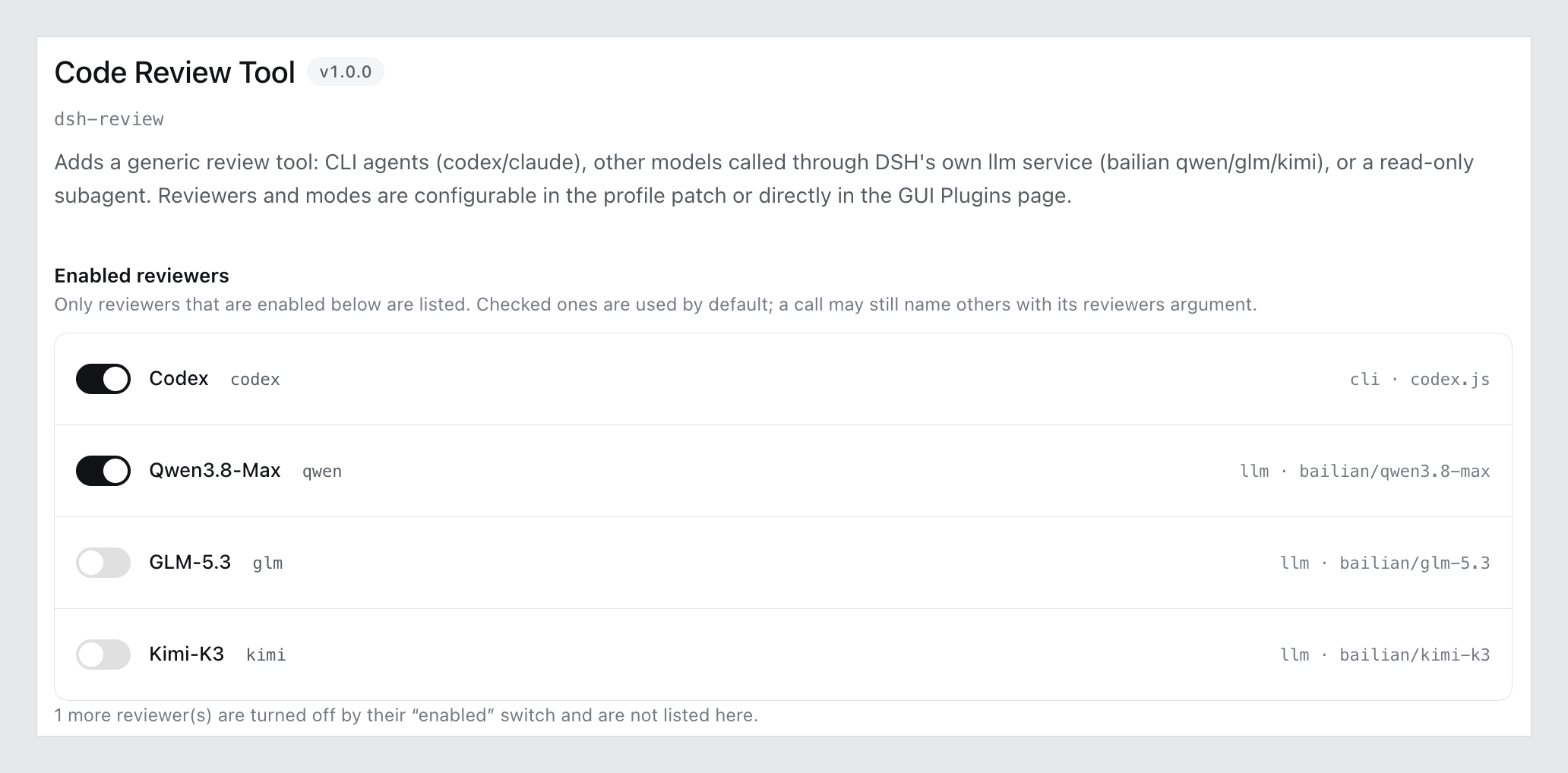
quick,balanced,deep, …) and reuse it, instead of retyping review instructions every time. - Configured in the GUI, and saved for you. Tick the reviewers you want; everything else stays collapsed under advanced settings. Edits are written about half a second after you stop typing — a status line at the top says where they stand, and a Save now button remains as a manual retry.
- No keys, no endpoints. Providers and credentials stay in your DSH config — this plugin only asks for what is already there.
Install
Clone it somewhere permanent, then install it into a profile:
git clone git@github.com:yutingzhao1991/dsh-review.git ~/code/github/dsh-review
dsh plugin --profile web add ~/code/github/dsh-review     # web → your profile name
Or ask your agent to run plugin_manager → install_bundle with that absolute path.
Restart the host afterwards. Updating works the same way: git pull, then restart.
Use
review()                                          // the reviewers you enabled, uncommitted changes
review({ reviewers: ["codex", "deep-dive"] })     // pick reviewers for this call
review({ mode: "deep" })                          // deep strength, several reviewers
review({ base: "main" })                          // working tree vs a branch
review({ commit: "abc1234" })                     // one commit
review({ instructions: "only concurrency and error handling" })
Reviewing takes minutes, so the call waits a little and then hands back a job id: read the
result with job_output, stop it with job_kill, or just wait — you are notified when it
settles.
Reviewers are opt-in: if nothing is enabled, a call with no reviewers fails and says so
rather than quietly running everything.
Reviewers
| Kind | What runs | Reads the code itself | Needs |
|---|---|---|---|
cli |
a coding agent you already trust | depends on the preset (codex reads the repo) | that CLI installed |
subagent |
a DSH child agent | yes, it has tools | a subagent provider |
CLI presets: codex, claude, gemini, opencode, cursor, or custom with your own
command template.
Where the CLI lives. The plugin looks, in order, at: executable (a PATH name or a path) →
~/.local/bin, ~/.bun/bin, /opt/homebrew/bin, /usr/local/bin → the current profile's
dependencies (node_modules/.bin/<name>, plus the package's own bin entry when the preset
declares one, e.g. @openai/codex's bin/codex.js).
That last step is the recommended setup: install the CLI as a direct dependency of the profile
(dsh plugin --profile <name> add <package>). Do not keep pinning an absolute path in your
patch — that is the trap we hit locally: a dependency reinstall pruned
node_modules/@openai/codex, the pinned path silently went stale, and the tool description still
advertised the reviewer as usable while every call burned a full run. Absolute paths still work
(highest priority), but their lifetime is tied to the dependency graph.
When the configuration looks wrong, run the self-check instead of a real review:
review({ doctor: true })
It checks, per reviewer, whether the executable resolves, which candidate found it, whether
--version runs, and whether the subagent provider is registered. It reviews nothing, starts no
reviewer, and does not need a git repository. Model connectivity for subagents is out of scope —
that would need a real request.
One thing worth knowing: a subagent inherits the parent session's model unless you set
agentModel, so it is not automatically a second opinion — name the model explicitly if you
want one.
Subagents get two safety nets by default: the review tool itself is filtered out (so a reviewer
cannot start more reviews) and a 30-minute wall-clock ceiling applies (timeoutMs per reviewer;
hardTimeoutMs still caps the whole call). Progress is reported while they run, so a long review
does not look stuck.
There is deliberately no "send the diff to a bare model" kind: a reviewer that can open the repository itself is worth more than one that only sees what it was handed.
- id: review
  name: dsh-review
  config:
    agents:
      - preset: codex
        model: gpt-5.6-sol
      - preset: claude
    reviewers:
      - id: deep-dive
        kind: subagent
        provider: spawn
        agentProvider: bailian      # any provider from your DSH config
        agentModel: deepseek-v4.1-flash
A subagent's model comes from your DSH configuration (provider, key, context window), and the GUI offers the registered ones as a list — nothing is duplicated in this plugin.
Review modes
A mode bundles how hard to look, what to say, and who to use.
| Field | Meaning |
|---|---|
strength |
light / standard / deep — built-in review framing |
prompt |
extra instructions for this mode |
reviewers |
which reviewers this mode uses |
when |
always / complex / never — a review policy for the agent to follow |
config:
  defaultMode: balanced
  modes:
    balanced:
      strength: standard
      reviewers: [ codex ]
    deep:
      strength: deep
      reviewers: [ codex, deep-dive ]
With no modes configured the plugin adds no constraints at all — you keep steering the agent
with your own prompt. when only takes effect if you also set injectPolicy: true, and it is
stated in the system prompt, not enforced as a gate.
Configuration
Everything can be set in the GUI; these are the same knobs in YAML. Only the ones worth knowing:
| Key | Default | Meaning |
|---|---|---|
defaultReviewers |
none | reviewers used when a call omits reviewers; empty means none are enabled |
defaultMode |
none | mode applied when a call omits mode |
language |
auto |
zh / en / auto report language (auto follows your instructions) |
injectPolicy |
false |
state each mode's when rule in the system prompt |
agents / reviewers |
[] |
define CLI and subagent reviewers (agents is the preset shorthand, reviewers the full form) |
modes |
{} |
named review modes |
waitMs |
0 |
how long a call blocks before handing back a job id. 0 returns immediately (reviews take minutes, so waiting rarely pays) |
hardTimeoutMs |
0 |
wall-clock ceiling; 0 = no limit — you decide when to stop it |
maxResultChars |
80000 |
report cap; longer reports are truncated with a path to the full file |
maxDiffChars |
160000 |
diff cap for reviewers that receive the diff |
Known limitations
- Reviews always run in the session's working directory; you cannot point them elsewhere.
- One call reviews one scope (uncommitted / a base branch / a commit), matching the underlying
CLIs.
baseandcommitare mutually exclusive. A range plusinstructionsworks for subagents but not for the codex CLI (its range flag and PROMPT exclude each other): if every selected reviewer is such a CLI the call is rejected up front, otherwise the CLI ones are named in the report footnotes — put the focus in a mode'spromptinstead. - A mode's prompt reaches codex only when no range is given (its CLI refuses both at once); the range is always honoured, and the report says when the prompt was skipped.
- codex only runs inside the directories it trusts (
~/.codex/config.toml). - An invalid
base/commitfails before any reviewer starts, instead of running for minutes and reporting a batch that reviewed nothing. - Report scaffolding (headings, footnotes, errors) is Chinese;
languageonly controls the reviewers' own instructions. - Truncated reports stay in
$TMPDIR/dsh-review-*/report.md; other runs clean up after themselves. - The reviewer list in the tool description is a registration-time snapshot: the host does not
reload plugin code when the profile's dependencies change (measured:
patchReload: liveonly reloads the patch layer), so the description can lag behind disk. Usereview({ doctor: true })for the current truth. For the same reason, plugin code changes need a host restart. - When a CLI's answer comes from stdout and stdout was truncated (past
collectMaxBytes), the report footnote says the tail may be missing and gives the spill path. When no executable can be found, every candidate path and its failure reason is listed.
Development
node selftest.mjs # drives the plugin with a fake host: no DSH, no codex, no model calls
No comments yet. Be the first to write one.