Cacheback
DeepSeek's prefix cache has been paying you back. Cacheback prints the receipt.


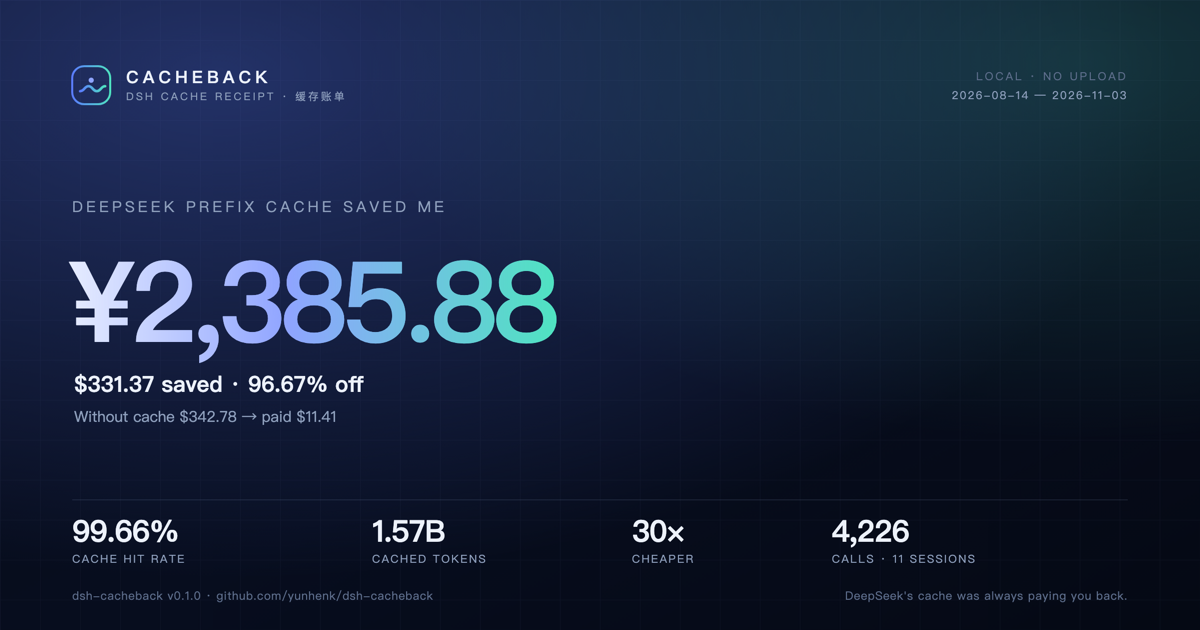
Cacheback is a DeepSeek Harness plugin that turns the session logs already on your disk into a line-by-line cache receipt. It replays every model call, prices it at DeepSeek's published peak/off-peak rates, and answers one question:
How much did DeepSeek's prefix cache actually save me?
On the machine this was built on: 1.57B cached tokens, a 99.66% cache hit rate, and ≈¥2,386 saved — the same prompts would have cost about 30× more at the cache-miss price. Project names are redacted in the screenshot; your receipt uses your own workspace names.
English | 中文
The 30-second version
A cache hit on deepseek-flash costs $0.003 per 1M tokens off-peak. A cache miss costs $0.15 — 50× more.
DSH already records both numbers for every call, but nothing puts them on one page. Cacheback does:
Cacheback · DeepSeek cache receipt
2026-08-14 → 2026-11-03 · 11 sessions · 5 projects · 4,226 calls

DeepSeek prefix caching saved you ≈¥2,385.88 ($331.37).
Without cache $342.78 → you paid $11.41 · 30× cheaper · 99.66% hit rate

Spend: cache read $6.76 · cache miss $1.29 · output $3.35
Tokens: 1.57B hit · 5.3M miss · 3.64M out

Projects
  Project A            $185.55  ·  2,186 calls  ·  99.66%
  Project B             $70.53  ·  1,041 calls  ·  99.69%
  Project C             $68.86  ·    780 calls  ·  99.67%

What to improve
  · Peak premium: 2,119 calls ran at peak. Off-peak is half price.
  · 4 cold starts cost $0.14. Resume a session instead of starting a new one.
  · Output is 29.4% of the bill. Shorter answers cut the biggest line.
  · Keep the tool prefix stable: plugin changes rewrite the cached prefix.

Cache score 99.7 · S
Then make it shareable:
/cache receipt   # self-contained HTML receipt, print to PDF
/cache card      # 1200×630 SVG card for X / GitHub / Slack
/cache 30d       # last 30 days only
/cache redact    # hide project names and paths before sharing
Install
dsh plugin --profile web add github:yunhenk/dsh-cacheback
Or install from a local checkout while developing:
dsh plugin --profile web add link:/absolute/path/to/dsh-cacheback
The plugin has zero runtime dependencies, makes zero network requests, and reads only the session logs DSH
already writes. A restart (or HMR reload) makes /cache available.
Or install from Discover. Add this index source under Plugins → Discover → Index sources:
https://raw.githubusercontent.com/yunhenk/dsh-cacheback/53d96752f562e5e5280e07733dcb2ee9d7869986/market/index.json
What the receipt measures
| Figure | Meaning |
|---|---|
| Saved | What the same calls would have cost at the cache-miss price, minus what you actually paid. |
| Cheaper | No-cache cost ÷ actual cost. On a warm session this is usually 20–50×. |
| Cache hit rate | Cache-read tokens ÷ (cache-read + cache-miss) tokens. |
| Peak premium | Extra dollars paid because calls landed in DeepSeek's peak window (09:00–12:00 / 14:00–18:00 Beijing weekdays). Off-peak is half price. |
| Cold starts | Calls that began with an empty cache and paid the full miss price for the prefix. |
| Spend split | Cache read vs cache miss vs output. Output is often the surprise. |
| Cache score | Hit-rate score with a letter grade, plus the four tips with the largest impact. |
There is no sampling and no estimation of token counts: every number comes from the provider usage DSH persisted on
each assistant/message. Pricing uses the official table (see docs/method.md), with the Chinese
public-holiday calendar applied to the peak window.
Privacy
- Local only. Cacheback reads
~/.dsh/sessionsand writes receipts to~/.dsh/cacheback. It never opens a socket. - No telemetry. No analytics, no “anonymous usage”, no remote font or image.
- Share safely. The SVG card contains aggregates only — no project names, session titles, or paths.
/cache redactalso replaces project names in the HTML receipt withProject A/B/C…. - Delete anytime. Remove
~/.dsh/cachebackand the plugin's profile entry. Session logs belong to DSH.
How it works
- Discover the newest
session*.jsonl(.zstd)under every~/.dsh/sessions/<project>/<session>/. - Decode the append-only log. DSH writes one Zstandard frame per batch; Node's decoder stops after the first, so Cacheback splits on the frame magic and decodes every frame independently (torn trailing frames are skipped).
- Replay each
assistant/message: provider usage (inputTokens,cacheReadTokens,cacheWriteTokens,outputTokens), model id, and timestamp. Seeded/forked history is skipped so calls are never billed twice. - Price each call at the rate for its model and its Beijing-time window. Cache writes are billed as misses.
- Aggregate by project, model, and day; compute the counterfactual, the score, and actionable tips.
- Render the chat summary, a self-contained HTML receipt, or a 1200×630 SVG card.
Parsed sessions are cached in ~/.dsh/cacheback/index.json, keyed by file size and mtime, so a repeat run only
re-reads sessions that changed.
Accuracy and limits
- Savings are a counterfactual. “Saved” assumes the same prompt would otherwise have been sent without a cache hit. That is the standard way to quantify prefix-cache value; it is not a refund.
- CNY is approximate. DeepSeek bills in USD; the receipt shows
≈¥at a configurable rate (default7.2). - Peak calendar is 2026. The official 2026 State Council holiday list is included. Other years fall back to weekdays only; override with the plugin config if you need a different calendar.
- Only DeepSeek calls are priced. Calls from another provider are counted and reported as excluded, because their cache pricing is different.
- Logs must still exist. If you delete session history, its receipt line disappears with it.
- Not a bill. Provider dashboards and invoices remain the source of truth; this is a local, auditable receipt.
Configuration
The plugin accepts optional config through the profile patch:
- id: cacheback
  config:
    usdToCny: 7.2
    lang: zh          # zh | en, default for the chat summary
    open: false       # open generated receipts in the browser by default
| Key | Default | Meaning |
|---|---|---|
usdToCny |
7.2 |
Display conversion for the approximate CNY figure. |
lang |
zh |
Default language for the chat summary; the HTML receipt and card are bilingual. |
open |
false |
Open generated files in the default browser. /cache receipt opens explicitly. |
Development
git clone https://github.com/yunhenk/dsh-cacheback
cd dsh-cacheback
node --test test/*.test.js
The test suite covers the pricing calendar, cache-write accounting, multi-frame Zstandard decoding, seeded-history deduplication, redaction/escaping, command parsing, and the HTML/SVG renderers. No model calls, no network.
See docs/method.md for the exact formulas and event schema.
For the DSH team
If you run DSH support, growth, or community: Cacheback is a local, privacy-preserving answer to “is the cache
working, and why is my bill high?” It needs no telemetry, no server, and no account. Point a user at /cache; the
share card tells an accurate, positive cache-value story with numbers from their own machine.
License
MIT. Built for the DSH plugin ecosystem.
No comments yet. Be the first to write one.