dsh-session-title-stamp


English | 中文
A DeepSeek Harness title provider for a configurable DATE | CATEGORY | NAME
title. Beyond automatic naming:
- Auto refresh — after a completed turn, with a 2-minute cooldown and a 100-message freeze; forks and user-pinned titles are skipped.
- Generate title — the conversation-header ↻ button, the session row's
Generate title menu item, or
/retitle. - Copy title — an extra item in the session
···menu copies the full title. - Settings page — preview and change format, emoji, title language, and refresh cadence without editing YAML.
- Optional category emoji —
categoryEmoji: truerenders titles such as1027 | ⚡ 优化 | .... - Hover stats — see duration, estimated CNY cost, and token count at a glance, without opening a dashboard.
- Category language —
categoryPreset: zh | en, or your owncategories. - Title language — names can follow the conversation, or be forced to Chinese/English.
- Failure-safe — a failed retitle keeps the current title.
- Zero build — pure Host logic plus a small hand-written browser half.
The title tells you what the session was about; the hover card tells you what it cost. Duration, estimated CNY, and tokens are one hover away — no dashboard.
Default format:
DATE | CATEGORY | NAME
For example, with categoryPreset: en:
1028 | Analysis | Short-drama platform verification
1027 | Fix | Four-device acceptance rework
1026 | Release | Ubuntu environment setup
1025 | Optimize | Reduce memory usage in the renderer
Dates are computed by the plugin from the session's creation time, never by the
model. Categories are chosen from a small configurable taxonomy and validated
locally. The model only proposes the category and the name; the provider owns
the final format. The default taxonomy is Chinese; set categoryPreset: en for
the English labels above.
Why
Long-lived workspaces collect dozens of sessions whose titles are either the
first few words of the first message or an auto-summary that drifts. A fixed
date | category | name convention makes the sidebar scannable across projects,
and mirrors conventions used by other coding agents.
Requirements
- DeepSeek Harness
>=0.2.1-rc.3 <0.3.0. - A working model route for the session; the title request uses the session's
current provider/model unless
provider/modelare configured.
Install
DSH Desktop / Web with Discover
Add this market index source in Plugins → Discover → Index sources:
https://cdn.jsdelivr.net/gh/xuedipiaofei/dsh-session-title-stamp@v0.8.0/market/index.json
Then install Session title stamp from the list. The plugin installs as a profile bundle and appears in the Plugins page, where it can be enabled or disabled like any other bundle.
CLI
From GitHub:
dsh plugin --profile <profile> add github:xuedipiaofei/dsh-session-title-stamp
From npm:
dsh plugin --profile <profile> add dsh-session-title-stamp
For a local checkout:
dsh plugin --profile <profile> add ./dsh-session-title-stamp
The Electron Desktop profile is managed by the application; use its Plugins
page rather than dsh plugin --profile desktop.
The bundle patch disables the shipped session-title-llm row and inserts this
provider. Do not enable the official
@deepseek-ai/dsh-experimental-session-titles-bundle at the same time: both
replace the same provider slot, and the title service accepts only one provider.
If another provider wins the registration race, this plugin logs a warning and
stays inactive instead of failing startup.
How it works
cordis.patch.ymldisablessession-title-llmand inserts thesession-title-stamprow from this package.lib/index.jsregisters a provider throughctx.sessionTitle.register()and reuses@deepseek-ai/dsh-session-title-llmfor route selection, timeouts, cancellation, token limits, and exact auxiliary-request logging.lib/format.jsis dependency-free: local-time date parts, template rendering, category validation, name sanitizing, and UTF-8 byte truncation.
The provider computes the date from session.header.createdAt in the host's
local time zone, asks the model for {"category":"...","name":"..."}, validates
the category, and renders the template. Empty {type} or {topic} segments
remove their neighbouring separator instead of leaving ||.
Retitle cadence
The provider is registered as first-prompt, so the title service names the
session once. After that, the plugin refreshes on a completed turn (turn/end)
with two guards:
- cooldown — at most one automatic refresh every
refreshMinIntervalMs(default 2 minutes), so a fast first answer does not generate twice; - freeze — after
refreshMaxTurnsuser messages (default 100), automatic refresh stops; long sessions rarely change their main topic./retitlestill works.
Forks and subagent sessions are skipped, as are titles pinned by a manual
rename. Setting refreshOnTurnEnd: false restores the legacy message-count
mode using retitleEvery.
Header button and hover stats
0.7.0 adds a small browser half:
- a refresh icon in the conversation header; it runs the same
/retitlecommand as typing it, and is disabled while the session is running.
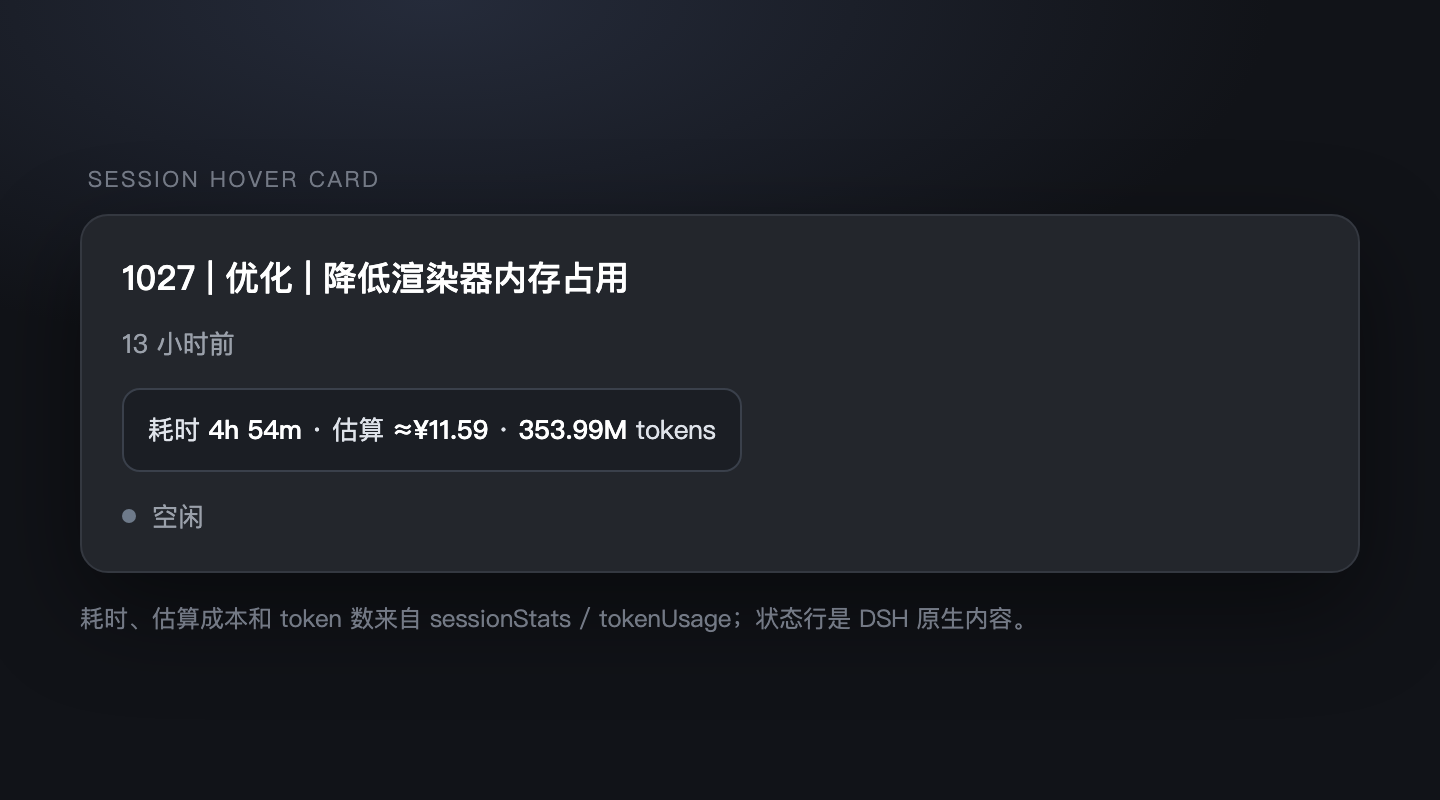
- a hover-card line under the native relative time, for example
Duration 1h 51m · est. ≈¥4.11 · 131.7M tokens; - a Generate title item at the top of the session row's
···menu, plus a Copy title item below the native Copy Session ID. Neither adds a dialog.
The hover line is derived from the sessionStats and tokenUsage projections,
priced with the current DeepSeek CNY rate table, and labelled as an estimate.
It is fetched from the host only when the hover card opens; a session that was
never loaded is not resumed just to show the numbers. Native DSH already shows
running / pending / completed-unread status (spinner, warning dot, idle line),
so this plugin does not add a second status-color layer.
Hover-card field guide
| Field | Meaning |
|---|---|
Duration 1h 51m |
Cumulative model + tool execution time from sessionStats; not wall-clock elapsed time |
est. ≈¥4.11 |
tokenUsage × the current DeepSeek CNY rate table; a rough estimate, not an invoice |
131.7M tokens |
Input, output, cache-read and cache-write tokens combined |
Idle / scheduled-task line |
Native DSH status content; this plugin does not add or replace it |
Mixed-model sessions are estimated with the session's last-used model, so the cost can differ from the actual bill. The line is intentionally omitted when the host has no stats for that session.
If the hover line is missing, the browser half could not reach the host stats route; the refresh button and automatic titles are unaffected.
Settings page
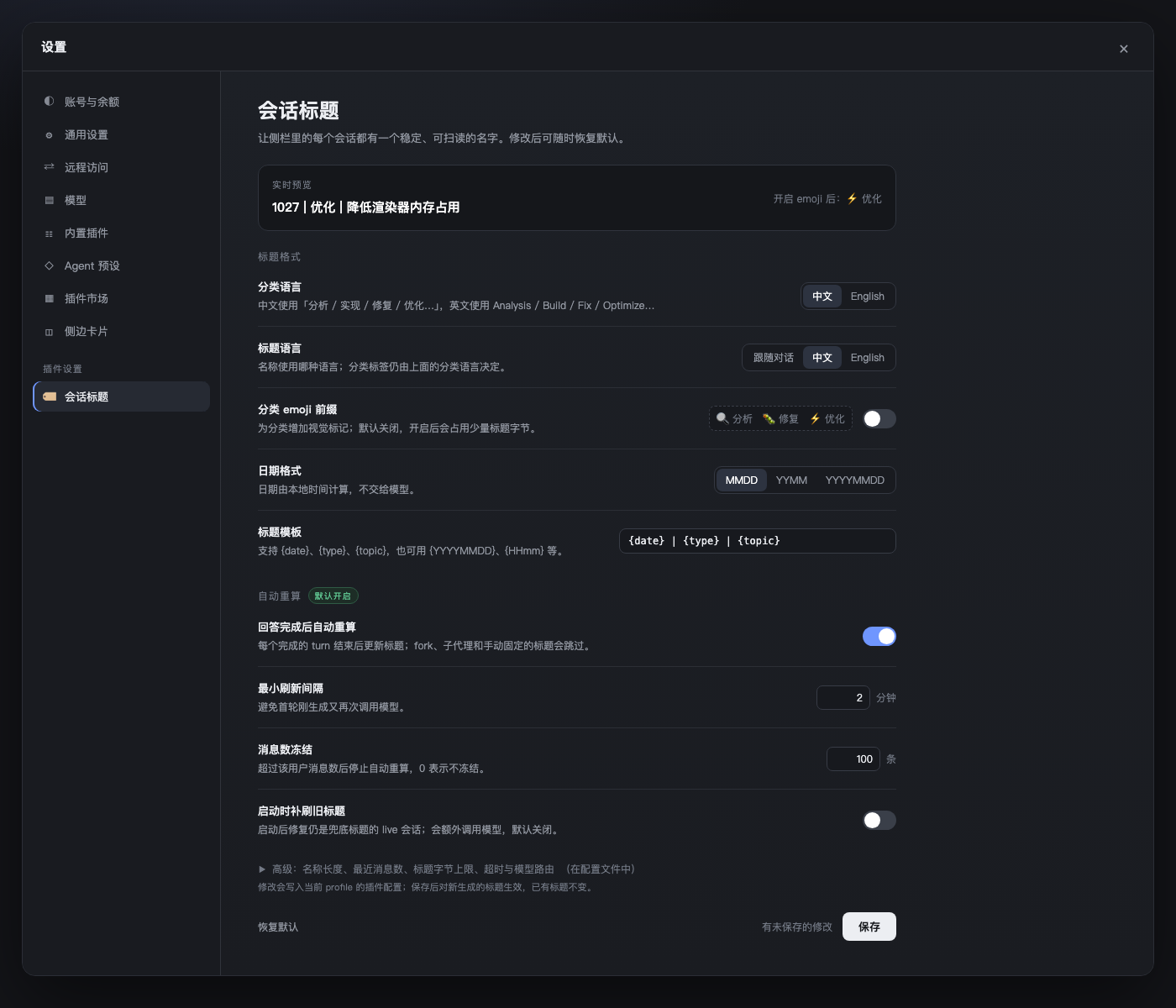
0.7.0 adds Settings → Plugins → Session titles:
- a live preview of the exact title the current template will produce;
- category language (Chinese/English), title language, optional category emoji, date format, and the title template;
- the auto-refresh switch, minimum interval, message freeze, and opt-in startup backfill, with the cost trade-off stated in place;
- advanced name-length, recent-message, and title-byte controls; timeouts, budgets, and model routing stay in the profile configuration.
0.8.0 adds the title-language choice and the advanced byte limit.
Saving writes the current profile's plugin config, so it applies to the next generated title without a restart. Existing titles are never rewritten.
Failures
- A failed retitle keeps the existing title: the provider throws, which is the title service's signal to retain the previous revision.
- Only a session with no title yet gets a local fallback: date, an inferred category, and the first message's leading words.
- A
max-tokensfinish is still parsed when it contains usable text; only an unusable response counts as a failure.
Configuration
Override the row in the profile's cordis.patch.yml:
- id: session-title-stamp
  config:
    refreshOnTurnEnd: true
    refreshMinIntervalMs: 120000
    refreshMaxTurns: 100
    categoryPreset: zh
    template: '{date} | {type} | {topic}'
    timeZone: Asia/Shanghai
    maxNameChars: 20
| Field | Default | Meaning |
|---|---|---|
refreshOnTurnEnd |
true |
Refresh after a completed turn; false falls back to retitleEvery |
refreshMinIntervalMs |
120000 |
Minimum gap between automatic refreshes; 0 disables the cooldown |
refreshMaxTurns |
100 |
Stop automatic refresh after this many user messages; 0 = no freeze |
retitleEvery |
10 |
Legacy message-count cadence, used only when refreshOnTurnEnd: false |
backfillOnStart |
false |
On startup, refresh live sessions whose title is still the fallback |
backfillMaxSessions |
30 |
Maximum sessions in one backfill pass |
backfillIntervalMs |
2000 |
Delay between backfill refreshes |
template |
{date} | {type} | {topic} |
Title template; see the placeholders below |
dateFormat |
MMDD |
Used by {date}: MMDD (1028), YYMM (2610), or YYYYMMDD |
timeZone |
host local | IANA zone used for date/time placeholders |
categoryPreset |
zh |
Built-in category language: zh or en |
titleLanguage |
auto |
Name language: auto, zh, or en |
categories |
preset | Explicit category list; overrides categoryPreset |
categoryEmoji |
false |
Prefix the category with its emoji (⚡ 优化, 🐛 修复, ...) |
maxNameChars |
20 |
Character cap before the byte cap applies |
maxTitleBytes |
service cap (80) |
Effective cap is the smaller of this and session-title's cap |
recentMessages |
8 |
First message plus this many recent messages are sent |
maxInputBytes |
4096 |
Input budget for one title request |
maxOutputTokens |
4096 |
Output cap, including reasoning tokens |
timeoutMs |
90000 |
End-to-end title-request deadline |
provider / model |
session route | Optional pair to route title generation independently |
Template placeholders
| Placeholder | Meaning |
|---|---|
{date} |
Date in dateFormat (1028, 2610, 20261028) |
{YYYY} {YY} {MM} {DD} {HH} {mm} {ss} |
Date/time parts; concatenate freely ({YYYYMMDD}, {HHmm}) |
{type} |
Category; an empty value removes the segment and its separator |
{topic} |
Name; an empty value removes the segment and its separator |
An unknown placeholder is left verbatim ({MMDD} {bogus} keeps {bogus}), so a
typo is visible instead of silently disappearing. The template owns the final
format; maxTitleBytes still clips the result.
The Settings page covers the common fields; the YAML table below remains the
automation/advanced source. The default taxonomy is Chinese. categoryPreset: en switches it to
Analysis / Build / Fix / Optimize / Debug / QA / Release / Docs / Other; categories
overrides either preset with any labels you want. The prompt lists the configured
labels and the local fallback maps common keywords onto them.
Privacy and cost
- The first eligible user message plus up to
recentMessages - 1recent messages are sent to the model. Message text is framed as JSON to keep user content from breaking delimiters. - The request uses the session's configured provider/model, or the optional
provider/modeloverride. The plugin makes no other network calls and collects no telemetry. - One auxiliary request is made for the first title, then at most one per
completed turn inside the cooldown, and none after the freeze threshold.
Title work is asynchronous and never delays the main agent response;
maxOutputTokens,maxInputBytes, andtimeoutMsbound it. - The resulting title is stored in the session log as a normal
session/titleevent. A manual rename pins the title and later automatic revisions do not overwrite it.
Compatibility notes
- This package targets the DSH 0.2 line.
engines.dshrefuses to install it on 0.3+ until it is updated against the new title API. - The bundle assumes the shipped row id
session-title-llm. If another title provider is registered first, this plugin logs and stays inactive; disable the other provider and reload. llm,commands,sessions,sessionProjections, andconnectionare awaited lazily; a composition without one still loads the plugin and degrades only the affected feature.- The browser half needs the Web composition's
sidebar.session.row.hoverandconversation.session.header.actionsseats. A shell that does not expose them simply shows no button/hover line. - The provider imports
@deepseek-ai/dsh-session-title-llmdynamically. A missing or incompatible executor degrades to local naming, but a changedctx.sessionTitleAPI can prevent registration. Pin the DSH range when publishing a release.
Development
The repository has no runtime or build dependencies.
npm test               # format tests, provider tests with a stubbed executor, metadata/index checks
npm run validate:index # optional: validate market/index.json with the official validator if installed
npm run pack:check     # inspect the npm tarball contents
The provider test redirects @deepseek-ai/dsh-session-title-llm to
test/support/stub-executor.mjs with Node's module.registerHooks, so it
exercises the real provider without a DSH install or model credentials.
Release steps are in PUBLISHING.md.
License
MIT © 2026 xuedipiaofei
No comments yet. Be the first to write one.