description: "Per-session skill visibility control for DeepSeek Harness — a composer tool-row control that lets you pick exactly which skills the model may see." kind: "plugin-bundle"
dsh-skill-gate
English | 中文

Summary
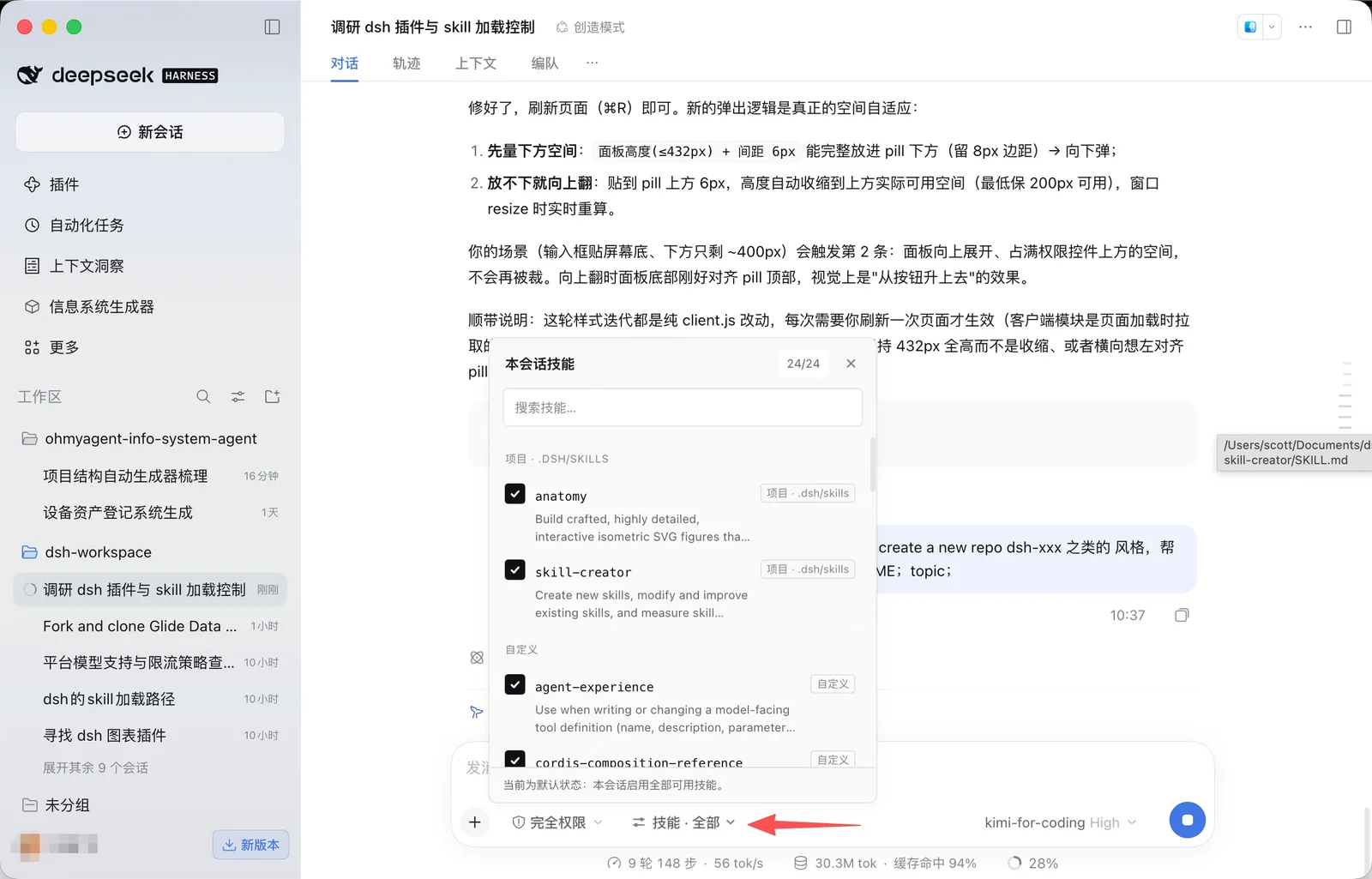
dsh-skill-gate adds per-session skill visibility control to DeepSeek Harness. A compact control in the composer tool row — right next to the permission control — opens a checklist of every skill the current session's composition can see. Uncheck a skill and it leaves the session completely: it disappears from the model's <available_skills> catalog, the skill tool refuses to load it, and /name gestures stop injecting it.
This is the visual, reversible equivalent of a CLI's --skill x,y,z flag. It exists for one job: when many skills live in a shared directory such as ~/.agents/skills/ and several of them conflict across business contexts, you decide — explicitly, per session — which ones the model may use, so the model cannot hallucinate its way into the wrong playbook.
The default stays exactly DSH's native behavior: every skill enabled, no restriction, until you uncheck something.
| Piece | Role |
|---|---|
index.js (Host) |
Wraps the skills service's list/snapshot/get with per-session filtering; persists gate state to ~/.dsh/skill-gate/state.json; serves two authenticated /api routes on the connection's shared channel |
client.js (Browser) |
The conversation.input.left slot control: a borderless tool-row pill plus a grouped, searchable checklist popover |
cordis.patch.yml |
One loader row; the browser half is discovered through the package's dsh.client declaration |
Features
- Native look and feel. The control adopts the composer bar's borderless tool-row design (chevron, hover wash, 13px medium label) and opens a menu-surface popover that flips upward when the viewport is short.
- Grouped, searchable checklist. Skills are grouped by source root — project
.dsh/skills, project.agents/skills, custom directories, user.dsh/skills, user.agents/skills, bundled, and runtime — so business skills stand apart from built-ins. Search filters across name, description, and path. - One mental model: checked = visible. The stored state is an allowlist of exactly what the model sees. Checking everything collapses back to the unrestricted default (
null), so "back to normal" is always one click ("Enable all") and never drifts. - Enforced at the registry boundary. Filtering wraps the live
skillsregistry, so the durable catalog published at every agent step, theskilltool's lookup, the/namegesture injection, and the UI's session skill list all agree — no partial views, no stale entries. - Instant, durable, hot-reloadable. Changes apply on the model's next step (DSH republishes the catalog automatically) and persist per session id. The state file is written atomically and watched, so hand edits and external tooling stay in sync. A default scope covers sessions that have no selection yet (including new sessions before the first message).
- Zero dependencies. The bundle imports nothing from
@deepseek-ai/*; every capability is reached through injected Cordis services, following the sameconnection.fetchchannel pattern asdsh-context.
Requirements
- Node >= 22.19.0
- A DSH runtime that satisfies
engines.dsh(^0.2.1-rc.3), with the skills capability mounted (any profile built on@deepseek-ai/dsh-base)
Install
From a clone of this repository, install the bundle into a profile with the Plugin Manager (install_bundle, target = the absolute package directory) or the dsh CLI. Then refresh the Web UI — the browser half is fetched at page load.
git clone https://github.com/wyf0931/dsh-skill-gate.git
plugin_manager  →  action: install_bundle
                  target: /absolute/path/to/dsh-skill-gate
The profile links the checkout, so editing client.js takes effect after a page refresh, and editing index.js after an application restart.
Usage
- Look at the composer tool row: the control reads
技能 · 全部(everything enabled). When a session has an active restriction it reads技能 N/Mwith the glyph and count tinted blue. - Click it. Uncheck skills that do not belong to this session's business context. Each toggle persists immediately.
- The next model step carries the reduced
<available_skills>catalog; disabled skills are un-loadable by the model and by/name. - Click Enable all (or re-check everything) to return to the unrestricted default. In a session-less composer the control edits the default scope inherited by new sessions.
Newly installed skills are detected dynamically through the filesystem provider's watchers and appear in the picker on the next open; while a restriction is active they start unchecked, keeping the allowlist honest.
State
~/.dsh/skill-gate/state.json
{
  "default": null,
  "sessions": {
    "session-…": ["archify", "office"]
  }
}
default: null means "no restriction". A per-session entry overrides the default; null inside sessions is normalized away. The file is the source of truth — edits are picked up live via an fs watch — and writes are atomic (temp file + rename). Entries are pruned past 500 sessions.
Limitations
- Subagents do not inherit the gate. Forked/spawned children run under their own session ids and fall back to the default scope. This is deliberate: delegated tasks are usually orthogonal, but per-child gating can be added if a use case demands it.
- Host code updates need an application restart. A linked install serves
index.jsfrom the checkout; the running host caches the module per process. - The Host half wraps the
skillsservice's publiclist/snapshot/getcontract (the same methods DSH's owntool-skillcalls). If a future DSH version renames them, the plugin logs a warning and degrades to "no restriction" rather than breaking sessions.
No comments yet. Be the first to write one.