dsh-raven-research
One progressive, source-grounded Task for deep research, writing, and learning — inside DeepSeek Harness.
Early checkpoints you can steer mid-run · citations verified against the bytes actually retrieved · no second agent runtime.







English · 中文
TL;DR · Experience · Install · Usage · Evaluation · Configuration · Operating · FAQ
[!IMPORTANT] v1 developer preview. Pinned and tested against DeepSeek Harness
0.1.2-alpha.1, which is an alpha prerelease and ships breaking changes. Not published to npm yet — install from a checkout.
TL;DR
- What it is: a DeepSeek Harness (
dsh) plugin that adds one progressive, evidence-aware Task abstraction for deep research, general writing, academic writing, and learning. - Why it matters: you get a useful Checkpoint early, you steer it mid-run instead of restarting, and every citation is checked against the bytes actually retrieved — not against what the model remembers.
- How it is built: one Cordis plugin split into an agent-role mode
(
raven_task, prompt, and Task context) and an optional host-role settings card. No second agent runtime, model host, vector store, or database. The Harness agent keeps researching and writing with its normal tools. - Install:
pnpm build && pnpm pack, add the tarball from the deployment root, then runnpx dsh-raven-install-presetand choose Raven as the session mode. See Install. - Use: talk to the Harness agent normally — no launch phrase, no separate Task UI, and no lifecycle commands to learn. Contextual guidance defaults to
autoand can be set tooff. See Usage. - Evaluation: the reproducible methodology, scenarios, and rubric are tracked, but generated benchmark outputs, raw Session logs, and review packets remain local and are not published. Run the suite privately to evaluate a specific release; no public aggregate winner is claimed.
Why Raven
A substantial research or writing request usually disappears into a long batch pipeline: you wait, you get one wall of text, and the citations are whatever the model remembered. Raven changes the shape of that work.
| Plain long-running agent run | With Raven |
|---|---|
| Silence until a final dump | An early useful outline, draft, or findings set as a Checkpoint, then incremental refinement of the same Artifact |
| A correction restarts the work | A correction becomes a Steering Revision on the same Task; prior evidence and Checkpoints survive |
| Citations are remembered strings | Citations resolve to inspected Sources from web, local files, llm-wiki, or MCP; excerpts are matched against canonical Markdown |
| Three reprints of one wire story read as three confirmations | Claims sharing a declared sourceFamily are marked as not independent corroboration |
| Organized notes are mistaken for insight | A Synthesis Pass exposes Summary Debt and retains inspectable Insight Candidates with Claim lineage, assumptions, alternatives, and reversal evidence |
| Raven's interpretation is presented as sourced fact | External Claims say what Sources say; promoted analysis is separately rendered as a Raven inference from named Claims |
| Long-form prose starts from the first plausible outline | Structure Studio battles materially different evidence-linked argument architectures, then the user or Raven selects or hybridizes one before drafting |
| One dead link fails the whole run | Failed dependencies defer only the affected Claims; independently verified work still completes honestly |
| State dies with the tool call | The latest successfully persisted Task snapshot is rebuilt from the session log and supports stop/resume |
Normal discover → read → analyze → verify → refine movement stays autonomous. For substantive long-form writing,
Raven pauses once after private structural comparison when user preference can materially change the argument; this is
collaboration, not an approval gate, and the user can delegate or skip it. Raven otherwise asks only when an unresolved
choice changes the public outcome, evidence floor, audience, deliverable, significant cost, or an
external/destructive/sensitive side effect.
The product experience
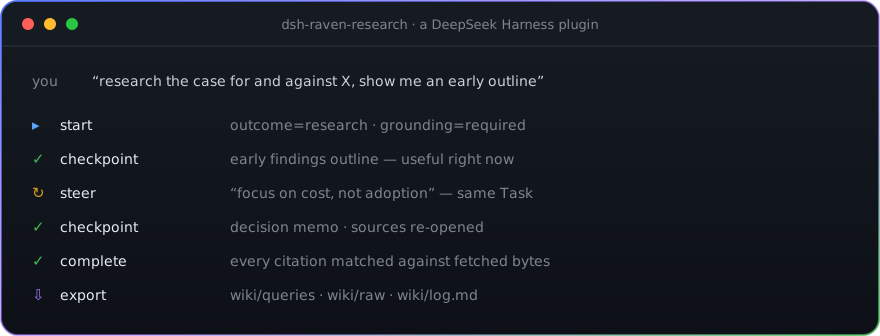
Start a new Harness session in Raven mode and make the outcome—not Raven's protocol—the request:
Research the evidence for and against centralizing our recovery records. Show me an
early useful evidence map, then turn the result into a decision memo for skeptical
engineering directors. Preserve contradictions and keep the conclusion reusable.
The same conversation then moves through one visible chain:
- Research: Raven finds Leads, opens the web/local/llm-wiki/MCP material with ordinary Harness tools, and admits only inspected Sources.
- Progressive evidence: an early Checkpoint gives you useful findings, limits, and citations while the Task remains open.
- Insight: Raven separates what Sources say from candidate explanations, assumptions, alternatives, and evidence that would reverse them.
- Competing structures: for substantial writing, Structure Studio presents a compact choice between genuinely different arguments—not renamed outlines.
- User collaboration: reply naturally:
Combine the recovery-risk opening with the uncertainty boundary, and focus on implementation risk.The same Task retains compatible evidence and invalidates stale structure. - Writing: Raven drafts one selected section at a time. Optional configured routes generate independent candidates and an adversarial synthesis; without them, the main agent continues normally.
- Source-checked Artifact: Completion binds the exact latest Checkpoint bytes and rechecks registered Claim/Source references. It explicitly does not pretend to discover omitted Claims or judge semantic entailment.
- Durable knowledge: ask
Keep the reusable conclusions in this llm-wiki.Raven returns conditional, marker-protected Markdown writes; a later independent Task can reuse the knowledge while reopening volatile facts.
You can pause after any Checkpoint and later say continue. You never need to mention Task IDs, actions, phases, or revisions. See Usage for more prompts and the evaluation suite for the controlled vanilla-versus-Raven methodology and preserved review evidence.
Features
- Batched discovery over the official search seam.
discoversends several complementary queries in one Task step through the Harnesswebsearch capability, folds one URL returned by several queries into one Lead, and keeps every sibling's results when a query fails — the failure is recorded as a Limitation, not an aborted batch. What comes back are Leads, never Sources: nothing can be cited until it has been opened and excerpted. - Agent Teams reuse. Where the deployment composes the Harness Agent Teams capability and Raven detects membership, the Raven Task belongs to the Team: every observed member reads and extends the same Task, and a teammate cannot start a competing one. Without a detected membership — including a missing or failing experimental capability — each Agent keeps an independent Task book.
- Progressive delivery. The Raven prompt directs the main agent to publish an independently useful Checkpoint early while the Task remains active. Checkpoint validation is runtime-enforced; when the Harness displays it and continues later model/tool steps is owned by the Harness agent loop.
- Steering instead of restarts.
steerapplies a user correction to the live Task and preserves prior evidence. - One Markdown-first Source fabric. Every Source keeps its Original Resource separate from Raven's canonical Markdown representation. Exactly four origins are supported: web, local files, llm-wiki pages, and MCP resources. Existing Markdown stays original; conversion names the producing Harness tool;
full,segment, orunknowncoverage prevents a bounded projection from impersonating a whole Resource. A successful non-web inspection persists a digest binding Resource, Markdown, producer, call ID, and coverage; unavailable or failed conversion defers dependent Claims. - Task-level Source Policy. Natural requests become steerable policy on the same Task: allow/block web hosts, prefer primary evidence, scope local or llm-wiki roots, and include/exclude named MCP sources. This is never deployment configuration.
- Citations checked against source material. Artifacts cite stable Source IDs with
[@source-id]. Raven independently re-fetches web Sources with the existing HTTP identity guarantees. Local, llm-wiki, and MCP Sources bind a prior successful Harness inspection. When a direct surface exposesinspectionCallId, the agent may pass it; when PTC hides a nested call ID, Raven resolves and stores the latest exact matching receipt from producer, resource arguments, coverage, and Markdown bytes. Raven checks directtool/call/tool/resultor paired PTC dispatch records, resolved file identity or MCP namespace, returned Markdown, and excerpt. Rendered citations expose Origin and conversion provenance. Unknown citations, unattested representations, cross-host redirects, and mismatched excerpts are rejected. - Independence-aware Claim trace. Every Completion appends a trace mapping material Claim IDs and text to Source
IDs, marking Claims whose Sources share one
sourceFamilyso reprints of a single originating record cannot read as several confirmations. Genuinely conflicting Claims are recorded as contested rather than silently resolved. - First-class Insight Candidates.
synthesizelets the main agent record candidate interpretations, connections, explanations, hypotheses, reframings, implications, and theses against named Claims. Each candidate retains its assumptions, rationale, confidence, competing explanations, and evidence that would change Raven's mind. It is never automatically fact or accepted analysis. - Defensible analysis lineage. Promoting a candidate requires a later material
analysisClaim with the exact candidate text, premise Claim IDs, and assumptions. The Artifact renders Source-backed propositions assource saysand promoted reasoning asRaven inference; a premise failure automatically defers dependent analysis. - Summary Debt without synthesis theater. A synthesis pass warns when a section merely organizes or restates
evidence, and when candidate reasoning has unusable lineage.
purpose=summaryandpurpose=explanationexplicitly suppress that diagnostic, so direct summaries, trivial writing, and ordinary learning remain lightweight. - Pre-writing Structure Studio. Substantive long-form writing explores 2–4 genuinely different argument architectures, privately battles what each explains, misses, assumes, repeats, requires, and contributes, then presents only the strongest alternatives and Raven's recommendation. The user can select, modify, reject, combine, redirect, delegate, or skip naturally. The resolved Skeleton retains Claim/Insight links, counterarguments, evidence gaps, weaknesses, and reader takeaway in Task state and drafting context; lightweight work bypasses the Studio.
- Honest partial results. Withdrawn Claims force the asserting prose to be edited in the same Checkpoint; a dropped citation may not leave a bare assertion standing. Unverifiable evidence refuses publication rather than silently downgrading to "unchecked".
- Contextual guidance.
guidance: autolets the main agent briefly surface one useful Raven option only when the current context calls for it — redirecting the work, changing source constraints, pausing/resuming, or preserving a result — without tutorials or approval gates.guidance: offsuppresses those hints; Task behavior is unchanged. - Session-replayable Task book. Direct calls and PTC mode
run_codecalls persist snapshots through Harness-owned session records, subject to the documented nested-log spill limit — see One Task book, two durability paths. - One sentence per line. Every stored Artifact is normalized so each sentence occupies its own line, making a line the smallest edit unit: a revision diffs as the sentences that actually changed instead of as whole rewritten paragraphs. The transform is Markdown-structure-aware and idempotent — fenced code, tables, headings, thematic breaks, link definitions, math blocks, YAML frontmatter, hard line breaks, and list/blockquote continuation prefixes are copied through untouched.
- Selected-Skeleton multi-model drafting.
draftbinds one exact selected-Skeleton section to its purpose, Claim/Insight lineage, evidence needs, counterarguments, audience, constraints, and wider argument flow. Configured routes produce independent candidates; Raven adversarially compares reasoning and expression across eight quality dimensions, then synthesizes strengths from multiple variants instead of choosing a winner. A real research, synthesis, or structure gap sends the Task back rather than polishing a broken argument. Variants, critique, and synthesis remain candidate material—not evidence—and single-model/main-agent fallback keeps Raven usable when the multi-model path is unavailable. - First-class settings namespace. Registering the plugin exposes
raven-researchto every configuration surface a Harness deployment composes; there is nothing to add to the Harness itself. - A settings card in the Web GUI. Raven ships a browser half that registers a card under Settings › Plugins for its own namespace — see Configuration for what that requires.
- Durable Raven Workspace. The separate
raven_workspacelifecycle initializes or safely adopts an llm-wiki, ingests Source-normalized documents, compounds completed Tasks into query/concept/entity/comparison pages, rebuilds the derived index, reports health defects, and lexically reuses stored knowledge in later Tasks. Conditional hashes and idempotent log markers prevent silent overwrites; originals and prior raw revisions remain intact. Markdown is authoritative, and no embedding or vector database is required. - Compatible one-off export.
raven_task action=exportstill emits artifact and immutableraw/pages plus an appendablelog.mdentry for users who want one Task without a maintained Workspace. Raven never touches the filesystem itself; the agent applies all bytes with ordinary Harness file tools.
Install
Raven is not on npm yet, so install it from a checkout. Everything below happens outside the Harness repository: you never edit a Harness checkout or a shipped preset.
Requirements
| Requirement | Version |
|---|---|
| DeepSeek Harness | 0.1.2-alpha.1 (checkout cd5ef8148158c3a752a658978873241fdf8e2bbc) — see Version pinning and peer dependencies |
| Node.js | ^22.19.0 || >=24.0.0 |
| pnpm | 11.21.0 |
| Peer dependencies | Eleven @deepseek-ai/* packages — the Cordis framework, schema library, Harness Service Definitions, preset owner, and settings-page owner — supplied by the Harness deployment, never bundled |
1. Build and pack
git clone https://github.com/wxxb789/dsh-raven-research.git
cd dsh-raven-research
pnpm install --frozen-lockfile
pnpm build
pnpm pack        # -> dsh-raven-research-0.1.0.tgz
2. Add the tarball to your Harness deployment
Run this from the deployment root; the package only has to be resolvable in that Node resolution graph:
pnpm add /path/to/dsh-raven-research-0.1.0.tgz
The tarball installs with no runtime dependency of its own; the deployment supplies the peers. They are peers rather than dependencies on purpose: a profile installs plugins with autoInstallPeers: false so they fall through to the running installation and every plugin shares one cordis instance. Once the package
is published, the equivalent dependency is dsh-raven-research@0.1.0.
3. Raven is isolated to its own mode
Raven contributes nothing until a session is started in Raven mode. In PTC mode, in any other mode, and on
every settings page, this package is invisible: no raven_task in the tool catalog, no system-prompt section, no
pre-step Task context, and no settings card. Choosing the mode is the act of asking for Raven, and it is the only
way to get it.
That is why installing Raven is one step — step 4, the mode — and not two. Raven splits by role:
| Role | Mounted by | Registers | Isolated? |
|---|---|---|---|
role: agent |
the raven agent preset, step 4 |
raven_task, its system-prompt section, the pre-step Task context, and the tools/ptc-dispatch-log waterfall |
yes — scoped to the mode |
role: host |
nothing, by default | the raven-research settings namespace (the Settings → Plugins card) and the mount-time capability warning |
no — a settings page is global |
The tools/ptc-dispatch-log waterfall does not need the host plane: event admission extends up the scope
chain and that event is scoped to dispatch.agent, so an agent-scoped listener still receives its own agent's PTC mode
sub-dispatches. Nothing the agent half needs is process-wide.
The settings namespace is the one surface that cannot be isolated, because a settings page is a global surface: a
card served from the host plane is visible from every mode, and a card served from inside the preset would appear
and vanish with a session using that preset. Isolation and the card cannot both be had — so isolation wins, and
Raven is configured in the preset row instead, in the config: block of the row the installer inserts. Every
field is listed there. Compatibility-sensitive network fields are explicit at safer new-install values; remaining
schema defaults stay commented until you change them:
- id: raven-research
  name: dsh-raven-research
  config:
    role: agent
    # guidance: auto
    # sourceVerification: remote
    sourceNetworkPolicy: public-only
    sourceCheckTimeoutMs: 20000
    # searchMaxQueries: 4
    # proseLayout: sentence-per-line
    # …
[!WARNING] This breaks isolation, deliberately. The card is a global page; mounting the host row makes Raven visible from every mode's Settings, including modes that will never offer
raven_task. Do this only if editing YAML is worse for you than a Raven card appearing in PTC mode.
dsh plugin add will NOT do this for you. Raven declares no dsh.bundle, and the CLI says so when you install
it — installed as a plain dependency, not a profile layer. That absence is the isolation; mounting the row is a
deliberate act.
Paste the row into your profile's own overlay, $DSH_HOME/profiles/<name>/cordis.patch.yml, which is applied
after every bundle layer:
# Raven's opt-in host row: the settings card, deliberately.
# `role: host` registers ONLY the `raven-research` settings namespace and the mount-time
# capability warning. No `raven_task`, no prompt section, no per-step Task context — those
# belong to `role: agent`, which the `raven` preset mounts. Other modes gain a card, not a tool.
# Delete this entry to return to full isolation.
- insert:
    - id: raven-research
      name: dsh-raven-research
      config:
        role: host
Restart the app afterwards: the composition is read at boot, and the browser half is loaded from the live loader entries, so a card cannot appear in a process that started before the row existed.
With the card mounted, the preset row's config: becomes the base layer: a value stored in the user's
settings.yaml overrides it while the provider is composed, and the preset values become authoritative again if
it goes away. Mounting both roles is supported — the double-mount check only warns when the same role is mounted
twice.
4. Install the Raven mode
The agent half reaches a session as an agent preset — which is what a mode in the new-session UI is. Install it with the bin this package provides:
npx dsh-raven-install-preset
That writes $DSH_HOME/.agent-presets/raven ($DSH_HOME defaults to ~/.dsh), the user preset root
@deepseek-ai/dsh-agent-presets already scans.
The mode INHERITS your deployment's own ptc preset, live. A preset's agent.cordis.yml is the whole
agent composition — persona, tools, shell, compaction — not an overlay on a default, so a preset containing only
Raven's row would boot an agent with no persona, no tools and no shell. The installer therefore:
- resolves a base preset —
--base <id>, defaulting toptc— by looking in$DSH_HOME/.agent-presets, then each--base-root <dir>you pass, then the shipped directories declared by the installed@deepseek-ai/dsh-agent-presetspackage or the package found through$DSH_CHECKOUT. If none carries it, the installer fails naming every location it tried and asks for an explicit--base-root; - writes
raven/agent.cordis.ymlas a ~2 KB composition of two top-level sibling rows: onecordis:includerow whosepathis that base composition, and beside it, at the same level of the same document, onedsh-raven-researchrow withconfig: { role: agent }. That second row is the whole difference from the base; - puts a generated header on top naming the base preset id, the path it is read from, and the fact that this is not a snapshot.
# $DSH_HOME/.agent-presets/raven/agent.cordis.yml — the whole file, minus its header
- id: inherited-ptc
  name: cordis:include
  config:
    # a file:// URL: the include resolves this with new URL(path, baseUrl) then
    # fileURLToPath, and a bare Windows path like Q:\… parses as a URL *scheme*
    path: file:///path/to/the/package-declared/preset/root/ptc/agent.cordis.yml

# Raven's row is a SIBLING of the include above — never inside its `patches` list.
- id: raven-research
  name: dsh-raven-research
  config:
    role: agent
[!IMPORTANT] This is live inheritance, not a copy.
cordis:includereads that file at mount time, so upgrading the Harness changes what Raven mode inherits on the very next session — there is nothing to re-sync and no copy to go stale.
[!IMPORTANT] The installer never touches your Harness. Raven is a plugin of a deployment, not a co-owner of it. Every write it makes lands inside
$DSH_HOME/.agent-presets/raven. Your preset files are read and never written, moved, renamed — not even a permission bit is changed.
[!WARNING] Why the row is a sibling, and must never move into
patches.Includerebases its child tree onto the directory of the file it included. A row inserted through the include'spatcheslist therefore resolvesdsh-raven-researchfrom inside your Harness install, where it is not installed; the include fails to apply; and the failing tree is written back as[]. Nothing suppresses that write — a nested include is instantiated from the plainInclude, not thePresetTreesubclass whosewrite()is a no-op. This truncated a real file: a deployment's shippedcodepreset was found at 3 bytes, down from 13605.
A side-by-side run over a copy of that same base reproduced it exactly. The patched shape failed to mount and left a 3-byte base. The sibling shape this installer writes mounted cleanly and left the base untouched:
HOST-ONLY tools: []
roster:            ["raven"]
installed file:    1981 bytes
base after mount:  13605 bytes (unchanged)
Both rows resolve from the installed preset directory, the base is read live and never written, and raven_task
appears only in the preset's scope. Your base file stays writable and is left exactly as it was — the guard is
emitting a shape that resolves, not a permission bit on a file this package does not own. Separately, in case
something else writes your base, the installer detects it, which costs nothing and touches nothing:
| what a re-run finds | what it says |
|---|---|
| base digest unchanged | nothing; the mode is up to date |
| base changed | that this is expected after a Harness upgrade, and nothing needs doing — live inheritance already picked it up. Still exits zero |
| base now contains Raven's own row | a warning naming the file, saying this installer never writes it, and telling you to restore it from your Harness install |
--snapshot remains for a deployment that would rather not depend on a file outside this package. It composes a
copy — the base's comments preserved by concatenating text rather than re-emitting YAML — and that copy goes
stale on a Harness upgrade; --snapshot --force re-syncs it.
The installer is idempotent in both modes: a re-run that would change nothing says so, and a live install whose base
moved on is still up to date, because it never copied it. It refuses to overwrite a differing copy without
--force. Use --dry-run to see what it would do without touching anything.
To put Raven inside an existing preset rather than give it its own mode, skip the installer and append the row from
examples/agent-row.cordis.yml to that preset's agent.cordis.yml:
- id: raven-research
  name: dsh-raven-research
  config:
    role: agent
    # Optional base layer for the raven-research settings namespace:
    # sourceVerification: remote
    # sourceCheckTimeoutMs: 30000
[!WARNING] Never edit a shipped Harness preset — copy it first. Raven publishes no process service, so this row needs no isolate realm. It consumes the preset's scoped
toolsandsystemPromptregistries and obtainswebdynamically when source reopening is available.
[!NOTE] The mode is the whole install. The host row is an opt-in that trades isolation for the settings card — see step 3. With the roles split they do not overlap, so mounting both does not register
raven_tasktwice.
[!IMPORTANT] The Harness mounts the Raven preset once under a standing scope and every Raven session joins that scope. Raven keys its shared plugin instance by Agent identity or successfully detected Team identity, so unrelated owners stay isolated while observed Team members share one in-memory Task book. Persisted snapshots are replayable — see One Task book, two durability paths.
5. Verify
Start the Harness, pick Raven as the mode for a new session, and ask the agent for something substantive (see
Usage). Raven is live when a raven_task call appears in the transcript and a Checkpoint arrives before
the final answer.
Upgrade
cd dsh-raven-research
git pull
pnpm install --frozen-lockfile
pnpm check          # lint, typecheck, test, build
pnpm pack
Then re-add the fresh tarball from the deployment root:
pnpm add /path/to/dsh-raven-research-<version>.tgz
pnpm keys a local tarball by its integrity hash, so new bytes are picked up even when the version string is
unchanged; if a deployment still serves the old build, run pnpm install --force.
A live install normally needs no re-sync after a Harness upgrade. This release has one explicit exception: older
Raven installs generated against the removed code base must move to ptc. Review any local edits in the generated
preset, then run:
npx dsh-raven-install-preset --force
The installer recognizes that legacy generated header and prints the same migration command without overwriting.
A --snapshot install still needs its snapshot-specific re-sync after every base change:
npx dsh-raven-install-preset --snapshot --force
Two things to check before upgrading:
- Harness pin. Compare
dshRaven.harnessVersioninpackage.jsonwith the Harness you actually run. Raven is pinned to one prerelease and does not claim compatibility with untested versions. - Base. A live install tracks the upgraded base automatically. A
--snapshotinstall does not: upgrading the Harness is exactly the case that leaves the copy inlined intoraven/agent.cordis.ymlstale, and running the installer without--forcereports that before changing anything. - Settings.
raven-researchvalues stored in the user'ssettings.yamlsurvive the reinstall; the presetconfig:block is only the base layer.
[!WARNING] An in-flight Task lives in the session, not on disk. Finish it or
exportit before swapping the build.
Uninstall
Remove the Raven mode. It is a directory, so deleting it is the whole step:
rm -rf "${DSH_HOME:-$HOME/.dsh}/.agent-presets/raven"If you mounted the row into a preset you maintain instead, delete the
- id: raven-researchrow from that preset'sagent.cordis.yml. If you opted into the settings card, also remove the host row from the profile bundle withdsh plugin --profile <name> remove dsh-raven-research.Remove the package from the deployment:
pnpm remove dsh-raven-researchOptional: drop the
raven-researchsection from the user'ssettings.yaml, if you ever opted into the card.
Every Raven registration — the raven_task tool, the prompt section, the agent/pre-step listener, the
tools/ptc-dispatch-log listener, the settings section, and the browser card — is disposer-backed and owned by its
Cordis fiber, so unloading removes all of it and leaves no orphaned tool or prompt text (pnpm test:dsh exercises
exactly that disposal path against a real Harness Loader). Restart the Harness if your deployment does not reload
the composition on change.
Nothing else is left behind: Raven owns no database and no cache, and writes no files at runtime (the preset directory the installer writes is what step 2 removes). Task state lives in the Harness session log, and anything you exported is a plain llm-wiki repository you already own.
Usage
raven_task is registered by the raven agent preset, so it exists only in Raven mode. Pick that mode when
starting the session; in any other mode the agent has no Raven tool and will answer without a Task.
Within Raven mode there is no launch phrase and no separate Raven UI — users talk to the Harness agent normally,
and the model drives the Task lifecycle. Say “only use these sites”, “block this site”, “use this local folder”, “include this llm-wiki”, “exclude this MCP source”, “focus on primary sources”, “pause here”, “continue”, or “keep this result”
in ordinary language; the agent translates that intent into Raven's internal protocol. In guidance: auto it may offer
one brief capability hint when useful. Set guidance: off in the Raven preset row (or the opt-in settings card) to
suppress those hints without changing the workflow.
Research the strongest primary-source evidence for and against this policy. Show me
an early findings outline, keep working, and refine it into a decision memo.
Turn these notes into an 800-word essay for engineering managers. Draft early so I
can redirect the emphasis.
Develop a literature-review section from these papers. Preserve disagreement and do
not invent references.
Teach me closures with one mental model, two worked examples, and a self-check.
Steering is just the next message — "focus on cost, not adoption", "block example.com", "use only this folder", or "cite only primary sources" — and it updates the same Task, including its Source Policy, instead of starting a new one.
Internal protocol reference (integrators)
raven_task is model-facing, not a user-operated workflow language. Users should never need action names, Task ids,
phases, or revisions; the main agent translates ordinary requests. The operations are documented here only for
integrators and tests:
| Action | What it does |
|---|---|
start |
Opens one Task with an Outcome, grounding level, and internal Structure Studio mode: collaborative, autonomous, or skip (the compatibility default). |
discover |
Runs one batch of complementary queries through the Harness web search seam and returns Leads — uninspected candidates, never Sources. A failing query becomes a Limitation instead of losing the batch. |
synthesize |
Examines named Claims for interpretation, records inspectable Insight Candidates with assumptions and alternatives, and reports Summary Debt for a synthesis-heavy scope. It neither publishes nor accepts a candidate. |
structure |
Records 2–4 materially different evidence-linked Skeleton Candidates, a complete private comparative battle, and Raven's recommended candidate or hybrid. The rendered result shows only compact alternatives and tradeoffs. |
select-structure |
Resolves the current argument architecture through user collaboration or delegated Raven choice. It may adopt one Candidate or persist a modified/hybrid Skeleton; substantive drafting is gated on this selection unless the Task is on skip. |
draft |
Binds one selected-Skeleton section to its reasoning/evidence contract, generates independent route candidates, adversarially compares them, and synthesizes strengths from multiple candidates. A real gap returns needs-revision; unavailable routes degrade to single-model/main-agent drafting. Every output remains candidate material, never evidence. |
checkpoint |
Publishes a user-visible Artifact version with new Sources, Claims, and recorded failures, and verifies grounded evidence. |
steer |
Applies a user correction to the same Task, preserving prior evidence and Checkpoints. It may change Structure Studio mode; every Steering Revision invalidates a stale selected Skeleton until the changed framing is battled and resolved again. |
complete |
Validates citation identity, material Claim links, matched excerpts, Source reachability, and the exact Artifact fingerprint against the latest post-steer Checkpoint. |
status |
Reports the current Task book, re-renders an exact selected Skeleton on demand, and returns one bounded page of unpromoted Insight Candidate IDs; optional nonnegative insightOffset advances through later pages. |
inspect |
Returns exact records for 1–8 explicitly named durable Insight Candidates; it never dumps the full Candidate collection. |
stop |
Marks the Task stopped; explicitly not Completion. It prevents later Task mutation after processing but does not cancel Harness work already in flight. |
resume |
Reopens a stopped Task — including an older one — without losing evidence or Artifact. |
export |
Returns llm-wiki page bytes for the agent to write with ordinary file tools. |
One sentence per line
Raven stores every Artifact in the Task's Prose Layout rather than in whatever line shape the model submitted.
Under the default sentence-per-line layout each sentence occupies its own line, so a line is the smallest
edit unit and a revision diffs as the sentences that actually changed. Markdown structure is never reflowed:
fenced code, tables, headings, thematic breaks, link definitions, math blocks, YAML frontmatter, hard line breaks,
and list or blockquote continuation prefixes are copied through as written.
The transform is idempotent, and the stored bytes are the ones Completion compares against — so the returned
Artifact, not the submitted one, is what the model edits next. Set proseLayout: as-written to store exactly what
the agent wrote, or proseFormat: plain where Artifacts are not Markdown.
Reasoning from evidence: Insight Candidates
A Lead is candidate evidence and a Draft Variant is candidate wording. An Insight Candidate is candidate reasoning:
an interpretation, connection, explanation, hypothesis, reframing, implication, or thesis that Raven can derive from
recorded Claims. action=synthesize gives that reasoning a durable, inspectable shape before any of it becomes accepted
analysis.
Each candidate records:
- stable
insightId, text, kind, and intellectual pattern; - premise
claimIdsrather than direct Source authority; - explicit assumptions and a rationale for why the connection may matter;
low | medium | highconfidence as a judgment, never a fact status;- evidence that
wouldChangeMind; and - optional
competesWithlinks to plausible alternative explanations; competition is semantically undirected, so a later Candidate may name an earlier immutable one.
After replay or context loss, status lists up to eight unpromoted Candidate IDs without dumping all durable reasoning. Its recall reports the current insightOffset and a nextInsightOffset when another bounded page exists; call status with that offset to reach later IDs. Call inspect with 1–8 explicit insightIds to recover those exact Candidate records, including the text, premise IDs, assumptions, rationale, reversal evidence, confidence, and alternatives required for a later promotion.
The pattern vocabulary directs Raven toward tension, hidden assumptions, alternative causal mechanisms, boundary conditions, counterfactuals, second-order effects, incentive mismatches, temporal and scale shifts, missing variables, cross-domain analogies, unexpected connections, and implications individual Sources do not state. It does not reward mechanical disagreement: useful candidates compare explanatory structures and name what would reverse them.
A Synthesis Pass names the Artifact or section scope, the Claims considered, and its purpose. With
purpose=synthesis, no interpretation is high Summary Debt and interpretation with unusable premises remains weak;
a candidate with usable Claim lineage clears the debt. Debt is tracked independently for each exact synthesis scope:
only a later debt-free purpose=synthesis pass over that same scope clears it. purpose=summary and
purpose=explanation accrue no debt but do not hide another scope's debt. The normal Checkpoint path also remains
available, so an explicit summary, trivial rewrite, or teaching explanation does not pay synthesis ceremony.
A candidate is never automatically accepted. A later Checkpoint promotes it only through a material
kind=analysis Claim carrying the candidate's unchanged text, insightId, exact derivedFromClaimIds, and exact
assumptions. Every premise must still be supported or qualified. Raven rejects the candidate as an external Claim,
renders accepted analysis under Analysis lineage as “Raven inference from …,” and automatically defers it if a
premise later loses support. Competing candidates remain visible after promotion. This is the intellectual substrate
Structure Studio uses; it does not add a second synthesis model loop.
Choosing the argument: Structure Studio
For substantive long-form general or academic writing, Raven sets structureMode=collaborative when user preference
can materially change the argument, or autonomous when the user delegates the choice. Research-only findings, direct
summaries, ordinary learning, small writing, and explicit user skips use skip and keep their existing lightweight path.
After enough evidence and analysis exist, Raven generates 2–4 Skeleton Candidates. A Skeleton is not an outline: it defines the piece's intellectual frame, thesis, central question, reasoning flow, section purposes, Claim and Insight links, evidence gaps, counterarguments with their own Claim/Insight lineage, unresolved weaknesses, and intended reader takeaway. Every Skeleton retains at least one recorded Claim or Insight link. Frames and theses must be materially different; punctuation/case copies, lexical near-duplicates, renamed headings, and reordered copies are refused. The full Studio procedure is injected only while a collaborative or autonomous Task is unresolved, so the skip path does not pay that recurring prompt cost.
Before showing anything, Raven records one Structure Battle entry per Candidate: what it explains better, fails to explain, assumes, repeats from conventional wisdom, requires as evidence, contributes as non-obvious insight, and offers to a hybrid. The tool result intentionally omits that tournament detail and presents compact alternatives, tradeoffs, and Raven's recommendation. The user can discuss, modify, reject, combine, redirect, delegate, or skip in natural language. This is a high-leverage collaboration point, not an approval gate.
select-structure stores either one exact Candidate or a resolved hybrid with chosenBy=user | raven. The selected
Skeleton—not merely its headings—enters every Draft Variant context as delimiter-safe data, including its Claim/Insight
links, counterargument lineage, evidence needs, weaknesses, and takeaway. Draft, draft-stage Checkpoint, and Completion
are refused on Studio-enabled Tasks until that selection exists. Each prose Checkpoint records the selected Skeleton's
Task revision, so selecting a different Candidate forces a new Checkpoint before Completion. Always-on Task context
carries only a bounded delimiter-safe frame/thesis/section-ID digest; after replay or context loss, status returns the
current compact alternatives or exact selected Skeleton before drafting. A Steering Revision clears stale selection so
changed framing is battled again. The current main model can run the full Studio alone; configured routes or subagents are optional sources
of private diversity and criticism, not a requirement.
Drafting and adversarial refinement
After a Studio-enabled Task selects its current Skeleton, action=draft requires one exact sectionId and a narrow
instruction. The complete Skeleton and the active section's purpose, Claim/Insight lineage, evidence needs, and
counterarguments join the Task request, latest audience/constraint steering, and current Artifact as the drafting
contract. Raven therefore asks models to write one coherent section—not to regenerate an entire long Artifact from an
isolated wording prompt. The combined contract is capped at 64,000 characters before any route runs. On the lightweight
skip path, a bounded paragraph, abstract, or similarly coherent unit remains available without sectionId.
Candidate generation is independent and concurrent: no route sees a sibling's prose. When two or more routes succeed,
Raven sends all successful candidates through an adversarial comparison of argument integrity, evidence fidelity,
originality, logical progression, clarity and compression, counterargument handling, reader value and surprise, and
whether the prose performs reasoning rather than merely restating material. Only a proceed comparison triggers prose
synthesis. The synthesizer must return structured contributions from at least two distinct candidates, each carrying
a route-specific exact fragment of at least two substantive words into the final prose. A winner-copy or malformed
result is rejected and another successful route is tried. Required Skeleton/section lineage
is retained intact through both refinement stages, while candidate material is fairly bounded around it. Candidates and
synthesized prose use the Task's Prose Layout, and truncation stays visible to later stages and the main agent.
A comparison can instead recommend research, synthesis, or structure. Raven returns needs-revision, persists the
obligation through replay/status/context, rejects another draft before the matching recovery succeeds, and blocks prose
Checkpoints and Completion until that recovery is followed by another draft round. These are autonomous recovery paths, not per-section approval gates. The structural
path still preserves the user's one high-leverage architecture collaboration when it materially changes the argument.
Every Draft Variant, criterion assessment, and synthesized sentence is a candidate, exactly as a Lead is. None carries evidence, may be cited, or counts toward the evidence floor. Model agreement is not corroboration; every factual or analytical proposition adopted into a Checkpoint must still obey Raven's Source/Claim/Insight provenance and final verification rules. Model output is rendered inside a delimiter-safe, explicitly untrusted candidate block. Durable Task state records only bounded section/revision, route, path, recovery, comparison, and validated contribution provenance—never candidate, critique, or synthesized text.
The deployment owns draftRoutes: the agent may select a subset and nothing else, because naming a model names spend
and a data path. An unknown route is refused rather than quietly substituted. A failed route loses only its attempt. If
fewer than two candidates survive, Raven explicitly uses the single-model or main-agent path and skips false comparison;
if no routes are configured, draft reports that multi-model refinement did not run while the existing main agent remains
usable. Raven never silently sends the request through the session model.
Keeping knowledge across Tasks: Raven Workspace
A Raven Task is one bounded research or writing job. A Raven Workspace is a separate, user-owned, long-lived llm-wiki. Task Completion does not close it, Workspace adoption does not start a Task, and Raven remains fully usable when no Workspace exists.
The internal raven_workspace tool supports the practical lifecycle:
| Action | Effect |
|---|---|
initialize |
Create only missing wiki/SCHEMA.md, wiki/index.md, and wiki/log.md for a fresh wiki. |
adopt kind=wiki |
Recognize an existing llm-wiki without rewriting any existing page; seed only missing standard structure. |
adopt kind=folder |
Leave every Original Resource in place and add immutable normalized-Markdown pages under wiki/raw/documents/. |
ingest |
Add later non-web Source-normalized material; identical input is a no-op and changed content creates a supersedes revision. Web material enters through a completed Task and grow, so excerpt verification cannot impersonate a full capture. |
grow |
Fold one completed Task into an existing or new query, concept, entity, or comparison page while retaining history, Sources, confidence, Task provenance, and contradictions. |
maintain |
Deterministically regenerate the disposable wiki/index.md catalog, but only from an explicitly complete Markdown snapshot (complete=true). |
health |
Report missing structure/frontmatter, type mismatches, raw digest drift, dangling Sources, unexplained contestation, and a stale generated index; global health also requires complete=true. |
reuse |
Lexically rank stored Markdown by title, tags, and body without embeddings; mark results as stored rather than freshly verified knowledge. |
Raven still owns no filesystem authority. Before a Workspace action, the agent inspects the needed wiki/**/*.md
files with ordinary Harness file tools and passes their exact bytes. health and maintain refuse to run unless the
agent explicitly attests that this is the complete Markdown snapshot; a partial set can neither report global health
nor replace the global index. The returned plan carries absent or current
sha256 preconditions for every write and a deterministic marker for every append. The agent must re-read targets,
enforce those conditions, apply the bytes with ordinary file tools, and re-read the result. Re-running the same
adoption, ingest, or Task contribution is therefore a no-op rather than a duplicate log entry or overwrite.
Mixed-document folders do not create another converter. Existing Markdown is passed byte-for-byte as
derivation=original; PDF, HTML, office, and other media must use the ordinary Source layer's existing Markdown
normalization and carry the Original Resource URI/media type, producedBy, coverage, and exact converted Markdown. Include inspectionCallId when the surface exposes it; otherwise Raven resolves an exact matching PTC receipt before the Workspace plan is accepted. Unsupported or failed normalization is reported and the original stays untouched.
reuse is prior knowledge, not a freshness waiver. For durable concepts, the later Task may inspect the selected
Workspace page and register it as an llm-wiki Source. For prices, office holders, product status, counts, or other
volatile/current Claims, Raven labels the stored result as requiring fresh verification and the agent must reopen the
authoritative Original Resource.
The compatible one-off path remains: after a Task has an Artifact, raven_task action=export returns a Task-addressed artifact page
under wiki/queries, Task-and-resource-addressed immutable wiki/raw excerpt pages with verification receipts
(capture: excerpt-only), and one marker-protected append for wiki/log.md. Every page carries an absent precondition: the agent must re-read it and never overwrite an existing path. Repeating the same export produces the same paths, bytes, and log marker; two Tasks with the same title cannot collide. Pass init=true only for a new repository. This is still useful when a user wants one Task and no maintained Workspace.
How it works (under the hood)
flowchart LR
  U[User request] --> S["raven_task start"]
  S --> C1["Checkpoint<br/>early useful Artifact"]
  C1 --> SY["synthesize Claims<br/>inspectable candidates + debt"]
  SY --> IC["promote defensible insight<br/>analysis lineage"]
  IC --> C2["Checkpoint<br/>refined Artifact"]
  C1 --> ST["steer<br/>user correction"]
  ST --> C2
  C2 --> V{"Source and Claim<br/>verification"}
  V -- "excerpt matches retrieved bytes" --> D["complete"]
  V -- "unknown citation / broken source" --> L["Claim deferred<br/>Limitation recorded"]
  L --> C2
  D --> E["export<br/>one-off llm-wiki pages"]
  D --> W["raven_workspace grow<br/>durable llm-wiki knowledge"]
  W --> S2["later Raven Task<br/>reuse stored knowledge"]
What the plugin registers
Raven exports plain Cordis plugin metadata (name, inject = ['tools', 'systemPrompt'], a Schemastery Config,
and apply) and keeps apply thin. On the host plane it registers:
- separate
raven_taskandraven_workspacemodel tools throughctx.tools; - one compact static section through
ctx.systemPrompt; - one
agent/pre-steplistener that puts the live Task book in front of the model before each step; - one
tools/ptc-dispatch-loglistener that keeps a PTC mode Task step durable (see below); and - the
raven-researchsettings section, gated behindctx.injectso a deployment without a settings service simply never runs that wiring.
The package also ships a browser half (dsh.client, exported as ./client) whose only contribution is one card in
the keyed settings.plugin.item slot, registered under the key raven-research — the same string the host half
registers as its settings namespace. That keying is what lets a plugin distributed outside the Harness repository
contribute a card at all: the tab pairs the two halves without ever learning what the namespace means. The browser
half mirrors no Task state; the tool, the evidence checks, the model calls, and the durable record are all host
concerns.
web is deliberately not injected: it is fetched dynamically from the context when a Source has to be reopened or a
discovery batch runs, so a deployment without it still loads and still writes. The experimental agentTeams
capability is read the same way and is never a dependency: it is private and unpublished upstream, so Raven mirrors
only the shape it reads and degrades to single-agent behaviour everywhere else. Every registration returns a
disposer owned by the calling fiber, which is what makes uninstall clean.
One Task book, two durability paths
Raven keeps one Task book per owning Agent identity — or per successfully detected Agent Team identity — and rebuilds it from the durable records carried by the owning Harness sessions rather than from storage of its own:
- A direct tool call carries the Task record as durable result metadata (
tool/result.meta, kinddsh-raven-research/task-state). - A call made inside a PTC mode
run_codeprogram is a nested sub-call with no result card, so the Harness computes no presentation metadata for it. Raven attaches the same record to the durable copy of that sub-dispatch instead, through thetools/ptc-dispatch-logwaterfall, as an HTML comment on the Harness-ownedtool/code-dispatchevent.
[!IMPORTANT] Raven writes no plugin-owned session event type. The Harness persistence read path accepts only its generated known-event set and exposes no event-name registration seam to out-of-repo plugins. A private event would therefore make the session unloadable; riding the existing
tool/code-dispatchevent keeps it loadable by construction. If a spill policy replaces an oversized log copy, that one step is simply not restored, and the next direct call republishes the whole record.
The latest successfully persisted snapshot restores the book when a session resumes. A spilled nested PTC mode log can omit that one step; the session still loads, and a later direct state-changing call republishes a full snapshot.
Raven derives the fields it reads from the official augmented SessionEventMap['tool/code-dispatch'] instead of
copying a payload shape. Because the published compile package predates PtcDispatchLog, pnpm test:dsh closes the
runtime half against the exact target checkout: it composes the official run_code, executes a real raven_task
sub-call through tools/ptc-dispatch-log, and verifies the resulting tool/code-dispatch replay.
One Task per detected Agent Team
When Raven successfully detects membership through the optional Harness Agent Teams capability, it keys the Task book
by Team id rather than Agent id. Observed members then share one active Task identity, evidence set, and Artifact, and a
teammate's competing start is refused. After a process restart, each member's durable records fold into the shared
book as that member is observed; until then the rebuilt view may contain only the calling member's persisted history.
Raven reads the capability structurally through ctx.get('agentTeams') and contains every call because the Team
packages are private and unpublished. No capability, no membership, or a throwing probe degrades to an independent
single-Agent book rather than pretending Team ownership was established.
The failure path carries the Task too
A failed call has to reach the model with the Task it must correct against, but the registry's own error text cannot
know a Task is open. Raven attaches a <raven_task_recovery> note through the tool-owned content finalizer — the
one hook that also runs for invalid arguments and cancellations, where the output projection never runs at all.
The verification pipeline
Grounded Checkpoints and Completion run recorded Sources through an internal SourceVerifier seam (a Harness-web
adapter in production, a deterministic adapter in tests):
- Reopen the recorded URL over the Harness
webcapability, bounded bysourceCheckTimeoutMs. - Reject a redirect that leaves the recorded source identity, so a parked or aggregated host cannot silently stand in for a citation.
- Normalize HTML presentation to text, then match the bounded excerpt literally; a mismatch reports the nearest retrieved passage instead of a bare failure.
- Treat a truncated retrieval as unverifiable, never as fabrication — a body the fetch contract cut off is a retrieval limit, not missing evidence.
- Report a per-Source timeout as unverifiable instead of holding the whole Checkpoint open.
Completion then re-checks citation identity, registered material Claim links, Source reachability, and the exact Artifact fingerprint, and appends the independence-aware Claim trace. Its result explicitly reports the boundary: Raven does not discover material assertions the agent omitted from the Claim inventory, and literal excerpt presence does not establish semantic entailment. The final assertion inventory and those judgments remain agent and reviewer responsibilities.
Package surface and non-goals
Raven ships as one dependency-light ESM package: one Cordis plugin, separate Task and Workspace model tools, one
prompt section, pure TypeScript Task and Workspace engines, a browser half contributing a single settings card,
compact same-session Task replay through official tool/result.meta and tool/code-dispatch, and three seams over
official Harness capabilities — a SourceSearcher for Leads, a SourceVerifier for evidence and Workspace document
normalization receipts, and a drafter for Draft Variants.
It deliberately excludes a Task GUI, model host, vector store, embedding requirement, custom scheduler, general agent framework, and Raven-owned database. Workspace Markdown is user-owned filesystem state applied through ordinary Harness tools; long-running goals, subagents, workflows, files, and persistence remain Harness responsibilities.
Design evidence and decisionsdocs/design/architecture.mddocs/adr/0001-one-task-one-tool.mddocs/adr/0002-llm-wiki-repo-format.mddocs/adr/0003-prose-layout.mddocs/adr/0004-draft-variants.mddocs/adr/0005-bundle-and-settings-card.mddocs/acceptance.mddocs/reverse-engineering/assessment.mddocs/reverse-engineering/hermes-research-skills.mddocs/reverse-engineering/hermes-r-round-references.mddocs/reverse-engineering/hermes-nana-wiki.mdCONTEXT.md
Configuration
Raven owns the raven-research settings namespace. Registering it is what exposes it: a Harness that composes a
settings provider serves the namespace to every configuration surface.
| Field | Default | Effect |
|---|---|---|
guidance |
auto |
auto lets the main agent offer at most one brief, relevant Raven capability hint and avoids repetition, tutorials, protocol details, and approval gates. off suppresses optional hints without changing Task behavior. |
sourceVerification |
remote |
structural-only withholds every remote check. No Source can then be confirmed, so a Checkpoint that records Sources is refused with the policy named. Set it only where the network is genuinely out of reach. |
sourceNetworkPolicy |
unrestricted (schema compatibility); Raven preset: public-only |
public-only refuses local/private destinations before calling the fetch provider. This reduces SSRF exposure but cannot prevent DNS rebinding inside the provider. Omitted legacy configuration remains unrestricted; newly installed Raven mode sets public-only explicitly. |
sourceCheckTimeoutMs |
0 (schema compatibility); Raven preset: 20000 |
Deadline for one remote Source check, in milliseconds. 0 means no per-Source deadline. Newly installed Raven mode explicitly uses 20 seconds; an exceeded deadline reports that Source as unverifiable instead of holding the Checkpoint open. |
sourceDiscovery |
seam |
disabled withholds action=discover entirely: the call reports discovery as unavailable and records a Limitation rather than returning an empty result the agent could mistake for "nothing exists". The agent keeps its own Harness tools. |
searchMaxQueries |
4 |
Upper bound on queries in one discover batch, mirroring the Harness web_search batch bound. The bound is applied before deduplication, so repeating a query spends its slot. |
searchMaxResults |
8 |
Upper bound on candidates requested per query, mirroring the Harness web_search source bound. The merged Lead list is bounded separately. |
searchTimeoutMs |
30000 |
Deadline for one discovery query, in milliseconds. 0 means no deadline. An exceeded query is recorded as a failed query and a Limitation; its siblings still return their Leads. |
proseLayout |
sentence-per-line |
How every stored Artifact is laid out. The default puts one sentence on each line, making a line the smallest edit unit. as-written stores exactly what the agent submitted. |
proseFormat |
markdown |
The Artifact format Raven assumes. markdown is the documented default final output format and is what makes the layout structure-aware. plain treats every line as prose, so a deployment whose Artifacts are not Markdown does not get its headings and code reflowed as sentences. |
draftRoutes |
[] |
Authorized model routes for independent section candidates and the later critique/synthesis stages, one provider/model per entry and split on the first slash. The agent may select a subset and nothing else. Two or more successful routes enable adversarial multi-model refinement; fewer use an explicit single-model/main-agent fallback. Empty never silently selects the session model. |
draftMaxTokens |
4000 |
Upper bound on each candidate, critique, or synthesis model call. 0 means the built-in bound. Every route and stage in a round shares it. |
draftTimeoutMs |
120000 |
Deadline for each candidate, critique, or synthesis model call. 0 means no deadline. A timed-out attempt loses only that attempt; successful candidates and fallback paths remain usable. |
[!NOTE] No setting can lower a Task's evidence floor. Withholding checks makes evidence unverifiable, which refuses publication; it never turns unchecked Sources into confirmed ones.
The composition entry in cordis.yml is the base layer. When a deployment explicitly opts into the global host
settings card, a value stored in the user's settings.yaml overrides that base on the next Raven step; if the settings
service goes away, the mode's composition entry becomes authoritative again. The override is process-global, which is
part of the isolation trade-off accepted by mounting the host row.
A browser card for this namespace is registered under Settings › Plugins by Raven's browser half, so the fields
above are editable without hand-writing settings.yaml. It is a disclosure card grouped into evidence, discovery,
prose, drafting, and other user preferences such as guidance, drawn to the same geometry and design tokens as the cards the Harness ships for its own
plugins — they share one list, and a card that measured itself differently would read as a different kind of object.
Every edit is staged and written only on Save, including a Reset, because a settings write is a durable
revision-fenced document mutation rather than something a control should commit as it settles; the card marks which
keys the user layer actually overrides from key PRESENCE rather than value comparison, refuses a Save while any
staged edit is unacceptable rather than writing the valid half of a form, and reads the section back afterwards
rather than treating "no exception" as "landed". Copy ships in English and Simplified Chinese.
The card states no validation rules of its own. Its fields, their control kinds, their accepted values, and their
bounds are read from the schema the Host half registered — reached through settingsScope.describe(), which carries
each namespace's serialized schema, and rehydrated through the Harness's own settingsSchema service, whose class
doc names this exact use: "Dynamic client plugins receive this Cordis entity instead of importing executable
helpers from one another." A refused draft therefore reports the schema's own words (expected number >= 0 but got -5), a bound that lives only in config.ts. Adding a field to Config makes it appear in the card without
touching the browser half; only its label, hint, and group are local, because the schema carries no title, order, or
group metadata and the Harness's own cards take all three from locale keys for the same reason.
One rule is deliberately this card's rather than the schema's: draftRoutes is array(string), so the Host accepts
any strings at all and the engine then skips every entry that is not provider/model. Refusing that Save is the
card declining to offer an action whose effect would be silence, and it is reported as the card's own rule.
Three honest requirements. The card only appears in a deployment that composes
@deepseek-ai/dsh-client-ui-settings-plugins — the Harness web app bundle does. It injects the browser locale and
settingsSchema services, so a client shell without them runs none of this wiring. And the keyed
settings.plugin.item slot it targets is the contract as declared by Harness 0.1.2-alpha.1; 0.1.0-rc.6 is still
the newest version published to npm and declares the older list-shaped slot, so Raven vendors the newer shape —
together with the locale registration signature, the schema service, the describe face, and the card chrome it
mirrors — and scripts/verify-dsh.ts asserts all of them against the Harness checkout under test, which turns any
drift into a failed release gate instead of a card that silently never renders, renders its own dictionary keys, or
judges values by a contract the Host no longer honours.
Because the client bundle preset that compiles .module.css is unpublished, the card carries its stylesheet as text
and injects one <style data-plugin="dsh-raven-research"> tag at module scope, which is the same end state that
preset produces. Losing that injection does not fail a build — it renders an unstyled blob inside a list of styled
cards — so tests/integration/client-bundle.test.ts asserts the CSS is in the artifact.
Operating Raven
Everything in this section is a runtime property of the deployment, not a Raven setting. A user who skips it discovers most of it when a Task refuses to complete.
Prerequisites
| Outcome | Needs a verified Source? | Needs a composed web capability? |
Needs a search credential? |
|---|---|---|---|
research |
Required | Only for web Sources | Only for action=discover |
academic-writing |
Required | Only for web Sources | Only for action=discover |
general-writing |
For external Claims | Only for web Sources | Only for action=discover |
learning |
For external Claims | Only for web Sources | Only for action=discover |
research and academic-writing default to grounding: required, and that floor cannot be lowered to none by a setting or by the agent. They may satisfy it with a verified web, local, llm-wiki, or MCP Source. Web Sources require the composed fetch provider and retain independent re-fetch checks. Non-web Sources require an explicit Task Source Policy plus Markdown from an ordinary Harness file/MCP tool. A successful owning-session receipt produces a persisted inspectionSha256, so later Completion or another Agent Team member can verify the immutable snapshot without the original event view. A grounding-required Task with zero verified Claims stays active rather than being labelled complete.
The stock Harness profile deliberately leaves HTTP fetch disabled because its current local
provider does not implement complete SSRF/private-network confinement. The shipped Raven preset explicitly sets
sourceNetworkPolicy: public-only, which refuses local hostnames, private/special IP literals,
and DNS names with any non-public answer before delegating. This is a pre-flight filter, not
an SSRF sandbox: the provider resolves the name again when it connects, so DNS rebinding
remains possible. A deployment that can reach sensitive internal targets must confine the
fetch provider at the network layer; do not use unrestricted as a substitute for confinement.
You will see the refusal as a Source check reporting:
DeepSeek Harness web capability is not composed
and, when a provider is composed but none of them can serve the request, the Harness's own error:
no usable web provider is registered
Discovery additionally needs the search provider's credential. action=discover uses
the web search half, which is a different provider from the fetch half — fetch can
work while search does not. The DeepSeek search provider resolves a credential through
the credentials service, and without it the query fails with:
DeepSeek search has no API key for "DEEPSEEK_API_KEY"; store it through the credentials service
That failure is recorded as a tool Limitation on the Task and the sibling queries keep
their Leads — a batch is never lost to one failing query. With no search half composed at
all, discover reports:
DeepSeek Harness web search capability is not composed
Discovery is a convenience, not a requirement: the agent's own retrieval tools still
work, and it is always the agent — never discover — that opens a Lead and records the
excerpt.
Multi-model refinement is off by default and needs no credential of its own. If draftRoutes
is empty, action=draft reports no Draft Variant route is configured, leaves the Task intact,
and tells the already-running main agent to continue; it never quietly sends data through the
session model. A configured route requires that provider's credential in the Harness.
Cost
Raven adds no model of its own, but two actions multiply work the deployment pays for.
- A multi-model draft round bills candidate generation plus refinement.
action=draftsends the selected section contract independently to every route indraftRoutes(or an authorized subset), so three routes begin with three concurrent billed completions. With at least two successes, one successful route performs adversarial comparison and a different route is tried first for synthesis. Failed critique or synthesis attempts may fall through the remaining successful routes, so the worst case isNcandidate calls + up toNcritique attempts + up toNsynthesis attempts; the normal successful path isN + 2.draftMaxTokens(default4000) anddraftTimeoutMs(default120000) apply separately to every call. This is why the deployment owns the route list: each stage names spend and a data path. - Verification re-fetches every cited web Source, twice per publication. Web Resources are reopened at
checkpointand again atcomplete; Completion does not trust the earlier result because a page can change. A Task with 20 web Sources checkpointed four times and completed once performs about 100 fetches. Local, llm-wiki, and MCP verification rechecks the bounded Markdown already in Task state and makes no network call; their ordinary Harness inspection happened before registration. - Discovery costs one search-backend call per query in the batch, up to
searchMaxQueries(default4), each requesting up tosearchMaxResults(default8) candidates.
Checkpoints that cite no web Source, plus steering, status, stop, resume, and export, perform no Raven network calls and bill nothing.
Data handling
Raven has no store, no telemetry, and no network destination of its own. Everything that leaves the machine leaves through a Harness capability the deployment composed:
| What leaves | Where it goes | When |
|---|---|---|
| Recorded web Source URLs, re-fetched in full | The origin host of each web Source | Every grounded checkpoint, and every complete |
| Local, llm-wiki, and MCP resource requests | Whatever ordinary Harness file/MCP tool the agent invokes | Before Source registration; Raven does not add a connector or second retrieval path |
| Search queries you or the agent formulate | The composed search backend (e.g. the DeepSeek search provider) | Every discover |
| The selected draft section contract — complete Skeleton, linked Claim/Insight records, linked Source titles/locators/excerpts/check state, audience/constraints — plus instruction and current Artifact | Every configured candidate route in the round | Candidate generation for every draft |
| Successful candidate prose plus bounded contract and critique data | The configured route attempted for adversarial comparison or synthesis | Multi-model refinement after at least two candidate routes succeed |
Artifact, instruction, Skeleton, linked evidence excerpts, Claim/Insight text, and candidate text can therefore cross
every configured route used by its stage. Configuring draftRoutes is the deployment's explicit authorization for this
bounded writing context; a route pointed at a third-party provider is a data path for it, and the agent cannot widen the
route list.
Outside those configured draft calls, Task Source metadata, bounded non-web Markdown representations, excerpts, Claims, Limitations, Source Policy, and Artifacts remain in the Harness session log. Workspace tool calls likewise carry the inspected Markdown snapshots and normalized documents needed for that operation; do not pass sensitive local or MCP content unless that session log is an acceptable persistence location. Applied Workspace pages also live in the user-owned llm-wiki. Raven itself writes no file at any point.
On export, Raven still writes nothing. action=export is a pure projection: it
returns llm-wiki page bytes and their intended paths, and the agent writes them with
ordinary Harness file tools, inside that agent's existing approval and sandbox boundary.
What lands on disk when you accept those writes is:
wiki/queries/<date>-<slug>-<task-digest>.md
                          one Task-addressed Artifact page with derived frontmatter
wiki/raw/articles/<source-label>-<task-resource-digest>.md
                          one immutable excerpt page per Source: Original Resource and
                          Markdown provenance, verification receipt, and body sha256
wiki/log.md               one append guarded by an operation marker
wiki/SCHEMA.md            seeded only with init=true
wiki/index.md             seeded only with init=true
Every projected page has an absent precondition. Re-read each target before applying the plan; write only when it is
still absent, and append the log entry only when its marker is absent. A conflicting existing path is a reason to stop
and inspect, never permission to overwrite.
The one-off raw/ pages store the bounded excerpt and provenance, not the full Original Resource or full
Markdown representation, so an export is not a copy of the sources you read. A maintained Workspace adds:
wiki/raw/documents/<title>-<identity>.md  immutable normalized Markdown plus Original Resource provenance
wiki/{queries,concepts,entities,comparisons}/<title>.md
                                           compounding knowledge pages with Task/source/history metadata
wiki/index.md                              deterministic disposable catalog
wiki/log.md                                append-only operations with idempotency markers
Limits
Task ceilings are per Task; Workspace ceilings are per operation. Both are enforced by their engines so a direct caller cannot bypass them. Inputs ride the Harness session log, so an unbounded Task snapshot or Workspace scan would eventually make a session unloadable.
| Cap | Limit | What happens at the limit |
|---|---|---|
| Source Markdown | 40,000 characters each | A larger normalized representation is rejected; shorten it to the relevant document section without altering the cited excerpt. |
| Sources | 256 | Further Source registrations in the submitted batch are rejected; the Checkpoint is refused with the cap named, leaving prior state intact. |
| Claims | 512 | Same — the batch is refused rather than silently truncated, so provenance is never partially recorded. |
| Checkpoints | 128 descriptors | Older descriptors are trimmed while the first is preserved, and one slot is reserved for Completion. The original Artifact remains in its historical tool result. |
| Limitations | 256 | Recorded failures stop accumulating. The Task keeps working; the cap is reported so a Limitation is never dropped silently. |
| Artifact | 100,000 characters | The submitted Artifact is rejected before it is laid out or hashed. Split the work or export and continue. |
| Steering Revisions | 128 | steer is refused; existing Checkpoints and evidence are untouched. |
| Durable Task snapshot | 1,000,000 UTF-8 JSON bytes | Non-final mutations leave 64,000 bytes reserved for Completion. A mutation whose combined Sources, Claims, excerpts, corrections, Limitations, and Artifact exceed its aggregate budget is refused without replacing accepted state. |
| Workspace Markdown snapshots | 512 files, 200,000 characters each, 4,000,000 total | The operation is rejected before producing a partial plan. Split ingest/grow work into batches; a Workspace beyond this complete-snapshot ceiling cannot run global health or maintain in one call. |
| Workspace documents per adopt/ingest | 64 | The whole submitted batch is rejected rather than silently dropping Original Resources. |
| Workspace reuse results | 20 | A larger requested result set is rejected; ranking itself remains lexical and derived. |
Capacity refusals leave the previously accepted state untouched, and a Task that has hit
a cap can still complete and export. Individual field ceilings (a request or correction at
20,000 characters, a summary at 2,000, an excerpt at 20,000, a Source title at 1,000, a
locator at 4,000) are reported the same way.
Troubleshooting
| What you see | Why | What to do |
|---|---|---|
DeepSeek Harness web capability is not composed |
No fetch provider, so no web Source can be verified. | Compose web, or use an explicitly scoped local, llm-wiki, or MCP Source whose Markdown was produced by an ordinary Harness tool. |
no usable web provider is registered |
web is composed but no registered provider can serve the request. |
Check which providers the deployment registers and whether they are available(). |
DeepSeek search has no API key for "DEEPSEEK_API_KEY" |
Discovery reached the search provider, which has no credential. | Store the key through the credentials service (Models page in the Web GUI, or the environment). Fetch is unaffected. |
DeepSeek Harness web search capability is not composed |
No search half at all. | Compose a search provider, or let the agent use its own retrieval tools — discovery is optional. |
| Discovery reports unavailable and records a Limitation, with no error | sourceDiscovery: disabled. |
Deliberate: an empty result would read as "nothing exists". Set it back to seam. |
no Draft Variant route is configured |
draftRoutes is empty — the default. |
Continue with the reported main-agent fallback, or set at least two provider/model entries to enable adversarial multi-model refinement. |
| A route is refused with the configured set named | The agent selected a route outside draftRoutes. |
Expected: the agent may only select a subset. Add the route to the deployment setting if it should be allowed. |
A Checkpoint citing a web Source is refused, naming structural-only |
sourceVerification: structural-only withholds remote web checks. |
Set it back to remote, or use a non-web Source with a verified Markdown representation. |
| Completion is refused: candidate bytes differ from the latest Checkpoint | The final edit was never published as a Checkpoint, or the submitted bytes were edited rather than the stored ones. | Re-read the rendered Artifact and complete with exactly those bytes. Storage is in the Task's Prose Layout, so the returned bytes differ from what was sent. |
| Completion is refused: a Steering Revision has no subsequent Checkpoint | A correction arrived after the last Checkpoint. | Publish a Checkpoint that applies the correction, then complete. |
| A cited Source reports its excerpt absent, naming the nearest passage | The excerpt does not occur in the retrieved body. | Repair the excerpt from the named passage. Do not weaken a correct excerpt until it fits — an absent excerpt is a different signal from a diverging one. |
A Source reports unavailable on a truncated retrieval |
The fetch was cut off; a cut-off body cannot disprove an excerpt from the tail. | Not an accusation of fabrication. Retry, or cite a locator earlier in the document. |
| Workspace write precondition no longer matches | A page changed after Raven inspected the Workspace, so applying the plan could overwrite newer knowledge. | Do not write. Re-read the current Markdown and re-run the same Workspace action. |
Workspace health reports raw-digest-mismatch or dangling-source |
Immutable material was edited, or a knowledge page references a missing raw page. | Preserve the damaged bytes, restore/re-ingest the Source, repair the reference, run maintain, then run health again. |
| A grounded Task will not complete despite good work | No material supported/qualified external Claim has a currently reachable, excerpt-matched Source. | Verify at least one Source, or accept completed-with-limits by deferring the affected Claims explicitly. |
| The settings card is missing from Settings › Plugins | The deployment does not compose @deepseek-ai/dsh-client-ui-settings-plugins, or the client shell lacks the locale/settingsSchema services. |
Edit settings.yaml directly. The Harness web app bundle does compose it. |
| An in-flight Task vanished | Task state lives in the session, not on disk. | export before swapping builds or ending a session. Use status after a resume to reconstruct the book. |
Version pinning and peer dependencies
Two version numbers in package.json look like they disagree. They do not, and the
difference is worth understanding before reading it as drift.
"peerDependencies": { "@deepseek-ai/dsh-tools": "*", ... },
"devDependencies":  { "@deepseek-ai/dsh-tools": "0.1.0-rc.6", ... },
"dshRaven": {
  "harnessVersion": "0.1.2-alpha.1",
  "harnessCommit": "cd5ef8148158c3a752a658978873241fdf8e2bbc"
}
The peers are * deliberately. A profile installs plugins with
autoInstallPeers: false and nodeLinker: hoisted precisely so an out-of-tree plugin's
peers fall through to the running Harness installation and every plugin shares one
cordis instance. A narrowed range cannot make a mismatched deployment work — it either
fails the install or resolves a second copy whose services the Harness cannot see, and
that failure presents as an absent service rather than as a version conflict. So the
range is not where compatibility is expressed.
The dshRaven pin is where it is expressed. It names the exact Harness version and
commit this build was tested against. scripts/verify-dsh.ts is its executable check —
it reads the pin from package.json (there is deliberately no second copy) and composes
Raven against a real checkout — and the release workflow refuses to publish a build whose
pin is absent or malformed. Read the pin, not the ranges, to know what this build runs
against.
The @deepseek-ai/* devDependencies are at 0.1.0-rc.6 while the pin says
0.1.2-alpha.1, and that gap is expected. Those devDependencies are the newest Service
Definition packages published to npm; the pin targets the Harness release, which
moves ahead of them. The two numbers describe different things and are not required to
match. Where the gap matters, Raven keeps the targeted client shape isolated in
src/client/slot-contract.ts; bundle tests exercise it, and test:dsh checks every
emitted client request against the target's own module table. Authenticated card
interaction remains an explicit release smoke, never an inferred source-text pass.
Dependabot ignores @deepseek-ai/* so it cannot move the compile seam without the pin.
The honest consequence of *: a pre-1.0 prerelease that reshapes a seam gives no install-time
signal. The pin plus pnpm run test:dsh against a matching checkout is the only thing
that catches it, which is why that gate is mandatory before a release — see
CONTRIBUTING.md.
Compatibility
Raven v1 is pinned and tested against:
- DeepSeek Harness
0.1.2-alpha.1; - Harness checkout commit
cd5ef8148158c3a752a658978873241fdf8e2bbc; - Node.js
^22.19.0 || >=24.0.0; and - pnpm
11.21.0.
DeepSeek Harness is currently an alpha prerelease and ships breaking changes. Raven does not claim compatibility with untested Harness versions.
Development
pnpm install --frozen-lockfile
pnpm run eval -- check   # strict benchmark inputs and fixture hashes; no model call
pnpm check
pnpm test:pack
The repository uses a TypeScript-first modern toolchain: TypeScript 6 for strict type checking, tsdown for ESM and
declaration builds, Vitest for unit/integration/acceptance tests, Oxlint with warnings denied, and pnpm with a
frozen lockfile and an explicit esbuild build allowlist. The reproducible paired methodology, eight controlled workflows, assessor catalog, review rubric, and paid/manual runner are documented in evaluation/README.md; deterministic integrity is part of pnpm check.
Verify the real Harness Loader, prompt registry, tool registry, execution pipeline, and Cordis disposal against the intended checkout:
$env:DSH_CHECKOUT = 'Q:\repos\deepseek-harness'
pnpm test:dsh
For a release-equivalent local gate:
$env:DSH_CHECKOUT = 'Q:\repos\deepseek-harness'
pnpm check:release
Acceptance coverage
The Vitest suite covers all four Outcomes and verifies that Raven …- batches complementary discovery queries, folds one URL into one Lead, and survives a failing query;
- refuses to present Leads as evidence, and reports withheld or absent discovery instead of an empty search;
- lays every stored Artifact out one sentence per line, idempotently, without reflowing Markdown structure;
- returns Draft Variants as candidates only, and reports an unconfigured or unknown route instead of substituting one;
- derives an inspectable Insight Candidate from multiple Claims, retains a competing explanation, and replays both;
- renders Source testimony separately from Raven inference with exact Claim and assumption lineage;
- detects summary-heavy synthesis while leaving explicit summary and explanation paths debt-free;
- refuses to promote an Insight Candidate as external fact or from a deferred premise;
- inserts exactly one host-plane row from the bundle patch, and registers the settings card under its namespace key;
- shares one active Task across a detected Agent Team and refuses a teammate's competing Task;
- restores persisted PTC mode Task snapshots without writing a plugin-owned session event type, while keeping the documented spill limit explicit;
- injects contextual guidance in
auto, suppresses it completely inoff, and preserves the same progressive workflow; - exposes a useful intermediate research Artifact before final verification;
- refines the same Task after a mid-run user correction;
- proceeds through normal stages without a confirmation action;
- grounds Claims through the same Source/citation model across exactly web, local, llm-wiki, and MCP origins;
- preserves original Markdown and exposes converted Markdown provenance;
- turns unreadable or unsupported resources into unavailable Sources, deferred Claims, and retained Limitations;
- rejects unknown references and excerpts absent from canonical Markdown;
- independently reopens cited web URLs before grounded Checkpoints and again at Completion;
- preserves independent results across partial source failures;
- requires Completion bytes to equal the latest post-steer Checkpoint;
- distinguishes Completion from tool/worker termination; and
- stops and resumes without losing the Task, evidence, or Artifact.
pnpm test:pack creates an isolated staging project with no lib/, links only the pinned development toolchain,
exercises the real prepack lifecycle without mutating the repository build, checks the exact 13-file allowlist,
and installs the tarball in a clean external consumer before import, apply, and model-tool execution. CI uses a fresh
pnpm store and registry; an offline workstation may set RAVEN_PACK_STORE_DIR, RAVEN_PACK_CACHE_DIR, and
RAVEN_PACK_OFFLINE=1 to reuse a pre-populated content-addressable store and metadata cache without linking the
consumer to this repository.
FAQ
Does Raven replace the Harness agent, or add another model? Neither. Raven adds one task abstraction and one tool. The existing Harness agent does the research and writing with its own tools and its own model.
Does synthesize run a new model workflow or choose among several models?
No. The existing main agent identifies and submits Insight Candidates; Raven validates, persists, renders, and
propagates their lineage. Structure Studio then uses those records to compare argument architectures without adding a
second synthesis model loop. Alternate configured routes or subagents may increase private diversity, but the current
model can generate, battle, and resolve Skeleton Candidates alone; Draft Variants remain wording candidates.
Do I need a vector database, an index, or an embedding pipeline?
No. Raven has no connector store of its own. Web Sources are independently reopened through the Harness web capability. The agent inspects local files, llm-wiki pages, and MCP resources with ordinary Harness tools and records bounded Markdown plus explicit Original Resource and producer provenance.
Does Raven search the web itself, or does the agent?
Both, on purpose. action=discover runs a batch of complementary queries through the same ctx.web search seam
that backs the Harness web_search tool, so the queries and their failures become part of the Task record instead
of disappearing into the transcript. The agent keeps its own retrieval tools for everything else, and it is still
the agent that opens a Lead and records the excerpt — discovery never produces evidence.
Does it work inside an Agent Team? When membership is successfully detected, yes: the Raven Task belongs to that Team rather than one member. Agent Teams is an experimental, unpublished Harness capability, so Raven consumes it optionally; without a detected membership — including a failing probe — every Agent owns an independent Task book.
Does it work without web access? Yes. A grounded Task may use local files, llm-wiki pages, or MCP resources without web access when its Source Policy names those inputs and ordinary Harness tools produce Markdown. Web Claims remain unavailable without a web provider. Any Source lacking verified Markdown is deferred, and a grounding-required Task with zero valid Claims stays active rather than being labeled complete.
Does it work in PTC mode (run_code)?
Yes — see One Task book, two durability paths.
How is this different from a "deep research" pipeline? A pipeline hides its middle and hands you one final report. Raven publishes the middle as steerable Checkpoints on one continuing Task, and gates Completion on excerpt-level verification rather than on the run having finished.
Does excerpt matching prove the Claim is true? No. Raven verifies a bounded excerpt against canonical Markdown and preserves its route to the Original Resource. For web it also verifies HTTP reachability and redirect identity. Literal presence is not semantic entailment; the agent remains responsible for Claim judgment.
Does Completion prove that every material assertion was registered as a Claim? No. Completion checks registered Claim/Source references and binds the exact latest Checkpoint bytes, but it cannot semantically discover a proposition the agent omitted from the Claim inventory. Raven instructs the agent to inventory the final Artifact sentence by sentence, exposes this limitation in a machine-readable verification scope, and keeps completeness and entailment in the review rubric rather than pretending they are deterministic checks.
Is it on npm? Not yet. Build and pack from a checkout — see Install.
Which DeepSeek Harness versions are supported? Only the pinned prerelease listed under Compatibility.
How do I remove it cleanly? Drop one preset row and one dependency — see Uninstall. Raven leaves no database or cache behind and does not delete user-owned llm-wiki Workspace files.
v1 limits
- Excerpt verification is literal, not semantic, and Completion cannot discover material assertions omitted from the registered Claim inventory (see FAQ).
- The four Outcomes select grounding defaults and explicit prompt policy inside the existing Harness agent. Optional configured draft routes add bounded candidate, critique, and synthesis calls but no autonomous second agent or deterministic prose generator, so content quality remains model-dependent.
- Natural-language correction detection is performed by the Harness model using Raven's pre-step context. The plugin
supplies the deterministic same-Task
steertransition; it does not guess corrections with a rule-based text classifier. - Without a composed Harness
webcapability, web Claims stay deferred; explicitly scoped local, llm-wiki, and MCP Sources remain available through their recorded Markdown. - The latest successfully persisted Task snapshot is replayable from the owning Harness session records, including multiple stopped or completed Task identities and later resume of an older Task. An oversized nested PTC mode log can omit that one step; a later direct mutation republishes a full snapshot. Cross-session reusable knowledge belongs to the separate Markdown Workspace rather than Task state. Scheduled maintenance and spaced-repetition storage remain out of scope.
- Raven renders Task progress through ordinary tool results and chat; its only browser surface is the settings card, and v1 has no custom UI for the Task itself.
- Adversarial multi-model refinement is off until a deployment configures at least two usable
draftRoutes; Raven continues through explicit single-model/main-agent fallback. Variants, critique, and synthesis are never evidence, cannot be cited, and never count toward the evidence floor.
Contributing
Issues and pull requests are welcome — see CONTRIBUTING.md for the gates, the pin rules, and
the release procedure, and SECURITY.md to report a vulnerability. Run pnpm check before opening a
PR; the release-equivalent gate is pnpm check:release with DSH_CHECKOUT pointing at a Harness checkout. Changes
are recorded in CHANGELOG.md.
If Raven saves you a rewrite, a ⭐ helps other DeepSeek Harness users find it — and browse
dsh-plugin for the rest of the ecosystem.
License
TL;DR · Install · Upgrade · Uninstall · Usage · How it works · Operating · Troubleshooting · FAQ
Keywords: DeepSeek Harness plugin · dsh-plugin · Cordis plugin · AI research agent · deep research · agentic research · source grounding · citation verification · evidence-based writing · academic writing assistant · learning assistant · retrieval-augmented generation · hallucination mitigation · TypeScript · Node.js
No comments yet. Be the first to write one.