dsh-recent-tasks
English | 中文



An always-last, collapsible 「最近任务」/ Recent tasks workspace group in the DeepSeek Harness sidebar. Chats that have no workspace land there instead of piling up in 未分组 — and because the group is a real workspace record rather than a look-alike drawn by a plugin, a chat started from it genuinely belongs to it.
DSH groups every chat under the workspace its session cwd resolves to. A chat started without a workspace gets no group at all, so it falls into the 未分组 bucket together with archived folders and deleted projects. This plugin registers one real workspace record for a dedicated folder and keeps it at the end of the workspace list: "no workspace" becomes an ordinary group with ordinary behaviour — collapse, expand, rename, drag order, pin, archive, search.
| Piece | What it is |
|---|---|
| Group | A genuine workspace record for <recentTasksDir>, registered through ctx.workspaceRegistry and re-pinned to the end of the durable order |
| Entry | + 最近任务对话 beside Settings at the sidebar foot, plus the Mod+Alt+N / Mod+Shift+N shortcut — both start a session in that workspace |
| Settings | 最近任务 rows inside Settings → General — folder, group name, pin-last, auto-repair — backed by this plugin's official live config |
| Host API | POST /dsh-recent-tasks/api/state and /ensure, read-only and idempotent; the only write path is the official settings form |
Screenshots
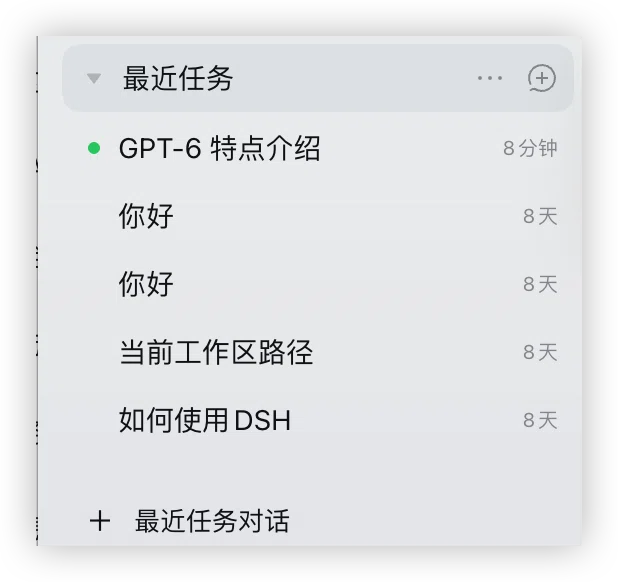
The group sits at the end of the workspace list and behaves like any other: GPT-6 特点介绍 is the chat that is running right now, older ones show how long ago they were used, and + 最近任务对话 at the sidebar foot starts a new chat in that folder.
Why a real workspace record
The alternative — a plugin-drawn group — cannot work: the sidebar's groups are the workspace storage domain, and no slot lets a third-party plugin insert a parallel group. Registering a record instead of shadowing the sidebar means:
- sessions started there are normal sessions whose
cwdis the recent-tasks folder, so the group'ssessionIdsfills itself through the official path (Workspace.sessionIdsis filtered byrealpath(cwd) === path, which also makes it impossible for a chat to be dragged into another group); - the file-access boundary is unchanged: the session's sandbox root is that folder, and escalation inside the chat works exactly as in a workspace chat (design §8.7);
- nothing official is patched, no
workspacelocale string is touched, and 未分组 keeps working untouched; the plugin's own group name is kept in the active language by renaming its own record, never the built-in namespace and never another group.
Requirements
- DSH with a
webordesktopprofile,0.2.0-rc.1or newer (developed and verified on0.2.0-rc.2, cordis~4.0.4) - Node.js
>= 22.19.0— only to build from source - pnpm is recommended when installing into a profile
- No network access, no native modules, no install scripts, no runtime dependencies
Install
The bundle entry (
id: recent-tasks) is self-declared by this package'scordis.patch.yml— no manual patch file is needed.
From npm (recommended)
dsh plugin --profile desktop add dsh-recent-tasks
Published on npm as dsh-recent-tasks. The package declares its repository, so the plugin market matches it back to this repo and can offer version and download information; installs are prebuilt and skip the build-approval step entirely. This is the path the plugin market prefers.
From GitHub
Install by repository identity to get the tip of main — useful for trying an unreleased change, and it is also how the plugin market resolves this package to winditer/dsh-recent-tasks when npm is not used:
dsh plugin --profile desktop add github:winditer/dsh-recent-tasks
For a web profile use --profile web. Restart DSH (quit fully and reopen); the 最近任务 group appears at the foot of the sidebar.
The built browser half (dist/client.js) is committed on purpose. A github: install never runs this package's build — pnpm blocks lifecycle scripts by default — so the committed bundle is what makes this install path work out of the box. Nothing is compiled on the consuming side.
From the app
Settings → Plugins → install bundle, pointing at this directory (or a file: spec). The script scripts/install-into-profile.sh is the manual equivalent: pnpm add file:<repo> plus a dsh.profile.bundles entry.
The dependencies entry is not optional — a bundle listed only in dsh.profile.bundles is erased by the desktop crash-recovery path, which re-derives the list from dependencies.
From the prebuilt tarball
Every release attaches the packed package, so the whole repository is not downloaded and nothing is compiled on the consuming side:
dsh plugin --profile desktop add https://github.com/winditer/dsh-recent-tasks/releases/download/v0.1.0/dsh-recent-tasks-0.1.0.tgz
The URL is pinned to the tag rather than written as releases/latest/download/… on purpose: latest resolves per request but the filename is literal, so a versioned asset name breaks that URL the moment the next release renames it.
From source (development)
git clone https://github.com/winditer/dsh-recent-tasks.git && cd dsh-recent-tasks
npm install
npm run build          # regenerates dist/client.js
dsh plugin --profile desktop add .
dist/client.js is regenerated by node scripts/build.mjs before every launch; if it is ever missing, the host half still loads and the app logs client bundle not found; run \pnpm run build` before launch`.
Settings
All four live rows are ordinary official settings: they appear both in Settings → General (rendered by this plugin's own row) and in Settings → Plugins (auto-derived from the plugin's Config), and both surfaces write the same document.
| Key | Default | Meaning |
|---|---|---|
recentTasksDir |
~/Documents/DSH 最近任务 |
Folder the group owns. Created on first use; must stay an absolute path. Changing it registers/uses the record for the new folder immediately. |
title |
最近任务 |
Group name used when a record is created. While the stored title is still one of this plugin's own default names (最近任务 / Recent tasks) it follows the UI language; any other title is yours and is never rewritten. |
pinLast |
true |
Re-assert the group's place at the end of the workspace list. |
autoRepair |
true |
Recreate the record if it was deleted from the sidebar. Switching it off turns deletion into a visible error instead of a silent rebuild. |
enabled |
true |
Master switch (patch only — no form). |
apiPrefix |
/dsh-recent-tasks/api |
Host API path (patch only). |
Edits are persisted by dsh-config-editor into the active profile's cordis.patch.yml (atomic write, validation, rollback) and hot-apply to the running host: the loader commits new values into the plugin's live Volatile refs and emits loader/volatile-update, which the host half uses to re-ensure immediately. This plugin never writes a config file of its own.
Precedence: the profile patch layer wins over this package's bundled defaults, so a user edit survives upgrades.
Behaviour details
- The API is small and local. Two idempotent POSTs (
state,ensure) requiringcontent-type: application/json; the JSON-only rule is also the CSRF defence, since a cross-site "simple request" cannot set that type without a preflight this route never answers. Nothing secret is exposed and the plugin never accepts a path or a command from the browser. - Failure is never silent. Every refusal is a code (
bad-config,dir-not-writable,dir-not-directory,missing-record,disabled,unavailable, …) which the client renders from this plugin's own locale namespace; the host never ships display text. - State is read-only.
statenever mkdirs, never creates, never reorders — a vanished record is reported (workspaceId: null+missing-record) and onlyensurerepairs it. - Reuse over creation. If the configured folder is already a workspace, that record is reused and its title is left alone (DSH's
createis idempotent perrealpathand ignores the title for an existing record). - The group name follows the UI language. The sidebar row and the workspace switcher both render the record's durable
titleverbatim — DSH localizes only its owndefault-workspacesentinel, and a plugin cannot add to the built-inworkspacelocale namespace. So while the stored title is still one of this plugin's own default names (最近任务/Recent tasks), the client half rewrites it to the active language through the officialworkspaces.rename— the same call the sidebar's own rename dialog makes — which updates both surfaces immediately and durably. Rename the group yourself in the sidebar, or configure a differenttitle, and the plugin never touches it again. The folder on disk is never renamed: the path is the session-grouping key, so moving it would strand existing chats in 未分组. - Nested folders are flagged. A recent-tasks folder inside another workspace renders as a child of it; the settings row warns instead of pretending otherwise.
- Deletion is honest. If the group is deleted while
autoRepairis off, both the entry point and the shortcut reportmissing-record— a chat is never quietly started somewhere else. - Shortcut fallback.
session.newalready ownsMod+N(desktop) andMod+Alt+N(web), andshortcuts.registerrejects an overlapping default. Desktop getsMod+Alt+N; web/macOS and web/Windows getMod+Shift+N; web/Linux stays unbound. A residual collision is caught and the sidebar entry stays the guaranteed way in.
Troubleshooting
| Symptom | Cause / fix |
|---|---|
| No 最近任务 group appears | Check Settings → General → 最近任务 for a coded reason; missing-record + auto-repair off, or dir-not-writable. |
| The group is nested under another workspace | recentTasksDir is inside a registered workspace — pick a folder outside every workspace. |
The entry point says unavailable |
The host half is not mounted (row disabled, or the row mounted before workspaceRegistry). Reload the app once after installing. |
| Settings row shows the read-only hint | No configForms in this composition (no official settings surface); edit the recent-tasks row in the profile's cordis.patch.yml. |
| Chats still land in 未分组 | They were created without this workspace's cwd. Existing chat history is never migrated (design §6.3/N3): the group owns new chats started through the entry or the shortcut. |
Development
node scripts/build.mjs      # build dist/client.js
node --test test/*.test.js  # 49 tests: protocol, host, client logic, bundle contract
node scripts/build.mjs && node --test test/*.test.js   # = npm run verify
npm pack --dry-run          # inspect the published file list
node_modules/@deepseek-ai/* are symlinks into the extracted 0.2.0-rc.1 tree under .asar/, which only exists so node --test can resolve @deepseek-ai/schemastery; production resolves those specifiers through DSH's own profile interception, so the package declares them as optional peers and ships no runtime dependency.
Layout
| Path | Role |
|---|---|
src/host.js → lib/index.js |
Host half: Config, the registry service, the JSON API, the volatile-config listener |
src/client.js → dist/client.js |
Browser half: sidebar entry, settings row, refresh loop, shortcut |
src/client-core.js |
React-free logic: state machine, planCreate, snapshot store, shortcut resolution |
src/protocol.js |
Shared vocabulary: codes, methods, path handling, response parsing |
src/locales.js |
recentTasks zh/en dictionaries (flat keys, 1:1 key sets) |
assets/ |
Screenshots used by this README (and picked up by the plugin market) |
screenshots.json |
The screenshot list the plugin market reads (its convention: declared beside package.json, paths relative to the repo) |
test/ |
protocol · host · client · bundle |
.agents/notes/ |
The design notes this implementation follows, including where it deviates from the draft spec |
License
MIT © 2026 dsh-recent-tasks contributors
No comments yet. Be the first to write one.