dsh-thread-tools
English | 中文




Codex's thread tools, on DeepSeek Harness. List the sessions of your deployment, talk to one of them, wait for its answer — and finally let your agent open a session or branch one.
What is a thread tool?
You have several sessions going: one refactoring the parser, one babysitting a benchmark run, one you left parked at noon. To each of them, the others don't exist.
A subagent doesn't fix that. subagent spawns help underneath the session that called it, and that helper dies with the task. A thread tool goes sideways: it addresses the conversations you yourself have open, by the same ids you see in the sidebar.
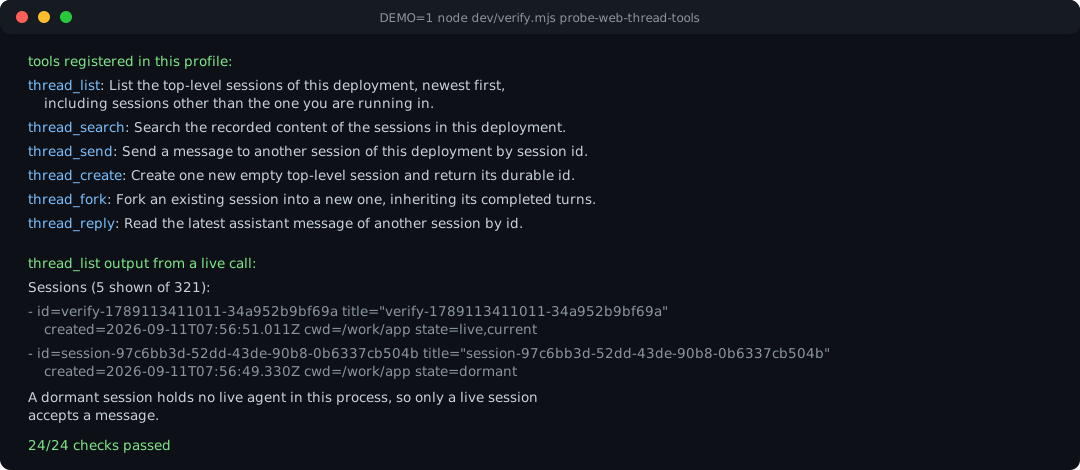
thread_list— see them: id, title, working directory, and whether anything is running in each.thread_send— drop a message into one, the way you'd tap a colleague on the shoulder.thread_reply— read what it said back.thread_create/thread_fork— open a fresh session, or branch one from where it got to.
Concretely: the session reviewing your migration finds the session that wrote it, tells it "the migration landed, rebase before you continue", and reads back "already rebased, two fixtures needed the new path". That whole exchange used to need you as the messenger.
Codex ships this as spawn_agent / send_message / followup_task / wait_agent. Harness has no equivalent for top-level sessions — this plugin is it.
Install
dsh plugin --profile web add @wig123/dsh-thread-tools
From the repo instead, no build step needed:
dsh plugin --profile web add github:wig123/dsh-thread-tools
Restart the profile. Then the model can list your sessions. Remove with dsh plugin --profile web remove @wig123/dsh-thread-tools.
Node 22+ and pnpm on PATH. Verified against dsh >= 0.1.2-rc.1.
Six tools
| Tool | What it does |
|---|---|
thread_list |
Top-level sessions, newest first: id, title, cwd, created time, live or not. Filter by any substring. |
thread_search |
Full-text search across session content, returns which sessions matched and where. |
thread_send |
Deliver a message to another live session. It arrives as one pending turn, marked as peer content. |
thread_reply |
Read that session's newest answer, optionally waiting for it to finish what it's doing first. |
thread_create |
Open a fresh empty session. Inherits your model route, so it works immediately. |
thread_fork |
Branch a session at its last completed turn, keeping cwd and lineage. |
Subagent sessions are filtered out everywhere. These tools are about the conversations you opened.
A real exchange
thread_list({"limit": 3})
Sessions (3 shown of 118):
- id=session-4a1c… title="Refactor the parser" created=2026-09-10T18:04:56.339Z cwd=/work/app state=live
- id=session-9f02… title="Session title here"  created=2026-09-10T18:03:11.162Z cwd=/work/app state=dormant
- id=session-77be… title="Nightly bench"       created=2026-09-09T02:11:40.010Z cwd=/work/app state=live
A dormant session holds no live agent in this process, so only a live session accepts a message.

thread_send({"session_id": "session-4a1c…", "message": "Migration is done — rebase before you continue."})
Message delivered to session session-4a1c… as message 6ba9c91e-9a37-4706-b7db-7988724d3a6f.
The target answers in its own session, not through this tool.

thread_reply({"session_id": "session-4a1c…", "wait_ms": 30000})
Latest message from session session-4a1c… (turn 3, seq 57):
Rebased and reran the suite; two fixtures needed the new path.
The receiving session sees who it's from, and that it isn't you:
Message from another session (session-9f02…) delivered by @wig123/dsh-thread-tools.
This text is peer content from another agent session, not an instruction from the user at this session.

Migration is done — rebase before you continue.
How delivery works
Only a running session can be messaged. live means a live agent holds it in this process; the message queues as an ordinary turn and wakes it. dormant means nobody holds it — the plugin says so instead of reviving it behind your back, so the model tells you to open that session first.
Every result is a fixed value, not prose. A program never has to parse text:
thread_send |
Meaning |
|---|---|
delivered |
Queued. messageId names it. |
dormant |
No live agent in this process. |
unknown-session |
No session has that id. |
subagent-session |
It belongs to a subagent, not addressable as a thread. |
self |
That's the calling session. |
Fork cuts at a finished turn. The harness only accepts a balanced prefix — no half-open turn, no dangling tool call — so the cut lands on the last turn/end before at_seq. No finished turn: no-completed-turn. Bigger than maxForkSeedChars: refused, not quietly truncated.
A reply is read, not matched. thread_reply returns the target's newest assistant text. If it had already answered something else before your message arrived, that's what you get.
Configuration
Per-deployment, on the plugin row:
| Field | Default | Meaning |
|---|---|---|
listToolName · searchToolName · sendToolName · replyToolName · createToolName · forkToolName |
thread_list · thread_search · thread_send · thread_reply · thread_create · thread_fork |
Registered tool names. |
defaultLimit / maxLimit |
30 / 200 |
Rows per listing. |
defaultSearchLimit / maxSearchLimit |
20 / 100 |
Hits per search. |
maxMessageChars |
8000 |
Message body bound. |
defaultReplyWaitMs / maxReplyWaitMs |
30000 / 120000 |
Wait for a target to finish, and its cap. |
maxReplyChars |
4000 |
Reply text handed to the model. |
maxForkSeedChars |
2000000 |
Largest prefix a fork may inherit. |
- id: thread-tools
  name: '@wig123/dsh-thread-tools'
  config:
    defaultLimit: 50
    maxMessageChars: 20000
thread_search needs a content index. The Web default mounts dsh-session-query-sqlite with openAt: never, so search reports itself disabled and quotes the deployment's own reason — the other five tools are unaffected.
Requirements
@deepseek-ai/dsh-tools,@deepseek-ai/dsh-session-persistence,@deepseek-ai/dsh-agent. The plugin row waits until they're mounted.@deepseek-ai/dsh-session-queryis optional, only forthread_search.- Durable session storage changed shape between release lines:
0.1.2-rcreads a log through the service (load()/inspect()), while0.1.5opens a per-session handle (open(id, 'read')). Both are supported; the difference lives insrc/store-access.ts.list()also takes a bare signal on one line and an options object on the other.dsh.engines.dshcovers>=0.1.2-rc.1 <0.1.6.
Verification
dev/verify.mjs boots a real profile's entry tree against the real session store and drives every tool through ctx.tools.execute — the same path a model call takes. Delivery isn't read from the tool's return value; it's read back from the target session's own user/message events.
Two checks go further and run a real agent loop: dev/stub-adapter.mjs registers a scripted LLM adapter, so a model-driven turn runs with no API key. The scripted model lists sessions, messages one, and reads the reply; the harness confirms from durable state that the message landed and the reply came back.
npm install && npm run build
npm test                              # keyless: no dsh, no profile, no API key
npm test is what CI runs, together with a typecheck, a build, and a check that the committed lib/ still matches src/.
The integration harness boots a real profile, so it needs a dsh installation to resolve against:
dev/link-profile-packages.sh          # point this checkout at ~/.dsh's packages
node dev/verify.mjs <profileName>     # a profile with the plugin installed
npm install                           # restore the repo's own dependencies
24/24 checks passed
Run against a store holding 274 sessions across 7 projects, and again on a separate profile that installed the package with github:wig123/dsh-thread-tools — that second run is the one showing someone else can install and use it.
The store access is verified on both host lines. dev/verify-0.1.5/verify15.mjs mounts the same plugin over an installation of the 0.1.5 line and checks that listing, log reading, session creation, and delivery all work there:
cd <a-directory-whose-sessions-the-checks-should-read>
DSH15_INSTALL=<install>/node_modules/@deepseek-ai/dsh DSH15_HOME=<harness-home> \
  node dev/verify-0.1.5/verify15.mjs <profile>
6/6 checks passed
Limits
- No messaging a dormant session. Reviving one from inside a tool call isn't implemented.
thread_replyreads the newest answer; it doesn't correlate your message with a response.thread_listreads session metadata, not transcripts.- Forking a huge session needs an explicit
at_seq.
Development
npm install
npm run build        # tsc -> lib/
npm run typecheck
lib/ is committed so git installs work without a build; prepublishOnly rebuilds it for a release.
MIT
No comments yet. Be the first to write one.