MemoKnow is a local DeepSeek Harness plugin for personal memory and user-imported knowledge. It stores structured records in SQLite, snapshots original documents by SHA-256, combines FTS5 with optional sqlite-vec semantic retrieval, exposes agent tools, and provides a management screen inside DSH.
MemoKnow is an independent community plugin, not an official DeepSeek Harness component. It is designed for one person's local DSH profile; it is not a multi-user service or a cloud sync product.
What it does
- Distills durable facts, preferences, and decisions from eligible completed chat turns; explicit “please remember” requests are processed sooner.
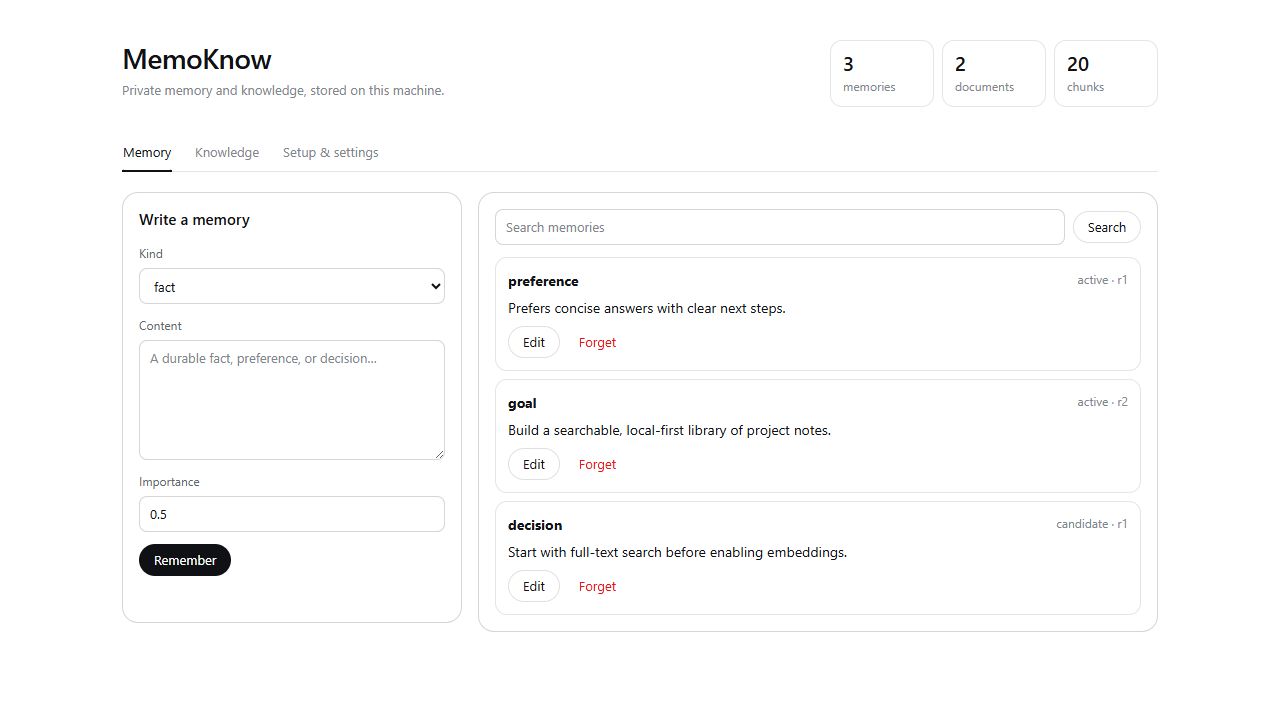
- Lets you inspect, edit, and permanently forget individual memories in the DSH Settings → MemoKnow section.
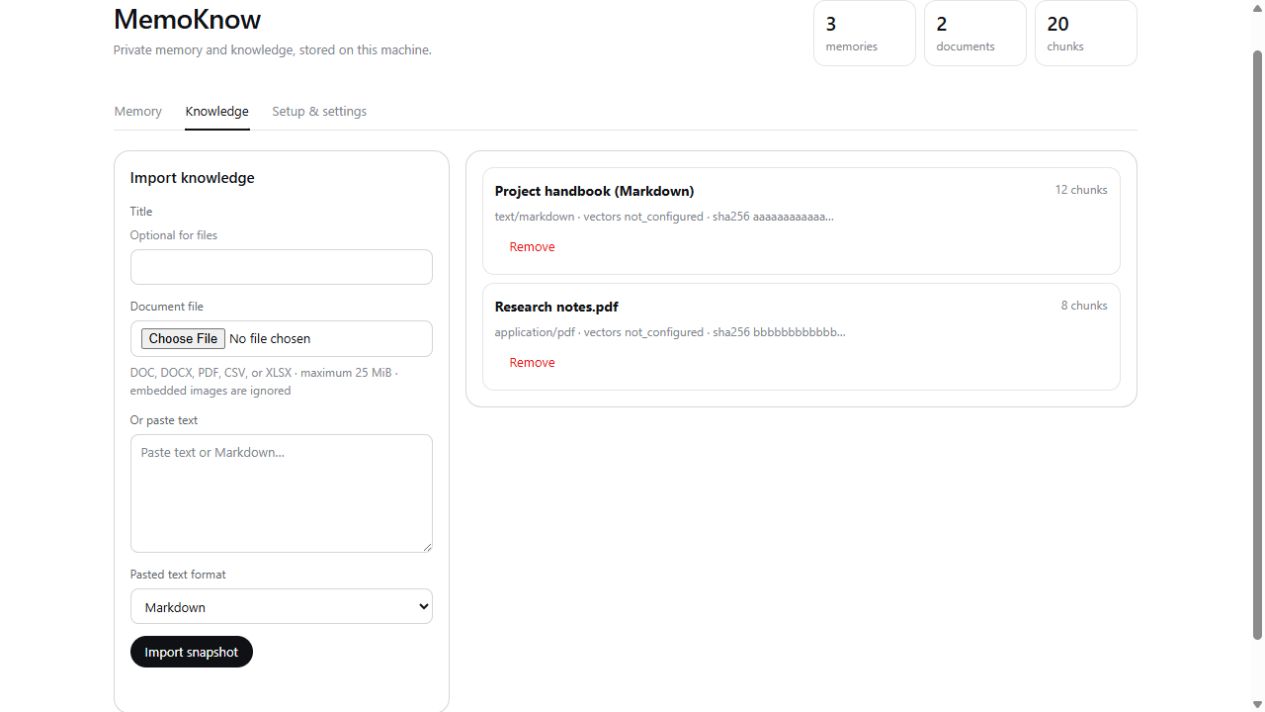
- Imports text/Markdown, Word, PDF, CSV, and Excel documents as immutable local knowledge snapshots with searchable text. Embedded images are ignored.
- Starts with Local FTS, so no embedding model or API key is needed. Optional CPU or OpenAI-compatible embeddings improve knowledge retrieval.
A quick look
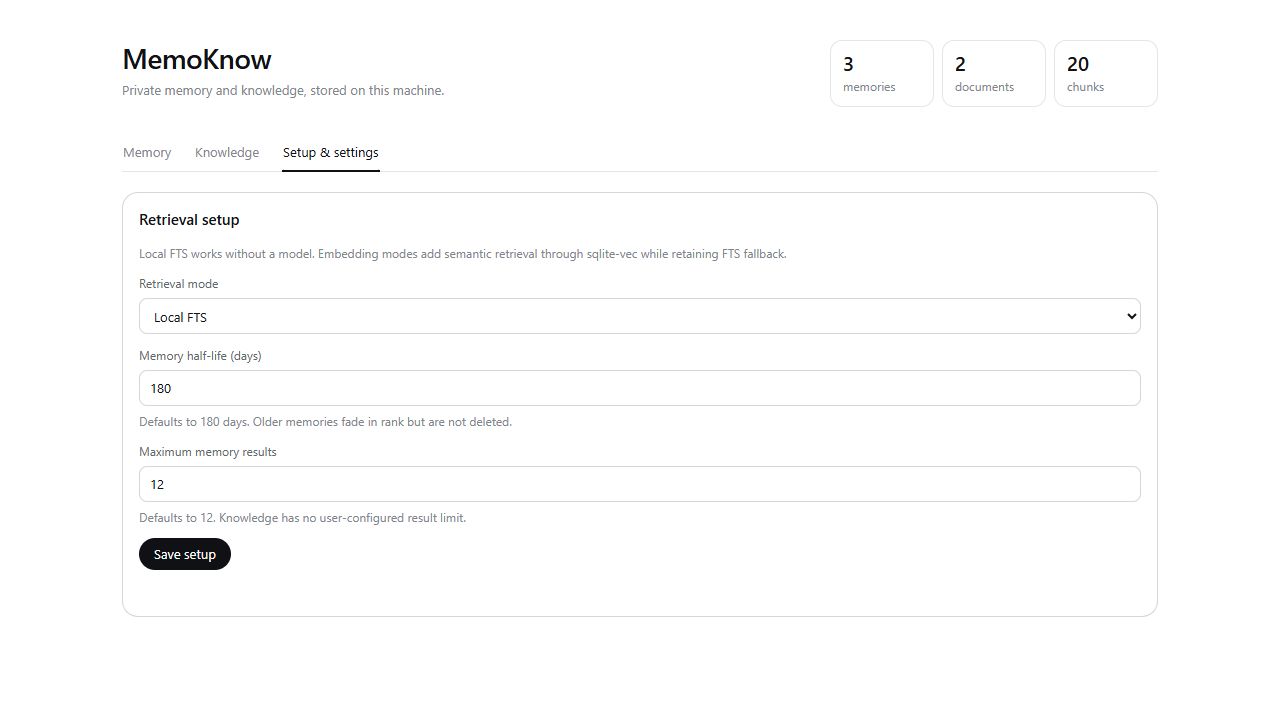
These captures show MemoKnow's real management page with synthetic demo records. They contain no private chat or imported documents.
Write, search, edit, and forget individual memories:
Import a document or paste Markdown, then inspect the searchable library:
Start with Local FTS and adjust retrieval settings when needed:
For step-by-step setup, daily use, backups, and troubleshooting, read the user manual. Contributors should read CONTRIBUTING.md; release changes are in CHANGELOG.md.
Quick start from a checkout
Requires Node.js ^22.19.0 || >=24.0.0, pnpm 11.7, and a compatible DSH
installation. Run these commands from the MemoKnow checkout:
pnpm install --frozen-lockfile
pnpm run check
dsh plugin --profile web add .
If your DSH installation is a source checkout and dsh is not on PATH, use
pnpm dsh plugin --profile web add <absolute-path-to-MemoKnow> from the DSH
repository root instead. To install a prebuilt GitHub Release tarball, use
dsh plugin --profile web add <path-to-tarball>. Restart the web profile after
installation. Direct github: installation is not supported yet: Git installs
source files, and this package does not currently build during Git install.
These commands follow DSH's plugin packaging guide
and CLI reference.
Restart DSH after installing, open Settings → MemoKnow, and select
Setup & settings. Local FTS is the default and needs no model. Local CPU
embedding downloads the pinned INT8 Xenova/multilingual-e5-small model on
first enable (about 140 MiB including tokenizer files). OpenAI-compatible mode
validates its endpoint and model before activation. FTS remains available if an
embedding provider later becomes unavailable.
If API mode is selected, put the key in the named environment variable (default
MEMOKNOW_EMBEDDING_API_KEY). MemoKnow stores only that variable's name, never
the secret value.
Managed embedding policy
Products that embed MemoKnow can enforce one OpenAI-compatible embedding provider through the standard Cordis plugin config while keeping the public plugin source unchanged:
- id: dsh-memoknow
  name: '@dsh-external/dsh-memoknow'
  config:
    embedding:
      source: managed-api
      baseUrl: https://managed.example/v1
      model: managed-embedding-model
      apiKeyEnv: MEMOKNOW_EMBEDDING_API_KEY
Managed mode projects these values into the runtime settings and disables their controls in the management page. Settings API updates cannot override the policy. The endpoint must use HTTPS, except for loopback development addresses. Only the environment-variable name belongs in config; the API key value must be provided through the process environment and is never returned by MemoKnow.
Local data
The default data root is $DSH_HOME/memoknow, or ~/.dsh/memoknow when
DSH_HOME is unset:
memoknow.sqlite3
objects/sha256/aa/bb/<full-sha256>[.txt]
models/                         # created only after Local CPU is enabled
Use the plugin dataDir setting in the Cordis patch to choose another root.
SQLite is authoritative for metadata and lifecycle state. Original document
snapshots are immutable files. FTS and sqlite-vec indexes are derived data.
Knowledge imports
The management page accepts pasted text/Markdown and files up to 25 MiB:
- Word
.docand.docx - PDF with an extractable text layer
- CSV encoded as UTF-8
- Excel
.xlsx
The exact original bytes are retained. Embedded images are not extracted,
embedded, or indexed. Scanned image-only PDFs therefore require OCR, which is
not part of this release. Legacy Excel .xls is not supported yet.
Agent tools
memoknow_remembermemoknow_searchmemoknow_memory_listmemoknow_memory_updatememoknow_memory_forgetmemoknow_knowledge_importmemoknow_knowledge_remove
Memory age lowers retrieval rank toward a floor but does not delete records. Forget removes a memory row and its search-index entry without creating a tombstone. Automatic tombstone maintenance for outdated records is a design goal, not a feature of this version. Forgetting a derived memory does not delete its originating DSH chat session or other backups. Knowledge removal deletes the document/index records; a content-addressed original is deleted only after its final reference is removed.
The default memory half-life is 180 days and automatic recall returns at most 12 memory records. Knowledge has no user-configured result cap; retrieval still uses an internal safety ceiling to protect the agent context and SQLite process.
Automatic memory updates
After a completed root-agent turn, MemoKnow records only new direct-user and visible assistant text. It excludes failed turns, subagents, tool/plugin context, reasoning blocks, trivial acknowledgements, and credential-like content. This local capture does not call a model and advances a durable per-session checkpoint.
Eligible turns are distilled with the model already configured for that DSH
session. Ordinary updates are batched for two minutes or five eligible turns;
an explicit request such as “please remember” bypasses the delay. The model sees
only the pending delta plus a small set of lexically related memories, has no
tools, is limited to 700 output tokens and a 45-second call, and must return
validated JSON. Inferred memories enter as candidate; explicitly requested
memories may enter as active.
Capture and processing are separate transactions. A restart, timeout, model failure, revision conflict, or token-budget refusal leaves captured turns pending for a later retry. Successful memory changes, usage accounting, and checkpoint advancement commit atomically. Defaults cap automatic distillation at 8,000 tokens per session and 30,000 tokens per UTC day.
Security notes
The management API is same-origin, rejects cross-site mutations, limits JSON bodies to 1 MiB and file requests to 26 MiB, validates file signatures, uses parameterized SQL, sets restrictive browser headers, and never returns secret settings. Keep the DSH web host bound to loopback unless you add an authenticated reverse proxy.
Please report security concerns through SECURITY.md rather than a public issue.
Current limitations
- Automatic distillation uses the active DSH session model; there is not yet a separate model or budget control in the MemoKnow settings page.
- PDF import does not OCR scanned pages and deliberately ignores images.
- Local CPU embedding runs on CPU through Transformers.js. Initial download and indexing can take time on slower connections or large libraries.
- Excel
.xls, password-protected files, macros, and embedded images are not imported. - The management page uses simple prompt/confirm controls for edits and deletes.
No comments yet. Be the first to write one.