dsh-data-agent


A DeepSeek Harness (dsh) plugin for managing database connections and running SQL, both conversationally and from the Web UI's Settings page.
Features
- Data-source management — register MySQL, PostgreSQL, SQLite, or ClickHouse connections (
da_add_data_source/da_edit_data_source/da_remove_data_source/da_list_data_sources), or manage them from Settings → Data Sources. - Connection checks & schema browsing —
da_test_connectionandda_get_schema(database overview or full column detail for one table), rendered as a Markdown table in chat and as a rich, expandable browser in both the chat card and the Settings schema viewer. - Table/column comments —
da_set_commentfrom chat, or click-to-edit inline in the Settings schema viewer; both write to the same store. - SQL execution with a read-only toggle —
da_run_sql, AST-verified (not string-matched) to reject write statements on a read-only source and to always reject statement-stacking. Toggle a source's read-only flag anytime withda_set_read_only(or the checkbox in Settings). - Charts —
da_render_chartrenders achart.jsbar/stacked-bar/line/pie chart from eitherdata(inline rows) orresultId(a priorda_run_sqlcall's result, referenced by id instead of resent — cached in memory per conversation for 30 minutes). Alongside the interactive Web UI chart, it also rasterizes a static PNG server-side (viaskia-canvas) and returns a URL to it, so the chart can be embedded as a Markdown image in the model's own reply.
Secrets are never stored directly: connections reference a passwordEnv (an environment variable name), resolved at connect time via the harness's ctx.credentials seam when mounted, else process.env.
Demo
https://github.com/user-attachments/assets/fa149214-cdd0-4820-9711-8e7451bb462f
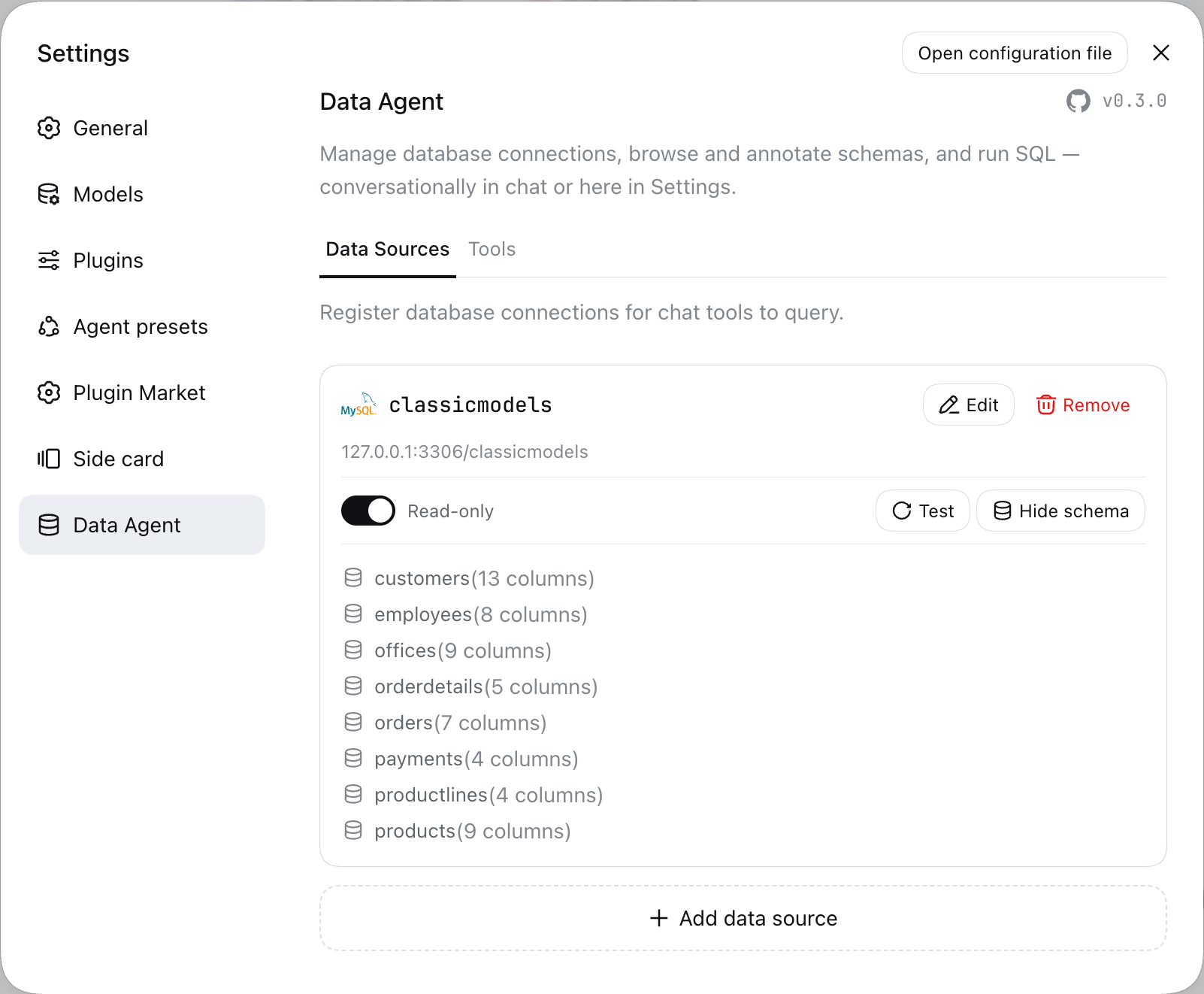
Connections, schema, and read-only toggling are also manageable straight from Settings → Data Agent:
Install
Requires a web profile already booted at least once (dsh --profile web).
# 1. Install the dsh launcher
npm install -g @deepseek-ai/dsh

# 2. Install this bundle into the web profile
dsh plugin --profile web add @tomowang/dsh-data-agent

# 3. Approve skia-canvas's native build script (needed for da_render_chart's PNG output)
dsh plugin --profile web approve-builds
dsh reconciles the profile manifest's dsh.profile.bundles list automatically (this package declares dsh.bundle.patch), fetching the published npm package — no local checkout or build step needed. Restart the web profile process to pick it up.
Develop
pnpm install
pnpm run typecheck
pnpm run test
Scripts:
pnpm run typecheck— type-check both the Host (tsconfig.json) and Client (tsconfig.client.json) sourcepnpm run test— run tests (vitest);tests/cover SQLite in-process (no server needed) plus the SQL classifier, persistence, and registry logic — to exercise the MySQL/PostgreSQL/ClickHouse adapters, register a source against a reachable instance (a local Docker container works fine) and runda_test_connection/da_get_schema/da_run_sqlfrom therepnpm run build— build both halves tolib/(build:host+build:client)pnpm run build:host/build:client(orwatch:host/watch:client, or plainwatchfor both at once) — build one half onlypnpm run dev— build both halves and link this plugin into the localwebprofile (see below)
Architecture
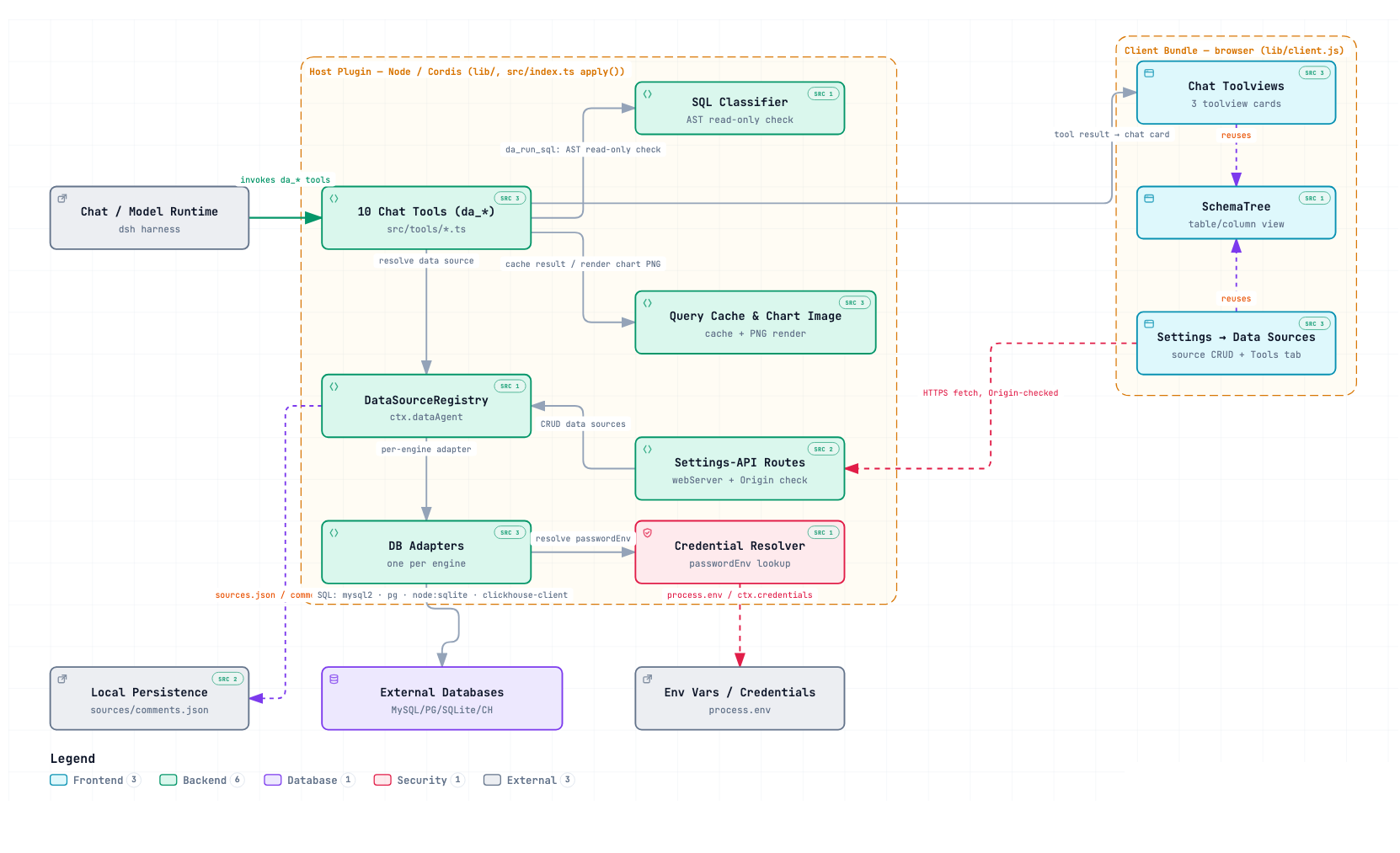
Project layout
src/
  index.ts                composition root: Config, apply() — mounts the registry, tools, the Settings-API routes, and the chart-image route
  data-source/
    types.ts, errors.ts   shared vocabulary and stable error codes
    registry.ts           DataSourceRegistry (ctx.dataAgent): the Map-based connection registry
    credential.ts         passwordEnv resolution (soft ctx.get('credentials'), else process.env)
    schema-comments.ts    merges comments.json into a raw schema result (shared by the tool and the Settings route)
    persistence/          sources.json / comments.json (atomic, cross-process-safe)
    adapters/              one DataSourceAdapter implementation per engine (mysql2, pg, node:sqlite, @clickhouse/client)
  sql/classify.ts         node-sql-parser-based read-only + single-statement enforcement
  tools/                  the ten model-facing tools (one file each), plus QueryResultCache (ctx.queryResultCache),
                          chart-config.ts (shared chart.js config builder), and the chart-image render/store/route
                          backing da_render_chart's static PNG output (ctx.chartImageStore)
  settings-api/           raw ctx.webServer routes + Origin trust check backing the Settings panel
src/client/                the browser bundle (see below)
  index.ts                client plugin entry: registers the three chat toolviews + the Settings section
  tool/                   da_run_sql / da_get_schema / da_render_chart chat cards (card models + components + toolview registrations)
  settings/               the Data Sources settings panel + its fetch() API client
  shared/SchemaTree.tsx   table/column browser shared by the chat card and the Settings panel
scripts/build-client.mjs esbuild build for src/client -> lib/client.js
cordis.patch.yml          the bundle layer applied when a profile lists this package
Developing against the web profile
Local development only — this links your working copy into a profile in place of the published package, so you can iterate without cutting a release. It assumes a globally installed dsh CLI (npm i -g @deepseek-ai/dsh, or any dsh resolvable on PATH) and a web profile already booted at least once (dsh --profile web).
Link this checkout into the web profile and register it as a bundle:
pnpm run dev
# same as: pnpm run build && dsh plugin --profile web add .
This is one-time (or re-run after changing package.json dependencies): pnpm link:s this directory into the profile's node_modules and appends @tomowang/dsh-data-agent to the profile's dsh.profile.bundles. Verify the layer, then boot:
dsh --profile web --dump-config   # confirm the "# == @tomowang/dsh-data-agent" layer
dsh --profile web
Because it's a symlink, no need to re-run add after an edit — but the profile loads lib/, never src/ directly, for either half: rebuild with pnpm run build (or the narrower scripts above) before the next boot picks up an edit. There's no hot-reload for either half (checked: @deepseek-ai/cordis-plugin-hmr explicitly excludes anything resolved through node_modules, which is how a linked profile always loads this plugin) — a running dsh --profile web process needs restarting to pick up a rebuilt bundle, reloading the page alone is not enough (the plugin bundle list is fixed at process boot). dsh plugin --profile web remove @tomowang/dsh-data-agent undoes the install.
For quick Host-only throwaway testing without touching any profile (also local development only; skips the client bundle, so no Web UI cards/settings — use the linked-profile flow above for that), overlay the source file directly against a deepseek-harness source checkout:
cd /path/to/deepseek-harness   # your local checkout
pnpm dsh web --patch <(cat <<EOF
- insert:
    - id: data-agent
      name: '/path/to/dsh-data-agent/src/index.ts'
      config:
        defaultMaxRows: 500
EOF
)
See deepseek-harness's plugin tutorials and packaging guide for the full plugin/bundle model.
Known v1 limitations
- SQL placeholder syntax isn't unified across engines:
?for MySQL/SQLite,$1, $2, ...for PostgreSQL,{p1:Type}, {p2:Type}, ...for ClickHouse (its HTTP interface only supports named parameters;paramsbinds to them positionally asp1,p2, ...). da_run_sql's safety check rejects any statement the parser can't classify (e.g. SQLitePRAGMA, some PostgreSQLEXPLAINforms, ClickHouseFORMATclauses) rather than guessing — useda_get_schemafor introspection instead of rawPRAGMA, and omitFORMAT(the ClickHouse adapter always requestsFORMAT JSONitself).node-sql-parser(the AST-based safety check) has no dedicated ClickHouse dialect; ClickHouse sources are classified against its PostgreSQL grammar, which is close enough for common SELECT/DDL/DML but will reject some ClickHouse-specific syntax as unparseable rather than misclassifying it.- The Settings panel's raw HTTP routes carry a hand-rolled
Origincheck rather than the harness's own/apitrust fence (which is specific toctx.remotecalls) — adequate for the existing loopback-only threat model, not a claim of parity.
No comments yet. Be the first to write one.