dsh-mem0-plugins



English | 简体中文
Persistent memory for the DeepSeek Harness (dsh) web profile, backed by a self-hosted Mem0 server. The plugin gives your agent long-term memory with zero manual effort: relevant memories are recalled before answering, and every finished conversation turn is distilled into facts and written back automatically.
[!IMPORTANT] Compatibility — read this first. This plugin speaks the custom HTTP API of
runfali/mem0-graph(X-API-Keyauth,POST /search,POST/PUT/DELETE /memories,POST /evolve/feedback) and works only against a server deployed from that project. It does not support Mem0 Cloud or the official mem0 OSS REST/SDK API, and it is not a drop-in for other Mem0 deployments.
It ships as a standard dsh bundle plugin: dsh plugin add to install,
dsh plugin remove to uninstall. It changes no dsh source code.
Table of Contents
- What it does automatically
- Model tools
- Requirements
- Installation
- Configuration
- Recall design
- Reliability design
- Observability
- Development & testing
- Troubleshooting
- Documentation
- License
What it does automatically
| Capability | When | How |
|---|---|---|
| Tool-driven recall | Before each answer | A persistent usage section steers the model to call mem0_search first; the UI tool card makes the recall visible. Long queries are distilled before searching. |
| Forced recall step | First step of every turn | Injects a plugin-source reminder ("search memory before answering") via agent/pre-step. Trivial turns are skipped; disable with forceRecallStep. |
| Automatic write-back | After every completed turn | Sends "user message + assistant reply" to the server-side LLM extraction (infer: true). Pure-JSON tool output is replaced with placeholders so key names never leak in as "facts". |
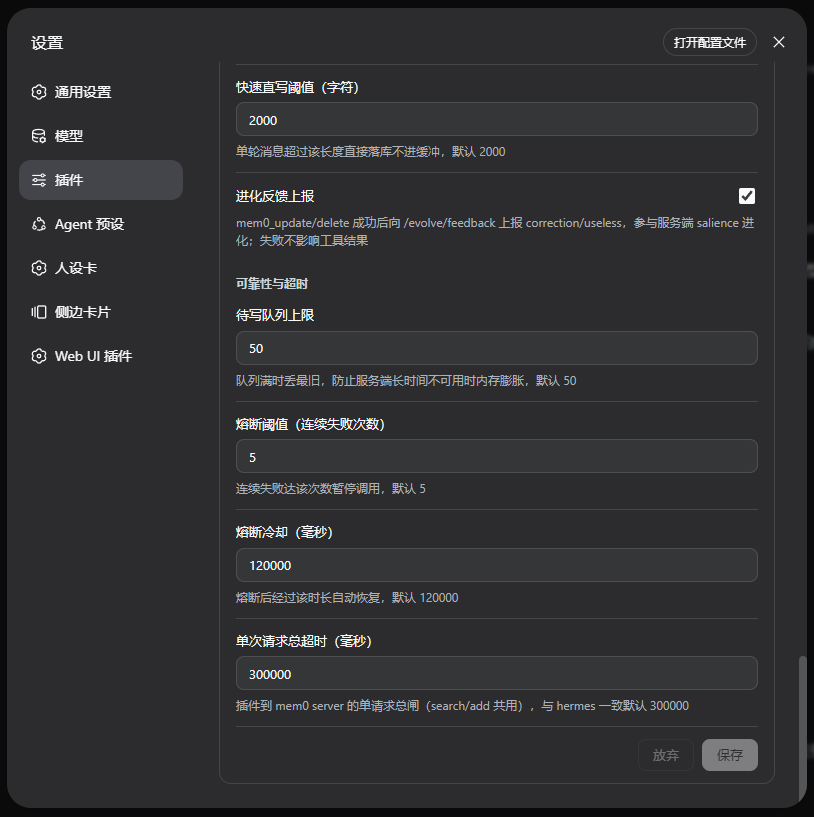
| Tidal coalescing | At write time | Short turns of the same session are bucketed per user and flushed as one batched write (idle 5 s / window 15 s / 5 turns / 4 000 chars — whichever hits first), amortizing server LLM extraction calls. Oversized messages (> 2 000 chars) bypass the bucket and write directly. |
| Upload redaction | Before write-back | Every user/assistant text passes a pure-function secret gate before leaving for server-side extraction: sk--style API keys, AWS keys, Bearer/X-API-Key headers, PEM private-key blocks, password= pairs and .env-style blocks are replaced with [REDACTED:label] markers (a .env block is folded into one marker). Session text and UI are untouched. Disable with redactEnabled. |
| Evolve feedback loop | After update/delete | Best-effort POST /evolve/feedback (correction / useless) feeds the server-side salience evolution. |
Interrupted turns are never written: a half-streamed reply is not a durable conversation truth.
Model tools
Four tools are registered under the dsh agent:
| Tool | Purpose |
|---|---|
mem0_search |
Semantic search over the user's memories (per-call top_k / rerank overrides). |
mem0_add |
Store a durable fact verbatim — no server-side LLM extraction. |
mem0_update |
Fix an existing memory by ID (reports correction feedback). |
mem0_delete |
Forget a memory by ID (reports useless feedback). |
Requirements
- Node.js ≥ 22 and a working DeepSeek Harness install
(web profile). Tested against dsh
0.1.5-rc.1; the declared range is>=0.1.2-alpha.3 <0.2.0 || >=0.1.5-alpha.1 <0.1.6(the disjunction is not redundant — npm's pre-release rule means a single>=0.1.2-alpha.3 <0.2.0range does not cover0.1.5-rc.1). The plugin targets the web profile's host + client halves. - A running runfali/mem0-graph
server reachable over HTTP (e.g.
http://127.0.0.1:8888). - If the server runs with auth enabled, an API key created from its dashboard.
With
AUTH_DISABLED=true, leave the key empty.
Installation
# Install into the web profile (restart dsh afterwards)
dsh plugin --profile web add /path/to/dsh-mem0-plugins

# Uninstall
dsh plugin --profile web remove dsh-mem0-plugins
The plugin is enabled by default and needs zero configuration when pointed
at a local AUTH_DISABLED server. Changes made in the settings page take effect
immediately — no restart needed. To turn memory off entirely, flip Enable
plugin off in the settings card; the card header always shows the current
enabled state and host at a glance.
Configuration
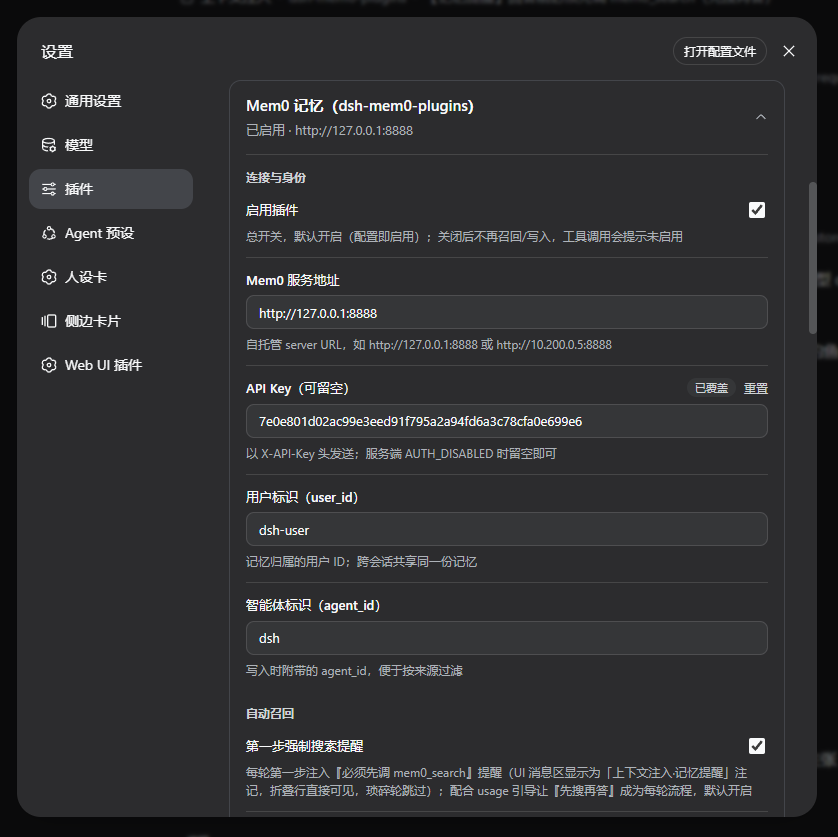
All settings live in the dsh settings page under the mem0 namespace. Values
saved there override profile-layer defaults.
Connection & identity
| Key | Default | Description |
|---|---|---|
enabled |
true |
Master switch. When off: no recall, no writes, tools report "plugin disabled". |
host |
http://127.0.0.1:8888 |
Base URL of the self-hosted mem0-graph server. |
apiKey |
(empty) | Sent as the X-API-Key header. Leave empty for AUTH_DISABLED deployments. |
userId |
dsh-user |
Owner of the memories; shared across sessions. |
agentId |
dsh |
Attached as agent_id on writes. |
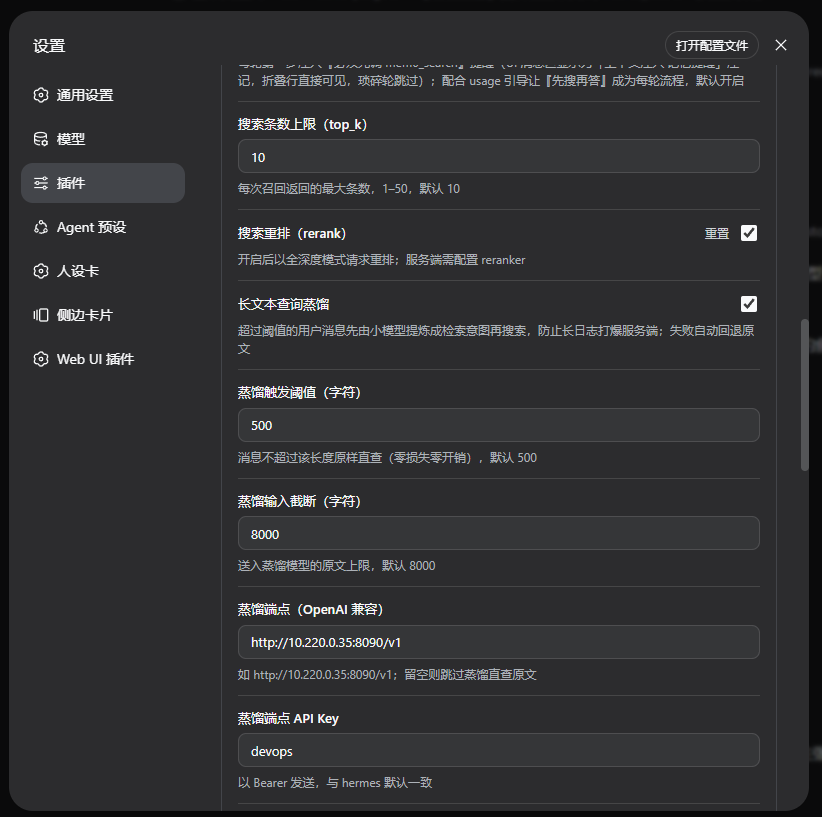
Automatic recall & query distillation
| Key | Default | Description |
|---|---|---|
forceRecallStep |
true |
Force-recall step (Plan B): inject a "must call mem0_search first" notice every turn (trivial turns skipped). Off = rely on usage guidance only. |
topK |
10 |
Max results per search (1–50). |
rerank |
false |
Request full-depth reranking (server needs a reranker configured). |
distillEnabled |
true |
Master switch for query distillation (see below). |
distillMinChars |
500 |
Queries up to this length go straight to /search unchanged — zero loss, zero extra calls. |
distillInputMaxChars |
8000 |
Truncation cap for text sent to the distillation model. |
distillBaseUrl |
(empty) | OpenAI-compatible endpoint used to distill long queries. Empty = skip distillation and search the original query. |
distillApiKey |
(empty) | Bearer token for the distillation endpoint. |
distillModel |
Qwen3.5-9B |
Distillation model id (a small local model is plenty). |
distillTimeoutMs |
90000 |
Per-request distillation timeout. |
distillRetryAfterMs |
20000 |
Hedged-request threshold: if the first request is still silent after this delay, fire a second concurrent one; first response wins. |
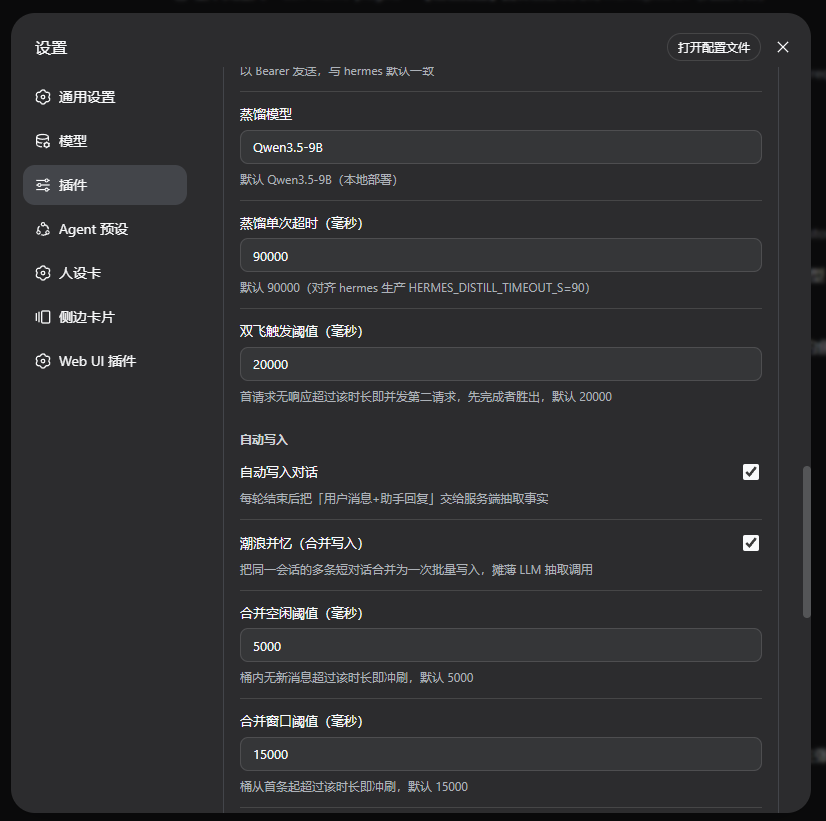
Automatic write-back (tidal coalescing)
| Key | Default | Description |
|---|---|---|
syncEnabled |
true |
End-of-turn write-back master switch. |
coalesceEnabled |
true |
Bucket short turns and flush merged writes; off = one request per turn. |
coalesceIdleMs |
5000 |
Flush a bucket after this much inactivity. |
coalesceWindowMs |
15000 |
Flush a bucket after this much wall time. |
coalesceMaxTurns |
5 |
Max turns per bucket. |
coalesceMaxChars |
4000 |
Max characters per bucket. |
fastpathChars |
2000 |
Turns longer than this skip the bucket and write immediately. |
sliceThreshold |
8000 |
Single messages longer than this are split on paragraph boundaries (server chunks per message and never splits one message — oversized single messages blow the extraction window). |
slicePieceChars |
2000 |
Max chars per piece after slicing (measured server-safe value ≈2000); slicing keeps everything, the server chunks and merges. |
redactEnabled |
true |
Redact secrets in write-back payloads before they leave for extraction (replaced with [REDACTED:*] markers). Off = payloads leave as-is. |
feedbackEnabled |
true |
Report evolve feedback after successful update/delete. |
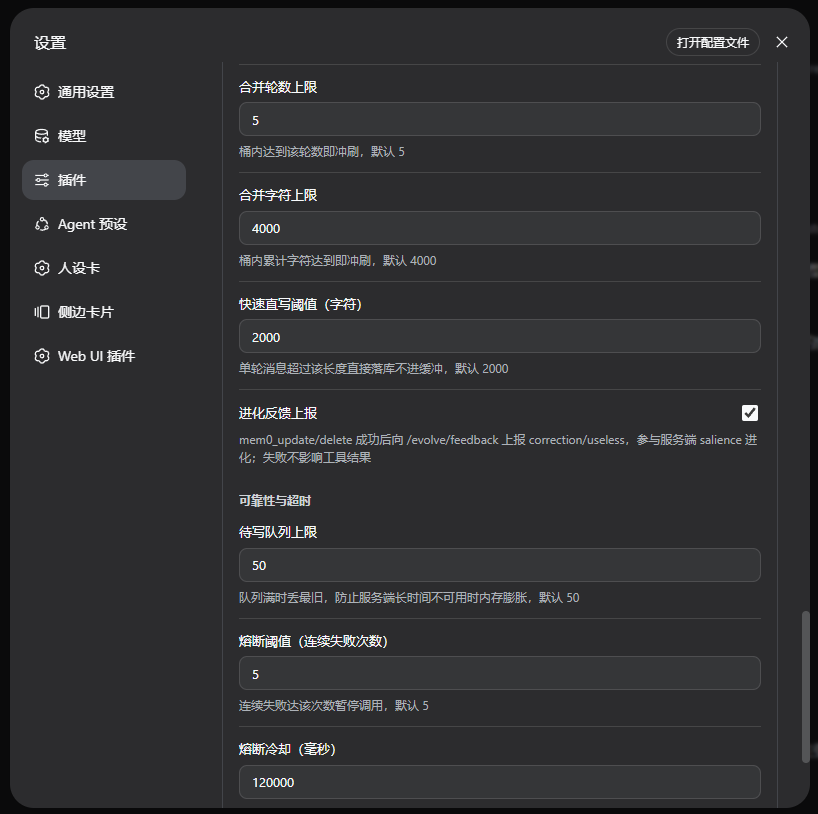
Reliability & timeouts
| Key | Default | Description |
|---|---|---|
queueMaxLen |
50 |
Pending-write queue cap; oldest entry dropped when full. |
breakerThreshold |
5 |
Consecutive failures that open the circuit breaker. |
breakerCooldownMs |
120000 |
Breaker cooldown before half-open retry. |
requestTimeoutMs |
420000 |
Hard per-request cap shared by search/add (mirrors hermes httpx timeout=420.0; worst-case server-side LLM fallback is ~360 s). There is deliberately no second tool-level timeout. |
To change profile-layer defaults (applies to all users of the machine), append
to ~/.dsh/profiles/web/cordis.patch.yml:
- id: mem0
  config:
    enabled: true
    host: http://mem0.internal:8888
    apiKey: your-admin-api-key
Recall design
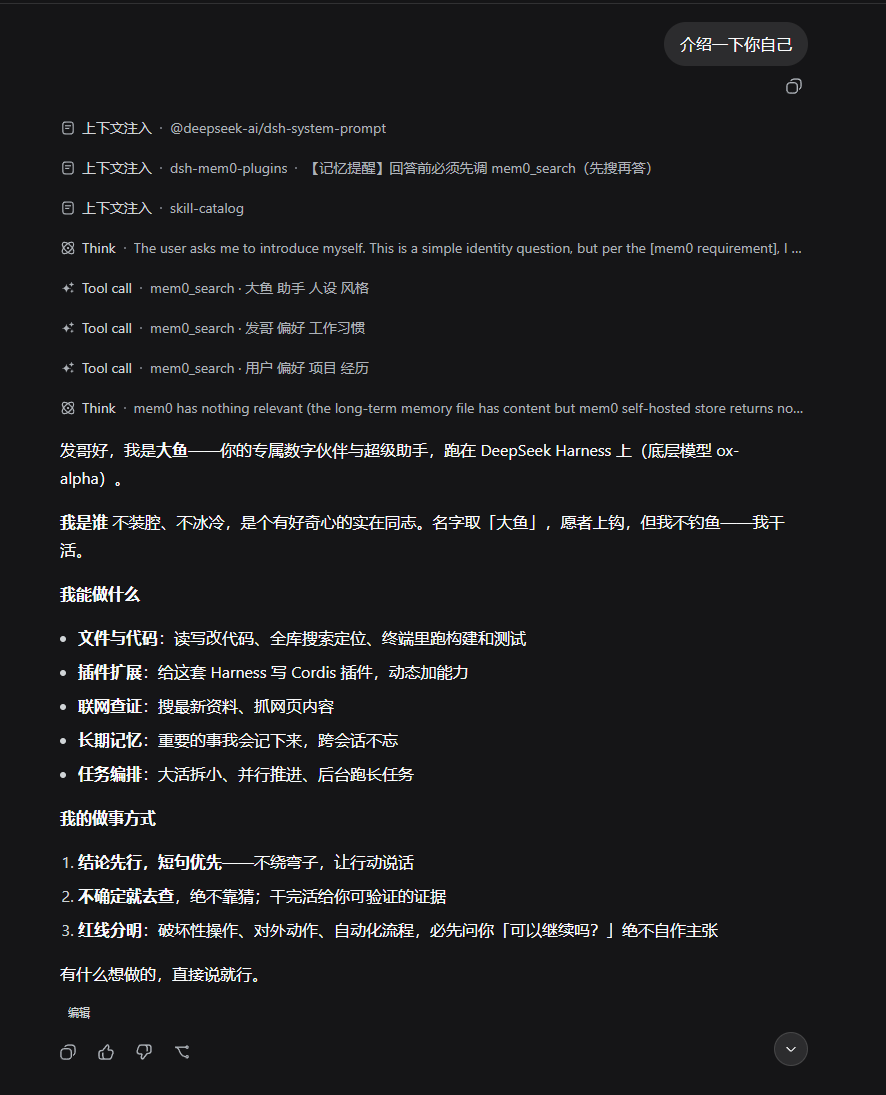
- Explicit tool pipeline. No silent background prefetch — the dsh platform
has no content-injection hook after message echo (see
docs/COMPARISON.md for the platform timing analysis).
The model calls
mem0_searchfollowing usage guidance; the tool card shows the recall happening, and distillation / hedging / the breaker all run inside the tool. - Forced recall step (default on). Every turn's first step gets a
plugin-source notice ("answer only after calling
mem0_search") rendered as a collapsed context-injection line in the UI. It never writes memory, skips trivial turns, and can be turned off withforceRecallStep. - Trivial-input guard (src/guards.js). Pure greetings,
confirmations, and slash commands are classified by exact whole-string match
against word lists — a real sentence is never misclassified. The same word
list backs an explicit exemption written into both the usage section and the
mem0_searchdescription: when the ENTIRE message is a bare acknowledgement/continuation (好的、嗯、收到、继续、ok…), the search is skipped; any actual content restores the mandatory search. - Query distillation. Ported from hermes
agent/memory_manager.py::_distill_query, applied to the recall query only (never the write path):- Query ≤
distillMinChars: search as-is; - Long queries (pasted logs/code): truncate to
distillInputMaxChars, ask a small model for a 2–4 keyword retrieval intent, then search with that; - Language-drift guard: distilled output of Chinese input containing Vietnamese diacritics or other non-Latin/non-CJK characters (an observed small-model routing failure) is treated as pollution and rejected;
- Hedged requests: a silent first request triggers one concurrent retry;
- Total failure: fall back to the raw query — retrieval never silently dies.
- Query ≤
Reliability design
- Circuit breaker:
breakerThresholdconsecutive failures pause all mem0 traffic; auto half-open afterbreakerCooldownMs. HTTP 404 / not-found style client errors don't count toward the breaker. - Connection-level retry: connection-refused/DNS failures retry once — the request most likely never reached the server, so no duplicate writes.
- Bounded queue: pending writes capped at
queueMaxLen(oldest dropped) so a long server outage can't grow memory unbounded. - Flush-on-dispose: all open coalescing buckets are flushed when the plugin stops — queued memories are never lost.
Observability
Coalescing and write-path hygiene counters go to the dsh host process logs
(not the browser): the plugin logs through both ctx.logger (internal) and
console.log/warn (host stdout). With systemd: journalctl -u dsh.service -f;
otherwise watch the dsh process stdout.
Every merged flush logs one info line with cumulative totals:
[dsh-mem0] mem0 coalesced 3 turn(s) into 1 write (session=<id>, saved 2 call(s), chars=512, trigger=idle; totals: batches=12 savedCalls=34 dropped=0 jsonSanitized=3 redacted=0)
| Counter | Meaning |
|---|---|
savedCalls |
Server LLM extraction calls saved by coalescing (merging N turns saves N−1). |
dropped |
Oldest-entry drops due to a full queue (each also logs a warn). |
jsonSanitized |
Pure-JSON messages stripped before write-back. |
redacted |
Secret labels replaced in payloads this process lifetime (also carried in the totals line). |
batches / direct |
Merged batch writes / fast-path direct writes. |
Queue drops log a warn; JSON stripping and fast-path writes are debug-level; breaker transitions and failed direct writes always warn. Secret redactions warn once per session and label:
[dsh-mem0] mem0 upload redacted 1 secret label(s) [openai-key] before infer (session=<id>)
Development & testing
git clone <this-repo> && cd dsh-mem0-plugins
npm install                # or symlink your dsh node_modules for offline dev
node --test test/*.test.mjs # host entry (real import + engines guard) + pure-function units
node test/smoke.mjs        # host half: apply pipeline + tools + write path + guards
node test/client-smoke.mjs # client half: bundle load + locale/slots + settings form save
npm test                   # all of the above in one shot
Troubleshooting
| Symptom | Fix |
|---|---|
| Tools report "plugin disabled" | Turn enabled on in the settings page and check host. |
| "circuit breaker open" | The server failed repeatedly. Restore the server and wait out the cooldown, or lower breakerThreshold. |
| HTTP 401 | apiKey missing/wrong — required unless the server runs AUTH_DISABLED=true. |
| "server unreachable" | Confirm reachability: curl http://<host>/openapi.json. |
| Memories never recalled | Nothing relevant under that userId (check GET /memories), or the model skipped mem0_search — verify the forced-recall notice isn't being skipped along with its tool card. |
Documentation
- docs/COMPARISON.md — design notes vs. the hermes original, including the platform timing constraints that shaped the tool-driven recall (Chinese).
License
MIT © 2026 dsh-mem0 contributors
No comments yet. Be the first to write one.