dsh-preflight · 预检
Forecast a task's steps, tokens, duration and cost from this machine's own session history, with a local price table for cost estimates · A DeepSeek Harness plugin
English: Before you run a task, open Settings → Preflight, describe the task, and see what similar past sessions on this machine cost: steps, input/output tokens, wall-clock duration and (when you configure prices) money — each as a P25 / P50 / P75 range. A local price table drives the cost estimate; nothing runs under the composer.
中文: 执行任务前,打开 设置 → 预检,输入任务描述,看看这台机器上相似的历史会话花了多少:步数、输入/输出 token、时长,以及(配置价格后)费用,都以 P25 / P50 / P75 区间给出。价格表只用于预测结果里的费用估算;输入框下方不再显示常驻预算条。
The plugin is read-only and local: it derives everything from the session projection cache DeepSeek Harness already writes, adds no prompt, tool or model call, writes no session, and never contacts the network.
Screenshots
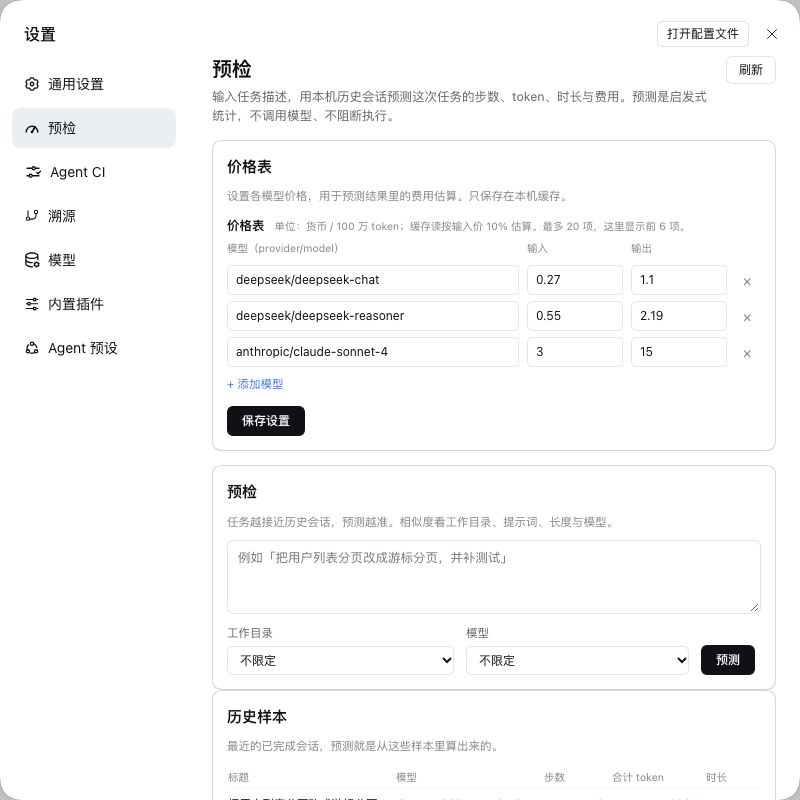
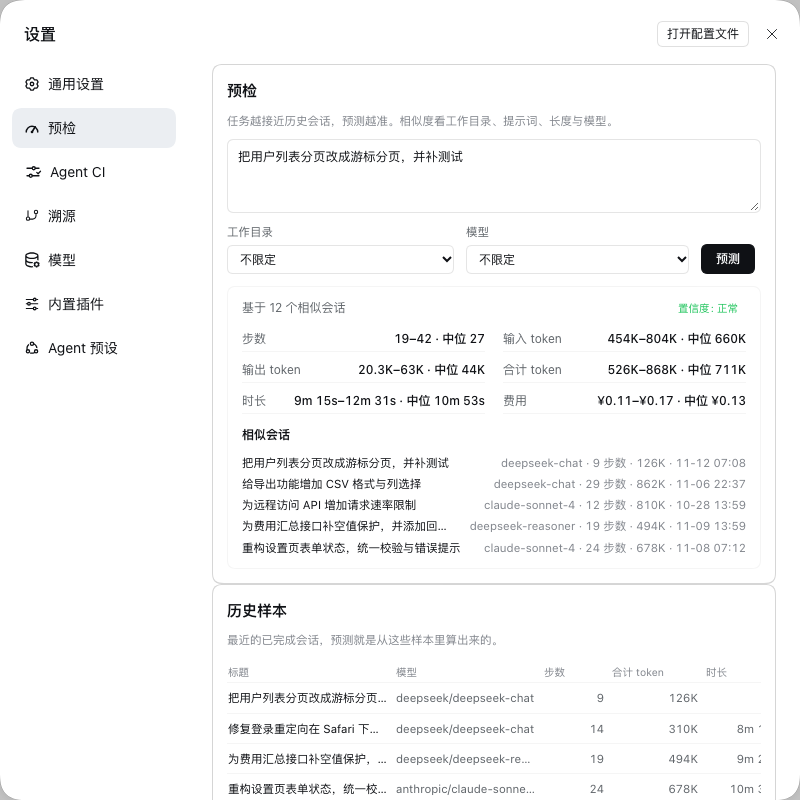
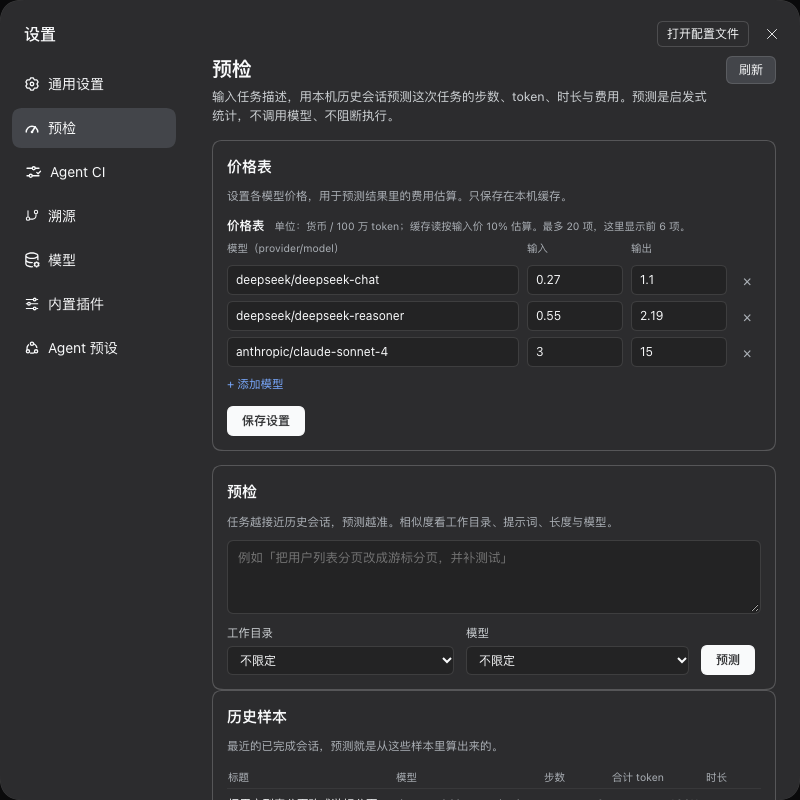
Screenshots are taken from a demo profile seeded with synthetic sessions; no user data is shown.
What you get
Settings page: Preflight
Open the Harness settings and pick Preflight (「预检」) in the left navigation. One scroll, three blocks:
- Price table — provider/model → input and output price per 1M tokens. Saving validates and writes atomically to the plugin's own cache. Prices are used only for the cost estimate in the forecast card; the plugin does not display or enforce a token budget.
- Preflight — a task description, an optional working directory and an optional model. Predict returns a card with:
- steps
P25–P75and the median, - input, output and total tokens,
- human-readable duration,
- cost when the selected sessions' models have a price; otherwise “No price configured”,
- a confidence badge (
normal/low) derived from the spread of the token forecast, - the five most similar sessions the forecast was drawn from.
- steps
- History samples — the 20 most recent finished sessions (title, model, steps, total tokens, duration, time) and how many sessions/files were used or skipped.
The page has four states: loading (skeletons while the first scan runs), error (with a Retry button), empty (no usable samples yet — explains how samples appear), and populated.
Install
Three ways:
- Market — search for
dsh-preflight(or 预检) in the plugin market and install. - From GitHub —
dsh plugin --profile <profile> add github:ruaibeite/dsh-preflight - From a local checkout —
plugin_manager: install_bundle target=/path/to/dsh-preflight
The host row is injected by the package's own cordis.patch.yml. The browser half loads with the next page load; the host half registers at startup, so if the Preflight page appears but the data does not load, restart DSH once. Uninstall with plugin_manager: remove_bundle (or from the market), then restart the app so the host half unloads.
How it works
$DSH_HOME/storages/session_projcache/sessions/*.json
        │  read-only parse: prompt · cwd · model · steps · tokens · duration
        ▼
$DSH_HOME/cache/preflight/samples.json     (path + size + mtime, incremental)
        │  similarity scoring over this machine's sessions
        ▼
GET|POST /dsh-preflight/api
        │  report · predict · settings · save-settings
        ▼
Settings → Preflight
$DSH_HOME is DSH_HOME when set, ~/.dsh otherwise.
Samples
Every projection-cache file is parsed into one compact sample: the first prompt (turnOutline.turns[0].prompt, falling back to titleInput.first.text and the title), cwd (workingDirectory, falling back to identity.cwd), provider/model (modelSelection.lastUsed), steps/turns (sessionStats), the four token buckets (tokenUsage.totals), and duration (lastPromptAt - identity.createdAt when plausible, otherwise llmMs + toolMs). Sessions without steps, without token usage or without a timestamp are skipped and counted. Corrupt files are skipped, never fatal. The scan keeps an incremental cache keyed by path + size + mtime in $DSH_HOME/cache/preflight/samples.json, and readers share a 30-second in-process cache.
Prediction
The forecast is a nearest-neighbour statistic, not a model call:
- Similarity — same cwd +3, prompt word-set Jaccard ×2 (English words and CJK 2-grams), prompt length ratio ×1, same model +0.5. The 12 highest-scoring sessions are the candidate pool.
- Fallback — fewer than three sessions score above 0.15: fall back to the 12 most recent sessions in the same cwd, then to the 30 most recent overall.
- Quantiles — P25 / P50 / P75 with linear interpolation for steps, input tokens, output tokens, total tokens and duration.
- Cost — only when a matching price row exists:
(uncached input × input price + cache read × input price × 10% + cache write × input price + output × output price) / 1M. No price, no guess. - Confidence —
lowwhen the interquartile range of total tokens is above 1.2× the median, otherwiseok.
Privacy
- Local only. The plugin reads the session projection cache on this machine. It makes no external network request and adds no prompt, tool or model call.
- Read-only on your data. It never writes a session, never appends an event, and never touches your repositories.
- Its own cache only. Settings and the incremental samples cache live under
$DSH_HOME/cache/preflight/and are written atomically (temp file + rename). - One local route. The only network surface is the same-origin
GET|POST /dsh-preflight/apiroute the settings page calls on the DSH host. Nothing is uploaded. - No credentials. The plugin never reads
.credentials.yamlor any provider credential, and it does not log prompts.
Known limitations (v0.1.1)
- This version only forecasts: it never blocks, stops or cancels an Agent, and it no longer shows a session budget strip (DSH's own composer statistics cover that).
- The forecast is a heuristic statistic over your local sessions, not a bill. A provider's bill charges cache tokens, discounts and plan differences the plugin cannot know.
- Only sessions that have a projection cache entry are counted; sessions without one contribute nothing.
- Prices are entered by hand and stored locally; cost uses cache reads at 10% of the input price and cache writes at the input price, which is an approximation.
- UI copy follows the DSH language setting; the prediction itself is language-agnostic and works for Chinese and English prompts alike.
Verify
cd dsh-preflight
npm test
Two plain-Node suites, no dependencies, no Harness process, no browser, no network, and no real $DSH_HOME (every filesystem test uses mkdtemp).
test/host.mjscovers projection-cache parsing (complete records, missing model/cwd, corrupt JSON, missing token usage), the incremental cache (reuse, rewrite, deletion), percentiles, similarity scoring and fallbacks, prediction and cost, settings validation/atomic write/read-back, all route actions and error paths (400/405/413/500), andapply()with a fake context.test/render.mjsloads the realclient.jsin a small in-repo React harness and checks the four page states, the price table form, the forecast card with and without prices, and that the bundled dictionaries matchlocale/*.jsonkey-for-key.
Layout
index.js            host half: projcache parsing, prediction, settings, route, activation
client.js           browser half: settings section, price table, forecast form
locale/zh.json      bundled copy (registered through the locale service)
locale/en.json
test/host.mjs       host tests
test/render.mjs     browser-half tests
No comments yet. Be the first to write one.