DSH HUB
HomePlugin StoreCommunityRankingsResourcesPublish Guide
Plugin source
Back to catalog

riesbri /

dsh-tui

Topic repository only

An interactive terminal surface for DeepSeek Harness: an in-process Cordis bundle over the real interaction seams, with its own renderer

★ 0 Stars0 Forks0 IssuesN/A Community rating0 Confirmed installs
View on GitHub
READMESource: main@a0193b61

dsh-tui

ci

A terminal interface for DeepSeek Harness, built as an in-process plugin rather than a client.

╭──────────────────────────────────────────────────────────────────╮
│ dsh-tui 0.1.0                                                    │
│ ~/code/my-project                                                │
│ deepseek-official / deepseek-v4-flash                            │
╰──────────────────────────────────────────────────────────────────╯

───────────────────────────────────────────────────────────────────
› Read the LICENSE file and name the license. Use the read tool.

⏺ read file_path=~/code/my-project/LICENSE
  ⎿ <path>~/code/my-project/LICENSE</path>
    <type>file</type>
    1: MIT License
    … 21 more lines

● The LICENSE file is the MIT License.

╭─ my-project ─────────────────────────────────────────────────────╮
│ › ask anything                                                   │
╰──────────────────────────────────────────────────────────────────╯
  ● ready · deepseek-v4-flash · 14k/1.0M · /model · ctrl-d quit

Prompts, questions, and the model picker share one framed overlay:

╭─ Indentation: Do you prefer tabs or spaces? ─────────────────────╮
│ ❯ Tabs                                                           │
│   Indent with tab characters.                                    │
│   Spaces                                                         │
╰──────────────────────────────────────────────────────────────────╯
  ↑↓ move · enter confirm · esc cancel

While a turn runs, the status line carries a spinner, elapsed time, and context pressure read from ctx.tokenMeter — dim until 70% of the window, then yellow, then red:

  ⠙ working 4s · deepseek-v4-flash · 13k/1.0M · ctrl-c interrupt

Requirements

  • Node ^22.19 || >=24
  • A working DeepSeek Harness installation with a model configured. If dsh web starts and answers a prompt, you are ready.

Install

1. Get a dsh command

This plugin is launched by the harness's own CLI, so you need a way to run it. Either works:

npm install -g @deepseek-ai/dsh     # a global `dsh`

Or, from a harness source checkout, use its workspace script — pnpm dsh behaves as dsh does:

cd ~/path/to/deepseek-harness
pnpm dsh --version

Everything below writes dsh. Substitute pnpm dsh (run from inside the harness checkout) if that is your setup.

2. Build this repo

git clone https://github.com/riesbri/dsh-tui
cd dsh-tui
pnpm install
pnpm build

3. Install the bundle into a profile and launch

dsh plugin --profile tui add ./packages/tui
dsh --profile tui

A DSH profile is a named stack of plugin bundles under $DSH_HOME/profiles/<name> (default ~/.dsh). dsh plugin add creates the tui profile on first use, installs this bundle into it, and appends it to the profile's bundle list — so the profile becomes @deepseek-ai/dsh-base plus this frontend.

A relative bundle path is resolved against the directory the command runs in. With pnpm dsh that directory is the harness checkout, not this one, so pass an absolute path instead:

pnpm dsh plugin --profile tui add ~/path/to/dsh-tui/packages/tui
pnpm dsh --profile tui

Confirm what was composed without launching:

dsh --profile tui --dump-config      # this bundle appears as a "# == @riesbri/dsh-tui" layer

To remove it, which strips both the dependency and the layer:

dsh plugin --profile tui remove @riesbri/dsh-tui

Installing straight from a git URL is not supported yet: dsh plugin add github:riesbri/dsh-tui would install the repository root, which is a workspace rather than the bundle. Publishing to npm is what reduces installation to one command.

Usage

dsh --profile tui Start a session in the current directory
dsh --profile tui -C ~/code/api Start in a different workspace
dsh --profile tui "run the tests" Submit a first task on open
dsh --profile tui --help Flags for this frontend

Inside a session:

enter Send
/model Switch model — the picker lists every route the mounted adapters advertise
/compact, /plan, /goal, /permission, /feedback Harness commands, dispatched through ctx.commands
ctrl-c Interrupt the running turn; with nothing running, quit
ctrl-d Quit
ctrl-l Clear the display
↑ ↓ enter esc Move, confirm, and dismiss inside an overlay

Editing: ← →, home/end, ctrl-a/ctrl-e, backspace/delete, ctrl-u/ctrl-k/ctrl-w.

Sessions are written to the harness's own session store, so a transcript survives exit and is readable by the harness's session tooling — but this frontend cannot yet reopen one. See the roadmap.

The frontend needs a real terminal on stdin and stdout. Piped or redirected, it exits non-zero with a message rather than idling with no interface; use --profile headless for scripted runs.

Why this one

Three terminal frontends for the harness exist, and they differ in where they run, which decides what each can reach. (Note that the unscoped dsh-tui on npm is a different project; this one publishes as @riesbri/dsh-tui.)

Runs as Renderer Needs a server
@riesbri/dsh-tui (this) in-process Cordis plugin own, no dependencies no
@xmoon76/dsh-pi-tui in-process Cordis plugin vendored pi-tui fork no
dsh-tui (unscoped) client over the harness's remote API Ink + React yes, a running dsh web

All three are reasonable. These are the properties this one has, so you can tell whether they are the ones you want:

It can answer ask_user_question. That seam accepts exactly one provider per context and the web host's API proxy claims it, so only a frontend running inside the process can register it. A client has to carry questions over a wire instead, and the harness's own ACP server deliberately carries no questions, tools, or plans at all.

Nothing to start, nothing to serialize. cd project && dsh --profile tui. No server, no port, no event stream, no reconnect logic, and no wire format to keep in step with the harness.

It adds no third-party packages. The renderer declares no dependencies and no peers; the bundle depends on the renderer and peer-depends on harness packages plus commander, which the harness already ships. Installing it into a profile therefore pulls in nothing new — which matters on a pre-release harness, and over SSH.

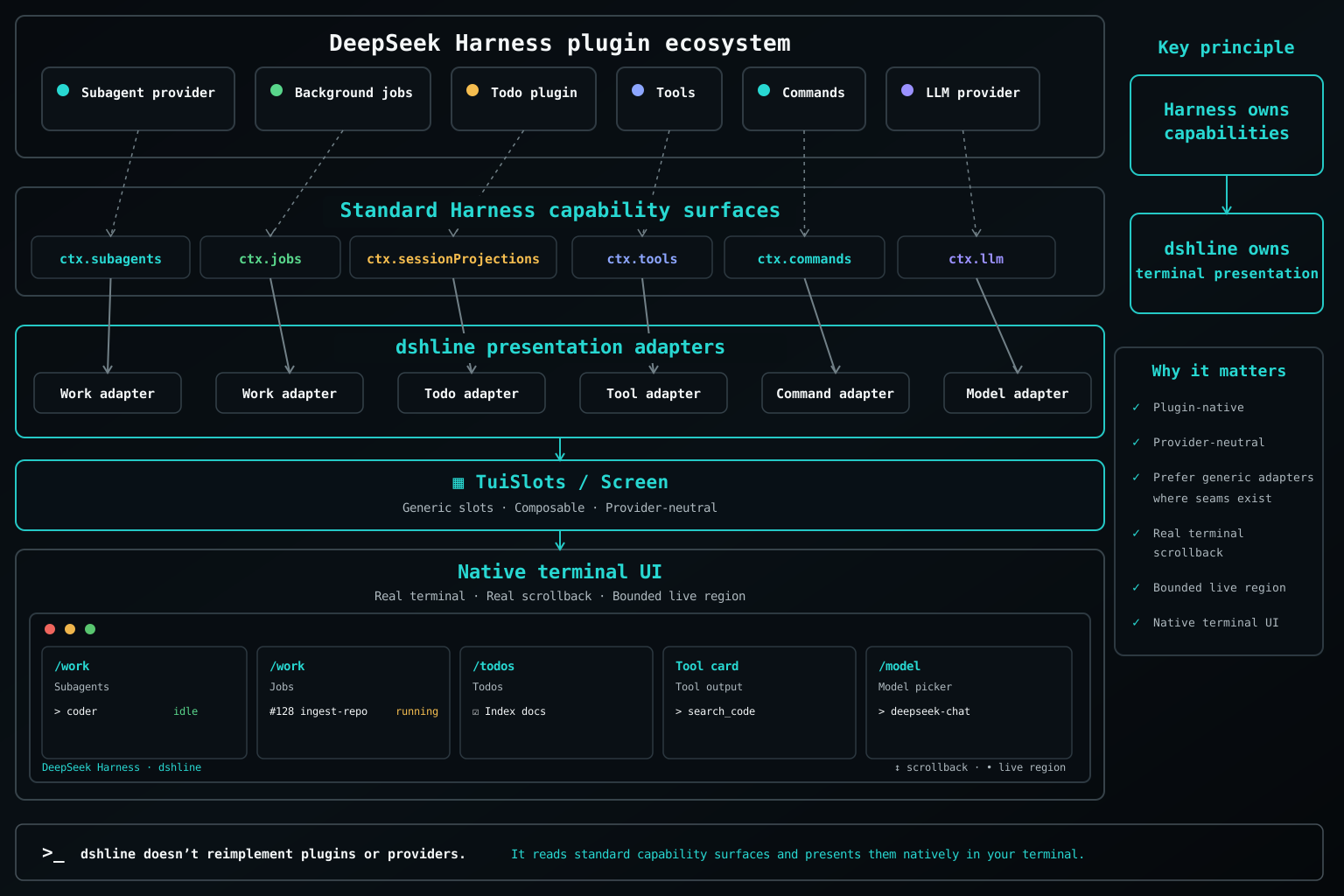
It leaves your terminal alone. It never enters the alternate screen. Finished output goes to the terminal's own scroll buffer and only a small region at the bottom is redrawn, so scrollback, mouse selection, and copy keep working as usual.

It is also the newest and least featured of the three. Read the limitations below before choosing it.

Architecture

Two packages, split so the drawing half never learns about agents:

Package Owns
@riesbri/dsh-tui-renderer Display width, key decoding, the input buffer, box drawing, and the screen. Imports nothing from the harness, so it is testable with no terminal and no model.
@riesbri/dsh-tui The bundle: the session loop, the transcript projection, the interaction seams, and the slot registry.

The screen appends and redraws one region. A chat transcript only grows, so the renderer owns no full-screen buffer. Finished output is written into the terminal's scroll buffer and never touched again; only the bottom live region — a streaming reply, a prompt, the composer — is redrawn in place. Scroll position is therefore never modelled and never reflowed on resize. The invariant that makes it correct: the live region is the last thing on screen, so every write goes through Screen.

Widths follow Unicode East Asian Width. The harness is bilingual; its shipped agent presets are named in Chinese. A CJK ideograph measured as one column corrupts every row in the buffer, not only the row holding it, so the redraw arithmetic counts rendered rows and a wrapped or CJK line is climbed correctly.

Measuring and cutting agree about escape sequences. displayWidth ignores them, so wrapToWidth and truncateToWidth do too: they tokenize into zero-width escapes and visible characters, never cut inside a sequence, and reopen styling on a continuation row. A styled line that measured wider than it drew would wrap early, taking every framed row with it.

Untrusted text is escaped before it reaches the terminal. Everything a model, a tool, or a session log produces is untrusted for terminal purposes: an escape sequence in tool output could repaint the live region, and a carriage return could reposition the cursor. Such text passes through escapeControls and is shown in caret notation. Styling is a separate function, applied only to strings this frontend composes itself.

The chrome is plugins too. The banner, composer, status line, and every overlay are independent registrations into ctx.tuiSlots — the terminal's equivalent of the web client's ctx.slots. Slots are positional (stream, composer, status), so a view chooses where it sits by naming one, and whichever view owns text entry reports where the cursor belongs.

ctx.tuiSlots.register('status', { render: () => ['my widget'] })
ctx.tuiSlots.pushOverlay(myPrompt)   // takes the whole region and every key

Roadmap

Ordered by what most changes daily use, not by what is easiest.

Next

  • Session resume — --resume and a session picker. Needs foldSurface from dsh-session to rebuild a transcript, since replaying events in order is wrong where compaction has replaced ranges, plus process handoff so a resumed session re-enters its own workspace.
  • Markdown to ANSI — headings, emphasis, lists, and fenced code in replies. The harness already depends on mdast-util-from-markdown, so this is a rendering pass over an AST rather than a parser.
  • Tool cards from render intent — consult presentCall/presentResult instead of showing a name, its arguments, and a truncated preview. Diffs and search results have shapes worth drawing.

Then

  • Composer input — @ file mentions with completion, a / menu built from ctx.commands.list(), and history on the vertical arrows.
  • Multi-line input — a deliberate newline key, so a pasted block arrives as one message.
  • Streaming without a tail limit — commit finished lines as they complete and keep only the partial line live.
  • Themes — colours already pass through a single style() call, so this is a palette seam rather than a rewrite.

Maybe

  • Reasoning display — the session log carries reasoning-delta chunks that nothing renders yet.
  • Background jobs and subagents — the harness has job_* tools and a subagent registry; a live panel for either needs layout this renderer does not do.

Limitations

  • No session resume. Every launch starts a new session.
  • No markdown rendering. Replies are plain text.
  • No themes. One palette.
  • Tool cards are generic. presentCall/presentResult render intent is not consulted. Every variant of that intent is documented to degrade to raw content, so this is the sanctioned fallback rather than a correctness gap.
  • A streaming reply shows only its last 8 lines while it streams. The live region is redrawn by climbing rows, so it has to stay shorter than the screen; the full text is committed once the assembled message lands.
  • A multi-line paste submits one message per line. The decoder reports an embedded newline as enter, and the composer sends on enter.
  • No @ mentions, autocomplete, or command menu. A typed /name dispatches, but nothing lists what exists.
  • The approval prompt is unreachable in a default composition. It claims approval/request for its own agent and delegates the rest, but @deepseek-ai/dsh-base emits no such event: the sandbox denies out-of-workspace operations outright, and the only bundled plugin that returns an ask decision is the Claude Code hooks bridge, which base does not mount. Mount @deepseek-ai/dsh-hooks-claude-code, or your own tools/pre-execute policy, to reach it.

Development

pnpm install
pnpm build       # tsc for the renderer; the bundle is transpiled
pnpm test        # 93 tests, no terminal and no model required
pnpm typecheck   # needs a harness checkout — see below

Build and test need nothing but this repository. pnpm typecheck is the exception: it resolves the harness's real service types, and those cannot come from the registry, because a published harness package depends on one that is not published. Its devDependencies therefore point at a sibling checkout:

parent/
├── deepseek-harness/
└── dsh-tui/

Clone the harness beside this repo and build it once (pnpm install && pnpm run build there), and pnpm typecheck works. Without it, install and build are unaffected and only typecheck fails, reporting unresolved harness modules.

For any other layout, point the links at your checkout rather than editing the manifest by hand:

node tools/link-harness.mjs ~/src/deepseek-harness
node tools/link-harness.mjs --check     # are the links resolvable?

It writes a relative path when the checkout is reachable from this repo, so the manifest stays portable and carries no home directory.

This is also why the bundle is transpiled rather than compiled: pnpm build must work for anyone who wants to install the plugin, so it uses TypeScript's transpiler by way of tools/build-bundle.mjs, which erases types per file and resolves nothing. Typechecking is a separate, contributor-only step.

CI runs the build and the full suite on Node 22 and 24. The typecheck against the harness job clones and builds the harness to run tsc -b; because that takes minutes and can fail for reasons outside this repository, it runs on workflow_dispatch rather than gating every push.

Rendered layout is verified against a real terminal. packages/renderer/tests/rendered.spec.ts feeds the renderer's output to @xterm/headless and asserts the rows a person actually sees — borders landing in one column for ASCII and CJK, a live region leaving no tail behind when it shrinks, styling surviving a wrapped row, and an escape sequence in tool output being shown rather than obeyed. Stripping escape sequences out of the byte stream cannot reconstruct a frame, because the redraw uses cursor positioning, which is why an emulator is the reference.

These tests are hermetic — no pseudo-terminal, no harness, no model — so pnpm test runs them and CI covers layout without a separate job. Reading emulator output takes one piece of care: a wide character occupies two cells and translateToString skips the second, so rows are measured in columns rather than by string length.

License

MIT

Not affiliated with or endorsed by DeepSeek.

DSH HUB

A community index for DSH plugins. Not an official GitHub or DeepSeek AI product.

CommunityResourcesAPIAbout
—/ 5

No ratings yet

Manifest verification required

Commit a0193b613b14

Community comments

No comments yet. Be the first to write one.