dsh-sidebar-session-provider-icon
English · 简体中文
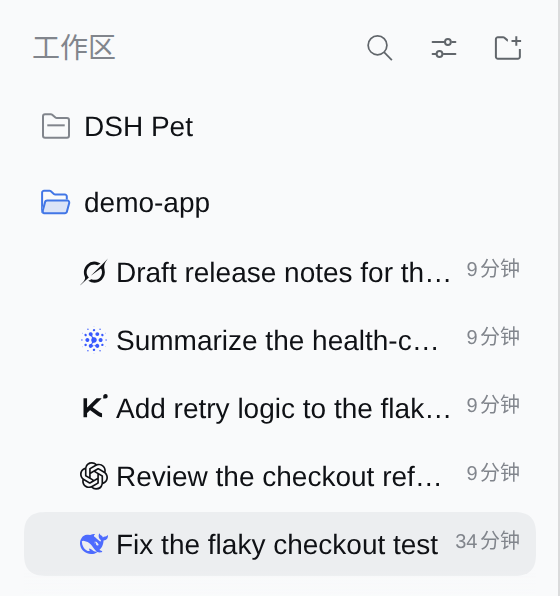
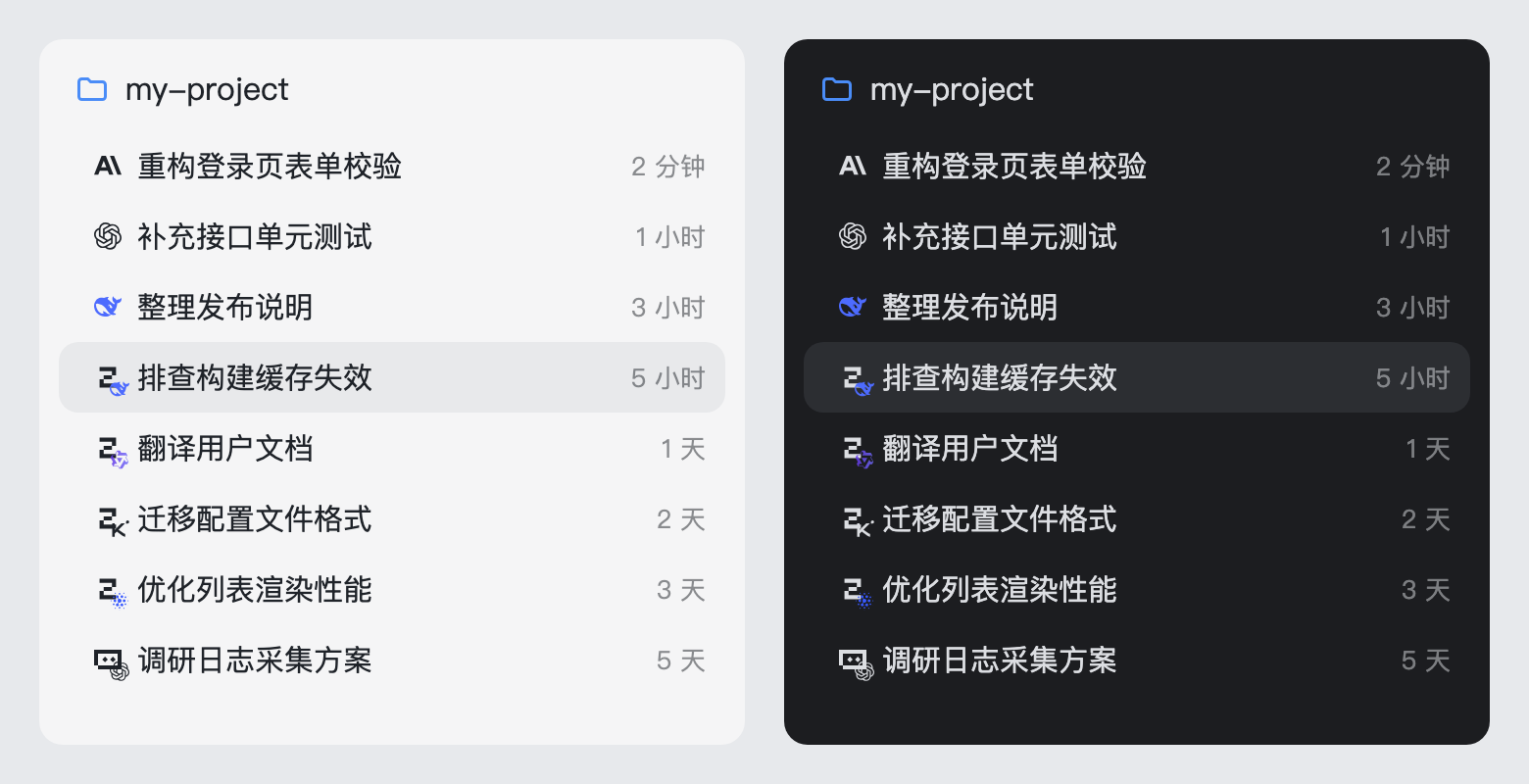
In the DeepSeek Harness (DSH) session list every row looks alike, so you cannot tell which model a conversation uses without opening it. This plugin puts the brand logo of the model currently selected in the input box in front of each session title, and updates it the moment you switch models. When the provider and the model come from different vendors (for example opencode-go/deepseek-v4-flash), the provider logo carries a small model logo in its bottom-right corner.
Install. DeepSeek Harness 0.2.0-rc.2, Node.js >=22.19.
# from npm — prebuilt, no build approval
dsh plugin --profile web add dsh-sidebar-session-provider-icon

# or straight from source — builds locally, approve the build when dsh asks
dsh plugin --profile web add prgrmrwy/dsh-sidebar-session-provider-icon
Restart DSH and refresh the Web page. Nothing else is needed: no configuration, no network access, and no files written outside the DSH profile that installs it.
In the ohmydsh repository this plugin is wired through the dsh.yaml entry sidebar-session-provider-icon (source: local), so a source change there only needs dsh build and a restart. Current behavior is specified in openspec/specs/sidebar-session-provider-icon; design history lives in the archived changes sidebar-session-provider-icon and sidebar-provider-icon-composite-model-badge.
How it behaves
The logo shown for a session comes from two sources, in this order:
- Live selection (preferred). The official
dsh-client-ui-model-selectionstore, read asctx.modelDirectories.directoryFor(sessionId).store.current. It is the single per-session state shared by the input-box selector and the/modelcommand, and it publishes{ provider, model }as soon assession.selectModelsucceeds. The open session, including a blank one that has not sent a message yet, therefore follows the input-box selection. - Last request (cold-history fallback). A Host
providersession projection folds therequest/headerevents of the session log, so a history session whose selector has not been loaded in this browser still shows the provider of its most recent real request. It survives restarts and uses nolocalStorage.
Brand resolution has two independent dimensions: the provider route picks the main logo, the model id picks the corner logo.
| Selection | Shown |
|---|---|
claude/claude-opus-5, codex/gpt-6-luna, deepseek-official/deepseek-v4-pro (same vendor) |
a single Anthropic / OpenAI / DeepSeek logo |
opencode-go/deepseek-v4-flash, opencode-go/qwen3.8-flash, opencode-go/kimi-k2.7-code |
OpenCode, with DeepSeek / Qwen / Kimi in the corner |
traex/GPT-5.6-Sol[1m], traex/DeepSeek-V4-Flash, traex/Gemini-3.1-Pro-Preview |
Trae, with OpenAI / DeepSeek / Gemini in the corner |
traex/openrouter-3o[1m], traex/Seed-2.1-Pro-0915 |
Trae, with OpenRouter / ByteDance in the corner |
known route + unrecognized model (e.g. opencode-go/omen-alpha) |
the route logo only, no corner logo |
| unknown or generic route | a single logo from the model name; if that also fails, a neutral single-letter badge |
- Route first.
opencode-go/deepseek-v4-flashshows OpenCode as the main logo; DeepSeek can only appear in the corner. - No impersonation. A model whose vendor cannot be identified gets no corner logo, and never a letter badge in the corner.
- Size. The composite keeps the 14×14 footprint of a single logo, so the row layout does not move. The corner logo is the bare 10px glyph, overhanging the bottom-right by 4px, with no plate, ring or padding: at this scale any decoration eats the pixels the glyph needs.
- Tooltip. Hovering always shows the exact
provider · model.
| Layer | Implementation |
|---|---|
| Host | src/provider.ts registers the provider projection (it requires the sessionProjections service) and folds request/header; it only serves the cold-history fallback |
| Client data | Subscribes to the per-session stores of ctx.modelDirectories; the selector choice wins over the projection fallback |
| Client DOM | row-locator.ts holds all knowledge of the official row DOM; a MutationObserver maintains a separate badge <span> in front of the title |
| Brand art | src/client/assets/*.svg, downloaded once and bundled; logos.ts resolves the provider brand and the model brand separately and renders the composite when they differ |
The badge content is derived only from (provider, model); index.ts rebuilds a badge only when those values or the tooltip change.
Configuration
None. The plugin row carries no config fields and the package reads no environment variables.
Recognized brands:
| Dimension | Brands |
|---|---|
| provider and model | DeepSeek, OpenAI/GPT/Codex, Anthropic/Claude, Grok/xAI, Kimi/Moonshot, GLM (Zhipu), MiniMax, Pi, OpenClaw, Hermes Agent (the misspelling hermas is also accepted), OpenCode, Qwen, Tencent Hunyuan (hy3, hy4-*), Meituan LongCat, Xiaomi MiMo, Gemini/Gemma, NVIDIA (Nemotron), Meta (Muse Spark, Llama), Ant Group (Ling/Ring), OpenRouter, ByteDance Seed |
| provider only | Trae (trae, trae-ai, traex*; exact name or prefix, never a substring) |
The model dimension covers every identifiable model family in the OpenCode Go / Zen catalogs, plus the GPT, DeepSeek, Gemini, OpenRouter and ByteDance Seed families in the current TraeX catalog.
Brand art is pinned and vendored, never hand-drawn and never fetched from a CDN at runtime:
- every brand except OpenCode:
@lobehub/icons-static-svg@1.94.0, MIT; the color variant is used where one exists; - OpenCode: the official provider SVG from
anomalyco/opencodeat commit5e75e5e9901f0d178f425bfb47f1bd46cbe78a59, MIT.
Per-file source URLs and SHA-256 checksums are listed in src/client/assets/README.md. Some color SVGs carry gradient/clip ids; the corner instance suffixes them with -sub so copies on the same page never resolve each other's definitions.
To add a brand: put the SVG in src/client/assets/, record source, pin, license and SHA-256 in the assets README, then add rules and tests to providerBrandOf / modelBrandOf in logos.ts.
Boundaries & safety
- The official
StateDotis never replaced, moved or hidden; times, row menus and drag behavior stay official. - The badge is a standalone
<span>in front of the title. If the row DOM cannot be located reliably, the plugin silently shows nothing and leaves the page intact. - No network requests of its own: the logos ship with the bundle and the data comes from DSH's own stores and session log.
- Code is MIT-licensed (LICENSE). The brand icons are vendored from MIT-licensed upstreams; their copyright notices, the exact rendering changes, and the trademark position are in THIRD-PARTY-NOTICES.md. Brand owners retain their trademark rights; the marks only identify the selected provider route and model and imply no endorsement.
Development
lib/ is a gitignored build artifact. In a standalone checkout:
npm install
npm run typecheck
npm test
npm run build
In the ohmydsh monorepo this package is a workspace member: install once at the repository root and add --workspace dsh-sidebar-session-provider-icon to the last three commands. dsh build / sync also builds lib/ on demand before installing the local package; refresh the Web page to pick up a new client bundle.
Under vitest, small SVGs are inlined as data URLs with attribute quotes rewritten to '. Any regex that rewrites SVG attributes must accept both " and '.
No comments yet. Be the first to write one.