dsh-turn-trace
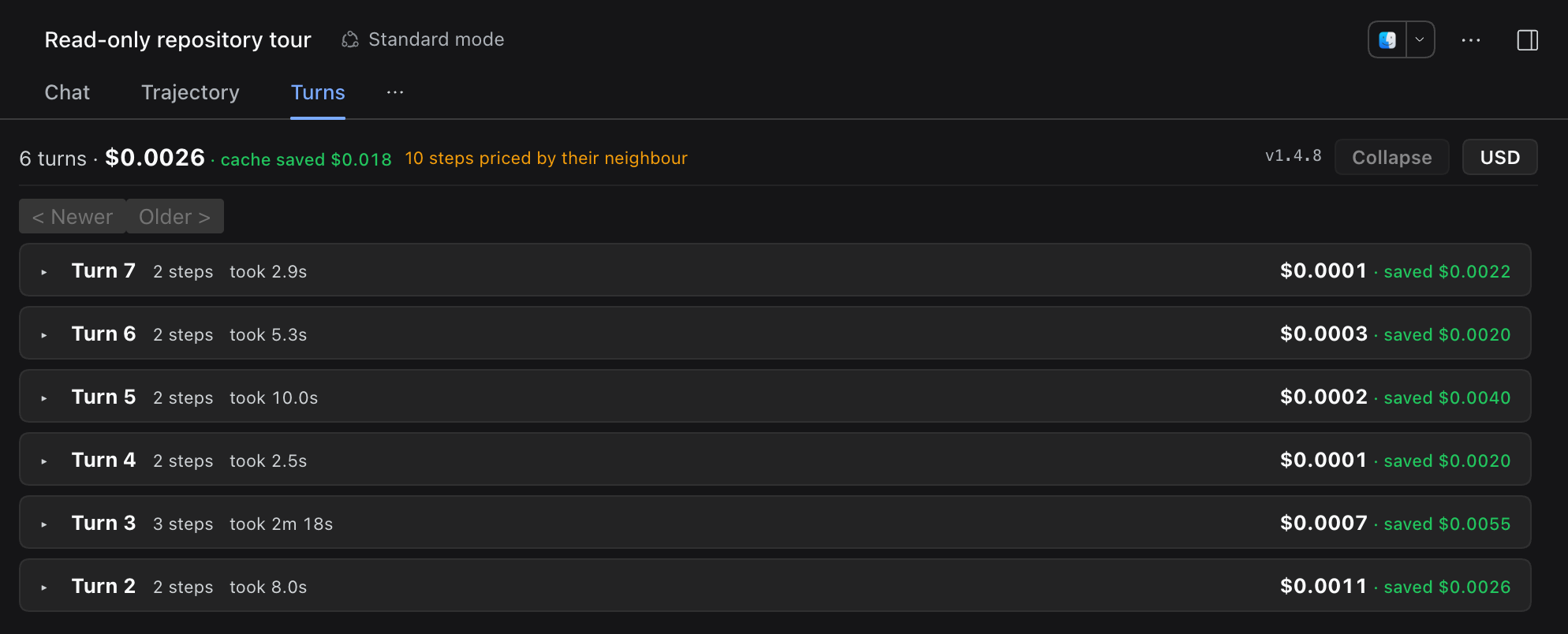
A receipt for every turn. A Turns tab inside DeepSeek Harness: expand a turn to see what it cost, expand a step to see what that cost.



What it does
- Turns are a list, collapsed. Each row is money and step count.
- Expand a turn: every step shows
Step i/n, its tokens, and its money. - Inside a step: the calls it made —
llm · model · 6.4s,bash · ok · 41s.
Tools do not consume tokens. A step's tokens always belong to its model call, which is why the money sits on the step, not on the tool.
Why not just use Trajectory?
Trajectory answers when: the event ledger and timing. Turns answers how much: each step's tokens and money, plus the calls that step made. It is additive — Chat and Trajectory stay exactly where they are.
Playback, wall-clock Gantts, and cross-session dashboards are deliberately out of scope; those already have better homes.
Install
Requires the DeepSeek Harness desktop app (Homebrew cask deepseek-harness) or any dsh profile that serves the Web UI.
# from npm
dsh plugin --profile desktop add dsh-turn-trace

# from a local checkout
git clone https://github.com/nrenvo/dsh-turn-trace
cd dsh-turn-trace
pnpm install && pnpm build
dsh plugin --profile desktop add link:$PWD
Restart the app, open a session, and click Turns next to Chat and Trajectory.
What you see
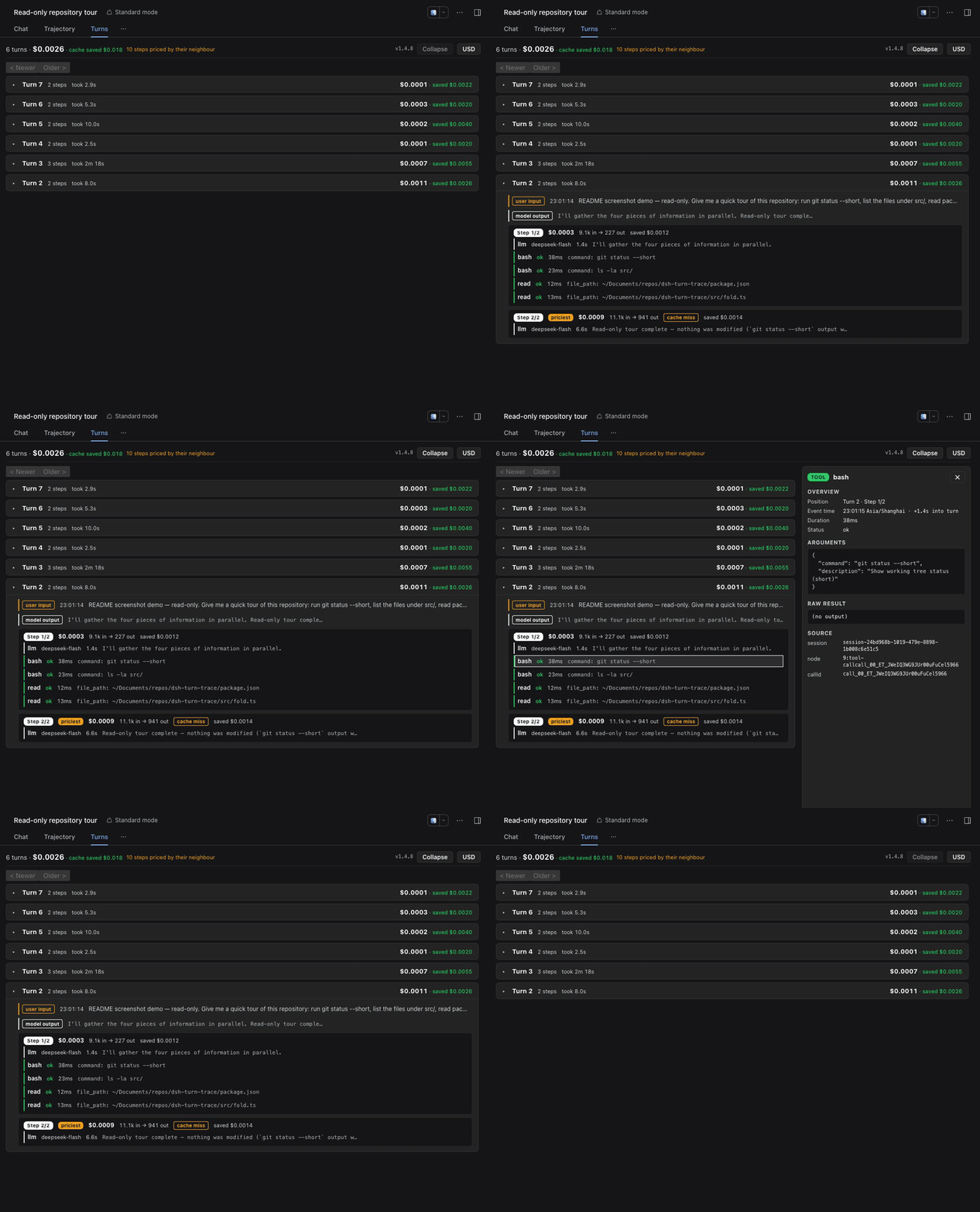
A 7-second tour: expand a turn, click a call, and open the inspector.
| Level | What it shows |
|---|---|
| Header | turn count, session total, cache savings, USD/CNY switch |
| Pager | ten turns per page, newest first; Older pulls the next history window |
| Turn | step count, wall-clock duration, money, money saved by cache |
| Step | Step i/n, money, tokens in/out, cache savings, priciest badge, cache-miss flag |
| Call | llm: model + duration · tool: status, error, duration, argument head · user: prompt |
| Inspector | click any row: overview, arguments, raw result, source |
The tab follows the DSH language setting (English / 中文); it does not guess from the browser.
How it works
The view is client-only. It reads the chat snapshot the shell already holds
(useChat → order + nodes) and folds it into turns → steps → money. No host
plugin, no package-private RPC, no polling: the snapshot updates as the session
runs, so the view re-folds on every change.
Pricing
Each call is priced from DeepSeek's published per-1M-token rates, using that call's own timestamp to pick peak or off-peak (peak: 01:00–04:00 and 06:00–10:00 UTC, weekdays). Rates live in src/pricing.ts so they can be updated in one place. These are estimates, not billed amounts.
Accuracy and limits
- A step is priced from its own recorded model id (
finalNode.requestConfig.model, thenproviderMetadata.model). A step that carries no id inherits the nearest recorded model and is counted in the header; if the session recorded no model at all, the step stays unpriced instead of being guessed. - Chinese public holidays are not modelled, so holiday sessions read slightly high.
- Only the loaded window is folded; Older pages older history in through the slot's
loadOlder.
Development
pnpm install
pnpm test            # fold + pricing assertions, no runtime needed
pnpm test:activation # boot-safety: apply() must never throw (needs a build)
pnpm typecheck       # tsc --noEmit
pnpm build           # tsdown, then wraps lib/client.js in __ModuleLoader__.load(...)
The client bundle registers through window.__ModuleLoader__.load({ id, factory });
scripts/wrap-client.mjs adds that envelope after the CJS build, so the browser
half uses the runtime's require('react') instead of bundling its own copy.
lib/ is committed so github: installs work. After changing source, run
pnpm build and commit lib/ with the change.
No comments yet. Be the first to write one.