dsh-plugin-balance-ui
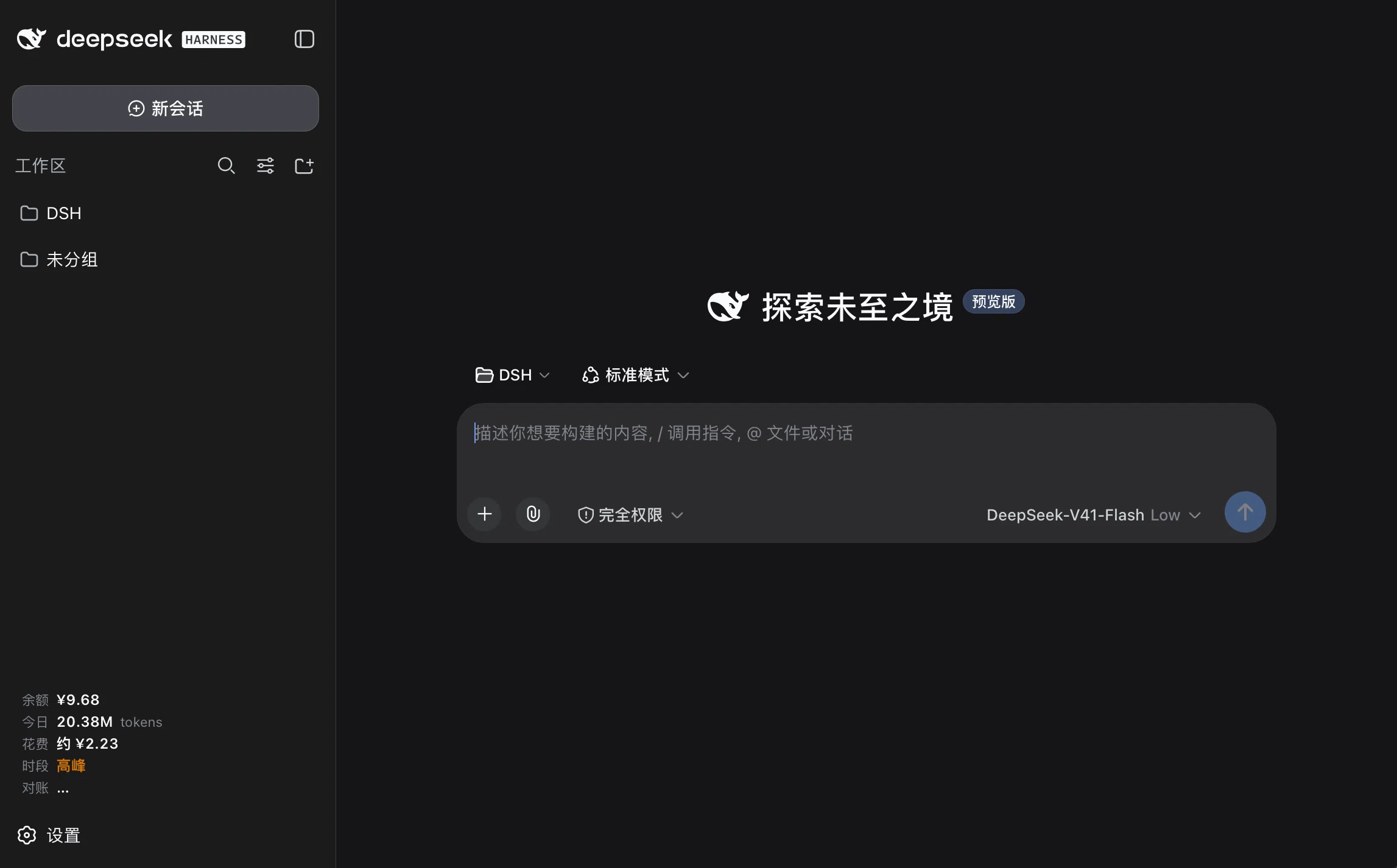
Account and usage panel for the DeepSeek Harness (dsh) Web client. It adds a block to the sidebar footer showing your DeepSeek account balance, today's token usage, an estimate of today's spend, and whether the current Beijing-time billing tier is peak or off-peak.
What it shows
With the sidebar expanded:
| Row | Meaning |
|---|---|
| 余额 | Account balance from GET /user/balance, in the account's own currency |
| 今日 | Today's total tokens (input + output + cache hits), compacted |
| 花费 | Estimated spend for today, in CNY |
| 时段 | 高峰 or 空闲 for the billing tier in force right now |
| 对账 | The gap between the local estimate and what the account balance actually lost, over the fully sampled days (up to 7) |
While the sidebar is collapsed, the same four values are stacked as compact text inside the rail.
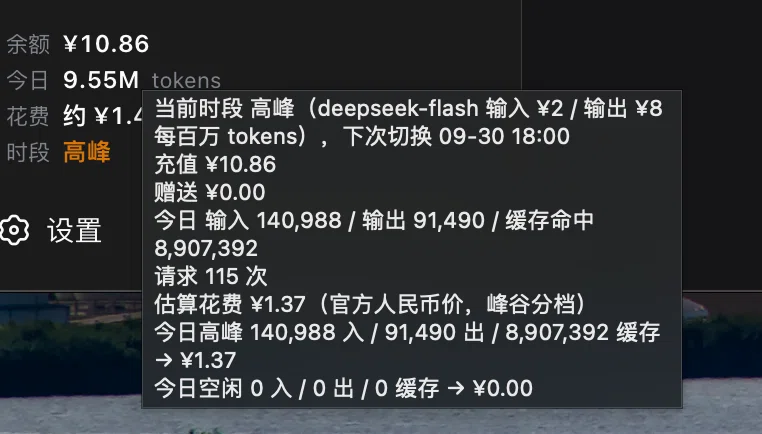
Hovering the block shows a tooltip with the exact figures: topped-up and granted balance, input / output / cache-hit token counts, request count, the per-tier subtotals behind the spend estimate, the current per-million-token rates, and the Beijing-time stamp of the next tier switch.
How the numbers are produced
Everything is derived on your machine from data dsh already has. The plugin does not call any service other than DeepSeek's own balance endpoint.
- Balance — the host half calls
https://api.deepseek.com/user/balancewith the credential resolved through dsh's credential seam, cached for 30 seconds. - Usage — the host half walks the session logs under
$DSH_HOME/sessions(default~/.dsh/sessions), decompresses the.jsonl.zstdfiles, and folds everyassistant/messagerecord whose timestamp falls after local midnight. The result is cached for 10 seconds. Files are only read; nothing is written back. - Spend — the browser half prices each model row against DeepSeek's published CNY list prices, using the peak bucket and the off-peak bucket separately.
reasoningTokens is reported by the host but never billed separately, because it is already a subset of outputTokens. Cache-write tokens are priced at zero: DeepSeek's published table lists cache-hit input, cache-miss input, and output only.
Peak and off-peak
DeepSeek bills two tiers, with off-peak at half the peak rate. Peak is Beijing time (UTC+8) 09:00–12:00 and 14:00–18:00, Monday to Friday, excluding Chinese public holidays; every other hour, including all weekends and holidays, is off-peak.
The host tags each assistant message with the window it landed in, so each tier is priced at its own rate rather than a blended average. The tier badge is driven by its own timer scheduled on the next Beijing boundary, so it flips at 09:00 / 12:00 / 14:00 / 18:00 / midnight rather than up to one poll interval late.
Rates
Quoted from https://api-docs.deepseek.com/zh-cn/quick_start/pricing, CNY per million tokens:
| Model | Tier | Input | Output | Cache hit |
|---|---|---|---|---|
deepseek-flash |
peak | ¥2 | ¥8 | ¥0.04 |
deepseek-flash |
off-peak | ¥1 | ¥4 | ¥0.02 |
deepseek-v4-pro |
peak | ¥9 | ¥27 | ¥0.3 |
deepseek-v4-pro |
off-peak | ¥4.5 | ¥13.5 | ¥0.15 |
Retired ids deepseek-v4-flash and deepseek-v4-flash-vision-exp are aliased to deepseek-flash, since the service still accepts them and bills them at the Flash price. A model with no entry in the rate table is reported as unpriced, and the spend row renders — instead of guessing.
The 2026 Chinese public holidays are listed explicitly, from 国务院办公厅关于2026年部分节假日安排的通知 (国办发明电〔2025〕7号). Statutory make-up workdays (调休上班的周六周日) need no entry, because weekends are off-peak regardless. The holiday list needs refreshing once a year — the notice for the following year is published each November. A year not in the list is treated as having no holidays, which over-estimates spend mildly during weekday peak hours rather than failing.
The spend figure is an estimate, not a bill. It is computed from locally recorded token counts and published list prices. It does not know about discounts, grants, or any pricing change DeepSeek makes after this release.
Reconciliation: why the estimate and the bill disagree
An estimate that silently drifts from the real bill is worse than no estimate, and nothing on this machine can see the difference on its own: session logs record what dsh used, while only the account knows what it was charged.
So the host half samples the account balance on a timer — every 15 minutes whether or not a UI is open, plus whenever the footer polls — and keeps a small local history. Spending is recovered as the sum of the balance decreases between samples. Increases are never counted as spending; they are classified as a top-up (a rise in topped_up_balance) or a grant (a rise in granted_balance).
The footer's 对账 row then shows the gap between the two, and the tooltip breaks it down per day and names every cause it can actually observe:
Only days the sampler covered from their midnight are compared, so the window grows from one full day toward seven as sampling accumulates. A partially sampled day is excluded rather than counted against an estimate that covers the whole day — otherwise every install would report a large fake drift on its first day. The panel states the window it used. On a fresh install the row reads 样本不足 until the first full day is available.
- Usage this machine never saw. The real charge is higher than the log estimate — calls from another client, a direct API integration, or session logs that were pruned.
- Discounts or grants absorbing the cost. The real charge is lower than the estimate.
- Credit movements. Top-ups and grant credits inside the window are reported so they are not mistaken for spending.
- Sampling gaps. A decrease is attributed to the local day of the later sample, and if a top-up and some spending fall inside one gap they can cancel out and hide the spending. When the largest gap is wide enough for that to matter, the panel says so.
- Holiday attribution. Days inside the window that are Chinese public holidays are listed, because they are priced off-peak.
- Unpriced models. Tokens from a model with no rate-table entry are reported rather than quietly costed at zero.
Two blind spots are stated rather than papered over. Local session records carry no cache-write field at all, so if DeepSeek charges for cache writes, that cost is invisible to this estimate and the panel says so unconditionally. And reconciliation is only attempted for a CNY account: the rate table is in CNY, so a differently-denominated account is left uncompared instead of compared wrongly.
Install
From the plugin market (dsh-market), search for balance-ui.
Or from the command line:
dsh plugin --profile web add dsh-plugin-balance-ui
Then restart the dsh service so the new profile layer is composed.
Requirements
- A dsh profile backed by the Web app.
- A DeepSeek API key available to dsh's credential seam as
DEEPSEEK_API_KEY. Without it the usage rows still work; only the balance row shows an error. - Node.js ≥ 22.15.0 (the host half uses
zlib.zstdDecompressSync).
Routes
The host half registers four same-origin, read-only JSON routes:
| Route | Payload |
|---|---|
GET /dsh-balance |
{ ok, available, infos: [{ currency, total, granted, toppedUp }] } |
GET /dsh-usage |
Today's token totals, peak/off-peak buckets, and per-model rows |
GET /dsh-usage-history?days=7 |
The same shape, bucketed per local day, for 1–30 days |
GET /dsh-spend-ledger?days=7 |
Sampled account movement per day, plus top-ups, grants and sampling gaps |
All four reject non-GET/HEAD methods and cross-origin requests, and send cache-control: no-store.
Privacy
The API key is resolved inside the dsh process and used only for the upstream balance request. It is never written to a response, a log line, or an error message. Session logs are read, never written.
The one thing this plugin does write is its own balance-sample store, at $DSH_HOME/dsh-plugin-balance-ui/balance-samples.json (by default ~/.dsh/dsh-plugin-balance-ui/balance-samples.json). It holds nothing but timestamps and the four balance figures the upstream API already returned — no key, no prompt, no token counts — and it is pruned to the last 120 days. Deleting the file is safe: the plugin starts sampling again and reconciliation returns to 样本不足.
There is no telemetry and no third-party service.
Tests
npm test
Runs the node:test suite with no dependencies: the peak/off-peak calendar, the balance-ledger maths (spend, top-ups, grants, coverage, sampling gaps), the per-day fold against synthetic session logs, the reconciliation maths (including the non-CNY guard), and the routes end-to-end against a fake cordis context and a stubbed upstream.
License
MIT — see LICENSE.
No comments yet. Be the first to write one.