dsh-flutter-tools
A Flutter panel for the DeepSeek Harness sidebar: run, inspect and profile a Flutter app without leaving the conversation.
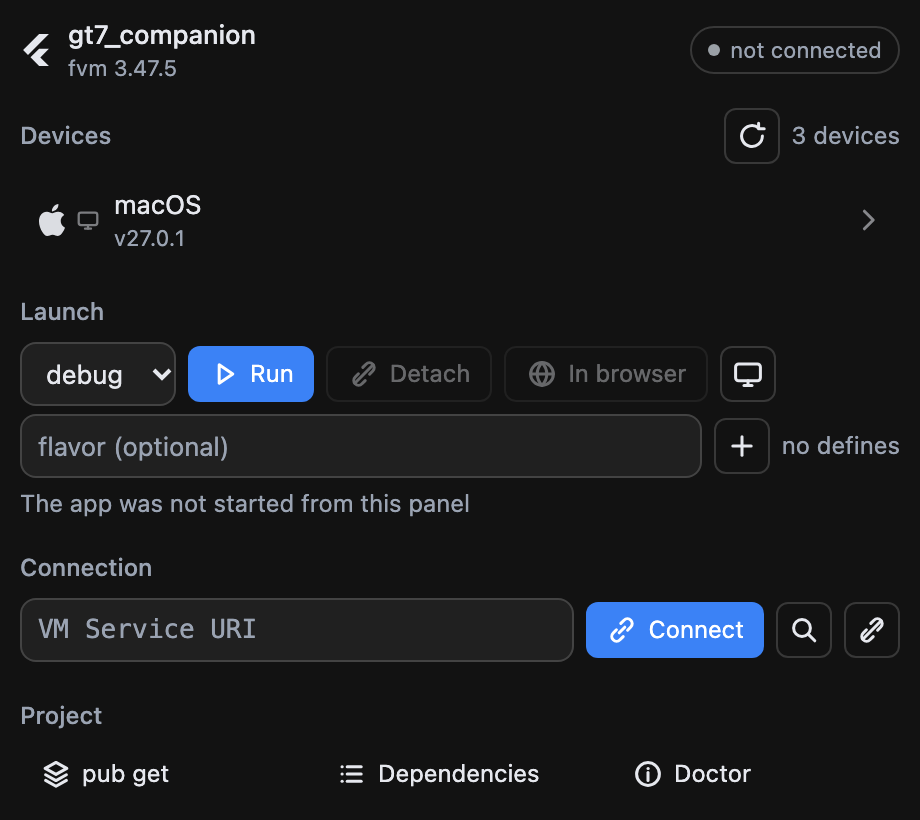
Devices come from a long-lived flutter daemon, launching is flutter run --machine with the VM
Service URI picked up automatically, and everything else goes through the running app's own VM
Service and flutter-devtools-mcp.
Features
- Devices — a long-lived
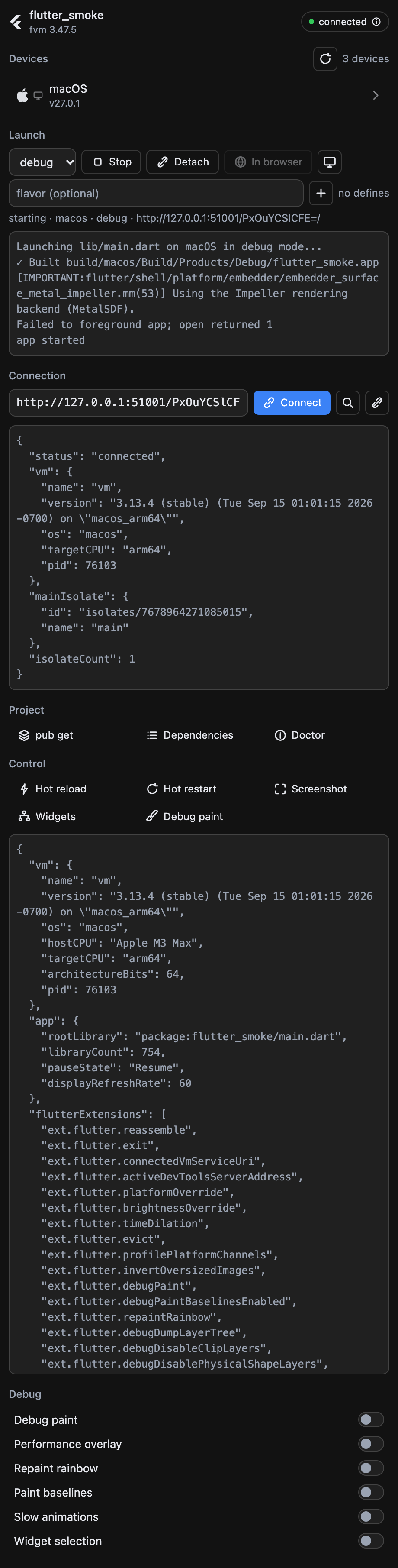
flutter daemon(events, not polling): a phone plugged in appears by itself. The section shows one selected device with its OS logo (Apple, Android, Windows, Linux, or a browser for web targets) plus a small kind icon; clicking opens the list to switch, and the choice is remembered per project. Emulators come from the same daemon. - Launch — device, mode (debug / profile / release), flavor and
--dart-definepairs, then one button that runs or stops depending on the state. The panel readsapp.debugPortand connects itself; app logs land in the panel. - Flavor and defines — flavors are suggested from the project (Android
productFlavors, non-default Xcode schemes); defines are a key/value editor. Both are remembered per project and validated before they reach the command line. - Control — hot reload, hot restart, screenshot (inline), widget tree, debug paint.
- Debug toggles — the service extensions the app actually registered:
debugPaint,showPerformanceOverlay,repaintRainbow,debugPaintBaselinesEnabled,timeDilation,inspector.show. - DevTools inside the panel — the daemon hosts the DevTools server and the panel embeds it (inspector, performance, cpu-profiler, memory, network, logging), with a button to move the same page into a sidebar browser tab.
- App facts and memory — VM version, platform, pid and isolates as a key/value block; live heap readout, a GC button, saved memory snapshots and a compare of the last two.
- Captures and profiling — rebuild tracking and HTTP capture as single switches, profiling
session,
collect_performance_sessionwith the workspace root filled in. - Project commands —
pub get,pub outdated,flutter doctorwith rendered output:pub outdatedbecomes a table with the upgradable rows highlighted,flutter doctora checklist. - Detach and web — leave the app running while the panel stops tracking it, or open a web build in a sidebar browser tab.
- SDK — the workspace's own pin (
.fvm/flutter_sdk, then.fvmrc) wins over whatever is onPATH.
Install
DeepSeek Harness → Settings → Add plugin, then paste this repository's address. That field takes
a plugin package name, a GitHub repository address or a local directory. The CLI takes the same spec
(dsh plugin add …); note that a profile the desktop app manages refuses CLI changes, so the plugin
manager is the usual route.
Requirements:
- a Flutter SDK (the workspace pin is preferred,
PATHis the fallback); npxonPATH—flutter-devtools-mcpis fetched on first use;dsh-better-sidebarfor the sidebar tab;- a Flutter app running in
debug(rebuild tracking) orprofile(metrics).
How it is put together
| File | Half | Role |
|---|---|---|
index.js |
host (Cordis) | registers the /flutter routes, owns the flutter daemon, the flutter run child and the flutter-devtools-mcp child, serves panel.html |
panel.html |
served page | the whole UI, plain HTML/CSS/JS — no build step |
client.js |
client bundle | registers the sidebar tab whose body is an iframe onto /flutter |
icon.svg |
manifest asset | the icon the plugin manager shows, declared as icon in package.json |
cordis.patch.yml |
bundle patch | the mount row; its name must equal the package name so the client bundle is served at /plugins/dsh-flutter-tools/client.js |
dev-server.mjs |
development | runs the same routes outside DSH for UI iteration |
docs/ |
development | the screenshots above |
Endpoints
All under /flutter, loopback Host only.
| Route | Purpose |
|---|---|
GET /flutter |
the panel page (?cwd=&sessionId=) |
GET /flutter/config |
workspace cwd, fvm pin, resolved Flutter, toggle labels |
GET /flutter/devices |
live device list (daemon) |
GET /flutter/emulators |
emulators from the daemon |
GET /flutter/flavors |
flavors found in the project (Android blocks + Xcode schemes) |
GET /flutter/run |
launch state: running, appId, mode, flavor, defines, VM Service URI, log tail |
POST /flutter/run |
launch on a device: { deviceId, mode, flavor, defines } |
POST /flutter/run/stop |
stop the launched app |
POST /flutter/run/detach |
leave the app running, stop tracking it |
POST /flutter/emulator/launch |
boot an emulator: { emulatorId } |
GET /flutter/devtools |
DevTools page URL: ?page=…&uri= |
GET /flutter/extensions |
registered debug extensions plus their current state |
POST /flutter/extension |
toggle one extension: { name, value } (allowlist only) |
GET /flutter/heap |
heap usage of the main isolate (?uri=) |
POST /flutter/gc |
collect garbage, then report heap usage |
POST /flutter/command |
one-shot CLI: pub_get | pub_outdated | doctor |
POST /flutter/call |
flutter-devtools-mcp tool call: { tool, arguments } (allowlist only) |
Notes from building it
Things that cost time, recorded so nobody pays twice.
flutter daemon --machineis not a valid flag: it exits 2 with no output. The daemon speaks the same protocol without it.flutter emulators --machinedoes not exist either.--show-web-server-deviceis deliberately not passed: measured, it changes exactly one thing — the syntheticweb-serverdevice appears in the list — and nothing here depends on it.flutter run,flutter daemonandnpxare wrappers: the real process is a grandchild (dartvm), so a plainchild.kill()leaves it running. Children are spawned detached and killed by process group — except afterapp.detach, where a group kill would take the detached app down with it, so the tool is killed by pid instead.- Measured: the tool does not exit by itself after
app.detach(still alive 20 s later), while the app it launched survives on its own. - The VM Service needs an
isolateIdforgetMemoryUsage, and has nocollectAllGarbageRPC — that is whatgetAllocationProfile(gc: true)is for. ext.flutter.brightnessOverrideis not offered as a toggle: it reports the platform's effective brightness, so "off" still reads as dark on a dark system and the switch would lie.--dart-defineis compile-time: a changed define takes effect on the next launch, not on a hot restart.- Command output is clipped head-first:
pub outdatedkeeps its column header at the top, and a tail clip left the panel with rows it could not parse. - The plugin icon is a data URL built by the harness from a top-level
iconinpackage.json; there is no HTTP route for it, and the path must stay inside the manifest directory.
License
MIT — see LICENSE.
Development
node dev-server.mjs 9100 /path/to/flutter/project # the panel, outside DSH
Screenshots in docs/ were taken from that dev server with Chrome in dark mode at device scale 2.
Attribution
The tab icon and the plugin icon are Flutter's mark, taken from simple-icons (CC0). Flutter is a trademark of Google; the mark is used here only to label Flutter tooling.
No comments yet. Be the first to write one.