简体中文 · English

Retro Music Toolkit
An 8-bit / 16-bit game music workstation built for AI agents
Fully local, no API. The same score always renders the same audio.






🎧 Listen online · Quick start · vs. music models · Technical details
git clone https://github.com/narrastory/retro-music-toolkit.git
cd retro-music-toolkit/scripts/runtime && npm ci && npm run build
node dist/cli.js example --out song.json && node dist/cli.js render song.json --out song.wav
What it does for you
🔒 Fully local — no model, no account
No API key, no GPU, no cloud calls, no per-generation billing. Once dependencies are installed it runs with the network unplugged. Your scores and audio never leave your machine.
🔁 Reproducible output
The same JSON and the same seed render the same audio — today, next year, on another computer. Drum noise, humanize jitter and random arpeggios are all derived from the seed, so you can commit a score to Git and manage music the way you manage code.
✏️ Change one note without starting over
Bass wrong in bar 9? patch edits that one note, leaves everything else untouched and returns a per-field change log. You never lose the parts you were happy with.
🩺 Tells you where it is wrong
Non-chord tones on strong beats, bass clashing with the chord, parallel fifths, unresolved leaps, a loop seam that never returns to the opening chord — diagnostics report the bar and the note ID, and often the exact repair value.
[!TIP] Want to hear it first? 👉 Listen online (five original game cues: an orchestral cave market, a swing-jazz tavern, a subtractive-synth crystal descent, an NES-style boss battle and an orchestral waltz finale; English and Chinese) Every example is rendered offline from a JSON score in this repository. Audio synthesis uses no music generation service. The repository ships the five MP3 previews and editable score JSONs only; WAV masters are rendered locally from the scores.
See it in 60 seconds
node dist/cli.js example --out song.json     # a ~40-line score that runs as-is
node dist/cli.js render song.json --out song.wav
node dist/cli.js describe song.json          # read the piece's structure as text
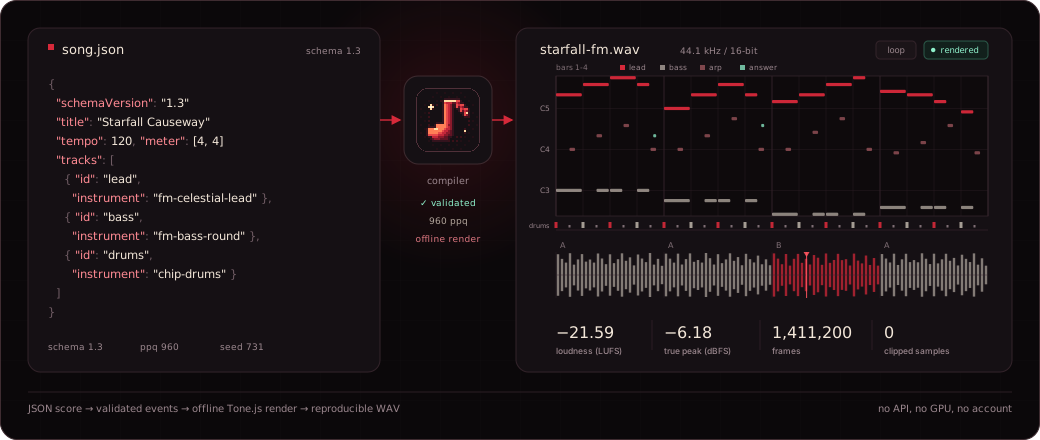
describe gives a structural summary an AI can reason about without hearing anything:
# Starfall Causeway
genesis-inspired, modern voice, 120 BPM, 4/4, 16 bars (64 beats), loop export
- lead (fm-celestial-lead, melody): 60 notes, 3.8/bar, range B4–C6,
  peak C6 at beat 38.00, 37% stepwise motion
- bass (fm-bass-round, bass): 64 notes, 4.0/bar, range F2–D3, peak D3 at beat 40.00
- drums (drums): 128 hits, 8.0/bar — hat×64, kick×32, snare×32
Sections:
  A-1: bar 1, 5.13 events/beat, median E4 — opening
  B-9: bar 9, 4.75 events/beat, median D4 — similar to previous
Measured numbers from the render report (Starfall Causeway, FM version):
| Duration | Integrated loudness | True peak | Clipped samples |
|---|---|---|---|
| 32.0 s | −21.59 LUFS | −6.18 dBFS | 0 |
How is this different from a music generation model
They solve different problems.
| Music generation model | Retro Music Toolkit | |
|---|---|---|
| Input | A text description | A JSON score |
| Runs on | Cloud API / local GPU | An ordinary laptop, offline |
| Cost | Per generation | Zero |
| Reproducibility | Same prompt, different result | Same score, same result |
| Editing | Regenerate the whole piece | Change a single note |
| Explainability | You get audio | You get a score and diagnostics |
| Source material | Training data is not traceable | Procedural sounds plus traceable CC0 / CC BY samples |
A generation model is good at handing you a first idea. This toolkit is good at turning an idea into something that ships in a game, can be revised, and renders the same way every time. If you already have a melody in mind, or you are building an AI agent that needs dependable output, this is the one you will use every day.
Who it is for
| ✅ A good fit | ❌ Not a good fit |
|---|---|
| Building a composition or game-dev AI agent that needs stable, verifiable tool calls | You want one sentence in and a finished song out |
| Indie game developers who need loopable, endlessly revisable BGM | You need vocals, recorded instruments or modern pop production |
| Environments that must be offline, dependency-free and licence-clean | You need bit-exact chip emulation (NSF / VGM playback) |
| Treating music like code: version control, review, CI | You never want to touch structured data |
[!IMPORTANT] It does not compose for you. You (or your agent) supply the melody; it validates, constrains, renders and reports.
hardwaremode is an audible approximation, not bit-accurate 2A03 / YM2612 / BRR emulation. The examples are verified at the signal level only, with no subjective listening review — whether they sound good is for you to judge.
Capabilities
✍️ Compose
|
🩺 Diagnose
|
🔊 Sound
|
📦 Deliver
|
Designed for AI agents
- JSON in, JSON out: every command returns structured data; errors carry a machine-readable
code - Meaningful exit codes:
0success,1tool error,2invalid score - Token-aware: stdin / stdout,
--compact,--bars 9-16to work on a section - Self-verifying: validation errors include the repair value;
patchreturns a per-field diff
cat song.json | node dist/cli.js validate - --compact
Subtractive synth and orchestral instruments
A subtractive engine adds analog-style voices: stacked detuned oscillators, a filter with its own envelope, and an LFO for pitch, filter and level, with four presets (analog-pad, analog-lead, analog-bass, analog-pluck). A CC0 orchestra pack (~16.6 MB, VSCO 2 CE and VCSL) adds string ensemble, pizzicato, flute, clarinet, French horn, harp, marimba, vibraphone, ocarina and harpsichord. Every root is pitch-verified, and sustained instruments loop seamlessly with a crossfade.
Synth and orchestra guide (Chinese)
1.3: common instruments and sample variations
Six new common instruments add bass, short bass, clean/short guitar, piano and acoustic drums (~4.4 MB). Velocity layers and seeded round robin are selected at compile time, including stable solo, crop and loop playback. Packs are separated by CC0 / CC BY 3.0 / CC BY 4.0; retain applicable attribution and license notices.
1.2: sampled instruments and stereo reverb
A compact (~1.9 MB) CC0 starter collection adds recorder, piano, kalimba and glockenspiel, with 12 root samples. Import selected instruments with SHA-256 checks into portable offline scores. Opt-in seeded convolution reverb has independent track sends; existing scores retain their dry sound.
Quick start
[!NOTE] Node.js 22 or newer. macOS, Linux and Windows are all supported (verified on all three in CI). The first install needs network access for dependencies and Chromium; after that everything runs offline.
git clone https://github.com/narrastory/retro-music-toolkit.git
cd retro-music-toolkit/scripts/runtime
npm ci
npm run browser:install     # rendering only; compile and diagnose work without Chromium
npm run build               # also marks the CLI executable (skipped on Windows)
Write, check, revise, export:
node dist/cli.js example --out song.json      # a minimal, runnable score
node dist/cli.js validate song.json           # full compile check
node dist/cli.js diagnose song.json           # arrangement and harmony findings
node dist/cli.js render song.json --out v1.wav

node dist/cli.js patch song.json --patch changes.json --out v2.json
node dist/cli.js render v2.json --out v2.wav --dither
node dist/cli.js compare v1.wav v2.wav --out ab.wav   # level-matched comparison
Full documentation (in Chinese): quick start · 1.1 guide · score format · Agent entry point: SKILL.md (English)
Technical details
ArchitecturePipeline: JSON → strict Zod validation → semantic, sample and harmony checks → pattern/clip expansion (swing, humanize, hold, cropping, single-voice chord arpeggio) → integer-tick events → voice allocation → Tone.js offline synthesis → limiting, dither and analysis → PCM16 WAV.
| File | Responsibility |
|---|---|
model.ts |
Zod schemas, PPQ = 960, pitch conversion, structured errors |
compiler.ts |
Expansion, time transforms, chord rotation, voice allocation, loop boundaries |
harmony.ts |
Chord parsing, key, harmony and loop diagnostics |
motif.ts / voicing.ts |
Motif operators, chord voicing and arpeggios |
browser-engine.ts |
Tone.js graph and scheduling, warm-up, cropping, seam |
renderer.ts |
Node → Chromium bridge |
analysis.ts |
True peak, LUFS, clipping, boundary symptoms |
report.ts |
Piano-roll SVG, text description, HTML report |
Design decisions
- Integer ticks, not floating-point seconds. Every time transform happens at compile time, so loop length, voice conflicts and diagnostic windows all refer to what actually sounds.
- Drums and melodic parts have different voice semantics. Melodic tracks allocate against
maxVoicesand can steal; drums are independent one-shots that consume no voices. - Release tails are reported separately from held-note conflicts. The former is routine and harmless; only the latter needs a fix.
- Reproducibility. Drum noise, humanize jitter and randomised arpeggios are derived from the seed; runtime
Math.randomis banned. Cross-browser DSP differences can still shift individual samples, so bit-exact output is not claimed.
Size: roughly 7,500 lines of TypeScript, four runtime dependencies (tone, zod, playwright, esbuild), 162 automated tests (120 unit, 38 real-audio, 2 web), plus showcase checks.
instruments                    list presets and recommended ranges
validate SCORE.json            full compile check
compile SCORE.json --out F     expanded integer-tick events
diagnose SCORE.json            arrangement, harmony and loop findings
render SCORE.json --out S.wav  offline render
patch SCORE.json --patch P     targeted edits with a change log
arrange CONFIG.json            empty arrangement scaffold
motif / harmonize / arpeggiate development, accompaniment, arpeggios
vary / answer                  constrained variation and answering phrases
import-instrument              pack local WAVs into the project
report / describe / roll       visualisation and text structure
audition                       generate the instrument audition set
compare A.wav B.wav            level-matched A/B export
analyze AUDIO.wav              measure any WAV
schema / example / version
Render options: --solo --mode --bars --from/--to --seam --effects --match-rms --loop-diagnostics --loop-crossfade --dither --limiter
Global: --force --compact --stdout --help
import { readFile } from "node:fs/promises";
import {
  compileScore,
  renderScore,
  patchScoreWithReport,
} from "./scripts/runtime/dist/index.js";

const input = JSON.parse(await readFile("song.json", "utf8"));
const compiled = compileScore(input);
console.log(compiled.events.length, compiled.diagnostics);

const { score, report } = patchScoreWithReport(input, {
  operations: [{ op: "set-track", trackId: "arp", set: { gainDb: -18 } }],
});
console.log(report.changes); // per-field before / after

const { wav } = await renderScore(score, { solo: ["lead", "bass"] });
SKILL.md is the agent-facing entry point: full workflow, constraints and delivery standards. A host only needs shell access.
| Intent | Implementation |
|---|---|
| List instruments | INSTRUMENTS / cli instruments |
| Validate a score | compileScore / cli validate |
| Render | renderScore / cli render |
| Revise | patchScoreWithReport / cli patch |
| Analyse audio | decodeWav + analyzeChannels / cli analyze |
No MCP server ships with the package; the CLI and function calls already form a complete loop.
Roadmap
- tempo map / accelerando and ritardando
- MIDI import and export
- MML / shorthand notation front end
- voice-leading optimisation across chord changes
- MCP server
- lower-memory sample scheduling
Open an issue with the scenario you actually need.
Credits and licence
- Code and schema documentation: MIT
- Reference guides and generated audio: see NOTICE.md. The three background guides under
references/source-guides/were supplied by the toolkit's user; copyright remains with their authors and the MIT licence does not apply to them. - Dependencies: Tone.js, Zod, Playwright and esbuild, each under its own licence.
- The original 11 presets use procedural sounds. The bundled starter collection uses CC0 VCSL recordings, with license and source hashes included. No commercial game samples or ripped assets.
An 8-bit limit is not a drawback — it is the style. Using the limit well is arranging.
No comments yet. Be the first to write one.