dsh-model-garden
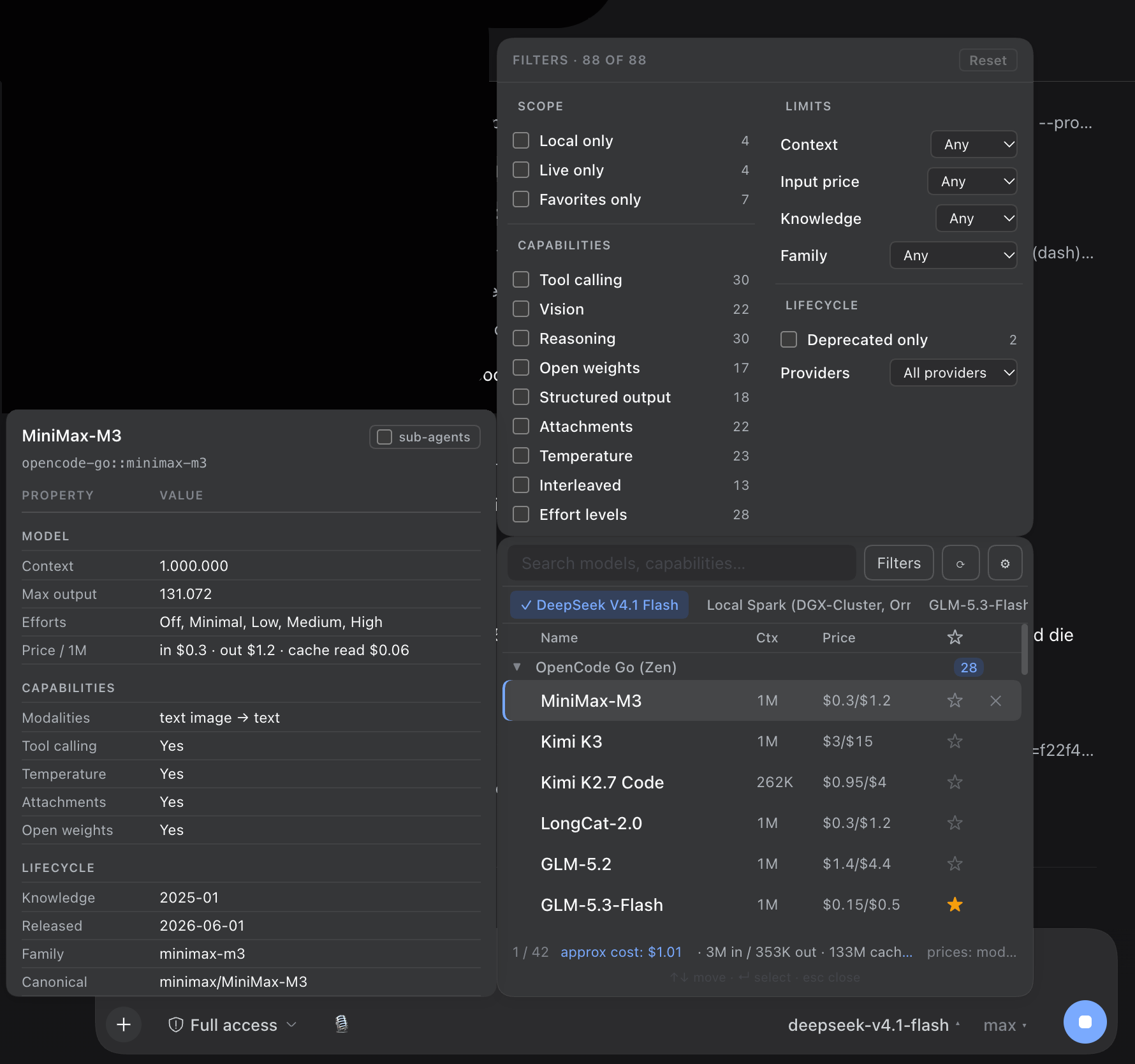
A model picker for the DeepSeek Harness Web UI (dsh web) that replaces the native composer model seat with a table-style picker: searchable, sortable, filterable down to model capabilities, with prices, live per-task cost, a rich detail card and a pinned default model for every sub-agent.


Why
The stock selector lists models. Model Garden answers the questions you actually have while picking one: what does it cost right now, which routes are cheap enough, which models can see images, which can call tools, which are deprecated, and which model should every sub-agent use — and it keeps those answers in sync with your providers.
Features
Picker and list
- Table-style list grouped by provider — click
Name,CtxorPriceto sort (asc → desc → back to grouped), collapsible groups, per-provider counts - Keyboard-first —
↑ ↓navigate,Home/Endjump,Enterselect,Escclose - Instant search across names, ids, descriptions and provider names — and the model's facts:
vision,tool calling,reasoning,structured output,attachments,open weights,temperature,interleaved, family, knowledge cutoff, release date anddeprecated - Favorites (⭐, persisted) and a hidden models/providers blacklist (✕ on hover, managed in the ⚙ panel, persisted) — the blacklist never touches your DSH configuration
- Local / Live awareness — providers are flagged local by their real endpoint (loopback / RFC1918 / LAN hostnames, never by price), and local gateways are probed for the models they currently serve
Advanced search (facet sheet)
The Filters button opens a two-column sheet above the picker. Every option carries the number of models it would match, and the header counts the result (Filters · 12 of 88):
| Group | Options |
|---|---|
| Scope | Local only · Live only · Favorites only |
| Capabilities | Tool calling · Vision · Reasoning · Effort levels · Open weights · Structured output · Attachments · Temperature · Interleaved |
| Limits | Context ≥ 32K…1M · Input price ≤ $0.50/$1/$3/$10 · Knowledge cutoff year · Family |
| Lifecycle | Deprecated only |
| Providers | one provider from a dropdown (Configured / Hidden, each with its model count) |
Everything is derived from your installation at runtime — no provider, model or family name is hard-coded:
- providers, counts and the
hiddenflag come from the live directory and your blacklist - capability counts, families, knowledge years, context sizes and prices come from the models.dev catalog cache
- an option with zero matches is disabled, and a whole group is not rendered when your catalog cannot fill it (a local-only setup still gets Scope, Lifecycle and Providers)
- the Context ladder only offers thresholds your models can reach; the knowledge years are the ones in your catalog
Filters combine with the text search (AND). Reset is always visible (dimmed while nothing is set), clears every filter and leaves the search text alone.
Detail card
Hovering a row opens the detail card as a fixed companion to the picker: left gutter, 1 px seam, shared bottom edge. On narrow windows it moves above the picker instead of hanging off screen, and it is height-clamped to the viewport.
The card is a table (Property | Value) with sections:
- Model — context, max output, reasoning efforts, price per 1M (in / out / cache read / cache write)
- Capabilities — modalities, tool calling, structured output, temperature, attachments, open weights, interleaved reasoning
- Lifecycle — knowledge cutoff, release date, last update, deprecation status, family, aliases, canonical id
- Provider — route, models.dev provider and env key, local-gateway metadata, provenance of each source
Facts merge three sources (DSH adapter via llm.resolveModelInfo, models.dev, and the raw /models record of a local gateway) and are cached, so the first hover after a restart is never blank.
Sub-agent default model
The sub-agents toggle sits next to the model name in the card header:
- tick it to make this
provider::modelthe model every future sub-agent runs with — spawns, forks, background children, workflow agents and cold resumes — whatever the session itself uses - hovering the toggle shows a short explanation above the card
- the pinned model carries a
subbadge in the list, so it is findable at a glance - the pin persists across restarts (DSH 0.2: the plugin's own profile entry; 0.1: the
model-garden:settings section) and is enforced host-side onagents.create/agents.resumeformeta.origin: "subagent" - main sessions are never touched; running children keep their model
Reasoning effort
Models that declare reasoning levels get a compact dropdown next to the model name in the composer — same trigger pill and menu surface as the picker:
- levels are detected from the directory first, then from the cached detail card, and fetched on demand for the selected model, so the pill appears without hovering the list
- picking a model starts it at the deepest level it declares (
none < minimal < low < medium < high < xhigh < max < ultra; numeric ids compare numerically, entirely unknown names fall back to the adapter's last entry) - an effort already set on the session is never overwritten
Prices and live cost
- Model prices from models.dev, shown as
$input/$outputper 1M, cached 24 h. Subscription routes whose catalog entry is all-zero resolve a reference price from their pay-as-you-go provider, so plan models show what their tokens would cost at API rates; only true local models stay unpriced - Live per-task usage (in / out / cache) is read from the session log and always visible while the panel is open; each model's usage is multiplied by its own price, so switching models mid-session is attributed correctly
- Session cost breakdown — hover the cost figure: per-model totals and a timestamped step table with sortable headers, copy and CSV export
- Context windows come live from the host
llmservice (local gateways included), with models.dev as fallback
Sync, refresh and cleanup
- Automatic sync — when the picker opens and the last pass is older than 6 h, then hourly while it stays open. Automatic passes are additive only (
keepRemoved=1): a provider that momentarily returns a short list can never delete your configuration - Manual ⟳ — re-syncs every configured
llm-pi-aiprovider from its liveGET {baseURL}/modelsand writes the merged lists back (added and removed), comment-preserving through the active profile's configuration editor - Deprecated models get a permanently visible red ✕ in the row. Clicking it asks inline (“Remove MiniMax-M2.7 from OpenCode Go?”) and deletes exactly that entry from the provider's configured list; every other field of the route survives
- Directory re-read every 5 minutes while mounted, so locally added models appear without reopening the panel
Look and feel
- Built on the harness design tokens (
--dsw-*) with opaque surfaces — panels never let chat text shine through; light and dark themes follow the harness, and missing tokens fall back to neutral colours - Docked sheets with 1 px seams: the filter sheet above the picker, the detail card beside it, both clamped to the viewport
- No build step, no runtime dependencies, no telemetry
Install
One command — the official plugin CLI installs the package and mounts it (the package carries a dsh.bundle.patch layer, so the CLI appends it to the profile's bundle stack):
dsh plugin --profile <profile> add dsh-model-garden
Then restart the DSH server and hard-refresh the browser (Cmd/Ctrl+Shift+R).
The host half needs the web stack (
webServerservice). In minimal/TUI profiles without it the plugin stays inert by design — boot is never blocked.
Upgrading from a manual install? Remove the old
model-gardendependency and any manual- insert:row for it from your profile'scordis.patch.ymlfirst — otherwise it mounts twice.
From GitHub (latest main)
The CLI also accepts a git spec — same bundle reconciliation, no manual patch edit. Useful to run an unreleased commit:
dsh plugin --profile <profile> add github:mrdevlorx/dsh-model-garden
Restart DSH and hard-refresh afterwards, as with a normal install. This tracks main; re-running the command updates to the latest commit.
Verify
curl -s http://127.0.0.1:3080/model-garden/subagent-model
# → {"subagentModel":null}                      (host half is live)
Manual install (without the CLI)
Add the dependency to the profile, list dsh-model-garden in dsh.profile.bundles in the profile package.json, reinstall, restart. The bundle patch inside the package inserts the loader row — no cordis.patch.yml edit needed.
How it works
The package is a static profile plugin with two halves:
| Half | File | Role |
|---|---|---|
| Client | client.js |
Registers the conversation.input.model slot (shadowing the native seat) and renders the picker, filter sheet, detail card and effort dropdown |
| Host | index.js |
Same-origin JSON routes on the harness webServer, catalog/detail caches, and the sub-agent enforcement on agents.create / agents.resume |
| Shared logic | lib/refresh-core.js, lib/pi-catalog.js, lib/detail-core.js, lib/subagent-core.js |
Dependency-free, unit-tested pieces: provider discovery + merge, pi-ai catalog loading, detail-card merge rules, sub-agent override semantics |
Host endpoints
GET  /model-garden/cost?session=<id>               real token usage of one session
GET  /model-garden/cost-history?session=<id>       usage steps attributed to their model
GET  /model-garden/catalog                         { "provider::model": { local, context?, maxOutput? } } (10 min cache)
GET  /model-garden/model-detail?provider=&model=   merged adapter + models.dev + gateway detail (6 h host cache)
GET  /model-garden/server-models                   live model inventory of local gateways
POST /model-garden/refresh-models                  re-sync provider lists (?keepRemoved=1 = additive)
POST /model-garden/remove-model                    delete one configured model from its route
GET  /model-garden/subagent-model                  current sub-agent pin (or null)
POST /model-garden/subagent-model                  pin one route::model, {} clears it
Every route is same-origin only: no CORS wildcard is advertised, and state-changing routes reject cross-site requests with 403 before touching anything. Provider credentials are resolved through the host credentials service (~/.dsh/.credentials.yaml) with process env as fallback, and are only sent to that provider's own /models endpoint.
Where state lives
| What | Where |
|---|---|
| Favorites, recent models, collapsed groups, hidden models/providers | browser localStorage (dsh.modelgarden.*) |
| Price/capability cache | localStorage (dsh.modelgarden.prices.v5, 24 h) |
| Detail cards | localStorage (dsh.modelgarden.details, 24 h per model) |
| Sub-agent pin | DSH 0.2: the plugin's profile entry (profile patch); 0.1: the model-garden: section of settings.yaml |
The DSH 0.2 migration is handled inside both halves: provider routes are read through ctx.configEditor (with the legacy settings document as fallback for 0.1) and written back through the profile's configuration editor, keeping the YAML comments of the profile patch intact.
CLI (refresh without a running DSH)
node node_modules/dsh-model-garden/bin/refresh-models.mjs \
     [--dry-run] [--keep-removed] [--provider <id>] [--timeout-ms <ms>] \
     [--profile <name>] [--settings <path>] [--home <dsh-home>]
On DSH 0.2 the tool reads the active profile's cordis.patch.yml (or pass --profile); on 0.1 it reads settings.yaml. Writes are comment-preserving; --dry-run only reports.
Configuration
No configuration is required. Tweakable constants:
MODEL_LIST_REFRESH_MS(client, 5 min) — directory re-read interval while mountedAUTO_REFRESH_MS(client, 60 min) /AUTO_REFRESH_STALE_MS(client, 6 h) — automatic additive syncPRICE_TTL(client, 24 h),CATALOG_TTL(client, 10 min)MODELS_DEV_TTL(host, 24 h),MODELS_DEV_RETRY(host, 2 min),DETAIL_TTL(host, 6 h),DETAIL_NEG_TTL(host, 10 min),DETAIL_ADAPTER_TIMEOUT(host, 8 s)REFRESH_TIMEOUT(host, 15 s per provider),REFRESH_HARD_CAP_MS(host, 60 s per pass),SERVER_MODELS_TIMEOUT(host, 5 s per gateway probe)HIDDEN_PROVIDER_PREFIXES(client) /SKIP_PREFIXES(host) — internal mirror routes excluded from the pickerPROVIDER_ALIASES/MODEL_ALIASES(client) — DSH route ids → models.dev ids for renamed and subscription routes
Compatibility
- Developed and tested against DeepSeek Harness 0.2.1 (rc.4 and rc.5) and carries the 0.1 code paths: provider routes are read through
ctx.configEditoron 0.2 and through the legacy settings document on 0.1; writes go through the profile's configuration editor (0.2) with the old deep-merge as fallback - The client half is plain React through
window.__ModuleLoader__; no build step, no dependencies - The sub-agent override rides on
meta.origin: "subagent"/parentAgent— the same seamdsh-subagentuses - The cost endpoints read the durable session log through the session facade (
snapshotEvents(), falling back toownEvents()/events) - Capability, price, family and knowledge filters need the models.dev catalog; without it the sheet simply offers the subset your data can fill
Slot note: the client declares
remote+remote.sessionin its inject list.modelDirectories.directoryFor()reaches intoctx.remote.session, and a cordis proxy bindsctxto the calling fiber — without those declarations the slot's inject factory throws and the native picker takes the seat back.
Development
node --test test/*.test.js
The suite covers the refresh merge logic, every HTTP endpoint against a 0.2-shaped context, the sub-agent override rules, and a structural test that asserts the advanced sheet keeps its two column wrappers (a lost column renders as one long list instead of failing loudly).
Credits
- Pricing and model metadata: models.dev (the same source OpenCode uses)
- Design tokens, slots and plugin API: DeepSeek Harness
No comments yet. Be the first to write one.