dsh-simple-auth

Ultra-light login gate for DeepSeek Harness web.
Zero production dependencies. One login field. Optional master / guest keys. Sessions are isolated by default; only the owner can share or unshare; the sidebar list is ACL-filtered; a bottom-right share FAB targets the currently selected session.
Other catalog login gates cover passwords, TOTP, or settings cards. This one stays a shared-key (or per-user key file) gate plus session ACL. Do not stack it with dsh-auth-gate, dsh-webui-auth, dsh-web-startup-auth, or dsh-auth-gateway.
Install
dsh plugin --profile web add github:lt9/dsh-simple-auth
If the profile is a pnpm workspace and add fails with ERR_PNPM_ADDING_TO_ROOT:
dsh plugin --profile web add -w github:lt9/dsh-simple-auth
Local checkout:
dsh plugin --profile web add ./dsh-simple-auth
Set the key before restarting dsh. The gate fails closed: if the key is missing, the login page explains that and every other request is denied.
export DSH_SIMPLE_AUTH_KEY='a-long-random-secret'
systemd / Docker: put the same variable in the service Environment / EnvironmentFile. To reuse an existing secret, point keyEnv at that variable instead of copying it:
# $DSH_HOME/cordis.patch.yml  (home layer; replaces this plugin row's config)
- id: dsh-simple-auth
  config:
    keyEnv: EXISTING_SECRET_ENV
Restart the dsh web process, open the UI, enter the key.
dsh --profile web --dump-config should list a row named dsh-simple-auth.
Screenshots
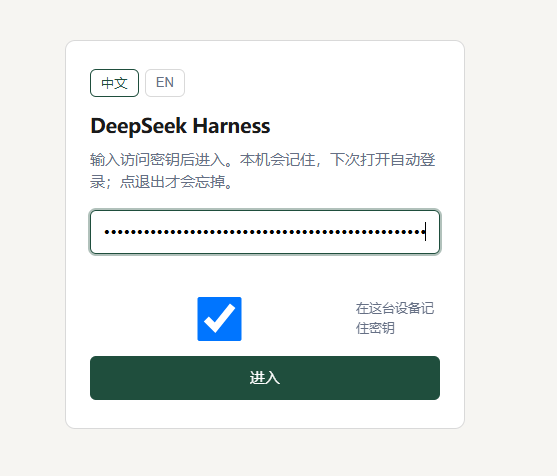
Login
Visitors enter the access key once; optional “remember key on this device”.
Session sharing (multi-user)
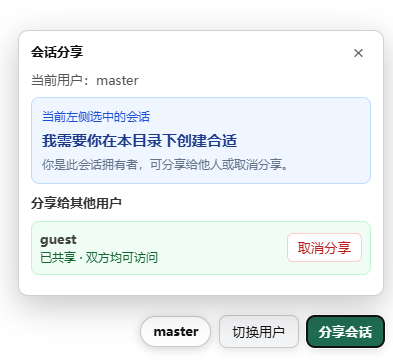
The share panel in the bottom-right targets the currently selected sidebar session. The owner can share with or revoke access for other users; guests can use the session but cannot manage sharing.
Requirements
- Node.js ≥ 20
- dsh web profile (tested on
@deepseek-ai/dsh@0.1.1-rc.2and@deepseek-ai/dsh@0.1.2-rc.1; both still exposewebServer.server) pnpmonPATHif you usedsh plugin add
What it protects
| Surface | Unauthenticated | Authenticated |
|---|---|---|
Pages (GET/HEAD) |
302 → /login |
passed through |
| APIs / other methods | 401 JSON |
passed through |
| WebSocket upgrade | handshake 401 |
passed through |
| Scripts | Authorization: Bearer <key> or X-Api-Key |
same as a session |
/login and /logout are the only public paths.
Configuration
All keys are optional. Defaults are applied in code (home-layer patch config replaces the whole object, it does not deep-merge).
| Key | Default | Meaning |
|---|---|---|
keyEnv |
DSH_SIMPLE_AUTH_KEY |
Environment variable that holds the access key |
keyFile |
"" |
If set, read the key from this file (trimmed). Takes precedence over keyEnv |
cookieName |
dsh_simple_auth |
Session cookie name |
sessionTtl |
604800 |
Cookie lifetime in seconds (7 days) |
cookieSecure |
auto |
auto follows X-Forwarded-Proto; true / false force the Secure flag |
rewriteLoopback |
true |
Present authenticated traffic as 127.0.0.1:<port> so dsh’s reverse-proxy Host fence does not 403 privileged APIs |
title |
DeepSeek Harness |
Login heading |
hint |
(built-in zh/en copy) | Login subtitle |
remember |
true |
Show “remember key on this device” (localStorage only; the server still uses the cookie) |
rpcMinTimeoutMs |
120000 |
Floor for AbortSignal.timeout injected into the web index. dsh’s unary RPC default is 30s; large session.history pages over a tunnel abort with The user aborted a request. 0 disables the inject |
Never put the key itself in YAML or git.
Multi-user session sharing (0.2+)
When usersFile is set, each login key maps to a user id + name. Cookies sign userId with a separate secret file. Sessions are isolated by default; the current session is the sessionId from DSH RPC (session.history / session.prompt, etc.), and titles come from official session.list. Owners can share that session. Shared users get mutual access but cannot share or unshare. Concurrent session.prompt / session.updateQueue on one session returns 409 session-busy.
[
  { "id": "master", "name": "master", "keyEnv": "DSH_SIMPLE_AUTH_KEY" },
  { "id": "guest", "name": "guest", "keyFile": "/path/to/guest-key" }
]
| Key | Default | Meaning |
|---|---|---|
usersFile |
"" |
JSON user list; enables multi-user when valid |
aclFile |
$DSH_HOME/simple-auth/acl.json |
Session owner / sharedWith |
secretFile |
$DSH_HOME/simple-auth/secret |
Cookie HMAC secret (auto-created) |
legacyOwner |
master |
Owner for pre-existing sessions on upgrade |
Known limitations
- Sharing a session shares the live agent, not chat text only. Credentials, bash, workspace, and settings remain machine-wide.
- This is access control, not a substitute for TLS or treating the agent as remote code execution.
- Catalog listing (when present) is not a security audit.
Disable / uninstall
dsh plugin --profile web remove dsh-simple-auth
Then restart the dsh web process. To disable without uninstalling, stop setting usersFile / keyEnv / keyFile — the gate fails closed.
Security notes
- Fail-closed: misconfiguration does not leave the UI open.
- Login attempts are rate-limited per client IP (honors
X-Forwarded-Foronly when the peer is loopback). - Sessions are HMAC-signed with the access key (stateless). Rotating the key invalidates every cookie.
- Authenticated JSON
/apiresponses that look likesession.historypages dropassistant/chunkevents whose message already closed (dsh #4678) so the browser does not download tens of megabytes of redundant deltas. - Do not expose dsh over plaintext on the public internet; use HTTPS and keep
cookieSecure: auto. - Behind a tunnel, also pass the public origin to dsh:
--trusted-host your.example:port(repeatable). This plugin already rewritesHost/Originto loopback after login; the CLI flag is the documented backup for the/apifence.
Development
node --test
Zero production dependencies. The host half wraps webServer.server request / upgrade listeners (the same approach used by other dsh auth gates) so static files, /api, and sockets are covered even on builds that have no request-gate extension point. On 0.1.2 the web surface also has a browser-session cookie (connection.authorizeIndex); after our login cookie is valid, this plugin skips that second 401 so the SPA still loads without the process launch token. 0.1.1 has no such fence and is unchanged.
License
MIT
No comments yet. Be the first to write one.