Agentic Tool Catalog
An agent builds and maintains the tool catalog: schemas stay out of context, tools load on demand.
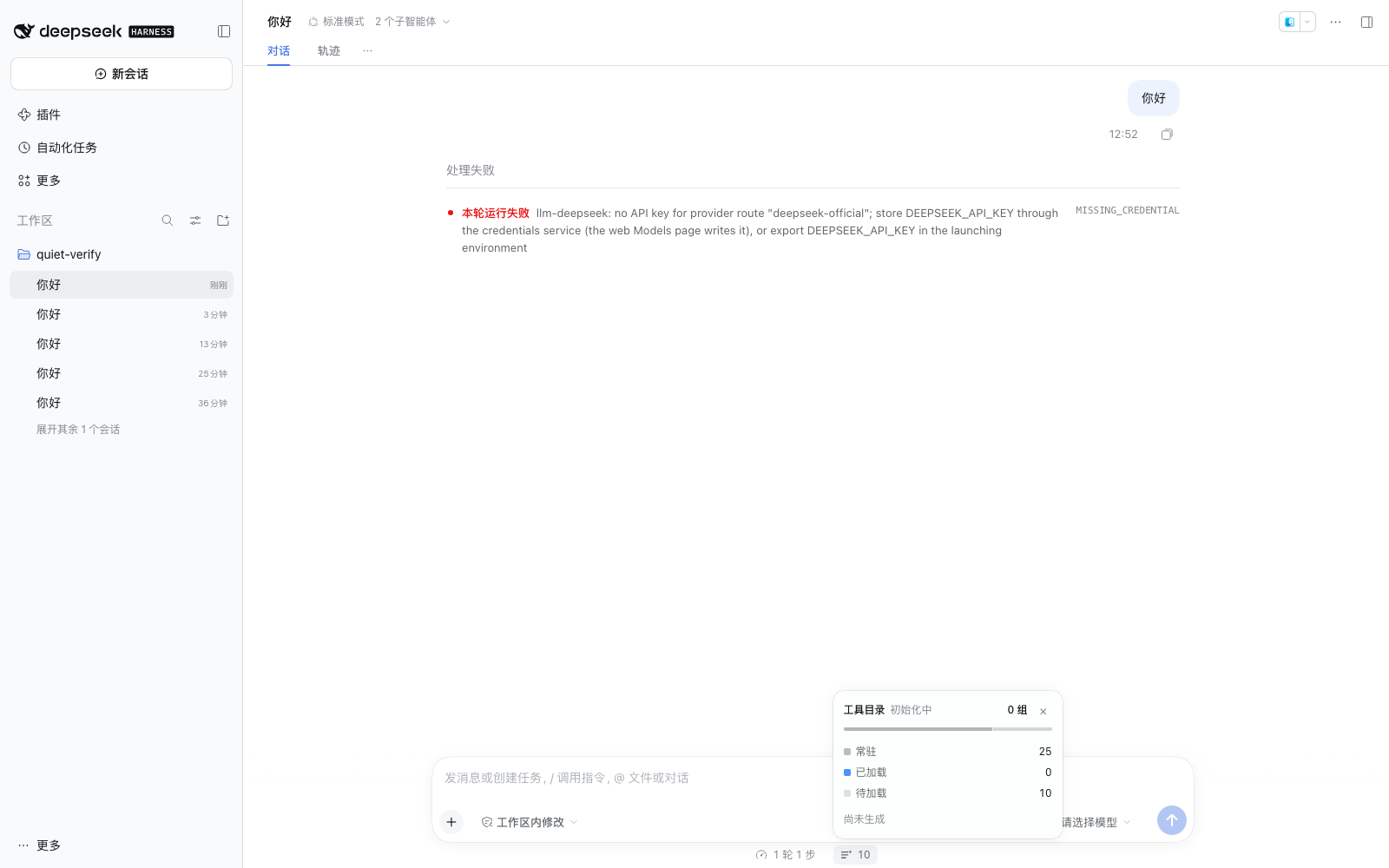
DeepSeek Harness normally sends every visible tool schema on every request. With many MCP servers and extension plugins that gets expensive: context bloat, slower requests, and degraded tool selection once the catalog grows past a few dozen tools.
Agentic Tool Catalog keeps a directory of deferred tools instead. A real DSH sub-agent reads the current
tool inventory, groups tools by intent, self-checks coverage, and returns a catalog. The plugin validates it,
caches it in official DSH Storage, and only ever sends a few lines of directory text — tools are loaded
by search_tools when a task actually needs them.
What you get
- Smaller requests: deferred tool schemas never enter the context until loaded (measured 91 deferred schemas ≈ 109.6 KB ≈ ~27k tokens replaced by a 443-character directory note in this profile).
- Agent-curated grouping: groups are generated by an agent (not by name prefixes, not by a manual list): browser tools split by intent, Google tools split by product, cross-server capabilities merged.
- Zero cooperation from other plugins: no declarations, no metadata, no code changes. Any installed tool is discovered automatically.
- Local-first: the generator runs on your DSH model; no external service is required.
- Reliable by design: strict validation, one retry with feedback, app-wide single-flight generation
(one real generator at a time, pre-warm included), timeout cancellation with archived child sessions,
persistent cache (official
ctx.storageDomain), incremental regeneration on catalog changes, and a visible "stale / refreshing" state if generation cannot complete. It always keeps working with the last successful catalog or a flat bootstrap directory — and never silently hides the failure. - Observable:
catalog_statusexposes catalog freshness/origin, groups, loaded tools, generation and storage health.
How it works
agent needs tools
  → tool catalog fingerprint (tool names + cache namespace)
  → hot cache / official Storage hit?  ── yes → use catalog
  → no: generate with a DSH sub-agent (incremental if a previous catalog exists)
        → validate (100% coverage, no duplicates, sane groups)
        → cache in official Storage + apply catalog (restriction releases tools on demand)
        → failure: retry once with error feedback; still failing → keep last successful grouping
          (status = stale, explicit warning + backoff retry) or flat bootstrap directory
- New sessions try generation immediately (pre-warm) while the global generator is idle; restored sessions generate on their first user message/search; catalog changes regenerate immediately (incremental first).
- One generator at a time by default: at most
catalogMaxConcurrentGenerations(default 1, configurable 1..4) real sub-agent runs exist app-wide. Requests for the same tool fingerprint are merged across sessions, pre-warm is skipped while another run is active, and a failed catalog backs off exponentially (10 min → 6 h) instead of retrying on every prompt. - No leaked generations: the timeout is enforced by cancelling the child, and each attempt's
origin=subagentsession is archived afterwards — hidden from every session list, with residual work stopped. Controlled bycatalogArchiveChildSessions(defaulttrue). - Generation is keyed by the tool set, not by time: one generation per unique tool fingerprint; the result is
cached in official Storage and reused across sessions/restarts. There is no periodic refresh — the timestamp
only moves when the tool set actually changes (install/remove a plugin or MCP server, preset change, etc.).
The catalog table keeps at most
catalogCacheMaxEntries(default 64) fingerprints and evicts the oldest. - Tools are hidden from the model with
agent.ctx.tools.restrict({ deny });search_toolsreleases them through DSH's native mid-conversation tool-addition path. - The catalog cache lives in official DSH Storage (
ctx.storageDomain, domainagentic_tool_catalog). If a profile has no storage service, the plugin falls back to memory-only caching (still functional; one regeneration after restart) and reportsstorage.mode = "memory".
Model-facing tools
| Tool | Parameters | Behavior |
|---|---|---|
search_tools |
query: string, limit?: number |
Search the catalog by intent/keywords (name, description, group id/description). Exact group-name queries load the whole group (up to groupMaxResults). Loaded tools become callable for the rest of the session (directly, or as tools.<name> inside run_code). |
catalog_status |
— | Read-only JSON: catalog (source/freshness/origin/total/groups/others), session (loaded/pending/restriction), generation (runs, cache hits, failures, timeouts, retries, dedupe, stale uses, incremental runs, archived child sessions, queue active/pending/joined/skipped, last error/ok, instance), storage (mode/entries/maxEntries/evicted), warnings. |
A short catalog:note system-prompt section lists deferred groups and counts; during bootstrap/stale states it
adds one explicit line explaining that the catalog is initializing/refreshing.
Configuration
- id: agentic-tool-catalog
  name: 'dsh-agentic-tool-catalog'
  config:
    maxResults: 6            # tools loaded by one generic search
    groupMaxResults: 30      # tools loaded by an exact group-name search
    promptNote: true         # inject the catalog:note system-prompt section
    resident: []             # override the built-in resident list (tool names/globs)
    extraKeepResident: []    # append globs that must always stay visible
    extraDeferred: []        # force globs to stay deferred
    catalogProvider: spawn   # DSH subagent provider used for generation
    catalogTimeoutMs: 120000 # per-generation timeout (cancelled, not just aborted, when it fires)
    catalogMaxConcurrentGenerations: 1 # app-wide concurrent generator limit (clamped to 1..4)
    catalogCacheMaxEntries: 64 # max cached tool fingerprints in official Storage
    catalogArchiveChildSessions: true # archive each generation child session after its attempt
    catalogResetNonce: ''    # cache namespace; change it to force regeneration
Most profiles need no configuration. New plugins/MCP servers are picked up automatically on the next catalog
change; if a tool must always be visible, add it to extraKeepResident.
Install
Local development (this workspace):
# via the DSH plugin manager
dsh plugin --profile web add dsh-agentic-tool-catalog
# local development (this repository)
dsh plugin --profile web add /path/to/dsh-agentic-tool-catalog
# or, from a shell in the DSH checkout
dsh plugin add /path/to/dsh-agentic-tool-catalog
Published package: dsh-agentic-tool-catalog (npm). Requires DSH >=0.2.1-rc.2 <0.3.0;
tested with 0.2.1-rc.2, 0.2.2-rc.1, 0.2.2-rc.2 and 0.2.2-rc.3 (both subagent activation shapes are supported).
dsh plugin --profile web add dsh-agentic-tool-catalog
Performance (A/B: with vs without)
Measured on 5 tasks × 2 independent sessions per arm, same model and tool surface (122 tools incl. Google
Workspace MCP), DSH 0.2.2-rc.1, deepseek-flash:
| Metric | without (all tools resident) | with this plugin | Change |
|---|---|---|---|
| Task pass rate | 100% (10/10) | 100% (10/10) | equal |
| First-request tool schema (payload) | 122 tools / 131,390 chars | 31 tools / 21,877 chars | −83.3% |
| First-request real prompt tokens (usage) | 49,504 | 18,536 | −62.6% / −30,968 per request |
| Avg total tokens / session | 452,463 | 268,551 | −40.6% |
| Avg steps | 7.40 | 7.90 | +6.8% |
| Avg cost / session | $0.0112 | $0.0116 | +3.7% (≈flat) |
| Avg wall time | 37.0s | 33.3s | −9.9% |
Avg search_tools calls |
0.10 | 1.30 | +1.2/session |
One-time catalog generation (background, cached in official DSH Storage) is excluded from these task metrics.
Full methodology and caveats: docs/benchmark.md · full data card: docs/data-card.md.
UI (minimal, read-only)
An icon + a small on-demand-tool count sits in the official composer dock (hover shows the catalog summary and uses the same hover treatment as the official context meter). Click it for a read-only panel modeled on the official ContextMeter: a segmented bar plus three rows (always available / loaded / on demand), a status dot and freshness word, and one meta line (groups · storage · updated). There is no directory dump, no configuration, and no long explanatory copy. It uses official slots/theme tokens and follows the light/dark theme.
Development & release
See docs/development.md for the layered validation flow (link dev profile →
npm artifact → staging composition → next dogfood → latest).
Plugin compliance is checked by scripts/check-plugin-compliance.mjs (run by npm test with --strict);
its rule matrix is the canonical spec source dsh-dev/docs/spec-matrix.md (DSH 0.2.2-rc.3).
Verification
node scripts/verify-agentic-tool-catalog.mjs          # module/regression tests
node scripts/verify-agentic-tool-catalog-schema.mjs   # real dsh-tools/schemastery/storage-domain compile
node scripts/verify-presentation.mjs                 # presentation files (locale/icon/detail)
npm run test:compliance                              # DSH plugin spec matrix (A+B blocking)
Benchmark methodology and data live in benchmark/ and are summarized in the
plugin page / release data card (compare with vs without the plugin on the same tasks).
Safety & privacy
- Everything runs locally: the catalog is generated by the configured DSH sub-agent; no external service is required.
- The cache contains only tool names/group descriptions and lives in official DSH Storage (
ctx.storageDomain). It never contains credentials, prompts, message content or tool results; it is derived data that can be regenerated at any time. - The UI status panel is read-only, same-origin, and scoped to the current session; it exposes no secrets.
- The plugin does not modify other plugins or install anything outside DSH's plugin system.
Known limits
- The cache is derived data. Losing it costs one regeneration (tens of seconds once per catalog); it is not user data and is not migrated between storage backends.
- Cold start: the very first run has no catalog yet and starts with a flat bootstrap directory while the agent generates one in the background. Subsequent runs, restarts and catalog changes use the persisted/incremental path.
- Generation child sessions are archived, not deleted: like any archived DSH session their log stays on disk but is hidden from session lists. Sessions leaked by plugin versions before 0.3.6 are not removed automatically — archive them once if you want a clean list.
- Generation quality depends on the configured model; the plugin validates strictly and retries/falls back with a visible status, but it cannot make a bad grouping "correct" silently.
- No UI dashboard yet (
catalog_statusis the observable interface); tools only (skills are not part of the catalog). Scale beyond a few hundred tools is not benchmarked yet. - Uses the public
tools.definitions/restrictsurface and the officialstorageDomainAPI; both are DSH-plugin-facing APIs subject to the usual0.2.xstability caveats.
License
MIT.
No comments yet. Be the first to write one.