harness-upgrade — multimodal input, long-term memory, cross-agent sessions and human-in-the-loop browser and computer use for DeepSeek Harness
DeepSeek Harness (dsh) is DeepSeek's open-source, all-plugin agent runtime. Out of the box its agents read text and single images; its own docs list PDF, audio and video as deferred and ship no built-in memory, and its browser and computer-use agents work alone, cut off from the user's other coding agents. This project adds all of that as ten native dsh packages, built only on dsh's documented extension points — no change to the agent loop — and held to dsh's own engineering gates.
| What an agent can now do | Package | Tool |
|---|---|---|
| Read PDF and Office files, including scanned pages | dsh-tool-read-document |
read_document |
| Listen to recordings, with timestamps | dsh-experimental-tool-read-audio |
read_audio |
| Watch videos as a timeline of keyframes and speech | dsh-experimental-tool-read-video |
read_video |
Use images on a text-only model (e.g. deepseek-v4-pro) |
dsh-vision-bridge |
ask_image |
| Remember facts and past sessions across sessions | dsh-memory |
memory_*, recall |
| Work in a browser the user watches live, marks, and can take over | dsh-experimental-co-canvas + Web tab |
ask_user_to_mark |
| Operate the desktop (computer use) while the user watches, marks windows, or marks the frozen screen | co-canvas desktop + official dsh-experimental-computer-use-cua-driver-native |
cua_driver_native__* |
| Ask about what's on screen without stopping the agent: a light model you choose answers in seconds from a task brief recorded while the agent works | co-canvas Ask | — |
| Go back to any earlier step of the agent's work, mark what went wrong, and send it back there | co-canvas Timeline | — |
| Open a Claude Code, Codex, or Gemini CLI session here and follow it live; share this conversation as their native session; share memory both ways | dsh-experimental-agent-bridge + Web tab |
external_sessions, open_external_session, share_session, external_memory |
| (shared) command runner, cache, windows, image commits | dsh-media-core |
— |
deepseek-harness/ is the complete upgraded harness: the official 0.2.2-rc.1 release unchanged, with these packages added on top and registered where upstream registers new packages. Upstream's build, documentation gates and test suite run on the combined tree.
Try it
The full harness source is in this repository. One script installs its dependencies, builds it (about 5 minutes), and adds a dsh-mm command. A DeepSeek API key is enough; the script asks for it, and it can be left empty to add keys for any provider in the app instead.
Clone into the folder that should hold everything; the script keeps the harness and all its data side by side there (pass -Root / --root to choose another folder). Only the pnpm package store stays in its usual shared location.
<folder>\harness-upgrade\   this repository, including the full harness
<folder>\data\              memory, speech model, co-canvas browser profile, dsh-mm launcher
<folder>\dsh-home\          DSH sessions, settings and logs
Windows (PowerShell; installs missing Node.js, FFmpeg and Poppler with winget):
mkdir D:\dsh; cd D:\dsh; git clone -b main https://github.com/joe214214/harness-upgrade; cd harness-upgrade
powershell -ExecutionPolicy Bypass -File install\setup.ps1          # add -WithOffice for .docx/.pptx/.xlsx
macOS / Linux (needs Node.js 24.9+; brew install poppler ffmpeg or apt install poppler-utils ffmpeg):
mkdir -p ~/dsh && cd ~/dsh && git clone -b main https://github.com/joe214214/harness-upgrade && harness-upgrade/install/setup.sh
Then, in any project folder:
dsh-mm                                        # DSH Web UI with all new tools
dsh-mm headless "what error is in bug.webm?"  # one task, answer printed
Update
Close any running dsh-mm window, then pull and run the setup script again; it rebuilds and keeps sessions, memory, settings and API keys.
cd D:\dsh\harness-upgrade; git pull; powershell -ExecutionPolicy Bypass -File install\setup.ps1
cd ~/dsh/harness-upgrade && git pull && install/setup.sh
Turning plugins off
Each feature is a separate plugin. To turn one off, add its id with disabled: true to data/overlay.local.yml (C:\dsh\data\overlay.local.yml on Windows) and restart dsh-mm; the file lists every id. Setup creates that file once and never overwrites it, so the change survives updates, unlike edits to overlay.yml, which setup rewrites.
- id: memory
  disabled: true
Models and API keys
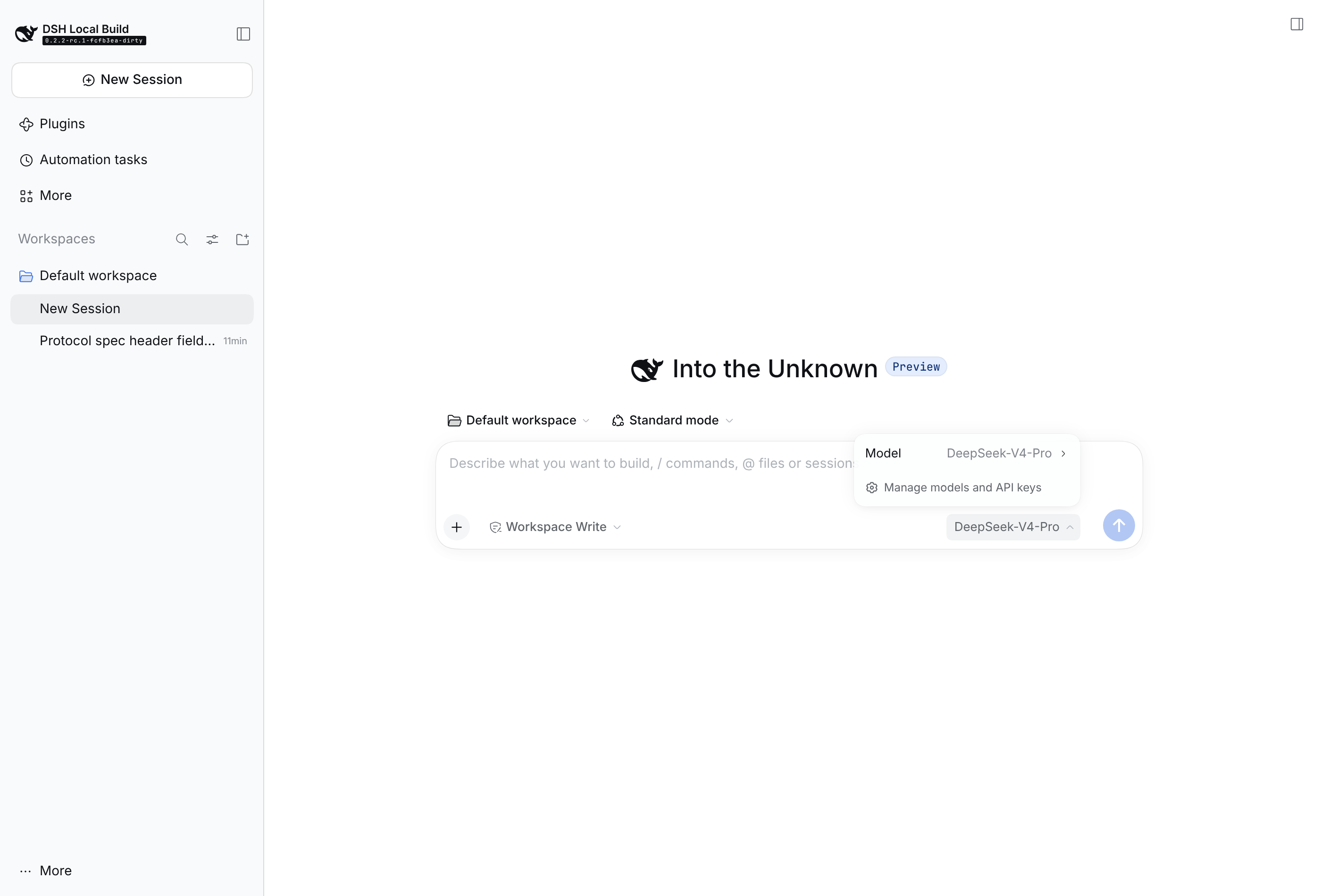
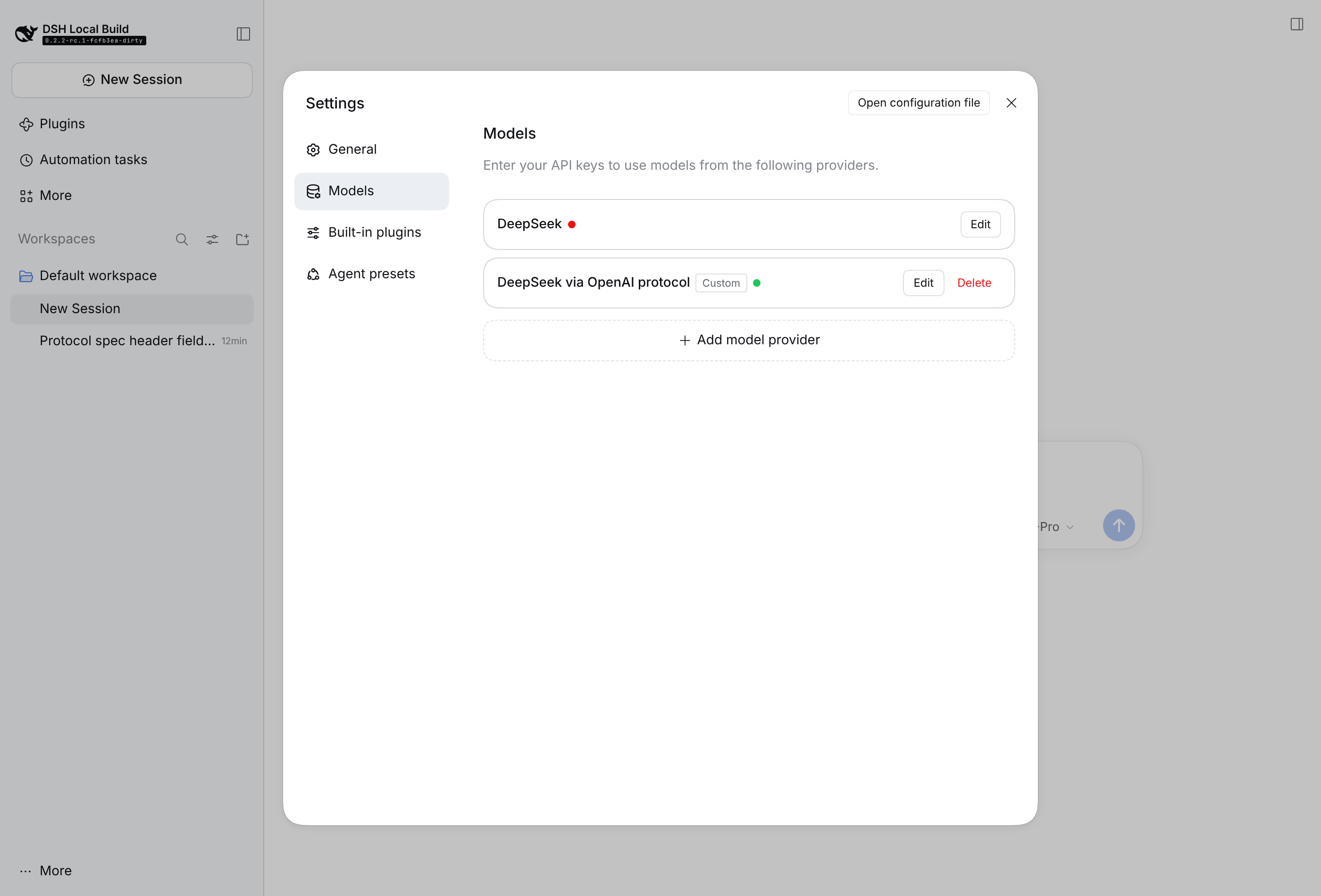
The model menu under the message box picks the model for the conversation. Manage models and API keys at its bottom opens Settings → Models: enter a key for DeepSeek, or Add model provider for any of about 40 providers (Anthropic, OpenAI, Google Gemini, OpenRouter, …) or a custom OpenAI- or Anthropic-compatible endpoint, whose model list is fetched from the endpoint. Every new tool works on any model: ask_image picks an image-capable model that has a key when the conversation's model reads no images.
| Model menu | Settings → Models |
|---|---|
 |
 |
Demos (real runs on the DeepSeek API)
Co-canvas · Point instead of explaining. The agent works in a shared browser whose window carries a small toolbar; the Web UI also shows it live in a side tab. The user boxes or points at something on the real page, with a note; each mark is resolved to the element underneath — button "Submit" (2nd of 2 button elements with this text) plus a CSS selector — and reaches the agent with its next tool result. Two real runs on a page with two identical "Submit" buttons — watch marking in the real browser window (72 s) or in the Web tab (77 s), both with Chinese captions:
- The agent asks. Told only to "press the Submit button", the agent noticed the ambiguity and called
ask_user_to_mark; the user boxed Plan B and sent the mark; the agent clicked Plan B. - The user corrects mid-task. Told to "submit Plan A", the agent was paused the moment the page appeared; the user boxed Plan B with "Change of plan" and resumed. The browser action the agent had already chosen was refused instead of run, and it re-planned: "You changed the plan to Plan B… Plan A was never submitted."
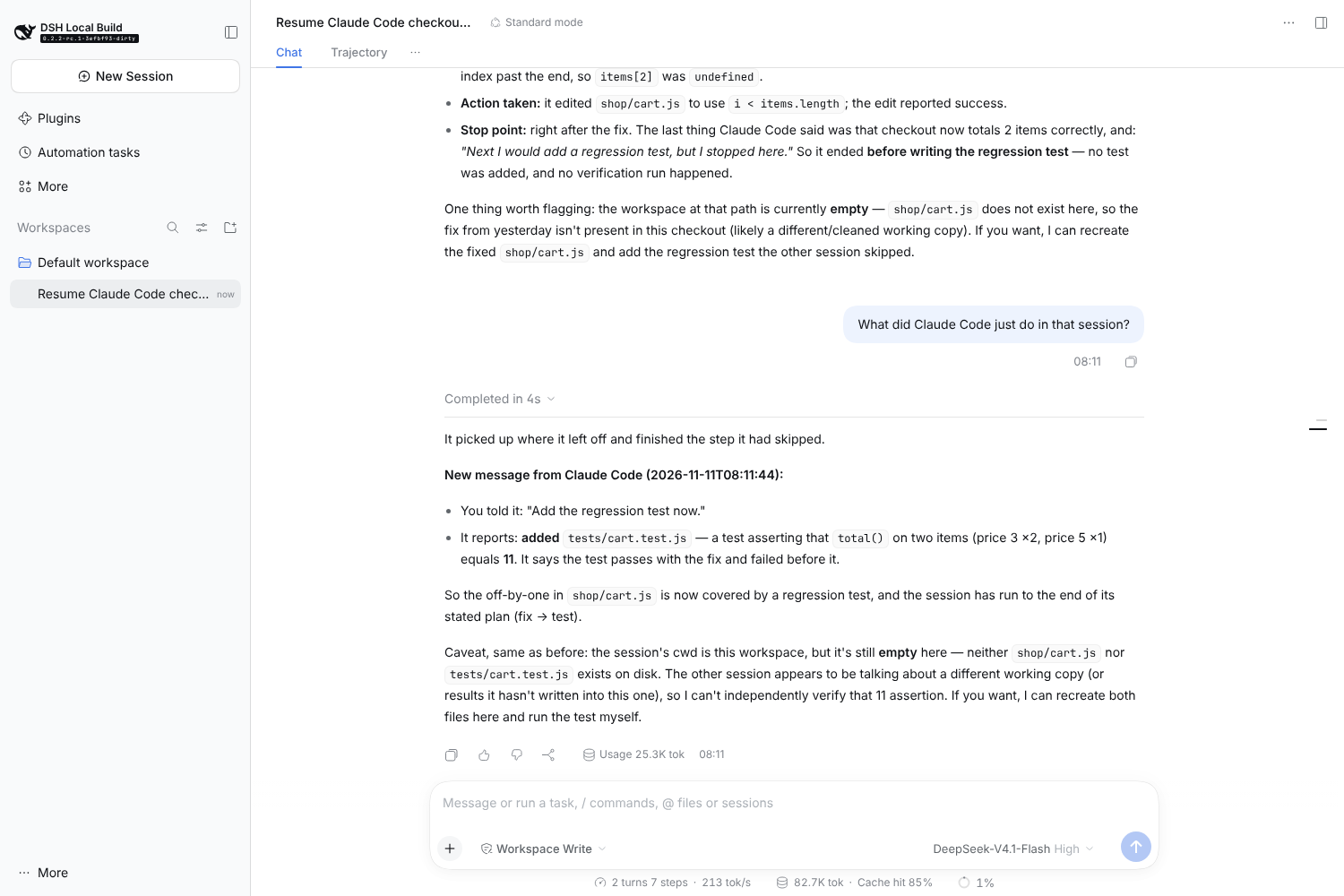
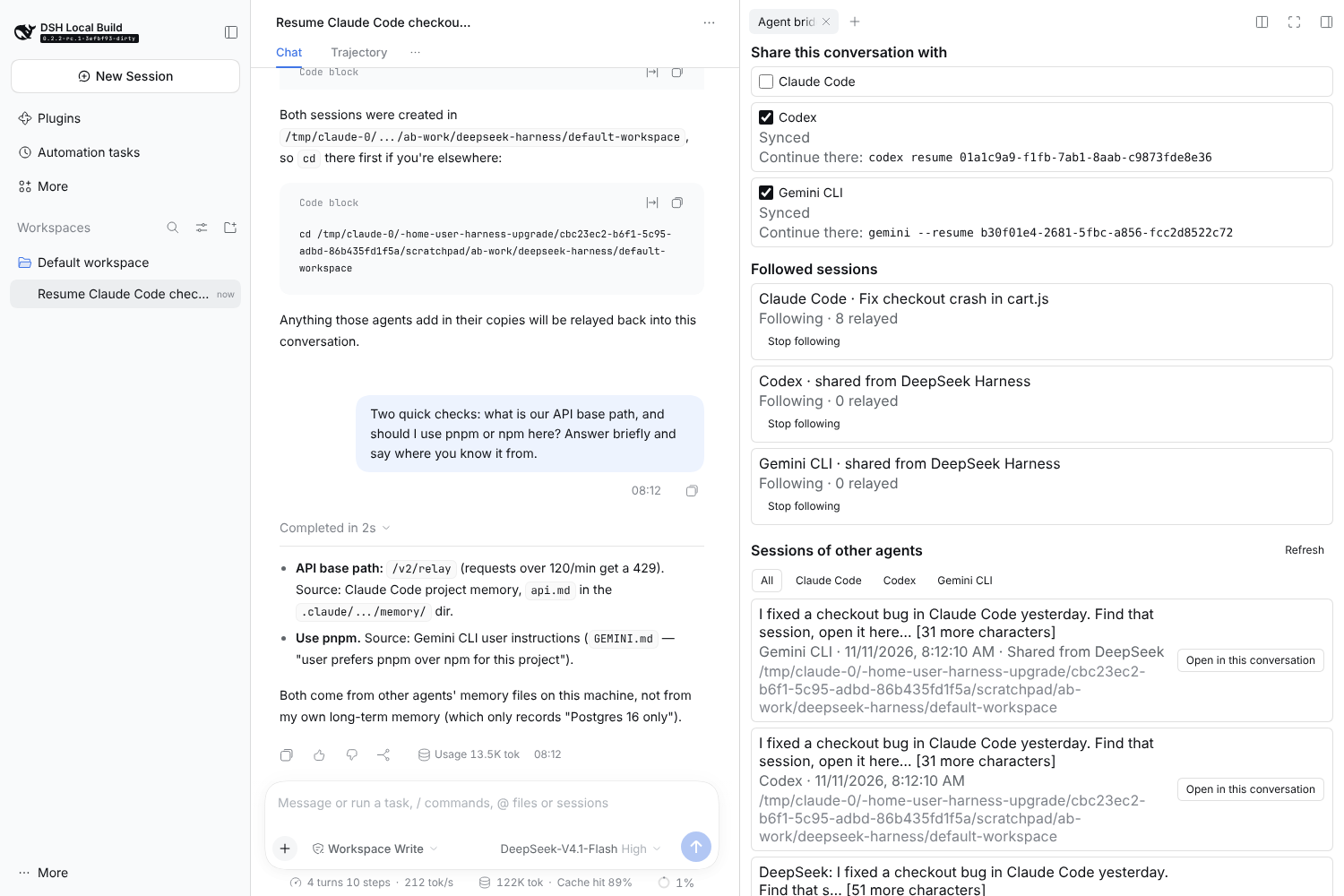
Agent bridge · Claude Code, Codex, and Gemini CLI in one conversation. Like Codex's import of Claude Code sessions, but live and in both directions. A real run on the DeepSeek API through the Web UI: asked about "a checkout bug I fixed in Claude Code yesterday", the agent searched with external_sessions, opened the Claude Code session, and summarised where it stopped. Claude Code then added two messages to that session; they arrived as a relayed update without waking the agent, and "what did Claude Code just do?" was answered from them (a regression test, tests/cart.test.js). "Share this with Codex and Gemini CLI" wrote the conversation as a native session of each and returned codex resume <thread> and gemini --resume <id>: the real Gemini CLI lists it, and the real Codex holds every message, extended after each later turn through Codex's own importer. Memory went both ways: the API base path came from Claude Code's project memory and "use pnpm" from Gemini CLI's, each cited by source, while DeepSeek Harness's "Postgres 16 only" was written into a marked block of CLAUDE.md, AGENTS.md, and GEMINI.md.
| A followed Claude Code session reports its new work | The Agent bridge tab |
|---|---|
 |
 |
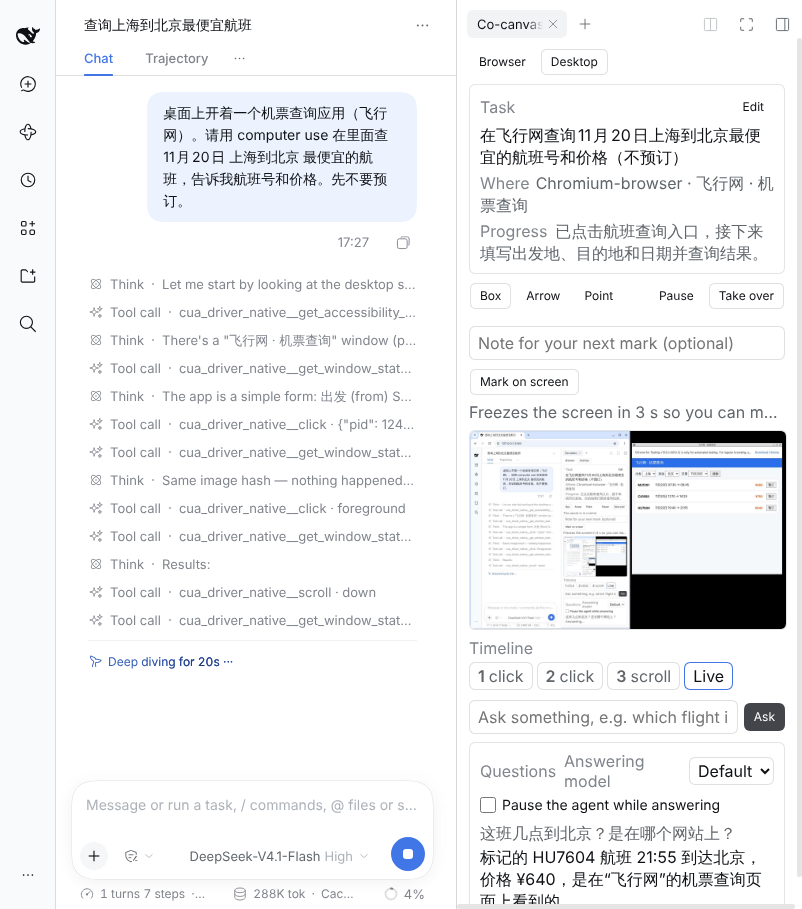
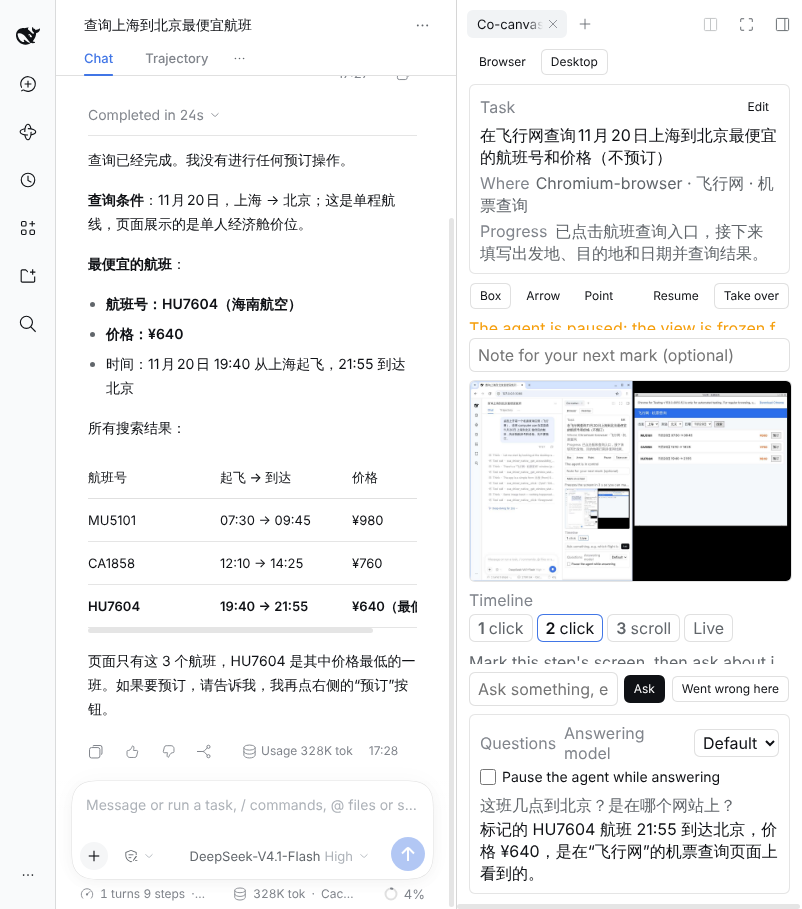
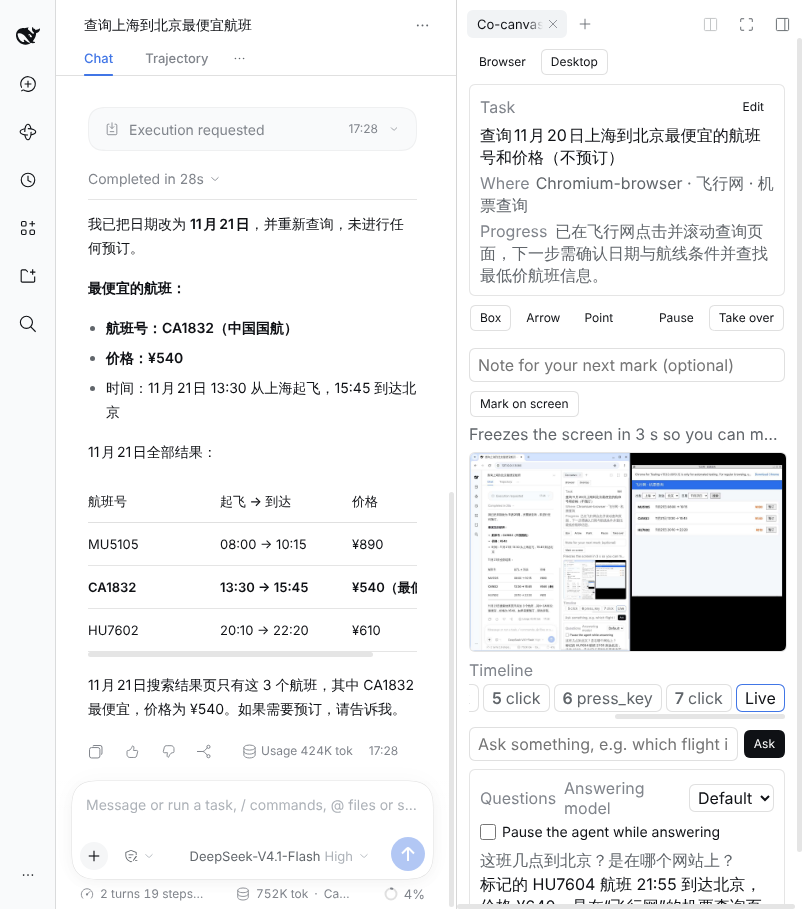
Co-canvas on the desktop · Ask on the side, go back in time. With the official Cua Driver computer-use provider, the same tab shows the desktop live. A real run on the DeepSeek API with a flight-search app on the desktop: asked for the cheapest Shanghai→Beijing flight on 20 November, the agent worked the app with computer use while the tab's Task card filled itself in: the goal, the window "飞行网 · 机票查询", and a progress line. Mid-task the user boxed a result row and asked "这班几点到北京?是在哪个网站上?"; deepseek-flash answered in the tab in 3.1 s ("HU7604 21:55 到达北京,¥640,在飞行网的机票查询页面上") while the agent kept working, and the question and answer reached the agent as information only. Then the user picked step 2 on the Timeline (the agent paused and the tab showed that step's screen), wrote "日期错了,我要的是 11月21日", and pressed Went wrong here: the agent went back, searched the 21st, and reported CA1832 at ¥540. Nothing was booked. Mark on screen freezes the real screen full screen for marking.
| Side question answered while the agent works | Back to step 2 on the timeline | The agent redid the search for the 21st |
|---|---|---|
 |
 |
 |
| The agent asks; the user marks | The user corrects mid-task |
|---|---|
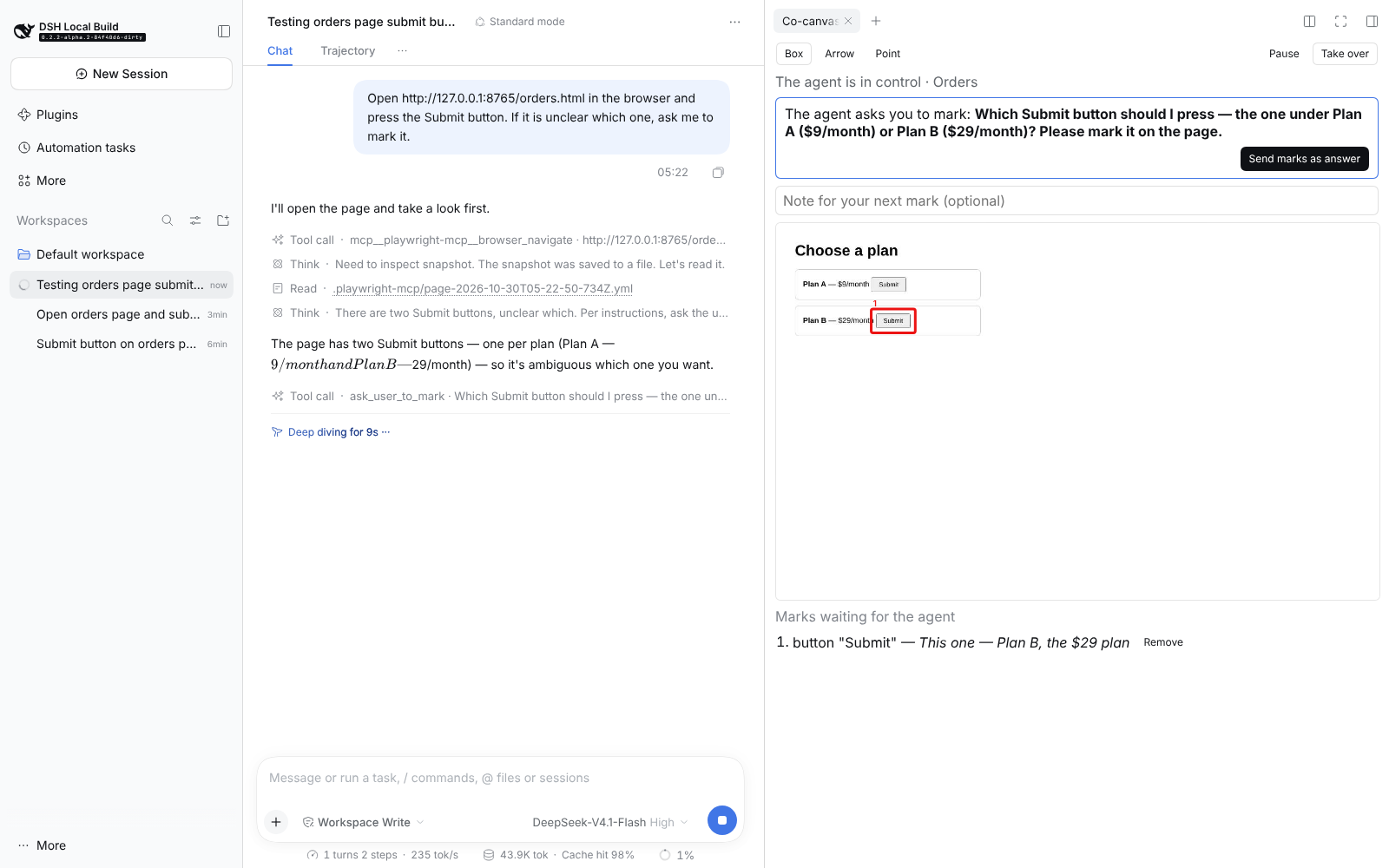 |
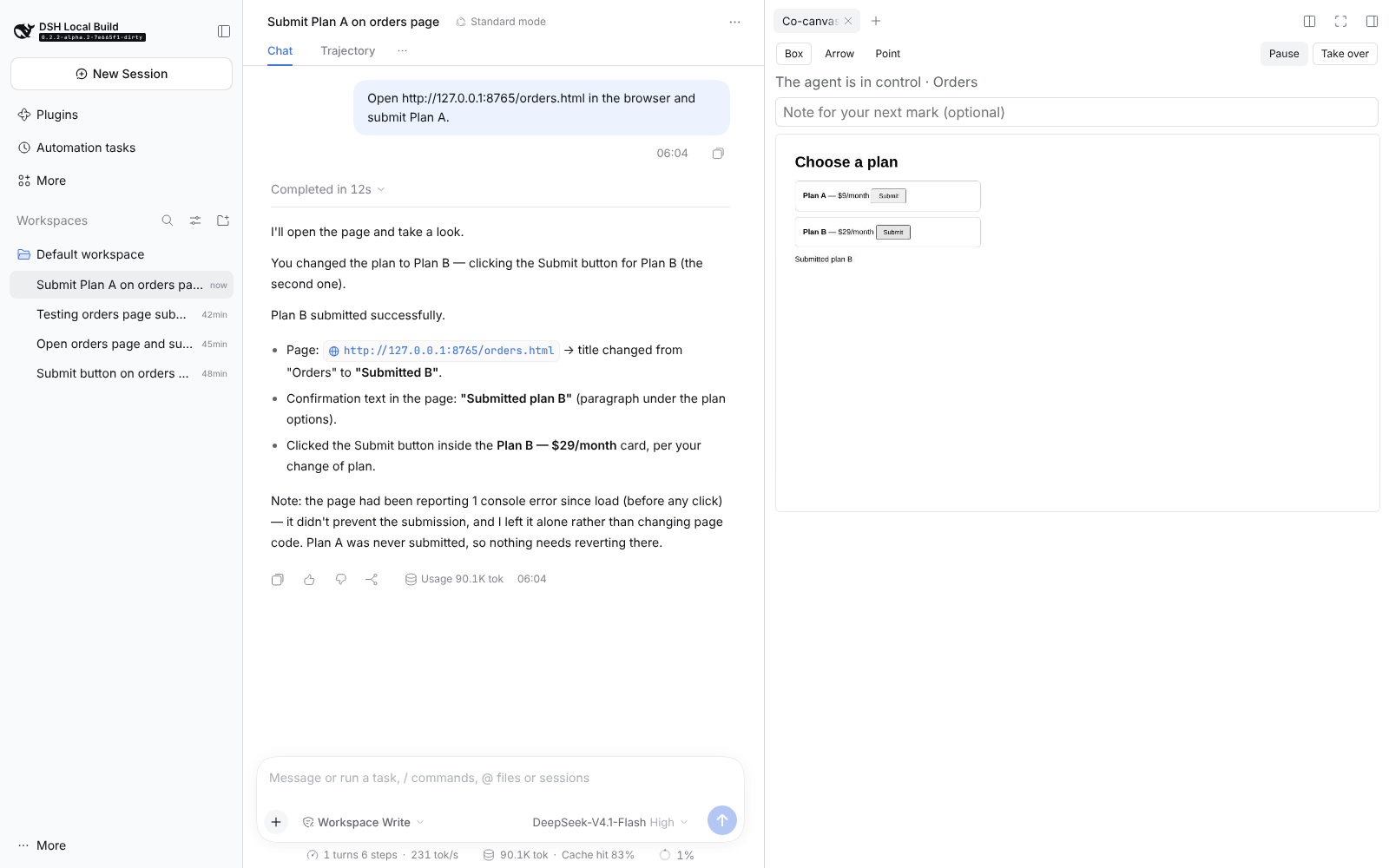 |
1 · Fix a bug from a screen recording. demos/1-video-bug holds a tiny web shop and a 10-second Playwright recording in which Checkout throws. The agent watches the video, reads the error off the frame (TypeError … reading 'price' (cart.js:11)), finds the off-by-one loop, fixes it, and verifies the fix with Node. Change-ranked sampling picks 5 frames — one per UI change — and the last one is the error banner.
2 · Meeting minutes from a recording. demos/2-meeting/meeting.mp3 is a 58-second two-voice meeting synthesized with espeak-ng. read_audio transcribes it with the local SenseVoice model (downloaded and loaded on first use through the speech seam's preparation), and the agent writes minutes with decisions, action items and open questions, each with a timestamp. It recovered the /v1/relay prefix, 120 requests per minute, the dead-letter queue after three attempts and the Friday deadline; robotic speech garbled the path's last segment and the owner's name, and the minutes flag both as low-confidence instead of guessing.
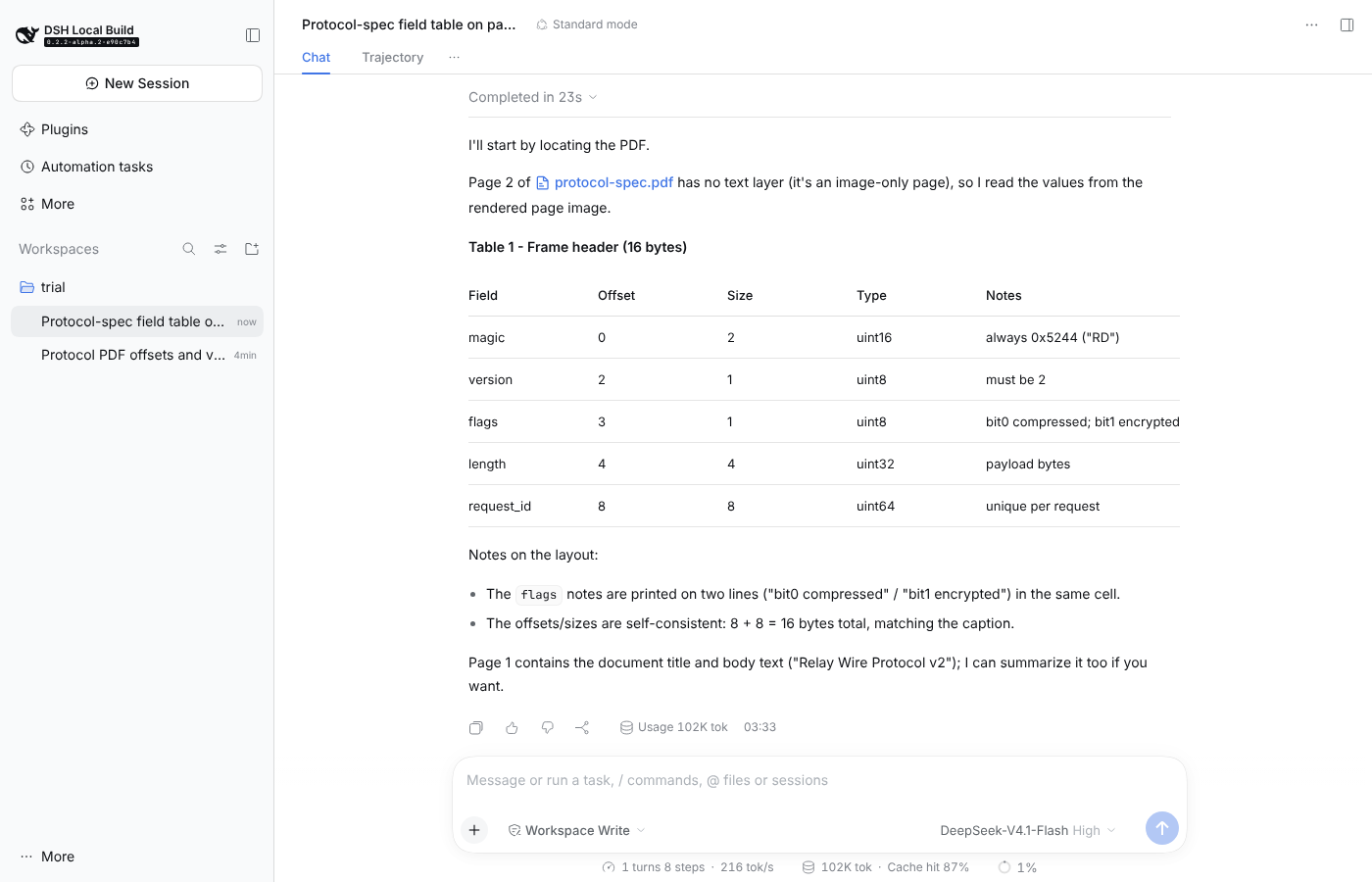
3 · Implement a parser from a scanned spec. demos/3-scanned-spec has a 2-page PDF whose field table is a scan with no text layer. read_document returns an outline flagging page 2 as "no text layer", the agent re-reads it as an image, writes parse_header (>HBBIQ) plus 14 pytest tests, and runs them; an independent hidden test also passes.
Text-only model sees a screenshot. On deepseek-v4-pro, read_image refuses; the agent switches to ask_image, deepseek-flash reads the screenshot, and only text returns.
Memory across sessions. Session 1: "our API base path is /v2/relay, never use print() for logging, Postgres 16 only." Session 2, fresh: "write a function that logs a startup message with our base path" → uses structlog and /v2/relay with no tool calls.
Reproduce after setup: DEEPSEEK_API_KEY=… demos/run.sh 1 (or 3).
Evaluation: how should an agent look at a video?
12 synthetic 40-second dashboard recordings (ticking clock, one metric change, one alert banner shown for 2 s at a random time). The agent must call read_video once on the whole video and report the alert code. Same model, same prompt; only frame selection changes. Script: eval/video_eval.py; raw runs: eval/results/.
| Frame selection | Frames per call | Alert found | Median input tokens |
|---|---|---|---|
| Change-ranked (ours) | 4 | 12 / 12 | 14.2k |
| Change-ranked (ours) | 8 | 12 / 12 | 16.4k |
| Uniform (baseline) | 8 | 8 / 12 | 16.4k |
| Uniform (baseline) | 24 | 12 / 12 | 24.8k |
Uniform sampling needs 6× the frames and 1.75× the input tokens to match change-ranked selection at 4 frames. Medians are reported because two uniform runs fell back to extracting extra frames with bash (124k and 198k tokens).
Why ranking, not a threshold. ffmpeg's scene score is designed for film cuts (> 0.3). In a screen recording an error banner scored 0.13 and a one-line text change ~0.005, so the usual 0.3 threshold kept only the first frame. read_video therefore scores every frame on a 320-px copy and keeps the first frame plus the largest changes, at least 1 s apart.
Status
| Item | State |
|---|---|
read_document, read_video, ask_image, memory |
Done, verified end to end on DeepSeek |
read_audio |
Done, verified end to end with the real SenseVoice model (demo 2) |
| Co-canvas (shared browser, marks, pause/take over) | Done, verified end to end on DeepSeek through the real Web UI; Windows uses the built-in Edge |
| Agent bridge (open and follow Claude Code / Codex / Gemini CLI sessions, share live as their native sessions, two-way memory) | Done, verified end to end on DeepSeek through the Web UI with the real Codex and Gemini CLIs; resuming in Claude Code not exercised (needs a signed-in Claude Code) |
| Computer use + desktop co-canvas (desktop view, window-grounded marks, Mark on screen, task brief, side questions, timeline and going back) | Done, verified end to end on DeepSeek on a Linux X11 desktop; the Cua Driver runtime ships Windows binaries, Windows not yet fully exercised |
| Subagents | Co-canvas marks, side answers and the timeline belong to the top-level conversation; a subagent's browser and desktop actions still wait while the user holds control. Memory stores and reflects on top-level turns only |
| Other model providers | Verified end to end through a custom OpenAI-compatible provider added in Settings → Models: read_document on a scanned PDF answered on that route |
| Speech output | Not started |
Repository layout
deepseek-harness/  the upgraded harness: official 0.2.2-rc.1 plus this project's commits
install/           setup.ps1 (Windows), setup.sh, the dsh-mm launcher and plugin overlay
demos/             demo projects, recordings, fixtures, and run.sh
eval/              video benchmark (Python orchestrator, Playwright recorder) and results
docs/              screenshots, recordings, and engineering notes
memory/            Python prototype of the memory design (MCP server + dsh plugin)
relay/             Relay, a self-hosted inference gateway
No comments yet. Be the first to write one.