dsh-session-mindmap
English · 简体中文

Turn a DeepSeek Harness session into a self-contained HTML mind map.
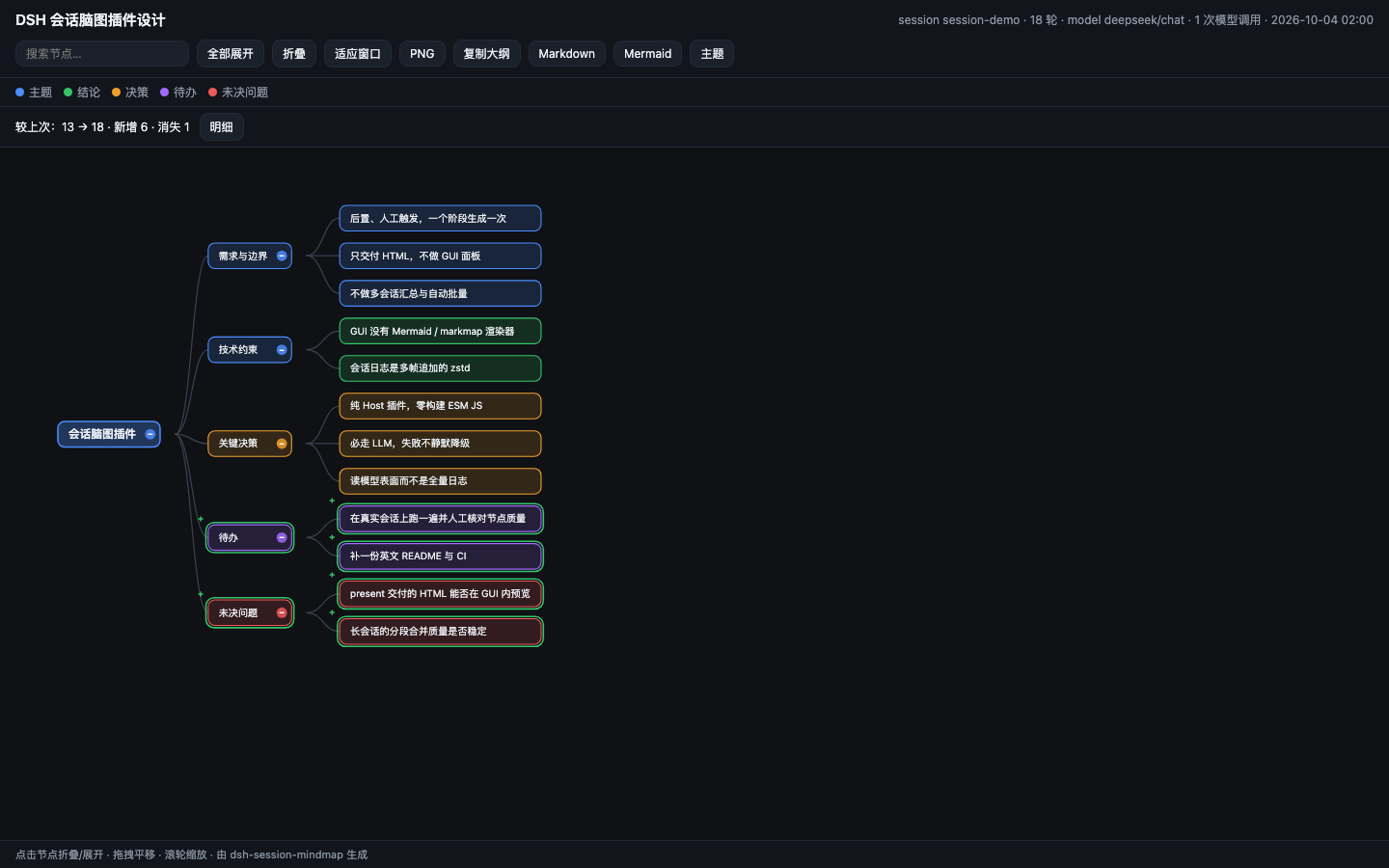
At the end of a work phase, run /mindmap and get one portable file that shows
what the session was actually about: topics, conclusions, decisions with their
reasons, todos and open questions. Open it in any browser, hand it to someone
else, or file it away — the file needs no network, no fonts and no CDN.
Why this exists
A long session is a terrible artifact: the interesting parts (what was decided, what was rejected and why, what is still unresolved) are spread over dozens of turns, and reading the transcript again is rarely worth it. This plugin produces the one-page version.
It is deliberately not a GUI panel, not an automation, and not a knowledge base: it runs when you ask it to, writes one file, and stops.
Install
# from npm
dsh plugin add dsh-session-mindmap

# from a checkout (development)
dsh plugin add /path/to/dsh-session-mindmap

# from git (lib/ is committed, so no build step runs)
dsh plugin add github:jianyuepei/dsh-session-mindmap
Requires DSH 0.2.0-rc.2 (dsh --version). The plugin manager refuses to
install when the declared peer versions do not match the running DSH; upgrade
DSH rather than forcing an exemption if you can.
Usage
Ask the model:
把这个会话整理成脑图
or call the tool yourself:
session_mindmap
  sessionId?  "last" or a session id; defaults to the current session
  kinds?      CSV of topic,conclusion,decision,todo,question,file
  focus?      only summarise this topic
  language?   zh or en; defaults to the plugin config
  force?      ignore the cache and call the model again
or use the command, which never involves the model in deciding anything:
/mindmap                       # current session
/mindmap last                  # most recent session
/mindmap session-abc --reveal  # a specific session, then select it in the file manager
/mindmap --no-open             # write the file quietly
/mindmap --focus=发布方案       # only one topic
/mindmap --kinds=topic,file    # include the files that were touched
/mindmap --lang=en             # one English map, without touching the config
/mindmap list                  # recent sessions with their ids and titles
The command is the intended entry point: it runs even when you do not want to spend a model turn on the request itself.
Output
<session workspace>/.dsh/mindmap/
├── <sessionId>-<yyyymmdd-HHMM>.html   # the deliverable
└── .cache/<hash>.json                 # map + exports, keyed by session state
- One click away. The result carries a same-origin link
(
/session-mindmap/artifact?id=…) instead of only a path, so the mind map opens in the browser directly. The file path stays on its own line for terminals, logs and headless runs. Links are process-scoped — they work while the DSH instance that generated them is running, which is the same lifetime the app's own token URLs have. - The HTML is standalone. No CDN, no web fonts, no images, no telemetry. It draws the map with inline SVG, so the file still works offline and can be attached to a chat or committed.
- What changed since last time. Generating a map for a session that already
has one reports the delta —
13 → 18 nodes · +6 · -1— lists the added and dropped topics, marks the new nodes in the artifact, and puts the same line in the result. It is a structural diff of two node trees: no model call, no cost, and the same input always gives the same answer. The previous run's node labels are handed back to the model with "reuse this wording", because two runs otherwise describe the same topic differently and the diff becomes noise. The bookkeeping lives in.cache/index.json. - Interactions: fold nodes, drag to pan, scroll to zoom, search to
highlight, hover to see which part of the conversation a node came from
(
segment 3 · seq 218-245), copy the outline, and export to PNG / Markdown / Mermaid from the toolbar. - Cache: keyed by the session's captured event sequence, the enabled kinds,
the focus, the language and the model. Re-running an unchanged session skips
the model call entirely;
force: true(or--force) bypasses it. - Regenerating writes a new timestamped file, so older snapshots stay put.
Add
.dsh/to.gitignoreif you do not want them committed.
Configuration
Set these in the plugin row (profile cordis.patch.yml) — a patch replaces the
whole config object, so restate every key you want to keep:
- id: session-mindmap
  name: 'dsh-session-mindmap'
  config:
    language: en
    maxNodes: 120
| Key | Default | Meaning |
|---|---|---|
provider / model |
empty | Empty follows the agent's default model. Point these at a cheap model if you generate these often. |
kinds |
topic, conclusion, decision, todo, question |
Node kinds to extract. Add file to include the files a session touched. |
language |
zh |
Node language: zh or en (the language tool argument overrides it for one run). |
maxInputTokens |
24000 |
Transcript budget for one model call. |
maxBlocks |
8 |
Hard cap on map calls for a long session, plus one merge call. |
maxNodes / maxDepth |
80 / 4 |
Clamps applied to whatever the model returns. |
maxOutputTokens / temperature |
8000 / 0.2 |
Per-call generation settings. A node costs roughly (label + detail) characters, so this cap has to hold the whole answer — see Troubleshooting. |
llmTimeoutMs |
180000 |
Per-call timeout. |
outputDir |
.dsh/mindmap |
Relative to the session workspace; absolute paths are accepted. |
cache |
true |
Reuse the last result while the session has not grown. |
openAfterBuild |
true |
Open the artifact after a human runs /mindmap. Ignored for model-invoked calls, which leave a deliverable card instead. |
How it works
sessionQuery.readSurface(id)        the context the model actually saw
        ↓  extract.js               events → one block per turn (pure)
        ↓  budget.js                token estimate → 1 call, or ≤maxBlocks + 1 (pure)
        ↓  organize.js              ctx.llm.stream → strict JSON, one retry (pure)
        ↓  schema.js                coerce, clamp, de-duplicate (pure)
        ↓  render-html.js           self-contained HTML with an inline SVG renderer
   <workspace>/.dsh/mindmap/*.html
Three decisions are worth knowing about, because they are the ones a reviewer usually asks about:
- No Mermaid. DSH's web GUI ships no diagram renderer (no Mermaid, no
markmap — verified by scanning the app bundle), so a
```mermaidblock would render as plain code. The picture is drawn by the generated file itself. Mermaid is offered as an export, for tools that do render it. - Sessions are read through
ctx.sessionQuery. The on-disk log is a multi-frame zstd append (one measured session held 136 frames), so decompressing it directly yields only the first frame. The service is the only supported source, andreadSurfaceis the closest thing to "what this session was about". - A model failure is an error, not a fallback. If the model does not return usable JSON after one retry, the run fails with a clear message instead of writing an artifact that merely looks like a mind map. A silent rule-based outline is the kind of output people would trust without noticing it is not what they asked for.
Privacy
- The plugin reads sessions through the host service and sends the transcript to the model you already configured. Nothing is sent anywhere else.
- Artifacts are written to the session's own workspace.
- The test suite contains no real session content: every fixture is synthetic. Please keep it that way.
Compatibility
| DSH | 0.2.0-rc.2 (older releases are refused by the plugin manager) |
| Node | >= 20.18 |
| Profiles | desktop and web (host-side plugin; no client bundle) |
| Build | none — the published lib/ is plain ESM, committed to git |
Development
npm install          # one dev mirror (schemastery); the DSH packages come in as peers
npm test             # node:test, 77 tests, no network, no DSH install needed
npm run demo         # regenerate examples/demo.{html,md,mmd}
Tests come in three layers, and the middle one is the point:
- Pure logic —
extract,budget,schema,render-*: no host, no I/O. - Wiring contract —
tests/index.test.jsrunsapplyagainst the real@deepseek-ai/dsh-tools, proving the registered tool compiles and validates its arguments. It skips (rather than failing) when the DSH packages are unreachable, so a contributor without them can still run everything else. - Pipeline —
tests/pipeline.test.jsdrives read → organise → render → write with a fake host, a canned model answer and a temp workspace.
lib/index.js          Cordis wiring: Config, tool, command
lib/config-schema.js  Schemastery schema (tested against the real peer)
lib/plugin.js         Host seams with no DSH imports: tool/command contracts, helpers
lib/pipeline.js       read → extract → organise → render → write (no DSH imports)
lib/extract.js        event log → per-turn blocks
lib/budget.js         token estimate + segmentation
lib/organize.js       prompts, streaming, strict-JSON parsing, map-reduce
lib/schema.js         mind-map model: parse, coerce, clamp
lib/render-md.js      Markdown / Mermaid / outline
lib/render-html.js    the standalone deliverable
scripts/make-demo.mjs regenerates examples/
Troubleshooting
模型两次都没有返回可用的脑图 JSON / "the model did not return usable mind-map JSON".
Read the first line of the error — it names the finish reason:
- output hit maxOutputTokens — the answer was cut off because it did not fit.
Raise
maxOutputTokens, or ask for less (--kinds=topic,conclusion,--focus=…, a smallermaxNodes). A truncated answer is not always lost: everything written before the cut is parsed, so the map comes back slightly shorter and the log says so. - anything else — the model answered with prose or a malformed object. Try
another model (
provider/model), or narrow the session withfocus.
The node budget in the prompt (NODE_BUDGET in lib/organize.js) and
maxOutputTokens have to agree: asking for more nodes than the output limit can
hold is what produced a wall of "no valid JSON" errors once. A test asserts the
two stay in sync.
Contributing
Issues and PRs are welcome. Three ground rules:
- keep the plugin host-only and build-free — no client half, no bundler, no new runtime dependency;
- keep real session content out of tests and issues;
- keep this file and README.zh-CN.md in sync — they are two translations of one document, not two documents.
Please run npm test and npm run demo before opening a PR; CI checks both and
fails if examples/ is stale.
DESIGN.md explains why the plugin is built this way: the measured
constraints, the architecture, the contracts, and the rules behind the failure
modes that have already been hit.
License
MIT
No comments yet. Be the first to write one.