dsh-delivery-board
Codebase-native delivery context.
Delivery state lives with the source: humans and models share one context.
From Plan through requirements, design, build, test, and go-live, if delivery state is not alongside the code, people and agents struggle to stay aligned: who owns what, what “done” means, and where work is stuck often live only in handoffs and verbal sync.
dsh-delivery-board is a skill-backed DeepSeek Harness (dsh) plugin that writes the stage pipeline, handoff trail, and client weekly report into in-repo delivery state. The board, audit, and weekly report are projections of that same state — not a separate service.
The goal is clear: run the full delivery lifecycle from the codebase, so PMs, engineers, QA, and AI agents share one Source of Truth.
dsh plugin --profile web add github:jerryxff26-alt/dsh-delivery-board
Desktop app: install the same GitHub spec, github:jerryxff26-alt/dsh-delivery-board, from the plugin manager. (The CLI command above is the verified path; the desktop plugin-manager flow has not been separately verified.)
Tested with DSH 0.2.0-rc.2 (developer preview). No runtime dependencies.
Demo
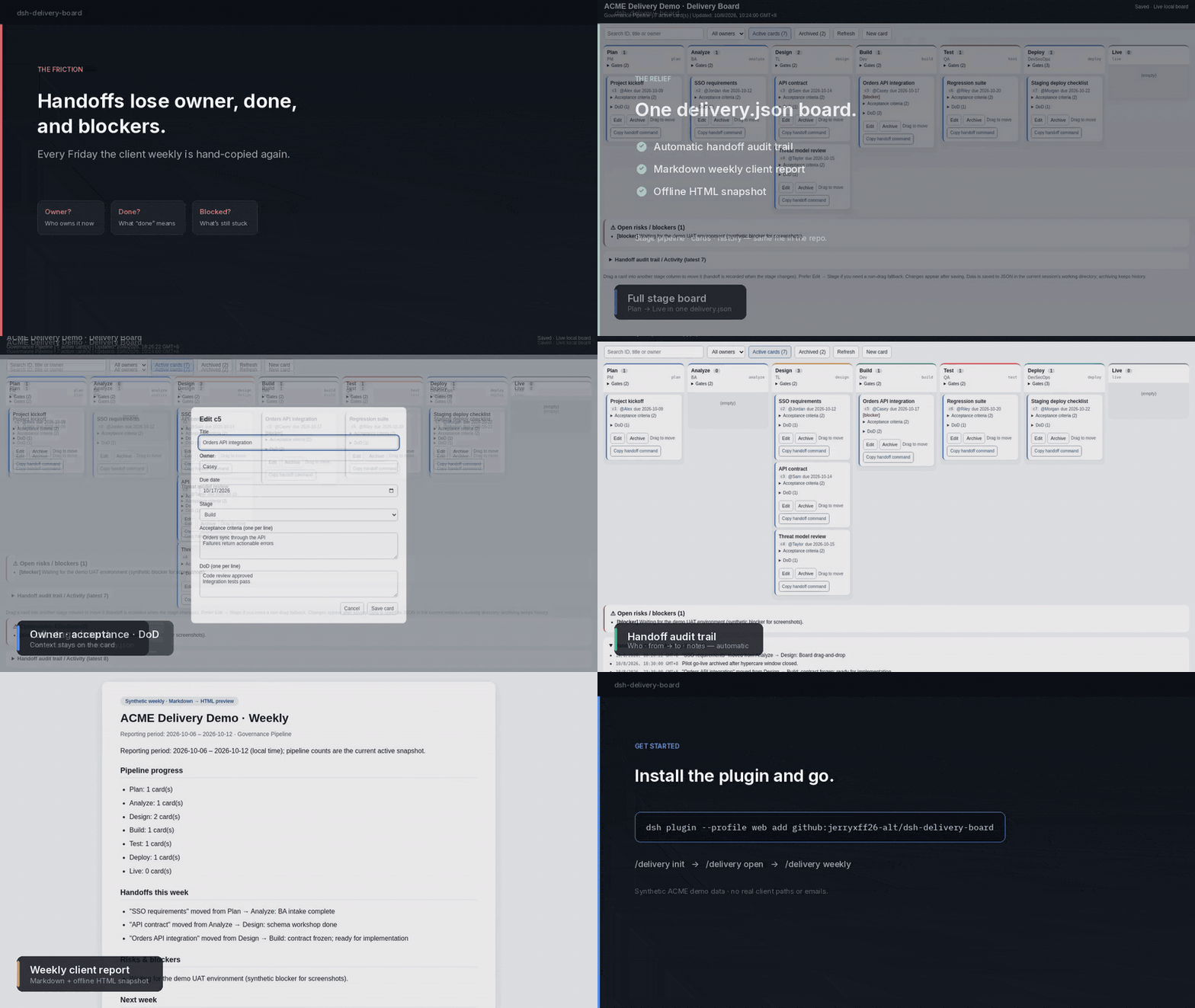
~19s silent walkthrough of board/report views (English overlays · synthetic data), not a model-led planning recording. MP4 if you prefer download over the inline GIF.
Design principles
- Delivery state is a first-class citizen — stages, owners, acceptance criteria (AC), Definition of Done (DoD), handoffs, and blockers live in the repo and evolve with Git.
- Views are projections — the local board, handoff audit, client weekly report, and offline HTML are all projections of the same delivery state.
- Operate through DSH — advance stages, fill in AC, log blockers, and generate weekly reports with
/deliveryor plain language; you do not treat JSON as the day-to-day editing UI. - Clear boundaries — this is not a rebuild of an enterprise project-management platform; it keeps in the codebase only the delivery context the current repo actually needs.
What you get
- Stage pipeline + cards — each card has an owner, due date, acceptance criteria and Definition of Done (DoD).
- Handoff audit trail — moving a card to another stage records who handed what to whom, automatically.
- Weekly report — a Markdown client report: pipeline snapshot, this week's handoffs, and cumulative risk/blocker logs (no resolution status yet).
- Local editable board — ask
/delivery Open the editable board; the tool serves a mouse drag-and-drop board on127.0.0.1that saves back to the same delivery state. Archive/restore keeps history. Accessibility fallback: Edit → Stage. - Offline HTML snapshot — a single read-only file teammates without DSH can open.
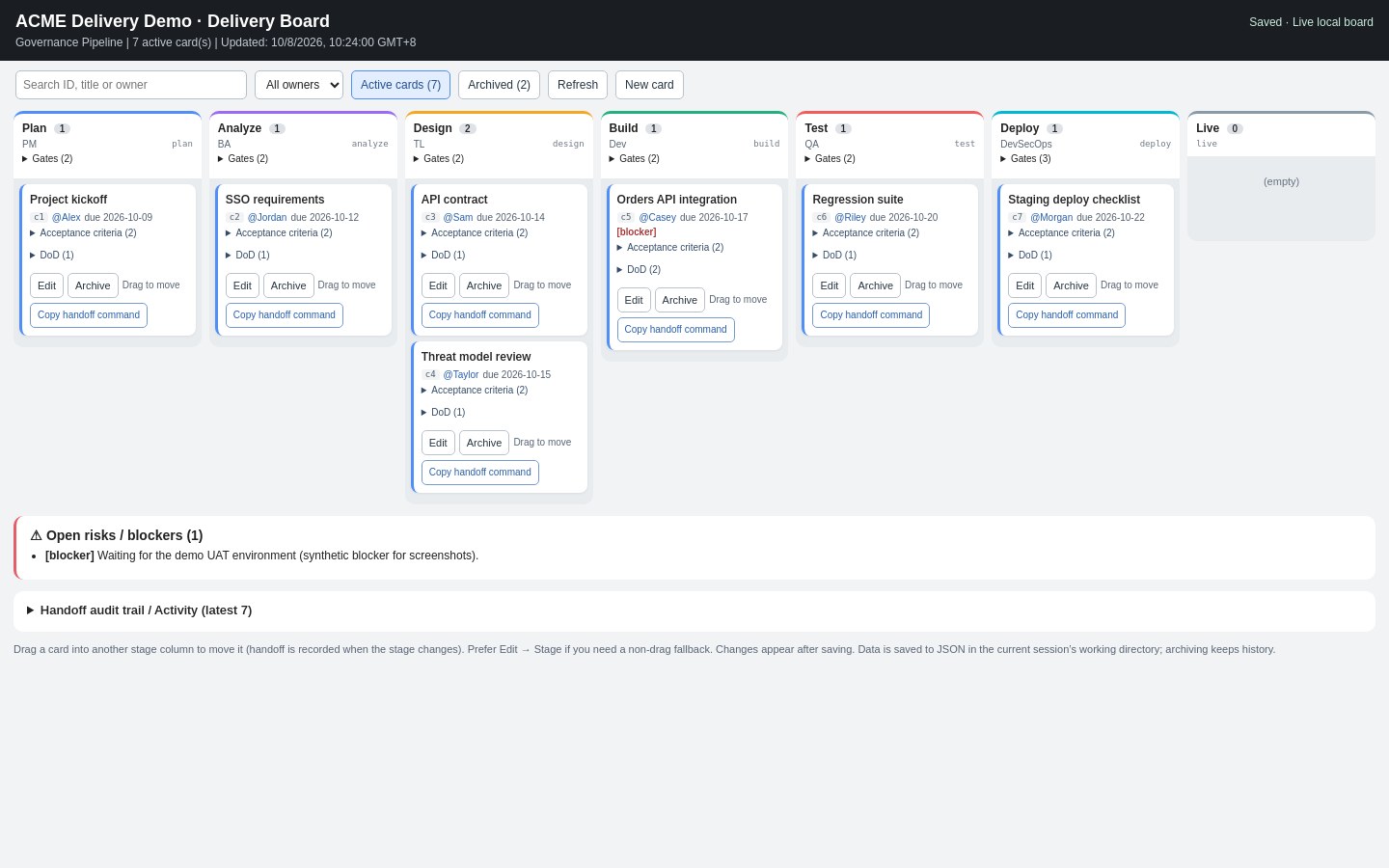
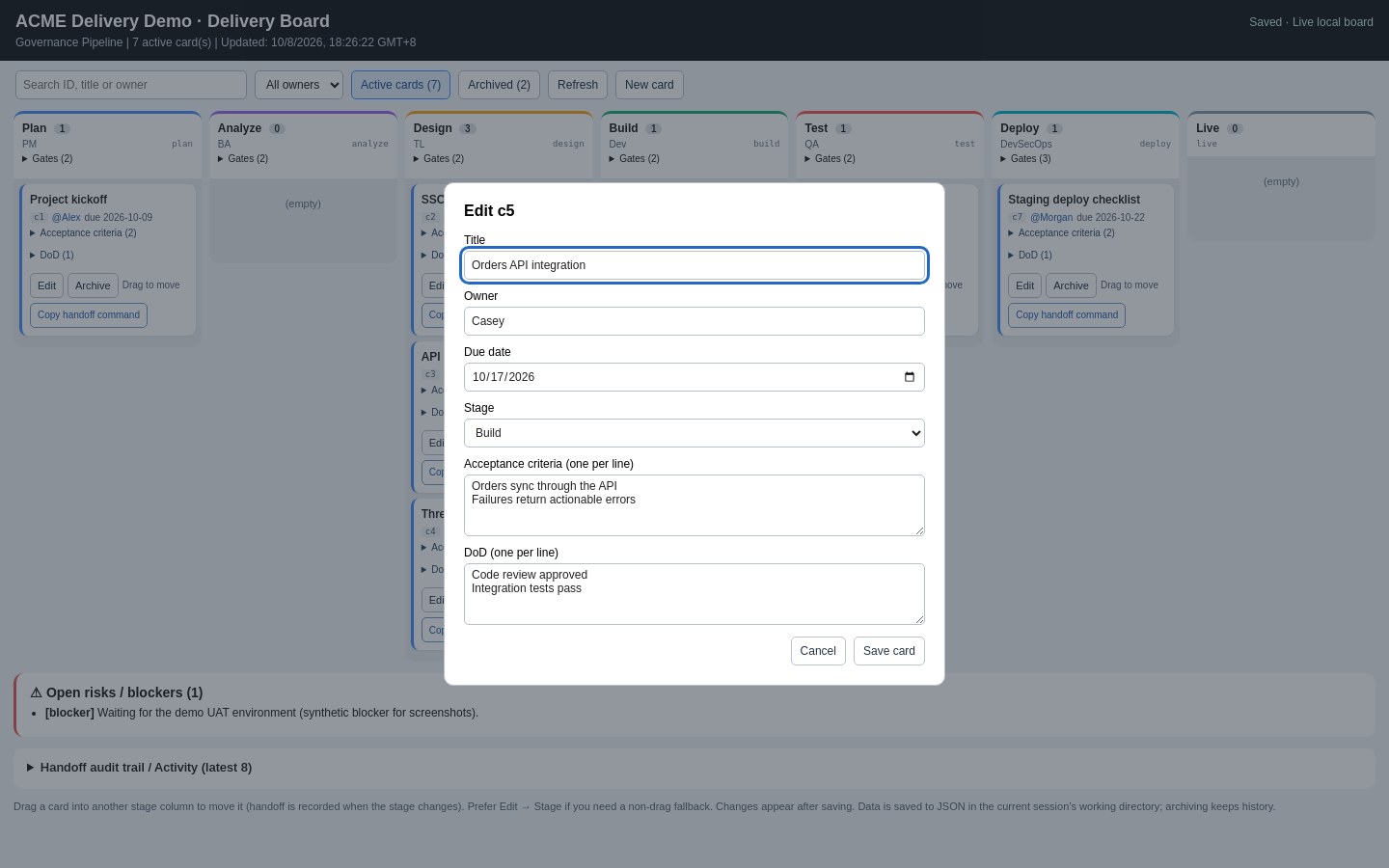
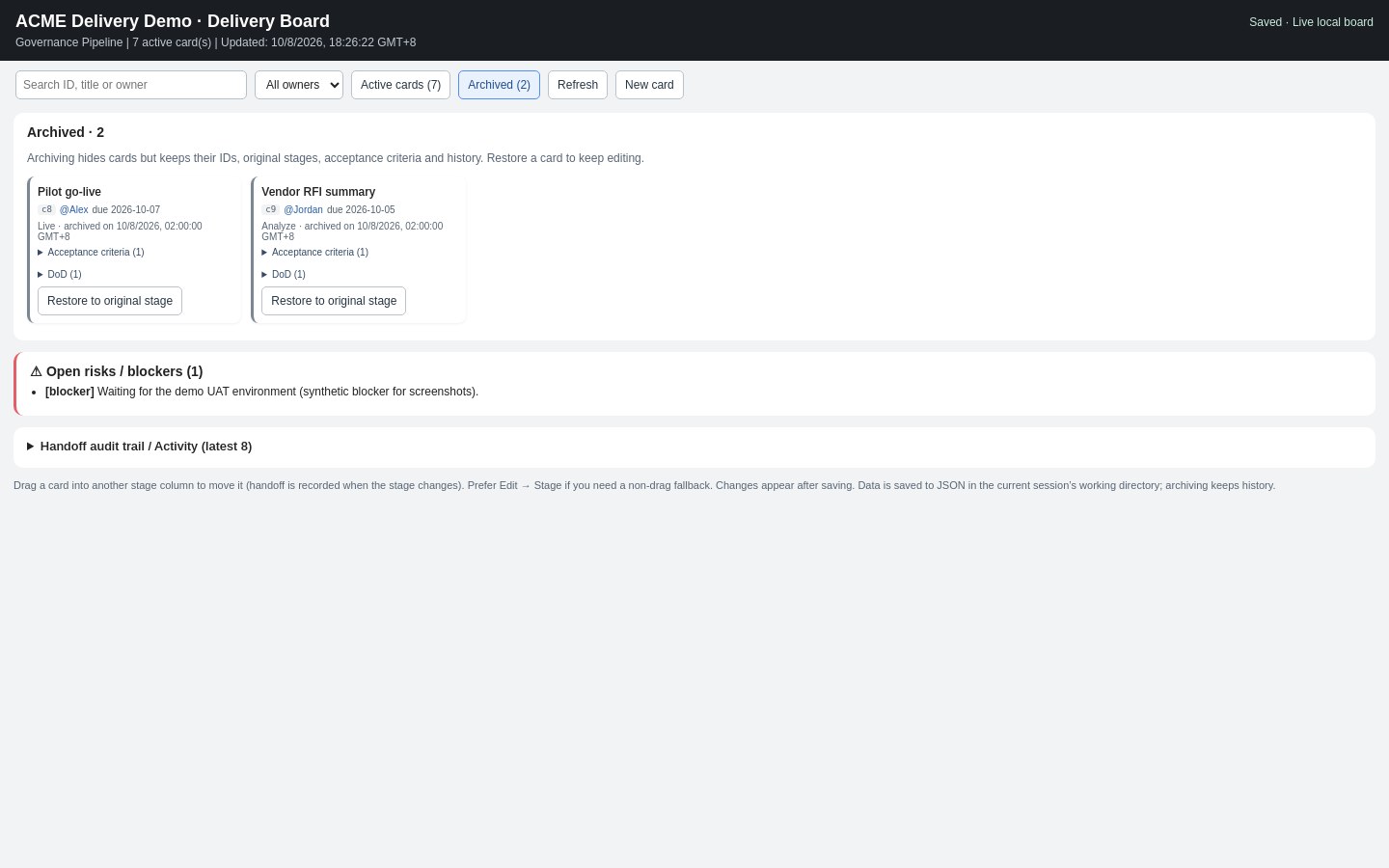
Screenshots captured at a normal laptop viewport (~1440×900) from a synthetic ACME board: denser columns so Plan→Live fit without horizontal scroll when possible.
Usage
Model-led skill (normal workflow)
The plugin bundles and registers a delivery skill. Type /delivery followed by the outcome you want; DSH loads its instructions into the model instead of parsing a direct command. No separate skill copy/install is needed. Plain-language requests can also discover the skill through DSH's skill catalog.
/delivery Review this repository and propose a delivery plan for ACME from its requirements and tests.
/delivery Create the cards from the approved plan; leave unknown owners and dates unset.
/delivery Hand off the API integration card to Test, assign Morgan, and summarize the available evidence.
/delivery Open the editable board.
/delivery Prepare the client weekly report for the week starting 2026-10-05.
The skill reads relevant repository context, identifies gaps, and generates stages, card content, acceptance criteria and DoD. It proposes a substantial plan before bulk creation. The existing delivery_* tools then validate inputs, save state, record handoffs and render views. The model reasons; the tools persist. delivery_init itself still creates an empty project deterministically; the skill orchestrates card creation after plan approval.
This is a skill backed by the existing plugin, not a prompt that edits JSON directly. The JSON schema, board UI and model-facing tool names are unchanged. Project-local skills can override the packaged skill using DSH's normal skill precedence.
Advanced direct controls (no model call)
The former native /delivery command is now /delivery-admin, so it cannot intercept skill prompts. Existing direct command examples or scripts must change their prefix; delivery data does not need migration.
/delivery-admin help
/delivery-admin init {"customer":"Demo","template":"governance"}
/delivery-admin card {"title":"API integration","stage":"build","owner":"Alice"}
/delivery-admin board
/delivery-admin open
/delivery-admin move c1 test
/delivery-admin update {"card_id":"c1","owner":"Bob","due":"2026-10-20"}
/delivery-admin archive c1
/delivery-admin restore c1
/delivery-admin weekly 2026-10-05
/delivery-admin html
board --archived includes archived cards. init, card, update and log take JSON objects; move also accepts JSON for owner changes and handoff notes. These advanced commands still delegate to the same validated tools.
For linked desktop development, fully quit and reopen DSH after updating the plugin. It needs DSH's skills service and tool-skill loader (supported by the tested 0.2.0-rc.2 runtime). Confirm the plugin shows Running. /delivery <request> is handled as a skill; /delivery-admin uses the direct command handler.
Pipeline templates
| Template | Stages | Gates |
|---|---|---|
default (ToB Delivery Pipeline) |
Client Requirements → BA Analysis → TL Design → Development → Testing → DevSecOps Launch → Live | 1–2 per stage (e.g. acceptance criteria frozen, security scan passed) |
governance (Governance Pipeline) |
Plan → Analyze → Design → Build → Test → Deploy → Live | Quality / risk / security sign-offs (e.g. rollback plan ready) |
Fully custom stages are supported via the stages parameter. Gates are display-only (human-confirmed) in v0.1.
Tools
| Tool | What it does |
|---|---|
delivery_init |
Initialize a project (customer + template or custom stages) |
delivery_card |
Add a card: title, stage, owner, due date, acceptance criteria, DoD |
delivery_move |
Move a card to another stage (records a handoff; owner can change). Same-stage owner changes are recorded as a decision, not a handoff |
delivery_board |
Quick text board; excludes archived cards unless requested |
delivery_open |
Editable local board URL (drag, create/edit, archive/restore) |
delivery_update |
Edit title, owner, due, acceptance and DoD without moving |
delivery_archive |
Hide a card without deleting data/history |
delivery_restore |
Return an archived card to its original stage |
delivery_board_html |
Read-only standalone HTML snapshot |
delivery_log |
Log progress / risk / blocker / decision |
delivery_weekly |
Client weekly report (Markdown) |
Editable local board vs offline HTML
delivery_open(via the skill, or/delivery-admin open) returns a URL. Drag cards between stage columns to move them (primary UX); use Edit → Stage as the accessibility fallback. Create/edit cards, archive/restore. Saves go to the same in-repo delivery state and audit history.- The live server starts on demand, binds only to
127.0.0.1on an ephemeral port and uses an unguessable capability path. Treat the URL as private to your machine; it expires when the plugin unloads or DSH exits. - If another tab, command or external edit changes the state file, a stale page cannot silently overwrite it: press Refresh and retry (conflict protection, not live sync).
/delivery-admin htmlwrites a read-only.html/.htmfile with search, owner filter and archive view; it cannot overwrite the data file.
Team collaboration
Commit delivery.json (the on-disk delivery state) to the team's shared git repo; git pull/push is the sync. Concurrent edits still need normal Git conflict review. Each stage renders up to 30 cards initially with Load more; search and owner filters cover the whole file.
Development
npm install
npm run check
npm test               # domain, HTML, commands, storage, HTTP, plugin and skill tests (real SDK from npm)
npm run test:desktop   # optional: plugin tests plus real skill registry/loader/routing tests from the installed macOS SDK
Local desktop development (macOS, tested with DSH 0.2.0-rc.2):
DSH_CLI="/Applications/DeepSeek Harness.app/Contents/Resources/runtime/cli/bin/dsh"
"$DSH_CLI" plugin --profile desktop add "link:$PWD" --offline --ignore-scripts
Fully quit and reopen DSH after installing or changing a linked plugin, then check Plugins → dsh-delivery-board shows Running. --dump-config works for CLI-managed profiles such as web, not for the desktop profile. Set DSH_DESKTOP_APP if the app lives elsewhere.
Implementation notes:
- Plugin contract
name / inject / Config / apply; tools viadefineTool; the bundledskills/delivery/SKILL.mdis registered throughctx.skills.register. Tool output renderers returnContentBlock[]. - Domain logic (
lib/delivery.js) and the HTML renderer (lib/board-html.js) are pure functions; all writes go throughlib/store.jsandctx.fs. - Weekly handoffs cover seven local-calendar days starting at
week_start(default: Monday of the current week). Risks/blockers are cumulative (no resolution status yet). - User content in HTML is escaped (covered by tests).
Roadmap
- Embed the editable board inside DSH instead of a local URL
- Enforced gate checklists, multi-project rollup
- i18n for board, reports and tool messages
Known limitations
- DSH is a developer preview. Peer range:
@deepseek-ai/dsh-tools >=0.2.0-rc.2 <0.3.0,@deepseek-ai/schemastery ~3.18.4; only 0.2.0-rc.2 has been tested. - No Gantt scheduling, automatic bulk archive, enforced gates or realtime multi-user sync.
- Drag/drop (and Edit → Stage fallback) are checked in a local browser harness; no full keyboard/mobile/WCAG claim.
License
MIT © 2026 jerryxff26-alt
No comments yet. Be the first to write one.