dsh-file-explorer


English | 中文
Published on npm as
@jaxzhou/dsh-file-explorer— the unscoped namedsh-file-explorerbelongs to a different author's plugin.
A Files tab for DeepSeek Harness, beside Chat and Trajectory: the session workspace as a tree, and a preview that adapts to what the file is — rendered Markdown, a JSON tree, highlighted source, an image, or plain text. Read-only, no configuration, nothing stored.
dsh plugin --profile web add @jaxzhou/dsh-file-explorer
dsh --profile web
Demo
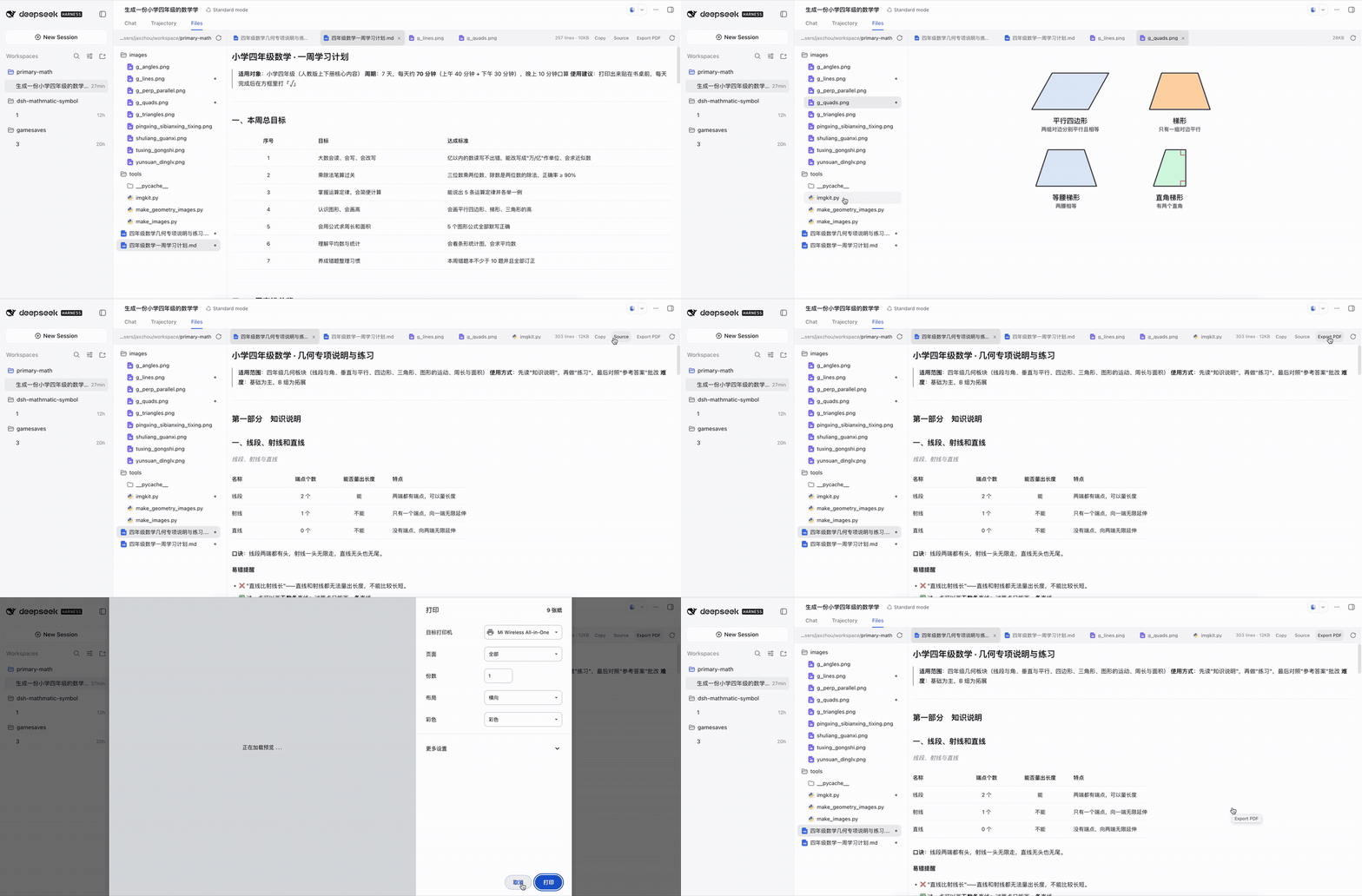
15 seconds — click for the full-quality MP4. A primary-school maths workspace: a lesson document rendered with its tables, the Source toggle showing the Markdown behind it, a second document open beside it in its own tab, and Export PDF, which hands the page to the browser's print dialog.
What you get
The left pane is the session's working directory, listed one level at a time, directories first. An expanded level stays expanded while you move between preview tabs.
Clicking a file opens it in a tab, so several files stay open at once — each with its own body and its own wrap setting. A file that is already open is focused rather than reopened, tabs whose names collide show their directory, and the tab's × or a middle click closes one.
The right pane picks each tab's body from the file:
| Category | Preview |
|---|---|
| Markdown | Rendered GFM — headings, tables, task lists, quotes, math, footnotes, images referenced beside the file, highlighted code fences — with a Source toggle, and Export PDF |
| HTML | Drawn as a page in a sandboxed frame: the file's own CSS applies, and its scripts run in an opaque origin that cannot reach this application. With a Source toggle, and Export PDF |
| JSON | A collapsible tree with per-value copy, and the same toggle |
| Source code | Syntax highlighting, line numbers, and a copy button for 24 grammars: TypeScript/JavaScript, shell, Python, Ruby, Go, Rust, Java, C, C++, C#, Kotlin, Swift, PHP, YAML, TOML, INI, HTML, CSS, SCSS, Less, SQL, XML, Lua, MDX |
| Images | PNG, JPEG, GIF, WebP, AVIF, BMP, ICO and SVG, drawn to the pane. An SVG goes through <img>, so its scripts never run |
| Anything else | Numbered plain text — an unmapped suffix (.vue, .proto, .txt) stays plain rather than guessing a wrong grammar |
Text previews wrap at their spaces and keep every word whole; an image reads its complete bytes. Every text body carries a Copy control in the pane's toolbar, which copies the file's own text — a rendered Markdown document copies its Markdown source. A rendered Markdown or HTML file also carries Export PDF, which hands the page to the browser's print dialog: every browser offers "Save as PDF" there, and its own layout engine keeps the text as text rather than rasterising the page the way a canvas-based PDF library would.
Requirements
DeepSeek Harness 0.1.5-rc.2 on the Web surface — dsh web, or a profile
composed from @deepseek-ai/dsh-base + @deepseek-ai/dsh-web-app. A headless or
SDK profile has no browser and gets no tab. The plugin declares no configuration,
so nothing in cordis.yml needs setting.
Install
dsh plugin --profile web add @jaxzhou/dsh-file-explorer
dsh --profile web                 # bundle membership is read at startup
A custom profile needs the Web composition first:
dsh --profile myprofile --from-default-profile web
dsh plugin --profile myprofile add @jaxzhou/dsh-file-explorer
dsh --profile myprofile
Prefer a checkout or a git ref? Nothing needs building — the runtime artifacts are committed:
dsh plugin --profile web add /path/to/dsh-file-explorer
dsh plugin --profile web add github:jaxzhou/dsh-file-explorer
Then open a session that has a workspace and click Files. To confirm the layer landed:
dsh --profile web --dump-config | grep -A 2 jaxzhou-file-explorer
Disable or uninstall
Disable the tab without uninstalling by adding an override to the profile's
cordis.patch.yml — it is applied after every bundle layer, and a
patchReload: live profile picks it up without a restart:
- id: jaxzhou-file-explorer
  disabled: true
Uninstall with dsh plugin --profile web remove @jaxzhou/dsh-file-explorer, then
restart the profile.
Privacy
- Read-only. Reads go through the harness's own
workspaceFilesRemote namespace; the Host's filesystem decides what is readable. The plugin holds no file access, no path resolution, and no credentials of its own. - Nothing stored. No disk writes and nothing added to the session log; view state lives in memory and is discarded with the session.
- Inert Host half. The package's Node side registers no service, tool, prompt section, or event.
- HTML runs sandboxed. A previewed page's scripts execute in an opaque origin,
which cannot read this application's DOM, storage, or session; an exported page
is printed with its scripts removed. An SVG draws through
<img>, so its scripts never run at all.
Known limitations
- Preview only — no editing, saving, or diffing.
- Strict JSON. Comments or a trailing comma make a file JSONC, which
JSON.parserejects —tsconfig.jsonis the common case. The pane says so and shows the highlighted source instead of guessing at a tree. - Text previews stop at 2 000 lines, with a truncation note and no "load more"; binary files report why they cannot be shown.
- Fixed grammar set. A suffix the shared highlighter does not carry is plain text, never an approximation.
- Listing only — no search, rename, context menu, or file watching; a level refreshes through Reload.
- Loaded previews are bounded. A working set of five tabs keeps its content; an older tab stays open and reads again when you return to it.
- One root. The tree is rooted at the session's working directory, and the Host refuses directory listings outside the workspace root.
- Markdown pulls in the images beside it. A destination relative to the document is read through the same workspace reader the file itself came from — up to 24 images per document and 8 MiB each. A file mention in inline code, a remote URL, and an absolute path are left to the renderer's own rules: the first stays inert, the second loads directly, and the third is not fetched.
- HTML previews do not resolve relative assets. A page drawn from a Blob
document has no base to resolve its own
style.cssor images against, so only absolute URLs load there too. An export prints the page as it renders without its scripts, which a static PDF has no use for anyway.
Contributing
Build, checks, the artifact model, and how the client bundle reaches the browser: CONTRIBUTING.md.
License
MIT — see LICENSE.
No comments yet. Be the first to write one.