scip-swift
A SCIP indexer for Swift. It converts a Swift repo's build
index into genuine scip.proto output — real protobuf Index/Document/Symbol/Occurrence
messages, consumable by any standard SCIP tool (the scip CLI, codeintel, Sourcegraph, editor
plugins) — by reading the same IndexStoreDB index
that powers Xcode's own "jump to definition" and SourceKit-LSP.
How it works
scip-swiftbuilds your repo with indexing-while-building enabled:- SwiftPM repos:
swift build --enable-index-store - Xcode-project repos:
xcodebuild ... COMPILER_INDEX_STORE_ENABLE=YES
- SwiftPM repos:
- It reads the resulting IndexStore via
IndexStoreDB'sSymbolOccurrencequery API. - It maps each occurrence to a SCIP
Occurrence/SymbolInformation— including symbol relationships (overrides), role bits, and minimal signatures — and emits a.scipfile.
Architecture
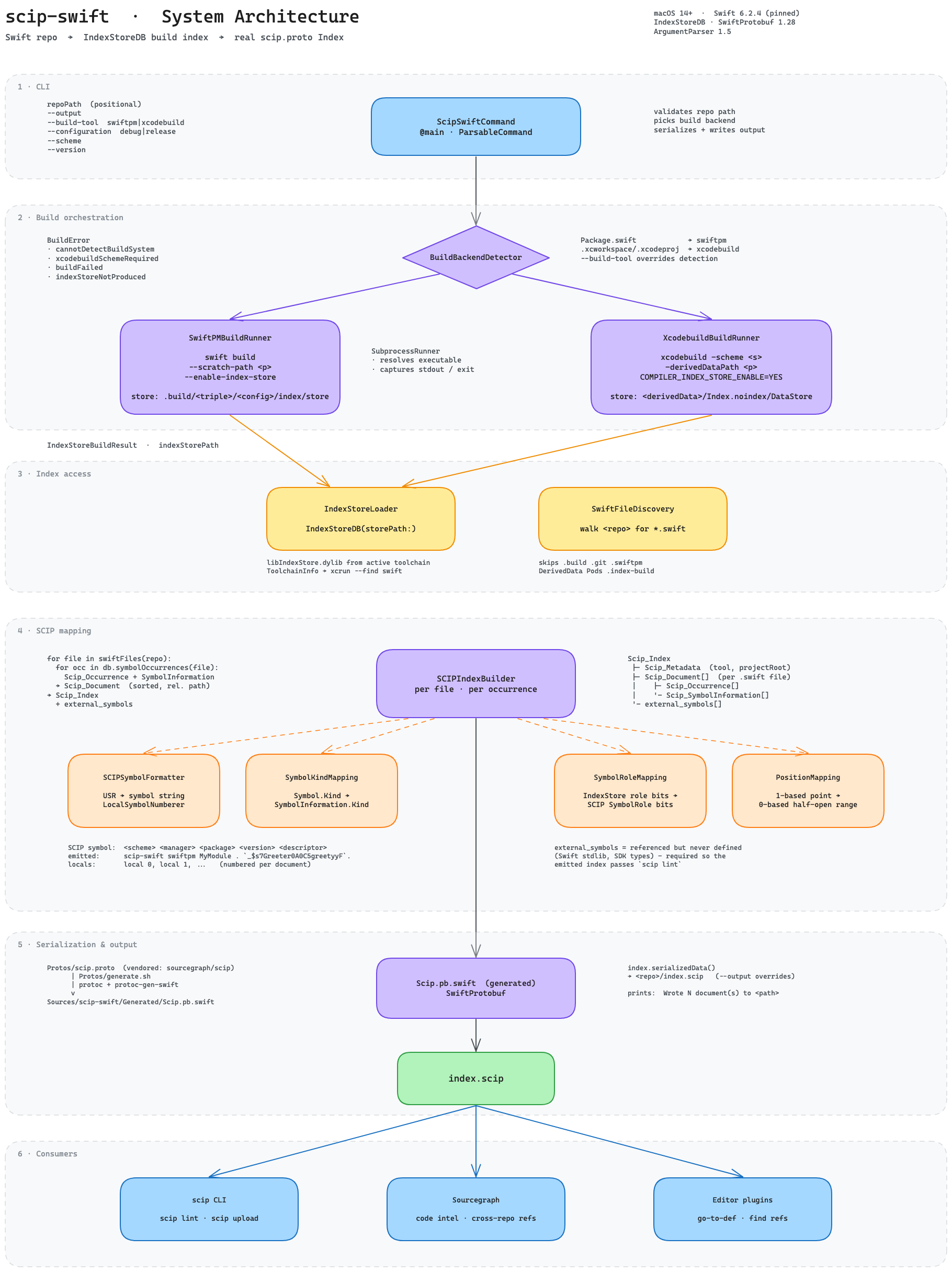
See docs/system-architecture.md for the component-by-component breakdown.
Install
macOS 14 (Sonoma) or later is required.
Homebrew:
brew install phuongddx/scip-swift/scip-swift
Or build from source (requires a Swift toolchain matching the pinned version in
.swift-version):
git clone https://github.com/jarvis-intelligence/scip-swift.git
cd scip-swift
swift build -c release
cp .build/release/scip-swift /usr/local/bin/
Prebuilt universal binaries (arm64 + x86_64) are attached to each GitHub release.
Usage
scip-swift /path/to/your/swift/repo
# writes /path/to/your/swift/repo/index.scip
The index subcommand is equivalent — useful for tools that always pass an explicit subcommand
name (index is also scip-swift's defaultSubcommand, so the bare form above dispatches to it):
scip-swift index /path/to/your/swift/repo --output /path/to/output.scip
Options:
| Flag | Meaning |
|---|---|
--output <path> |
Where to write the .scip file (default: <repo>/index.scip) |
--build-tool swiftpm|xcodebuild |
Override auto-detection (Package.swift → swiftpm, .xcodeproj/.xcworkspace → xcodebuild) |
--configuration debug|release |
Forwarded to the underlying build tool (default: debug) |
--scheme <name> |
Xcode scheme to build (only for xcodebuild; auto-detected if the project has exactly one scheme) |
--cache-dir <path> |
Directory for the incremental index cache (default: <repo>/.scip-cache). Passing this flag enables the persistent cache |
--index-only |
Skip the build step and read an existing IndexStore directly (from the cache directory) |
--version |
Print the converter version and the Swift toolchain version it was built against |
Indexing multiple repos
index-many indexes two or more repos independently, writing one .scip per repo or merging
them into a single index:
# one .scip per repo, written to --output-dir (default: current directory)
scip-swift index-many /path/to/repoA /path/to/repoB --output-dir out/

# merge into a single index (default: ./merged.scip)
scip-swift index-many /path/to/repoA /path/to/repoB --merge --merged-output combined.scip
index-many supports --configuration and --cache-dir as well.
Incremental indexing
Passing --cache-dir (or --index-only) switches the pipeline from a throwaway temp directory
to a persistent cache:
- Unchanged files reuse their previously computed
Scip_Document(keyed by the composite of the file's relative path and its SHA256 content hash), so re-indexing after small edits only reprocesses what changed. - The cache is invalidated wholesale when the Swift toolchain version,
scip-swiftversion, indexstore-db revision, build backend, or the emitted symbol format version (symbolFormatVersion, currently 5 — format 1 is the raw-USR era, format 2 the canonical descriptor-chain scheme, format 3 composite path+content-hash cache keys, format 4 import occurrences + Test bits, format 5 relationship bytes: type-level is_implementation edges, relationship-target external symbols, and stdlib-protocol canonical forms) changes (recorded inmanifest.json). A manifest that fails to decode — e.g. written by an older engine without the current fields — is treated as no manifest: the cache is discarded wholesale, so old-format caches never mix with new-format output. - The index builder additionally fingerprints the overload table (SHA-256 over each overload
group's identity and its source-ordered member USRs) as a global cache-validation key:
overload indices
(+N)depend on every group member repo-wide, so any overload change anywhere — even in files whose own content did not change — invalidates cached documents. This granularity is deliberately conservative (any overload edit invalidates everything); a per-group precise refinement is a recorded v2 follow-up. - Each cached document is accompanied by
docs/<key>.usrmap, a canonicalSymbol → USR side map for raw-USR fallback symbols, so external display names demangle identically on fresh and cache-hit runs. It rides the same composite (relativePath, content hash) key as its.scipdocand invalidates atomically with it. The.scipdoc/.usrmapkeys are composite by design — SHA-256 overrelativePath || 0x00 || contentHash— so two byte-identical files never share a cache entry and a renamed file misses naturally and rebuilds; a format bump (e.g. to the currentsymbolFormatVersion3) wholesale-invalidates older caches via the manifest gate. --index-onlyreuses the already-built IndexStore under the cache directory (it does not rebuild), so it fails withindexStoreNotFoundForIndexOnlyif no prior indexed build exists there.
Determinism
Indexing the same store twice is byte-identical, regardless of cache state:
- Occurrences are ordered by the canonical SCIP rules (ascending by range start, then range end, then symbol string) and deduplicated on (symbol, range, roles); documents ascend by relative path and document symbols by symbol string.
ToolInfometadata never embeds raw command-line arguments (they would differ between two CLI runs with different--outputpaths, and they leak local paths into shared artifacts). The one synthetic entry it does carry is the constantscip-cli-version=<pin>(the scip CLI version the output is gated against).
The scip CLI gate
Every emitted fixture index is validated by the real scip CLI from
scip-code/scip — the same tool consumers run — via the
ScipCLIGate suite (Tests/scip-swiftTests/ScipCLIGateTests.swift):
scip linton the MiniSwiftPackage, SchemeFixture, and HierarchiesFixture indexes must exit 0 with zeroerror:findings.scip snapshot --strict=falseoutput for the SchemeFixture and HierarchiesFixture indexes is diffed against the committed goldens inTests/scip-swiftTests/SchemeFixtureGoldens/andTests/scip-swiftTests/HierarchiesFixtureGoldens/(the CLI has no verify mode; the test harness owns the directory diff).- The gating binary's version is cross-checked against
ScipSwiftVersion.scipCliVersion— drift between the CI pin and the engine constant fails the suite.
Environment variables the gate understands:
| Variable | Effect |
|---|---|
SCIP_BIN |
Path to the scip binary (CI sets this to the checksum-verified pinned download; without it the binary must be on PATH). When neither resolves, the gate tests FAIL with install guidance — they never silently skip. |
UPDATE_GOLDENS=1 |
Regenerate the committed snapshot goldens instead of diffing (use after an intentional emission change). |
UPDATE_ROLE_TABLE=1 |
Regenerate Fixtures/SchemeFixture/role-table.json, the committed role-expectation table diffed by the RoleParity suite (see below). |
UPDATE_SYMBOL_TABLE=1 |
Regenerate Fixtures/SchemeFixture/symbol-table.json (see the cross-repo parity check below). |
UPDATE_RELATIONSHIP_TABLE=1 |
Regenerate Fixtures/HierarchiesFixture/relationship-table.json, the committed relationship-expectation table diffed by the RelationshipParity suite (see below). |
CI downloads the pinned CLI tarball from the scip-code/scip GitHub release over HTTPS,
verifies it against the release-published .sha256 sidecar (a mismatch fails the job), and
caches it keyed by SCIP_CLI_VERSION so an unchanged pin skips the download. SCIP_CLI_VERSION
(in .github/workflows/ci.yml) is the single pin and must match ScipSwiftVersion.scipCliVersion.
CI also builds and tests under the pinned Swift toolchain — selected via XCODE_PIN and verified
fail-loud by the workflow's select step plus the in-suite ToolchainDriftGuard test.
Role-bit oracle (RoleParity, NAV-01)
scip snapshot caret output renders only four role words — definition,
forward_definition, synthetic_definition, reference — so it can never show
ReadAccess/WriteAccess bits. The RoleParity suite
(Tests/scip-swiftTests/RoleParityTests.swift) is therefore the programmatic oracle for the
frozen access-bit contract (write > read/reference > no access bit; call sites contribute
nothing): it rebuilds the SchemeFixture index in-process and asserts role bits for every
occurrence family — property writes (both directions over the eleven write sites),
property/param/subscript reads, params on both symbol paths (clean local n symbols and
raw-USR fallback Terms), enum-case/type/function references, accessors including willSet,
and the definition invariants — against the committed expectation table
Fixtures/SchemeFixture/role-table.json. Regenerate that table with
UPDATE_ROLE_TABLE=1 swift test --filter RoleParity, under the pinned toolchain only (same
discipline as the snapshot goldens: role rows are toolchain-sensitive data).
Outline oracle (DocumentOutline, NAV-02)
documentSymbols correctness is gated structurally, not inferred from byte-identical
goldens: the DocumentOutline suite (Tests/scip-swiftTests/DocumentOutlineTests.swift)
rebuilds the SchemeFixture index in-process and (1) sweeps EVERY document for the
exhaustive invariant that every non-empty enclosing_symbol resolves to a symbol in the
same document (only local n symbols carry one), (2) pins the locals' enclosing targets,
and (3) derives each file's nesting tree by splitting document.symbols canonical strings
on their descriptor suffixes and asserts it equals a hand-written expected outline — for
the library file (including the #if-wrapped declaration and the same-file extension
member), the extension file (declarations as file-level entries, members under the
extended types, cross-module per the frozen scheme), and the deep-nesting section
(Lattice#Cell#Core#Phase#…, four container levels). Accepted outline shapes are
asserted explicitly, not assumed — see the outline bullets under Known limitations.
Relationship oracle (RelationshipParity, REL-01)
Relationship edges are gated like roles: in code, both directions, against a committed
golden. The RelationshipParity suite
(Tests/scip-swiftTests/RelationshipParityTests.swift) rebuilds the
Fixtures/HierarchiesFixture index in-process (two modules, HierCore + HierExt — the
SC4 content classes: protocol inheritance, direct and extension-declared conformances
(to LOCAL and to Swift-module protocols — Rect: HierShape, Equatable, CustomStringConvertible, a retroactive extension Circle: CustomStringConvertible),
a conditional conformance, a 2-level subclass chain with overridden
inits/properties/methods, a default implementation, an emoji-named conforming type, an
ObjC-rooted subclass, and a cross-module retroactive conformance to a local protocol)
and asserts BOTH DIRECTIONS over every relationship the engine emits
today: every expected witness edge (.overrideOf → is_reference +
is_implementation, the byte-stable 04-01 baseline) and every type-level clause edge
(the 04-02 harvest: baseOf/extendedBy clause refs → is_implementation ONLY,
scip.proto's Find-implementations semantics) IS emitted, and every emitted edge IS
expected. The 04-02 emission seams: (a) the clause-relation harvest attaches type-level
edges to the type's SymbolInformation in its defining document; (b) retroactive
extension-declared conformances ride the EXTENSION document via a carrier
SymbolInformation for the type's canonical string (D-23); (c) relationship targets that
never appear as occurrences mint into external_symbols (fresh and cache-served
documents symmetrically); (d) relationships are emitted pre-canonicalized (ascending
target sort + flag OR-merge, the Go CanonicalizeRelationships port); (e) external
protocols (Equatable, CustomStringConvertible, …) resolve to the frozen Swift-module
form (scip-swift swift Swift <pin> Equatable#) via the stdlib-protocol USR parser
rules, with system-ness from the parse. The suite also pins the NON-edges (implicit
default-implementation occurrences at conformance-declaration lines contribute no
relationship) and the corpus invariants (flags, ascending target order, one row per
symbol/target pair) against the committed expectation table
Fixtures/HierarchiesFixture/relationship-table.json. Regenerate that table with
UPDATE_RELATIONSHIP_TABLE=1 swift test --filter RelationshipParity, under the pinned
toolchain only (same discipline as the snapshot goldens: relationship rows are
toolchain-sensitive data).
Hierarchy answerability oracles (CallHierarchy/TypeHierarchy, REL-02/REL-03)
Call and type hierarchies are gated by consumer-simulation oracles that prove the
questions a consumer asks are answerable from the emitted index alone (both suites
rebuild the Fixtures/HierarchiesFixture index in-process, same scaffolding as
RelationshipParity, riding the same single swift test CI step):
CallHierarchyAnswerability(Tests/scip-swiftTests/CallHierarchyAnswerabilityTests.swift, REL-02): scip.proto'sSymbolRolehas exactly eight values and NOCallbit, andRelationshiphas only the four flags — there is no protocol surface for synthesized call edges, and abusing the flags as a call channel would corrupt Find References. The index therefore carries every call site as a reference occurrence with exact position and access bits, and the suite simulates the consumer derivation: a symbol is function-family when its SymbolInformation kind is constructor/function/getter/method/ setter (this keeps raw-USR fallback-Term functions — conditional-conformance witnesses, the default implementation — visible) or its canonical descriptor ends).(minted external symbols such asSwift String#init().); per document, occurrences ordered by position attribute to the nearest-preceding function definition, gated on carrying an access bit (role-0 implicit availability rows are skipped, exactly like the def-gated relationship emission). outgoing/incoming sets are asserted BOTH directions for every fixture function — the full cross-module chain (extCallerOfCaller → extCaller → coreDriver → Circle init + drawAll), dynamic dispatch (existential, class-virtual, and generic-constraint sites) asserted via the access bit + position, and corpus-wide attribution invariants (exactly-once, no phantom attribution, leaves empty). Documented v1 shapes: occurrence-only fallback-Term call sites (Double(spokes), array literals) are not answerable by name, and theextCallerOfCallercanonical string carries a word-substitution mis-parse (extCallerOf. — display name stays truthful) pinned as-is; both are recorded watch items, not emission contracts.TypeHierarchyAnswerability(Tests/scip-swiftTests/TypeHierarchyAnswerabilityTests.swift, REL-03): supertypes(T) = theis_implementationtargets on every SymbolInformation whose symbol is T (scip.proto's Dog/Animal Find-implementations semantics); subtypes and protocolImplementations(T) = the reverse scan over ALL documents' symbols plusexternal_symbols(stdlib-protocol conformers are first-class answers). Extension- declared conformances resolve through the TYPE's canonical string regardless of carrier document — the D-23 carrier emits the type's SymbolInformation into the extension document, soWheel#answers with bothHierShape#andGlowable#, andCircle#withHierShape#and the SwiftCustomStringConvertible#. The exhaustive invariant asserts every emitted edge is answerable forward AND reverse with no phantom results, and the type-level expectations reconcile withrelationship-table.json'sisReference=falserows (the RelationshipParity golden).
These consumer-derivation semantics are the definition of answerability that the
Phase-6 end-to-end validation (jarvis callHierarchy/typeHierarchy queries) checks
against: incoming/outgoing calls derive from call occurrences + nearest-preceding
function definition; supertypes/implementations from forward is_implementation reads
and reverse relationship scans including external symbols.
Import occurrences (ImportOccurrence, SYM-04)
Every written import / @testable import statement emits exactly ONE occurrence with
the Import role (0x2) — anchored on the module-name token (past any @testable
attribute) — resolving to the module's canonical symbol, REPLACING the old
reference-with-fallback-Term line at the same anchor. Module symbol forms follow the
frozen Phase-1 scheme (module descriptors end in /, never #):
- repo-local target module:
scip-swift swiftpm <Module> . <Module>/ - external/system module:
scip-swift swift <Module> <pinned Swift version> <Module>/
The manager choice comes from a fail-soft SwiftSyntax parse of the repo's Package.swift
(PackageTargetMap): a module named in the target list is repo-local; everything else
(Foundation, Testing, SDK modules) uses the swift manager plus the pinned toolchain
version. Module symbols land in external_symbols with the module's own name as the
display name. Implicit module occurrences — Swift Testing's macro expansion floods every
#expect/@Suite site with c:@M@Testing references — are filtered
(!roles.contains(.implicit)): they still emit as references to the module symbol but
never carry the Import role. The ImportOccurrence suite
(Tests/scip-swiftTests/ImportOccurrenceTests.swift) proves all of this corpus-wide:
exactly-one-per-import with column-precise anchors, zero Import roles at implicit or
non-import positions, corpus Import count == written-import count, and byte-identical
round-trips of both manager forms through the engine's own formatter.
Test-target marking (TestTargetMarking, NAV-03)
Occurrences in test-target documents carry the Test bit composed with their other roles
(definition|test 0x21, read|test 0x28, write|test 0x24, import|test 0x22) — the
"locate tests for a symbol" query; no occurrence in a library-target document
(Sources/**) ever carries it. Detection is Package.swift-driven (the same
PackageTargetMap): PRIMARY = the document's relativePath falls under a .testTarget's
declared (or default Tests/<name>) path; SECONDARY = the document's store
location.moduleName names a test target. The store's SymbolProperty.unitTest property
path in SymbolRoleMapping is retained as a belt: it never fires for SwiftPM + Swift
Testing targets (empirically), but it DOES fire for XCTest-shaped targets (class +
method occurrences carry it), so marking stays correct either way. The
TestTargetMarking suite (Tests/scip-swiftTests/TestTargetMarkingTests.swift) proves
both directions and pins the composed bit values on concrete sites.
Clean-runner reproducibility (CleanRunner, PROJ-01)
A cache written under symbol
format 4 is wholesale-invalidated by the next run (the manifest gate; the current
emitted-byte format version is 5 — see SymbolFormatVersion in
Sources/scip-swift/Caching/IndexManifest.swift).
scip-swift index on a cold cache reproduces byte-identical output. The CLI default
path (no --cache-dir/--index-only) is cold by construction — scratch, index DB, and
cache all land in a fresh temp directory. The CleanRunner suite
(Tests/scip-swiftTests/CleanRunnerTests.swift) wires the proof as tests on every push:
two cold runs with a persistent cache dir that is DELETED between runs (plus the
default-path double-run) must serialize byte-identical indexes with non-empty documents,
per-document symbols AND occurrences, and definition / reference-bearing counts above
thresholds — never an empty-but-lint-clean index. Build failures surface actionably:
an injected syntax error in a fixture COPY throws BuildError.buildFailed whose message
names swift build and carries the full compiler output. A cache written under symbol
format 3 is wholesale-invalidated by the next run (the manifest gate; the current
emitted-byte format version is 4 — see SymbolFormatVersion in
Sources/scip-swift/Caching/IndexManifest.swift).
macOS-host requirement
Indexing any repo that imports Apple-platform-only frameworks (UIKit, WatchKit, WidgetKit)
requires a macOS host with Xcode and the relevant SDKs — Apple does not ship the iOS SDK for Linux.
Pure Swift-package code without those imports can build (and be indexed) on Linux, but that's not
the common case for a real iOS app repo. If the underlying build command fails for this reason,
scip-swift surfaces it as a build failure rather than silently producing a partial index.
Known limitations
Canonical descriptor symbols, raw-USR fallback:
Scip_SymbolInformation.symbolis a canonical descriptor chain (scip-swift swiftpm MyMod . Shape#resize(+1).) parsed straight from the compiler's USR — never derived from the demangler, which stays display-only. A USR the parser cannot handle (exotic substitutions, parameters, malformed input) falls back to the raw USR as a single escaped Term under the canonical module header; each run prints how many symbols took that fallback. Known carried-forward scheme limitations (frozen with the Phase-1 spec):- Term-family retroactive collisions cannot carry
(+N)— the SCIP grammar allows disambiguators only on Method descriptors, so retroactive property/let/case collisions across declaring modules render the same string. - A getter and a zero-arg method of the same name collapse to one
SymbolInformation(they render the identical string); the surviving Kind is the definition last in source order. - Parameters take the raw-USR fallback — their canonical form needs enclosing-function container parsing, planned for a later phase.
- Term-family retroactive collisions cannot carry
Outline shape (documentSymbols), accepted v1 behavior — gated by the
DocumentOutlinesuite:- Extension declarations are file-level entries. An
extension Vec { … }declaration emits a fallback-TermSymbolInformation(kind Extension) that cannot nest via its symbol string; its MEMBERS nest under the extended type's path, across modules (SYM-02). The extended type is then a path-only outline node in the extending file. - Generic type parameters emit definitions under the TypeAlias kind. The store has no
genericTypeParamsymbol kind, soBox#T#renders kind TypeAlias (WR-05) — the type-parameter descriptor form ([T]) never appears in emitted symbols. - Swift-Testing documents carry no local-property symbols — the store emits no
.localoccurrences for test-file declarations on the pinned toolchain, soenclosing_symbolcoverage in test documents is empty (the invariant holds trivially there). enclosing_symboltargets render the un-disambiguated overload-group form — the locals branch assembles the.childOfsymbol without the overload index, so a local insideparse(+1)carries theparse()string. The target still resolves inside the same document; adding(+N)would change emitted bytes (asymbolFormatVersionbump).- Parameters are file-level raw-USR fallback Terms (D-06), so they cannot nest under
their enclosing function by symbol string; and structs without stored properties gain
compiler-synthesized default
init()definitions in the outline.
- Extension declarations are file-level entries. An
Occurrence ranges: IndexStoreDB (like the underlying IndexStore format) only records a single anchor point per occurrence — not a start/end range. The end column is the exact identifier-token extent from a
SwiftSyntaxparse of the file; the name-length approximation remains only as a fallback for regions the parser cannot recover (e.g. severely malformed syntax). Statically linkingSwiftSyntax/SwiftParsergrows the release binary from ~7 MB to ~24.5 MB — an accepted trade-off for this milestone (compiler-grade token extents without shipping a separate parser binary).No call-hierarchy role: real
scip.proto'sSymbolRoleenum has no call-specific bit; callRelationships: witness edges (
.overrideOf→ is_reference + is_implementation) and type-level clause edges (baseOf/extendedBy harvest → is_implementation only, attached to the type's SymbolInformation; retroactive conformances ride the extension document). Accepted v1 limitation — the ObjC superclass fallback (ObjCSuperclassClauseMap, D-21): a bounded, counted SwiftSyntax belt for class clauses whose store record carries nobaseOf; on the pinned toolchain the store records the NSObject clause pairing itself, so the belt fires zero times on the fixtures (unit-proven, counter surfaced in diagnostics). Accepted v1 Term limitations: protocol-extension member USRs (…PAAE…/…Rzlshapes), extension-decls:e:USRs, andc:objctargets render as raw-USR fallback Terms (pinned as-is inrelationship-table.json; a parser rule would widen the format-version ripple for no REL-01/REL-03 gain).USR stability across toolchain versions is not guaranteed by Apple — golden reproducibility is toolchain-pinned. This project pins the Swift toolchain version it's built and tested against (see
.swift-version); indexing with a different toolchain version may be fine in practice but isn't a supported/tested configuration. Concretely: Swift Testing synthesized accessor USRs carry toolchain-dependent hash suffixes, and newer toolchains emit extra stdlib interpolation occurrences (DefaultStringInterpolation.appendLiteral/appendPart) — both observed when a Swift 6.3.3 runner built indexes against 6.2.4-generated goldens. The committed snapshot goldens underTests/scip-swiftTests/SchemeFixtureGoldens/are therefore reproducible ONLY under the.swift-versionpin; CI enforces it (selecting the pinned Xcode viaXCODE_PINand failing loudly on drift, plus an in-suite toolchain drift guard), so a red golden diff on a different toolchain is environment drift, not a regression. To change the pin: switch to the new toolchain (xcode-selectorDEVELOPER_DIR), update.swift-version+ToolchainInfo.pinnedSwiftVersion+ the workflow pin pair (SWIFT_TOOLCHAIN_PIN/XCODE_PINin.github/workflows/ci.yml), and regenerate the goldens intentionally withUPDATE_GOLDENS=1under the new toolchain.
Development
swift build
swift test
Regenerating the vendored SCIP protobuf bindings (only needed if Protos/scip.proto is updated
from upstream sourcegraph/scip):
brew install protobuf swift-protobuf
Protos/generate.sh
License
Apache-2.0 — see LICENSE.
No comments yet. Be the first to write one.