dsh-login
English | 简体中文
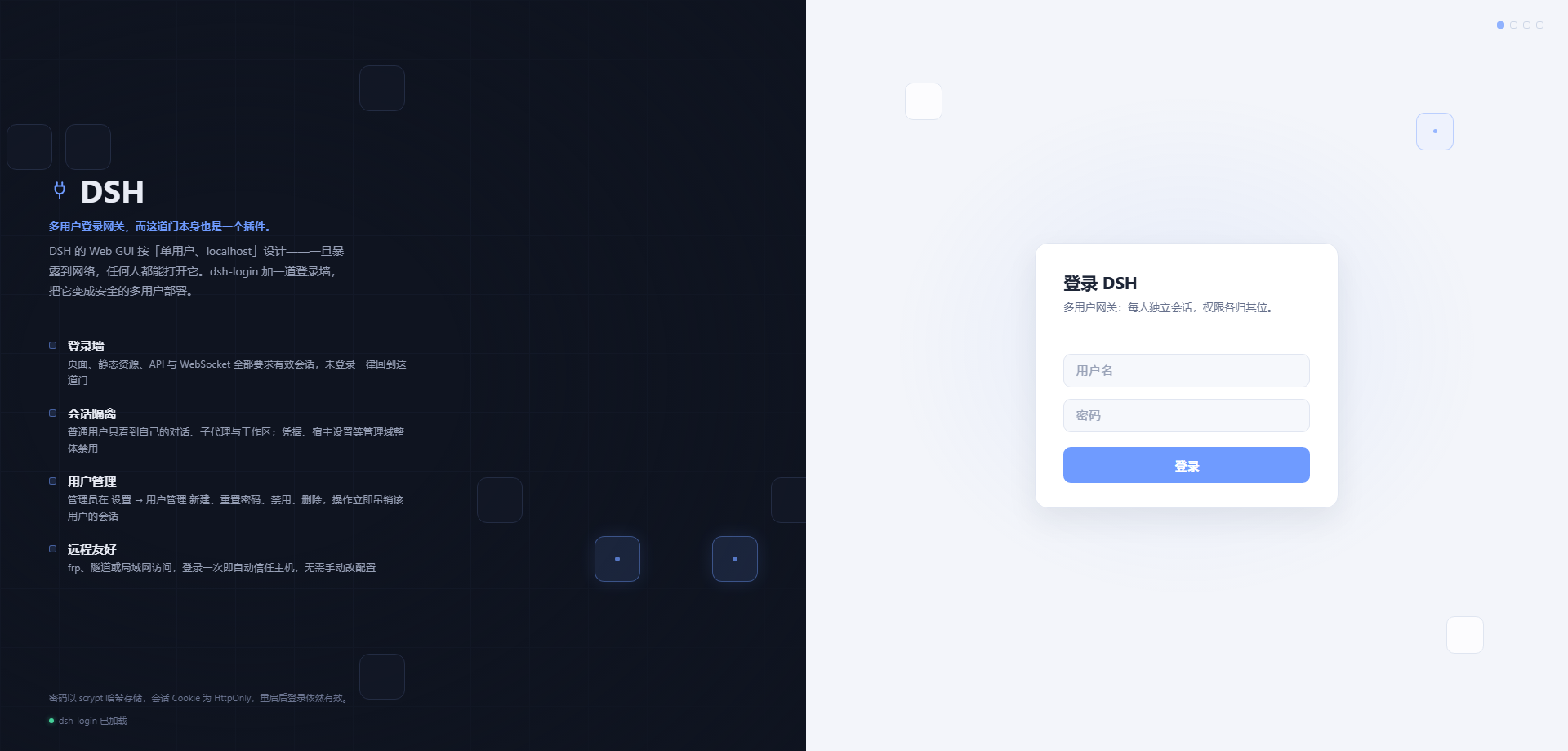
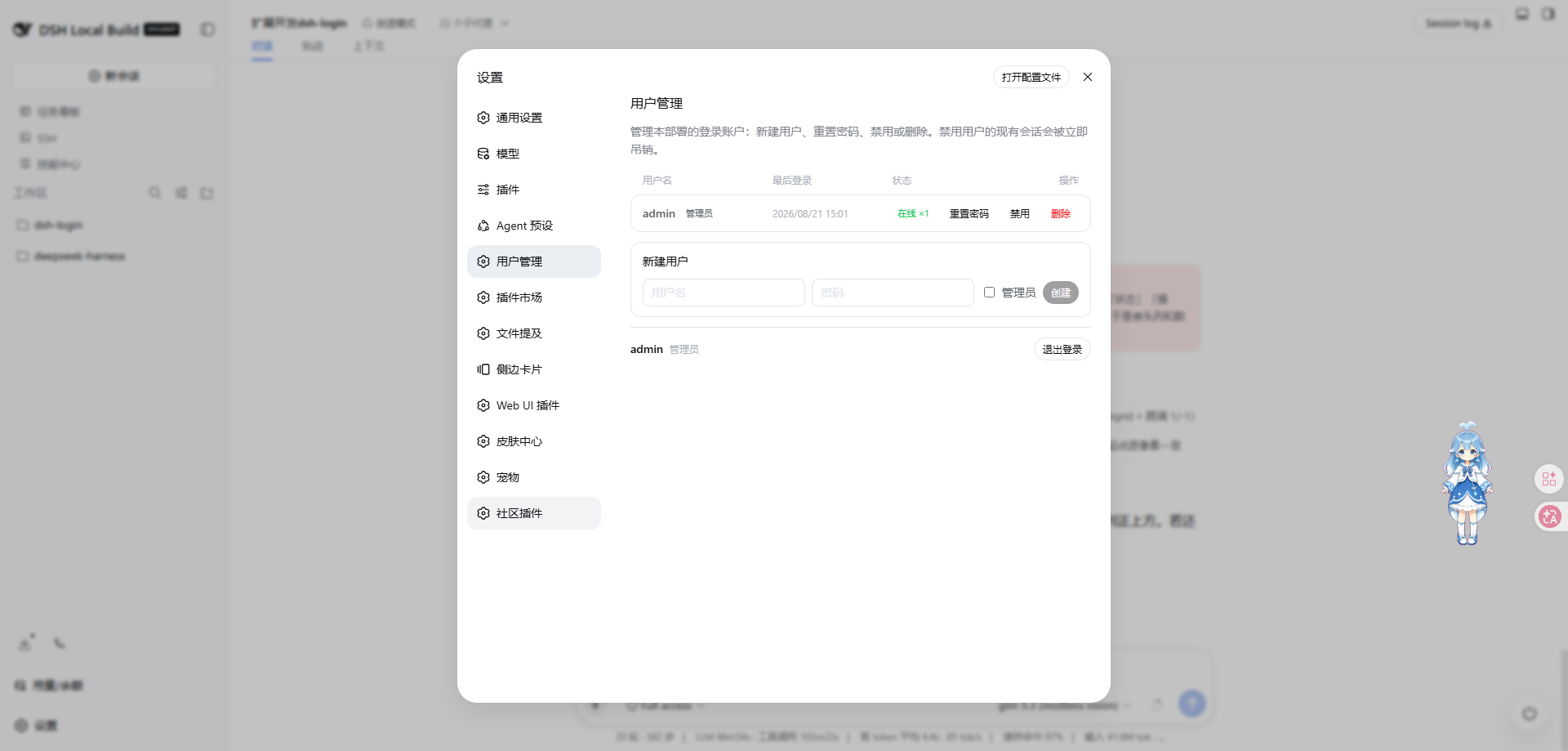
Adds a login page, user accounts, and per-user conversation isolation to the DeepSeek Harness Web GUI: every visit requires sign-in, ordinary users cannot see each other's conversations, and an admin manages all accounts from inside the GUI.
| Login page | User management (设置 → 用户管理) |
|---|---|
 |
 |
The problem it solves
The DSH Web GUI ships with no login — it assumes a single user on localhost. The moment you bind it to 0.0.0.0 (phone access, LAN sharing, a small team), anyone on that network can open your GUI: read every conversation, burn your configured model API keys, even change host settings.
dsh-login turns that exposure into a multi-user deployment:
- 🔐 Login wall — pages, static assets, SPA routes, the API, and WebSockets all require a valid session; unauthenticated visitors are redirected to
/login - 👥 Multiple accounts — the first visit creates the administrator account; further users are added by an admin right inside the GUI, no CLI needed
- 🙈 Conversation isolation — ordinary users see and act on their own conversations only (including their subagents/forks); the bridge wall denies non-whitelisted methods and narrows
session.list/session.search/workspace.listresponses to owned sessions, and the dispatch-seam guard ownership-checks every dispatch (including per-userworkspace.followframe filtering); other users' sessions, messages, and workspaces are invisible; credentials, host settings, and other admin domains are forbidden wholesale - 🎭 Whole-UI role gate — for ordinary users the gateway filters the client boot graph (
window.__DSH_BOOT__) before serving the page, so admin-only UI plugins never mount (uiRoleGate, on by default) - 🛠 User management — 设置 → 用户管理: last-login time, online session count, reset password, disable, remove; disabling/removing/password-changes immediately revoke that user's live sessions
- 👑 Admin exception — the admin is not isolated: all sessions visible, full configuration access
- 🚪 Logout — every user gets a logout entry in their settings panel
- 🌐 Remote access friendly — reach the GUI through frp/隧道/tunnels or a LAN IP without hand-editing
trustedHosts: the/apihost-trust fence uses a live set (LAN literals +trustedHosts+ auto-learned hosts), and any successful login learns its Host into a persisted whitelist you can manage in 设置 → 用户管理
Current status
Current release: @islibaodong/dsh-login@0.3.12 (git tag v0.3.12, npm latest) — tracks DSH 0.2.2-rc.1; full suite 22 files / 291 tests green, CI green. Per-version release notes: GitHub Releases.
0.3.12 is a security release. It fixes issue #11: streaming methods (workspace.follow workspace trees, and id-carrying invokes such as session.page) travel the /api/remote.mux WebSocket, which the POST-only bridge wall never saw — an ordinary user could enumerate and enter other users' workspaces. Since 0.3.12 a dispatch-seam guard ships in-plugin: connection admission requires a live dsh-login session on the browser path (the WebSocket upgrade included), and the gateway's dispatch seams gate every browser call per user — non-user methods denied, id arguments ownership-checked, workspace.follow frames filtered per frame. It also carries the merged PR #12 fix (DSH 0.2.2 homepage 400) and the CI rewrite (Node 24 matrix, dist freshness gate).
Compatibility history
| dsh-login | DSH | Notes |
|---|---|---|
| 0.3.12 | 0.2.2-rc.1 | issue #11 streaming-method isolation + PR #12 gateway fix |
| 0.3.11 | 0.2.2-rc.1 | dependency retarget onto the rc.1 line (vendor stable) |
| 0.3.10 | 0.2.2-alpha.3 | wire surface re-pinned 199 → 204 (schedule CRUD split, forge review) |
| 0.3.9 | 0.2.1-rc.5 | issue #10: the launch token never reaches remote clients |
| 0.3.8 | 0.2.2-alpha.2 | wire surface 146 → 199 (forge panel, session observation, CUA, liveshareShares) |
| 0.3.7 | 0.2.1-rc.3 | client-UI-only upstream release; zero adapter impact |
| 0.3.6 | 0.2.1-rc.2 | issue #4: allow-list re-derived from the real wire surface |
Older releases: see the releases page.
Upstream multi-user watch
Upstream DSH still ships no native user accounts — no user store, no login, no identity UI. What DSH 0.2.1-alpha.3 added is an authorize-only RBAC engine for non-owner Peers (packages/api/remote-access) plus multi-principal connection machinery; it never gates owner principals, and every dsh-login user arrives as one. dsh-login remains the account/authn layer.
- Ordinary users are conversation-only. In option A the native
connection/api-gatewayowns/apiand is agent-keyed. Three seams enforce the boundary — the first two ship in-plugin and are on by default:- Method allow-list + response narrowing on the bridge wall (
apiBridgeAuth): a non-admin POST whose wire endpoint is not on theUSER_ALLOWEDallow-list is denied — withquietDenials(default) as a wire-correct forbidden envelope, otherwise a plain 403.session.list/session.search/workspace.listresponses are narrowed to the user's own sessions/workspaces. - Dispatch-seam guard (shipped in 0.3.12, automatic — fixes issue #11): connection admission requires a live dsh-login session on the browser path — including the
/api/remote.muxWebSocket upgrade — and tags each browser peer with its dsh-login identity. The gateway's dispatch seams (dispatchRpc/openWireStream) then gate every browser call per user: non-user methods are denied, every id argument (sessionId/workspaceId/agentId/…) is ownership-checked against the sidecar, andworkspace.followstreams are filtered per frame with upstream's own per-principal semantics (narrowed baselines, delivered-set accounting, replace-resync on visibility loss, fail-closed on unknown frames). Untagged peers (launch-token CLI/SDK, host-internal calls) keep upstream semantics exactly. - REMOTE-layer guard (
wrapRemoteGateway, exported, optional): the deployment-side composition primitive over the public gateway API (docs/compose-guard.md). Since 0.3.12 the in-plugin guard already covers browser traffic, so composing this is optional belt-and-suspenders. Everything else is off limits:
- physical allow-list: the user-facing wire surface (
USER_ALLOWED, 124 of the 204 methods DSH 0.2.2-rc.1 exposes) —session.*(prompt/page/modelCatalog/selectModel/fork/attachment, the events/observe/state family, …),workspace.*,goals.*,subagents.*,terminal.*,job.*, the read-onlyworkspaceFiles.*/officeToPdf.*document preview, thellm.*model-picker reads,skills.list,commands.*,directoryPicker.*,schedule.*,speech.*,userQuestions.*,messageFeedback.*,sessionFeedback.record,fileUploads.upload,fileReferences.list,permissionPresets.catalog,productAnalytics.*,cotTranslation.*,sessionReferenceResolver.candidates, theremoteAccess.followgrant stream, and the 0.2.2 additions (forgePanel.*per-session,toolResults.watch,actionCards.act,pluginRecommendations.describe); any other wire method is refused. The list is exhaustive against the wire surface:tests/wire-surface.spec.tsfails if upstream renames or adds a method without a bucket (seedocs/adapt-dsh-0.2.1-rc.2-issue-4.md) - admin-only domains (
ADMIN_ONLY_METHODS, 79):credentials.*,settings.*,agentPresets.*, the native plugin manager (pluginManager.*,pluginMarket.*,pluginRegistryProbe.*,pluginInventory.*),dynamicCordisRunner.*,claudeCodeMods.*, the wholeaccount.*namespace (the single process-wide upstream DeepSeek Platform grant), CUA consent (cuaAccess.*),schedule.deleteInactive, and theliveshareShares.*share-management surface - host-internal:
workspace.initializeDefault(first-use plumbing; denied to users and never advertised) - an unknown method (not on this build's wire surface) is logged once per method to the host log with the target version, so an upstream rename leaves a diagnostic instead of a silent user-facing denial — refresh
src/api-filter.tsfrom the checkout withnode scripts/dump-wire-surface.mjs - workspace-scoped mutations are ownership-guarded by
workspaceId: a non-admin may onlyrename/delete/insertBeforea workspace that holds at least one of their own sessions, andcreateis confined to their own sandbox (workspaceRoot/<username>) — so they cannot touch other users' workspaces or register a workspace pointing at an arbitrary host directory - the physical
session.exportchannel (target in the query string, outside the envelope) is ownership-guarded at the carrier - streaming:
workspace.followframes are filtered per user at the dispatch seam (above) — a user's workspace tree never contains another user's workspaces or sessionIds
- Method allow-list + response narrowing on the bridge wall (
- Whole-UI role gate (
uiRoleGate, on by default): for an ordinary session the gateway filters the client boot graph (window.__DSH_BOOT__) before serving the index — entries in theADMIN_ONLY_UI_PLUGINSdeny-list never mount. Presentation-only: the/apiallow-list stays the security boundary; admins get the unfiltered graph; unexpected shapes fail open. Granularity is per package — hiding one slot inside an allowed bundle is out of scope, and a plugin that self-registers exact routes (e.g./api/pet/pets) is outside the bridge wall's reach. The split is binary today (admin / ordinary); extending it to arbitrary roles is evaluated indocs/role-based-ui-gating.md— feasible without upstream changes, one shared role policy must feed all three seams. - Default user workspace (
defaultWorkspace, on by default): non-admin users get a per-user isolated default workspace on first/apiaccess —mkdirtheir sandbox (workspaceRoot/<username>, default<DSH_HOME>/workspaces/<username>) → register it in the durable workspace registry → attach one session (sessions.create({ workspaceId }), the grouping shape) and record its ownership, so the workspace is immediately visible in the user'ssession.list/workspace.followand ready to use. This means a non-admin never starts out workspace-less on a public/FRP deployment; since 0.3.6 the native picker (directoryPicker.*) also works for them, withworkspace.createstill confined to their sandbox. Admins can toggle it live from the 设置 → 用户管理 panel's 默认用户工作空间 switch (persisted to<dataDir>/settings.json, effective immediately, no restart); turning it off does not remove existing workspaces. Provisioning is idempotent (once per user per process) and best-effort (failures never fail the triggering request). - Remote access compat (
remoteWebUiCompat, on by default): accommodates@linxin666/dsh-remote-web-uiunchanged. That popular plugin's/remotedevice-pairing gate 401s non-loopback (public FRP) desktop traffic — the model dialog, history, composer — independently of dsh-login's /api auth. When this flag is on, dsh-login writes remote-web-ui'senabled:true(which is what actually mounts its host routes; without it the server answers nothing and the client fail-closes onto a dead/remote405 wall) andrequirePairingForLan:false(a live, settings-backed flag re-read per request), so non-loopback traffic rides dsh-login's/apichannel gated by thedsh_sessioncookie instead. It also writespublicBaseUrlfrom theremoteWebUiPublicBaseUrlconfig when that is set — required for a public FRP/tunnel host so remote-web-ui's Host-header-based/api/pair/*fence trusts the ordinary-user origin (otherwise the browser there gets 403 on/api/pair/statusand the client still fail-closes onto/remote). No-op when remote-web-ui is not installed; admins toggle it live from the 设置 → 用户管理 panel's 远程访问兼容 switch (persisted, effective immediately). Note: withremoteWebUiCompatdefaulting to on, the pairing barrier is off for every dsh-login + remote-web-ui deployment — intended, since dsh-login's own /api auth still sits in front. - Capability discovery + quiet denials (
quietDenials, on by default): stops the browser-splashing "forbidden" walls that installed UI plugins (task-board, plugin-manager, agentPreset, doctor, …) trigger on an ordinary-user session when they probe/api/*they cannot use. Three layers: (1)GET /api/auth/capabilitiesreturns the authenticated identity's method/domain/UI-plugin surface (ordinary = theUSER_ALLOWEDallow-list + core plugins; admin = everything), and dsh-login injects a static non-admin baseline intowindow.__DSH_SESSION__at index-render time so clients that read it render no unauthorized feature instead of probing; (2) on the/apibridge wall, a denied non-admin POST is answered with a wire-correctserver-responseenvelope carrying{ ok: false, code: 'forbidden' }(HTTP 200) — the wall consumes the request body to echo the caller'srpcId, so the browser surfaces an ordinary denied-RPC error instead of a transport-failure splash; (3) withquietDenialsoff, denied POSTs fall back to a plain 403. Authorization is never loosened — only the shape of the denial is quieter. Admins can flipquietDenialsoff to restore plain 403 everywhere. /apibridge auth wall (apiBridgeAuth, on by default; DSH ≥ 0.1.6-alpha.2): on the upstreamconnection/requesthook dsh-login answers 401 for any bridged/apirequest without a livedsh_session— so logout/expiry/revocation actually cut/apiaccess even though the browser keeps the connection row's process-wide browser-auth cookie. Beyond authentication, the wall is the per-user enforcement seam: the method allow-list gate (above) and the response narrowing forsession.list/session.search/workspace.listride the same hook, and admittedsession.create/session.fork/workspace.createresponses are observed to keep the ownership sidecar warm (admin-created resources are recorded too, record-only, so the composed REMOTE-layer guard can attribute admin sessions). Plugin-exact routes (/api/auth/*, remote-web-ui's/api/pair/*pairing) never touch the bridge and keep working pre-login; since 0.3.12 the stream-mux WebSocket upgrade (/api/remote.mux) also passes the dispatch-seam guard's admission check, which requires a livedsh_sessiontoo. Turn it off only if you serve the bridge to clients that cannot carry thedsh_sessioncookie — e.g. remote-web-ui's/remotepaired-device channel re-issues requests server-side without it (pairing is by design a full-control credential outside dsh-login's user model). On DSH < 0.1.6-alpha.2 the hook does not exist and this is a harmless no-op.- Admin sees and does everything: unfiltered API access, all sessions/workspaces visible, and the 设置 → 用户管理 settings section.
- Logout: the settings panel's 用户管理/账户 section carries a logout entry for every user (POST
/api/auth/logout→/login);GET /logoutworks as a plain link. - Admin user management (设置 → 用户管理): ships inside the GUI settings panel via the browser bundle — no separate page. Inside it, the Allowed Hosts / Trusted Hosts card lists the
/apiwhitelist (learned + manually added) with add/remove — removing takes effect immediately. A 默认用户工作空间 switch toggles the per-user default-workspace provisioning live (persisted, no restart), and a 远程访问兼容 switch toggles the remote-web-uirequirePairingForLanbypass. The user list reports each account's last-login time (stamped on every successful login;neverbefore its first login after the feature shipped), online session count, and disabled flag; per-row actions reset passwords, disable/enable, and remove users (single non-wrapping line, right-aligned). Ordinary users get an 账户 section (identity + logout). The panel styles itself entirely through the framework's--dsw-alias-*theme tokens, so it follows the app skin (light/dark) automatically.
Data locations
| Data | Location |
|---|---|
| User accounts (scrypt hashes) | DSH credentials system, ref ${password}_USERS (default DSH_LOGIN_PASSWORD_USERS) |
| Session→user ownership sidecar | <DSH_HOME>/.dsh-login/ownership.json (configurable via dataDir; DSH_HOME env or ~/.dsh) |
| Auto-learned / admin Host whitelist | <DSH_HOME>/.dsh-login/trusted-hosts.json (configurable via dataDir) |
| Default-user-workspace toggle | <DSH_HOME>/.dsh-login/settings.json (configurable via dataDir) |
| Remote-web-ui compat toggle | <DSH_HOME>/.dsh-login/settings-remote-web-ui.json (configurable via dataDir) |
| Login sessions | <DSH_HOME>/.dsh-login/sessions.json (0o600; persisted across restarts, TTL drops stale) |
/api integration (option A, DSH ≥ 0.1.5-alpha.1)
For DSH ≥ 0.1.5-alpha.1 dsh-login no longer takes over the /api carrier: cordis.patch.yml
leaves the shipped connection row enabled, so dsh-client-connection + api-remotes /
api-gateway own the /api transport and the live Remote streams. dsh-login composes its
per-user layer on top of that native stack (see docs/adapt-dsh-0.1.5.md
and the verification checklist docs/verify-option-A.md):
fallback login wall + static serving through the native serveStatic, plus
connection.authorizeIndex on index responses so the browser receives its upstream /api
cookie. The old src/connection.ts carrier takeover and its dist/client.js re-stamp were
removed with the dsh-host-apiproxy-based per-user ApiProxy. Since 0.3.12 the per-user
conversation/workspace isolation is enforced automatically by the in-plugin dispatch-seam
guard (admission tagging + per-user dispatch gating + workspace.follow frame filtering) —
no deployment-side composition is required. The REMOTE-layer guard (wrapRemoteGateway +
createRemoteIsolation, with the composeDshLoginGuard glue that publishes the ownership
sidecar as dshLoginOwnership) remains exported as an optional deployment-side composition;
see docs/compose-guard.md.
Host trust is evaluated live per request. The /api fence uses a deduped effective set —
LAN literals from the web runtime + trustedHosts + the persisted whitelist (src/hosts.ts).
A successful login/setup auto-learns the request Host (gated by autoTrustHosts, default
true), so a public host reached through frp/隧道/tunnels is trusted after one login; learned
hosts bind immediately and removals apply without a restart.
Security notes
Protected by the gateway
| Asset | Protection |
|---|---|
Page navigation (/) |
302 redirect to /login if unauthenticated |
Static assets (/assets/*.js, .css, etc.) |
Same gateway check |
SPA routes (/conversations, /settings, etc.) |
Same gateway check |
The process launch token never reaches remote clients (issue #10). The
core mints one random launch token per process; dsh web prints the
/?token=… URL in the local console only, and that token is what mints
the browser cookie and what GET /connect exchanges for an owner-principal
API credential. Earlier releases bootstrapped a fresh device by bouncing the
browser to /?token=<launchToken>, which exposed the token to the remote
client (Location header → browser history, proxy access logs) — dsh-login
0.3.9 instead runs the same exchange server-side and serves the index
directly with the minted cookie, so the token never appears on the wire. A
remote user can therefore never reach owner credentials through dsh-login;
the token remains a local-console-only secret, exactly as upstream delivers
it.
Protected by the bridge wall
| Asset | Protection |
|---|---|
API requests (/api/*) |
isTrustedApiRequest host trust and a valid dsh_session cookie (401 without one); non-allowed POST methods denied for ordinary users (wire-correct forbidden envelope with quietDenials, else 403); session.list/session.search/workspace.list responses narrowed to owned sessions |
WebSocket (/api/remote.mux) |
Host-trust + browser-auth checks on upgrade (upstream fence); since 0.3.12 the dispatch-seam guard also requires a live dsh_session on the upgrade and filters workspace.follow frames per user |
Recommendations for public exposure
- With
autoTrustHostson (default), any successful login learns its Host into the whitelist (/api/auth/admin/hosts, manageable in 设置 → 用户管理), so an frp/tunnel host is trusted after one login — notrustedHostsediting needed. Keep it on unless you want only loopback + an explicittrustedHostsset to be accepted. - Use a reverse proxy (nginx/caddy) with TLS termination in front of DSH.
- The gateway cookie is
SameSite=Strict, protecting against CSRF on the login/logout endpoints.
Troubleshooting: a non-admin user "cannot add a workspace" over a public tunnel?
This is almost never the host whitelist (autoTrustHosts already learns the public host and login succeeds). Since 0.3.6 the native directory picker (directoryPicker.*) is admitted to ordinary users and workspace.create is confined to the caller's sandbox (workspaceRoot/<username>), so the native add-workspace flow works; defaultWorkspace (on by default) also pre-provisions an isolated sandbox on first /api access. If /api still answers not permitted for this user on a current build, the method is off this build's wire surface: check the host log for the one-per-method dsh-login: /api/<method> was denied … line (it names the DSH version the allow-list targets) and re-sync with node scripts/dump-wire-surface.mjs.
Architecture note: fallback vs prefix /
The gateway uses registerFallback() (not register({ kind: 'prefix', path: '/' })) because the DSH WebServer's prefix matching checks pathname.startsWith(prefix + '/'). For prefix /, this becomes //, which no normal path starts with -- a prefix / route only matches the exact path /. The fallback handler catches everything no named route claims, which is the correct catch-all behavior for the authentication gateway.
The WebServer has a single fallback seat. dsh-web-app's web-runtime row mounts frontend-static over it unconditionally, so the web-runtime row must be disabled when using dsh-login; dsh-login re-provides the webRuntime service that row owned (LAN trust, DSH_WEB_URL), leaving the rest of the composition intact.
Running tests
# Use Node >=24.9.0 with DSH 0.2.2-rc.1.
# Install the released DSH dependencies pinned in the lockfile; no checkout required.
npm ci
npm test
npm run verify:imports
npm run build
The .spec.ts files are the canonical vitest definitions, including the pure/multi-user-adjacent suites (users, ownership, hosts, admin-api, session, gateway, capabilities, remote-web-ui-compat, client-bundle, settings-panel, plugin-entry, bridge-list-filter, …). The connection / api-filter / multiuser-e2e specs were removed in the option-A adaptation (they tested the deleted dsh-host-apiproxy /api takeover); the dispatch-seam guard (admission tagging, per-user dispatch gating, workspace.follow frame filtering) is covered by tests/dispatch-guard.spec.ts, the REMOTE-layer isolation guard by tests/remote-guard.spec.ts (ownership scoping, admin passthrough, array/nested id-arg ownership), and the bridge wall (401 + method gate + quiet denials + record/filter tee + provisioning trigger) by tests/api-bridge-auth.spec.ts. CI runs the full suite on Node 24.9.0 and the latest Node 24.x, plus the legacy unit smoke tests, source-import checks, builds, and a committed-bundle freshness check. node --import tsx/esm tests/runner.mjs remains a lightweight unit smoke test. node tests/integration-runner.mjs runs the canonical gateway, multi-user login/setup/logout, and full-plugin HTTP integration specs.
Project structure
src/
├── index.ts          # Cordis plugin entry: registers auth routes, fallback login gateway, webRuntime
├── config.ts         # schemastery config schema (password, distIndex, dataDir, sessionTtl, ...)
├── users.ts          # UserStore: user records, scrypt hashing, credentials-backed persistence
├── session.ts        # SessionStore: sessions (user + admin flag) with TTL expiry, persisted across restarts
├── ownership.ts      # OwnershipIndex: sessionId → username sidecar (debounced JSON file)
├── hosts.ts          # TrustedHosts: trusted-host whitelist (live set + debounced JSON persistence)
├── api-filter.ts     # pure predicates (AuthUser/USER_ALLOWED/isUserAllowed) for the per-user admission seam
├── bridge-list-filter.ts  # wire-response observation: owned-session closure + session/workspace.list narrowing (used by the bridge wall)
├── host-session-access.ts  # lazy host-side session surface (sessionController first, typertGateway fallback) for provisioning/list-probe
├── provision.ts      # DefaultWorkspaceProvisioner: per-user sandbox + registry workspace + seeded attached session
├── glue.ts           # deployment-side composition glue (dshLoginOwnership service + composeDshLoginGuard), see docs/compose-guard.md
├── settings-panel.client.js  # settings-panel browser half (plain JS): 用户管理/账户 section, theme-token styled
├── workspace-setting.ts  # 默认用户工作空间 runtime toggle (extends BooleanSetting)
├── boolean-setting.ts  # live + persisted {enabled} runtime flag shared by admin switches
├── remote-web-ui-compat.ts  # writes remote-web-ui's enabled+requirePairingForLan+publicBaseUrl (settings-backed, live) to mount its routes & bypass pairing / trust the public host
├── capabilities.ts  # capability discovery (deriveCapabilities) + read-probe classifier (isReadProbe/QUIET_DENY_METHODS)
├── admin-api.ts      # /api/auth/me + /api/auth/capabilities + /api/auth/admin/* JSON routes (settings-panel backend)
├── auth.ts           # Cookie management + constant-time compare helpers
├── gateway.ts        # Auth gateway fallback (login wall + serveStatic + upstream connection.authorizeIndex)
├── login-api.ts      # POST /api/auth/login + logout + setup
├── login-page.ts     # Login and setup page HTML
├── http-json.ts      # readBody/sendJson helpers + resolveDshHome
├── remote-guard.ts   # REMOTE-layer per-user isolation guard (wrapRemoteGateway + createRemoteIsolation), exported from the host bundle
├── api-bridge-auth.ts  # shared /api bridge wall: 401 + method gate + quiet denials + response tee
├── dispatch-guard.ts   # dispatch-seam guard: admission tagging + per-user dispatch gating + workspace.follow frame filtering (issue #11)
└── web-runtime.ts    # webRuntime takeover: LAN trust + DSH_WEB_URL
tests/ (22 files / 291 tests green)
└── *.spec.ts         # vitest test definitions
License
MIT
No comments yet. Be the first to write one.