dsh-asr-plugin
English | 简体中文
Project site · Getting started


Unofficial local meeting transcription plugin for DeepSeek Harness (DSH) on Apple Silicon macOS. The plugin imports WAV, M4A and MP3 files, records microphone and system audio, and produces transcripts with timestamps and speaker labels. Meetings can be referenced explicitly in DSH messages for reading and export.
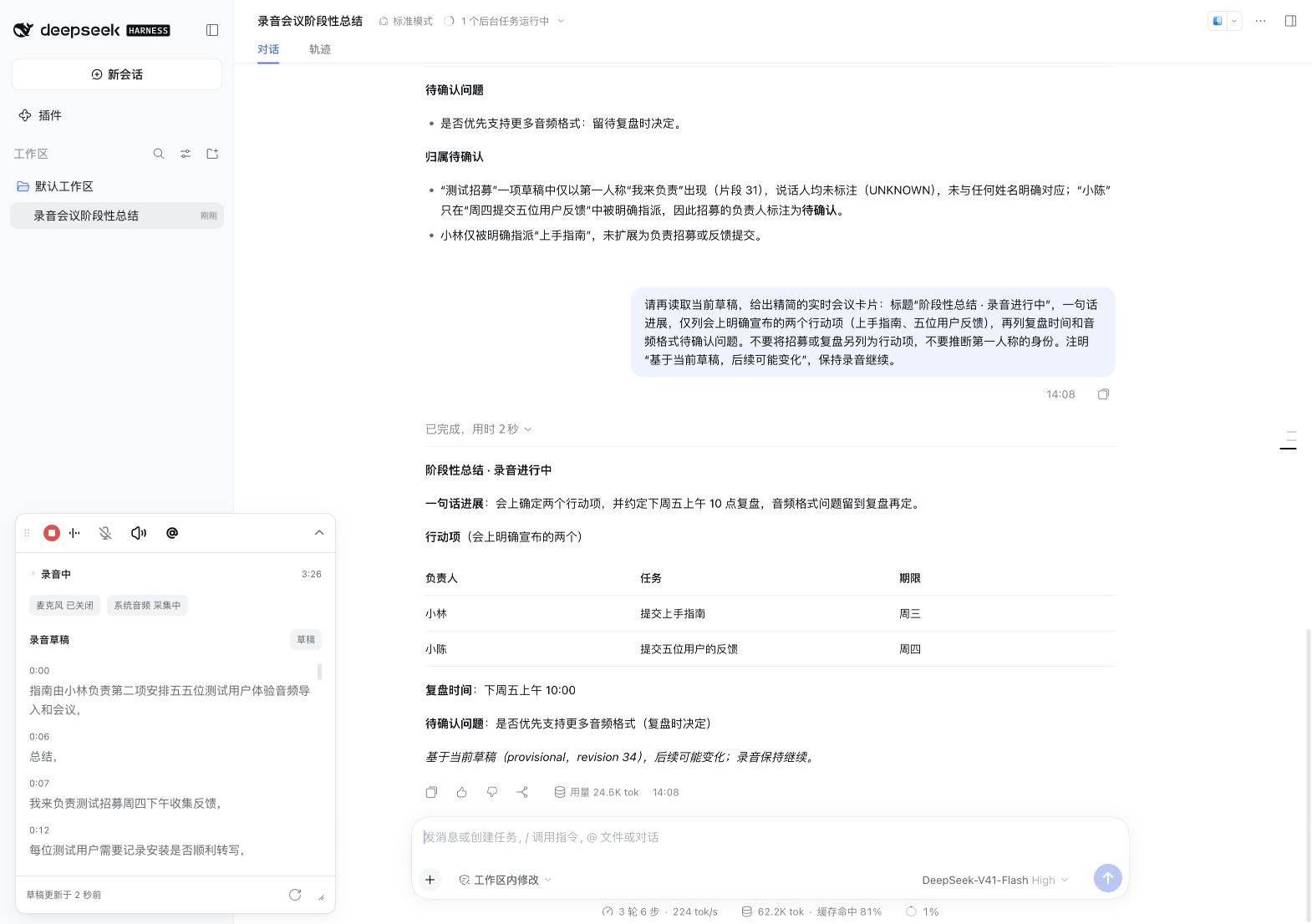
This example uses a fictional, speech-synthesized meeting. While recording
continues, an @ reference lets the configured DeepSeek model read the live draft
and generate an interim summary. The summary is a user-requested snapshot and can
change as the draft evolves. See the workflow screenshots
for the full example and environment details.
Official community showcase.
Compatibility
| Component | Requirement |
|---|---|
| Host | DSH 0.2.0-rc.2 |
| Runtime | Node.js 24 |
| Platform | macOS, Apple Silicon (darwin / arm64) |
| Microphone API | macOS 13.5 or later |
| System audio and dual-track APIs | macOS 14.2 or later |
These macOS versions specify API availability; they are not a tested OS matrix. DSH desktop and Web modes both process audio on the Mac running DSH. Windows, Linux and Intel Macs are unsupported.
Installation
Install @huliux/dsh-asr-plugin from the DSH Plugins page. Web profiles also
support the CLI:
dsh plugin --profile web add --ignore-scripts @huliux/dsh-asr-plugin@0.1.2
The package includes native add-ons and an ad-hoc signed recording Helper. The Helper is not notarized; macOS may require permission or security approval at installation and after updates. Keep system security protections enabled.
Desktop and Web profiles share the default meeting store. Run one plugin host per data directory. Preserve meeting and model data when replacing a package.
For package verification, local archive installation and release channels, see distribution. Source downloads require the complete source build before recording. Report installation problems through GitHub Issues, including the plugin, DSH, Node.js and macOS versions without meeting data or credentials.
Model preparation
In plugin settings, download the base models (approximately 278 MiB). Optional punctuation models require approximately 274 MiB and apply automatically to new recordings, imports and retranscriptions after verified installation. Existing tasks and transcripts retain their processing mode. A damaged installed punctuation pack must be repaired before starting new tasks.
Models are downloaded from pinned upstream revisions and verified by size and SHA-256 before installation. Weights are excluded from Git, npm and GitHub Releases. Enabling the plugin does not initiate a model download. Downloads support cancellation and retry; complete verified files can be reused after failure. See model assets for sources, proxy behavior and offline staging.
Recording and meeting access
Use Recording permissions in plugin settings to check microphone and system audio access. Each recording start performs fresh admission checks. A failed system-audio check may reflect permission, output volume or device routing. Silence during a recording does not establish a permission denial.
Expanding the recorder prepares models without capturing audio. Sequential recordings can reuse loaded model resources, which are released after five idle minutes. Audio, drafts and speaker state remain separate for each meeting.
Select a DSH session to record, or ask the DSH agent to import an absolute local
audio path. Use the @ picker to reference a meeting and request reading or export.
File writes use DSH Approval. Meetings persist independently of DSH sessions and
workspaces.
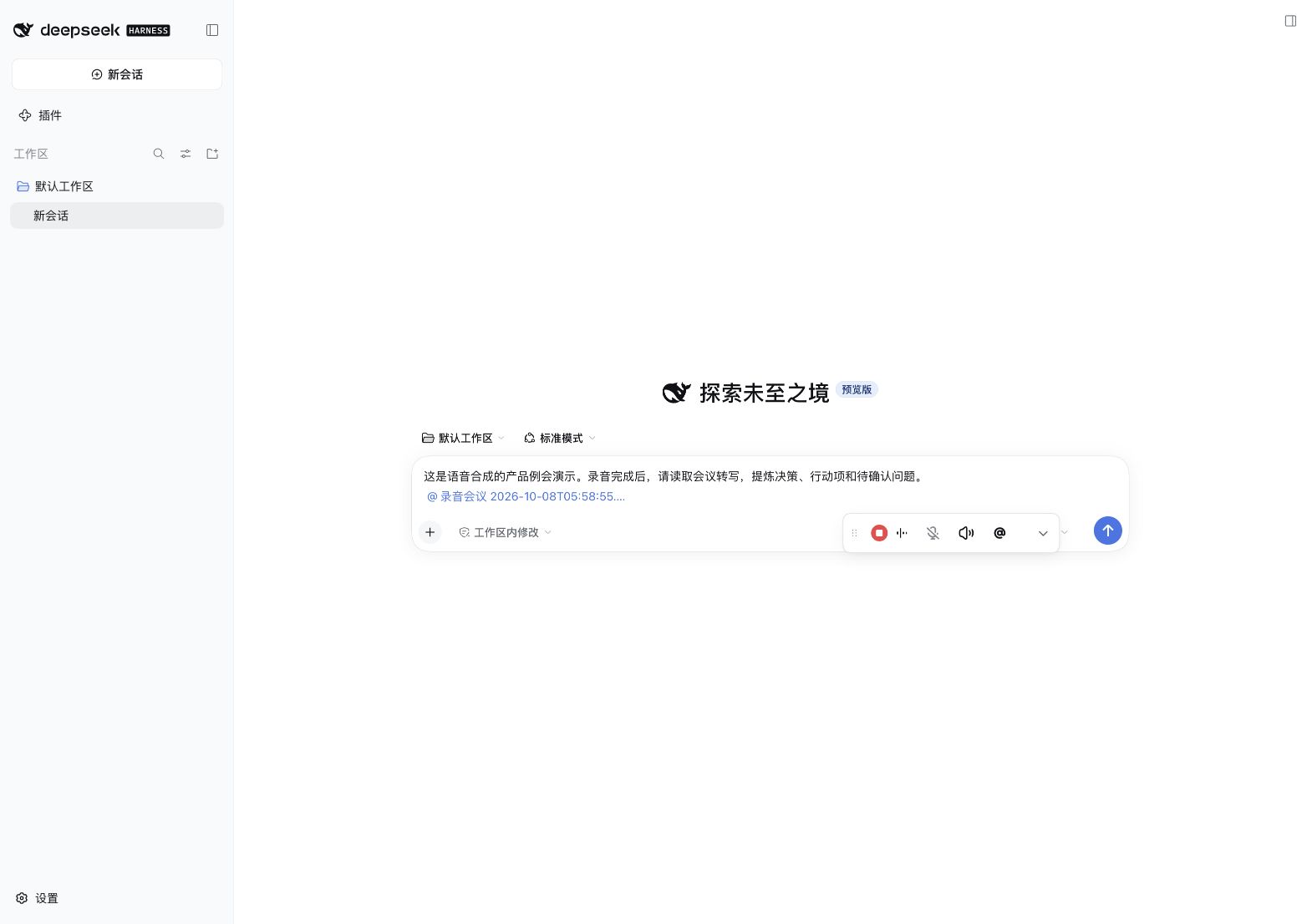
The compact recorder shows the active capture controls:
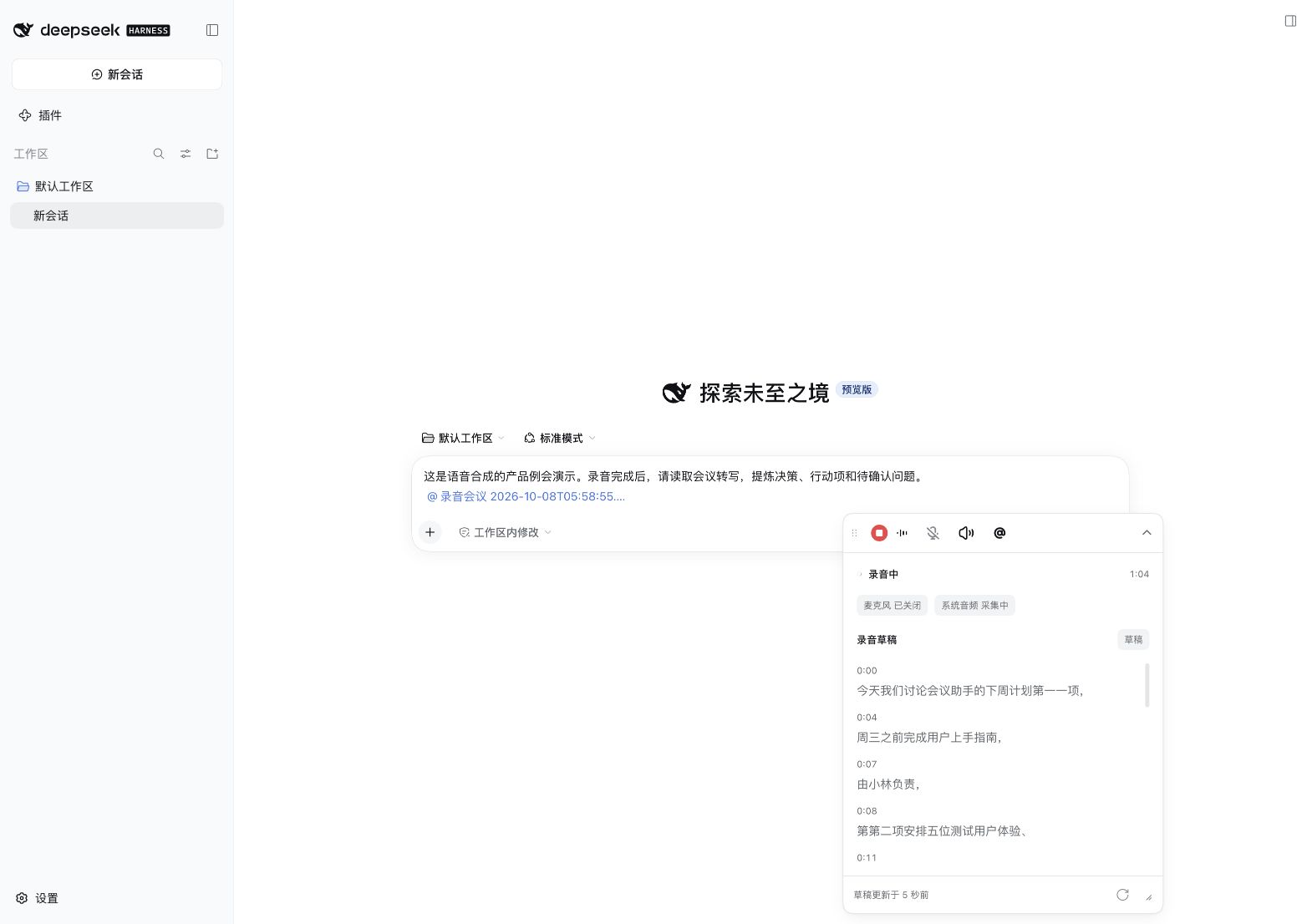
Expand it to view elapsed time, track states and the live transcript draft:
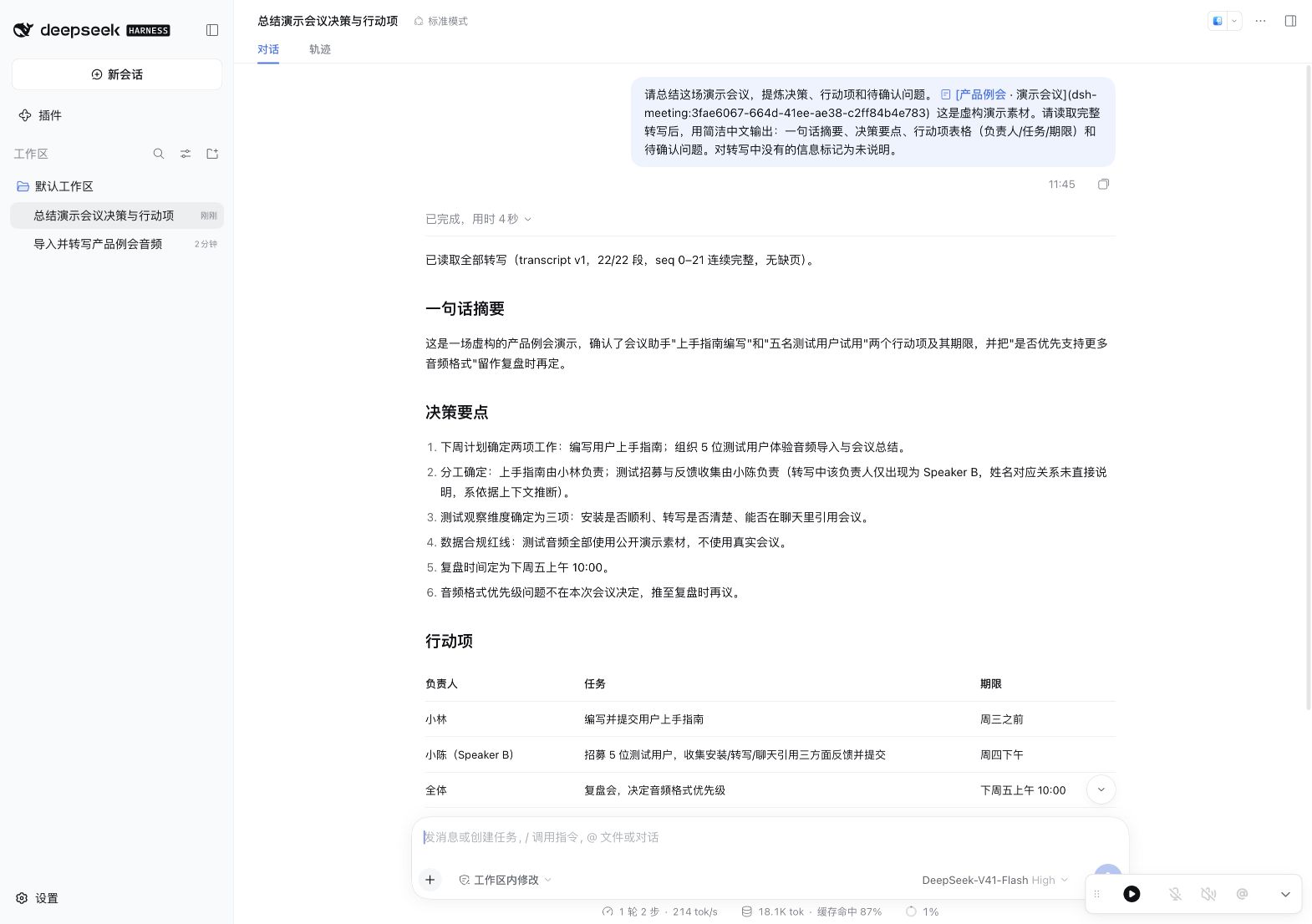
For imported audio or after recording, reference a meeting to summarize its committed transcript:
Audio inference runs locally after model preparation. Reading a transcript with an LLM can send its content to the provider configured in DSH; host configuration and provider terms govern that operation.
Limitations
- Speaker labels distinguish voices within a meeting; they do not establish personal identity. Recognition and speaker accuracy depend on input conditions; no general accuracy benchmark is reported.
- Three fixed model weights currently have one verified provider. A provider outage can prevent installation; same-named weights cannot be substituted.
- Sent message history can show an internal meeting-reference link even when the picker and composer display the meeting title.
Development and licensing
See development for source builds and verification, CONTRIBUTING.md for contributions, and publishing for package preparation.
Project-owned source is licensed under Apache-2.0. Third-party source
and models retain their respective terms; see
THIRD_PARTY_NOTICES.md and the notices in third_party/
and vendored native directories.
Support and contact
- Usage questions, bug reports and feature requests: GitHub Issues. See support guidelines for useful diagnostic information.
- Collaboration and private inquiries: dasenrising@gmail.com.
- Security vulnerabilities: follow the security policy to report privately.
No comments yet. Be the first to write one.