万象工阁 · Wanxiang Hall


English | 中文
One person's company, five people's output. A delivery org inside DeepSeek Harness: intake → architect → review → dispatch → build → accept → deliver, with hard gates and a receipt for every hand-off.
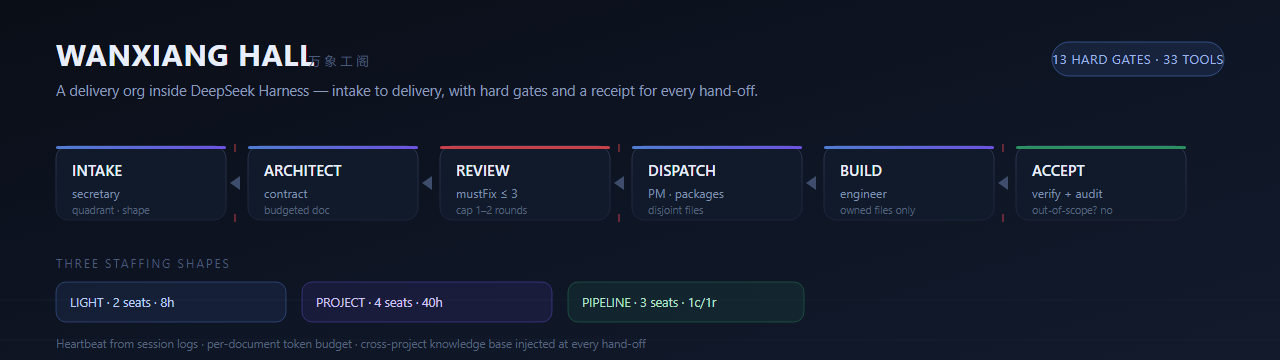
Wanxiang Hall turns the workflow of a small software agency into agents that check each other's work, a set of gates that cannot be bypassed, and a panel that shows who is actually working and where it is stuck.
Made by Huanzhan (company) / Wanxiang Huanrong (team).
The three ways a solo agent fails on long work
- It looks busy. Hundreds of tool calls in the session log,
0%on the panel — because progress is self-reported by the agent instead of derived from what it did. - A rejection becomes a full rewrite. The reviewer says "point 3 is wrong"; the author resends the whole document and quietly changes three other things; the next round is longer than the last. (Real case: 6 rejection rounds, 9 drafts, one document growing from 25K to 60K characters.)
- No convergence rule. What counts as done, how many rounds are allowed, when a human must be called — all of it is left to the user's patience.
What this plugin does about it
| Layer | Mechanism |
|---|---|
| Facts | Heartbeat derived from session-log mtime (activity.js: working / quiet / stale / stuck / dead / unassigned). All six states are computed, never stored. "Running" is not the same as "alive": an agent stuck inside one tool call for two days used to look perfectly healthy. |
| Rules | Transitions come from PIPELINES[shape] — plain data, per-stage requires checks and a rejectCap. Missing output, edits outside the declared files, or starting work before the scope is signed are all refused. |
| Surface | The panel shows derived facts only: stage, health, work packages, time box, priority quadrant, and the things waiting on you. |
Three staffing shapes
| Shape | Seats | Good for | Reject cap | Time box |
|---|---|---|---|---|
squad light |
architect + delivery engineer | one module, a batch of bugs, a new endpoint | 1 round | 8h |
crew project |
architect → reviewer → PM → engineer | several modules, cross-platform, packages that need integration | 2 rounds | 40h |
line pipeline |
architect → PM → engineer (many packages) | homogeneous bulk work | 1 round | none |
The light shape has no reviewer seat on purpose: whoever builds the thing reviews the plan (they own the deadline), and code acceptance is automated verification plus a spot-check diff. An independent reviewer only appears in the project shape, where "did we drift from the requirement" cannot be verified by a command.
Five seats
| id | Title | Job |
|---|---|---|
secretary |
Delivery secretary | intake, project setup, answering, proxy signature, spot checks, closing |
zhongshu |
Architect | requirement → contract / plan / package breakdown |
menxia |
Reviewer (project shape only) | structured rejection (mustFix ≤ 3) or approval |
shangshu |
PM (called delivery engineer in light, dispatcher in pipeline) | split packages, dispatch, integrate, quote and settle |
executor |
Engineer | change only the files its package declares |
You are the client. The signatures only a human can give — scope, extension, closing — are the one thing no agent may fill in for itself.
Four surfaces
- Intake — say one sentence to the secretary; importance/urgency quadrant plus a portfolio strip.
- Workstations — one seat chain per project; click a seat to jump into that session.
- Project board — stage, health, packages, time box, documents, verification, knowledge hits.
- Knowledge base — company memory (decision / constraint / pitfall / pattern / tool / glossary / client preference), shared across projects, 3 entries auto-injected into each hand-off.
Hard gates (headline)
- Stage changes only via
court_handoff, and only along edgesPIPELINESallows. - Per-stage
requires: the document that stage must produce is missing → no hand-off. - Rejection cap is per shape; past it the decision goes to the client, not into another loop.
- A revision after rejection must clear the ledger with
fixes:[1,2], and must not grow longer. - Documents have a hard budget by kind (contract 6K, plan 12K, package 2K …), overflow returns
BRIEF_TOO_LONG. - Hand-offs send an index and a pointer, not the full text; the receiver reads on demand with
court_read_brief. - Work cannot start before the scope is signed (
court_confirm_scope), and the scope cannot be signed before a plan exists. - Packages are validated for file overlap (
pathsConflict); overlapping packages must declaredependsOn. - Before closing, an out-of-scope audit runs: a file outside the declared ownership rejects the closing.
- Verification commands are pre-flighted when registered — a command that cannot even start (
env,encoding) is refused on the spot. - The user-action sheet can only be ticked by the secretary or the client; an engineer cannot declare "the user's step is done".
- When the time box is up, the client picks one of three (cut scope / extend / close); no automatic renewal.
- Empty-state guard: if the disk still holds projects and the next write would persist an empty state, the write is refused (this is how a real project list got wiped by a "file not found → treat as empty" read).
Full list: docs/gates.md (30 rules).
Install
Package name dsh-wanxiang-hall, zero host-side dependencies (Node built-ins only).
A. From npm (one line, easiest)
npm i dsh-wanxiang-hall --prefix <DSH_HOME>/profiles/<profile>
B. Straight from GitHub (no npm publish needed — npm fetches the repo as a tarball)
// <DSH_HOME>/profiles/<profile>/package.json
{
  "dependencies": { "dsh-wanxiang-hall": "github:hujiajunyu-lab/dsh-wanxiang-hall" }
}
C. Local checkout (edit and restart; no reinstall)
git clone https://github.com/hujiajunyu-lab/dsh-wanxiang-hall.git ~/wanxiang-hall
// <DSH_HOME>/profiles/<profile>/package.json
{
  "dependencies": { "dsh-wanxiang-hall": "link:~/wanxiang-hall" }
}
Why local works: DSH resolves a plugin from the profile's
node_modules.link:creates a directory junction there pointing at the repo. npm is not a runtime requirement — only one way to get the package intonode_modules.
The package ships cordis.patch.yml and presets/court.patch.yml, which register:
- an HTTP prefix
/court(panel data, knowledge base, backups); - the
court_*tool set (33 tools); - five session presets (secretary / architect / reviewer / PM / engineer);
- a system-prompt section injecting the current project index (order 130);
- a watchdog timer (every 10 minutes: liveness, nudge, escalation).
Where the data lives
| What | Where | Note |
|---|---|---|
| Project state | <DSH_HOME>/court/court.json |
projects only, no memory |
| Knowledge base | <DSH_HOME>/court/kb.json |
kept separate: an 8K body inside court.json would rewrite the whole file on every hit counter |
| Baselines, verification logs | <DSH_HOME>/court/baselines/, verifications/ |
|
| Backup | $COURT_BACKUP_DIR or ~/.dsh/court-backups |
plugin source + profile config + state, rolling 10 copies |
| Knowledge export target (optional) | you set it | no default; unset only disables "export to the wiki" |
Environment: COURT_STATE_DIR (state dir, for tests), COURT_BACKUP_DIR, COURT_SESSIONS_ROOT (session-log root used by the heartbeat).
Develop
node --check index.js    # syntax
node --test              # 128 unit + regression tests (bare `node --test`, not `node --test test/`)
Conventions:
- Never edit these
.jsfiles withGet-Content/Set-Content: Windows PowerShell reads them as GBK and writes UTF-8, shredding every Chinese string irreversibly (we lost 214 bytes that way). - On Windows,
npm/npm.ps1may be blocked by execution policy; callnode <npm-cli.js>or run node directly. - Tests isolate state through
process.env.COURT_STATE_DIRand never touch your real projects.
Roadmap
- Turn the three-way rejection choice into buttons (today: text + session)
- Diff view for the document version chain (
revisionsis already stored) - Split
client.jsinto modules (currently one bundle) - Vector retrieval for the knowledge base (today: local scoring + bigram tokens)
- Real-world validation of the pipeline shape
License
MIT — see LICENSE.
No comments yet. Be the first to write one.