dsh-plugin-subagent-model-route
English | 中文
Annotate every subagent with the model route it actually ran on, in both places you look at a subagent: the parent's catalog list and the child session's own header.
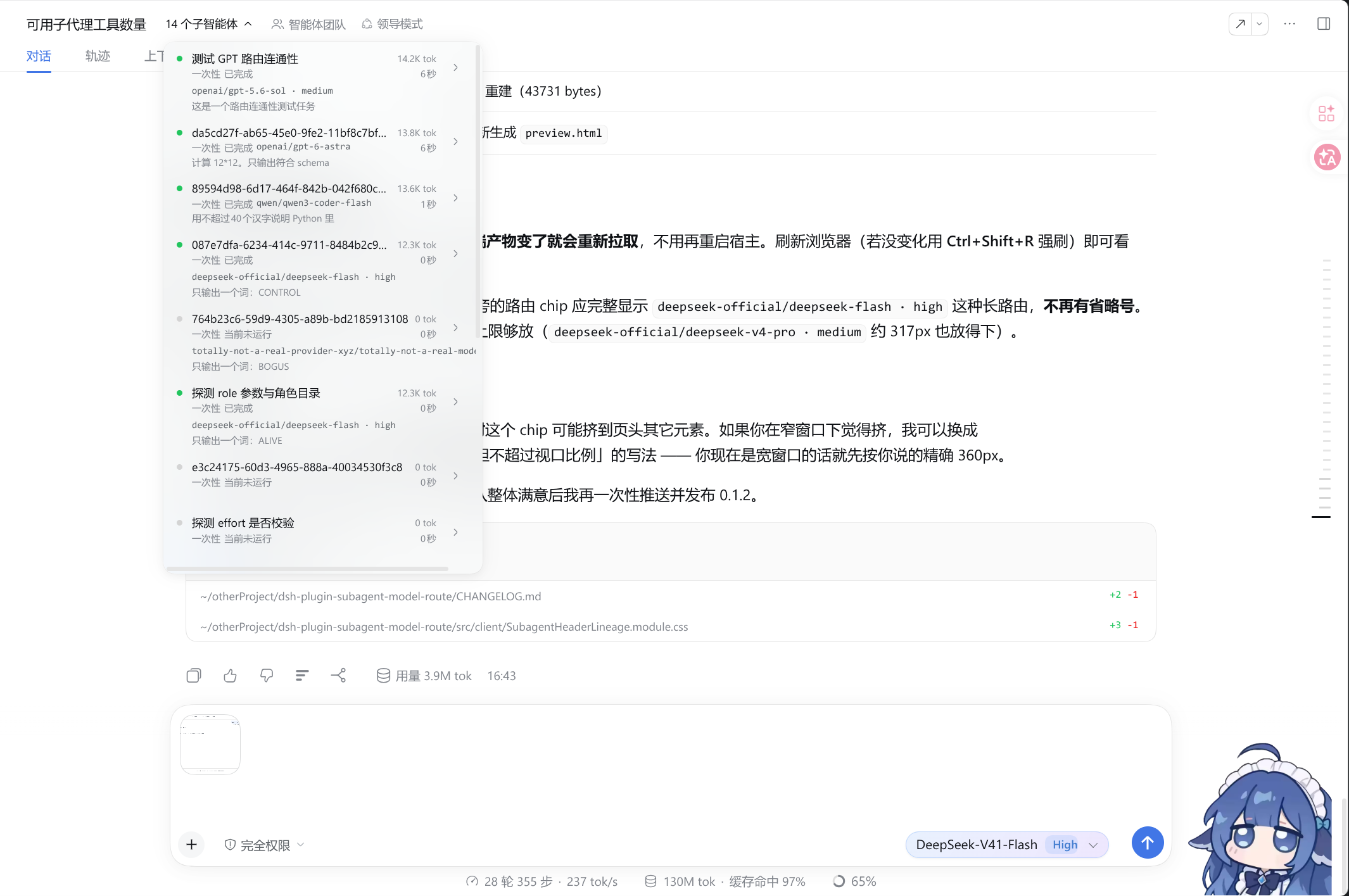
The parent's catalog: fourteen subagents, each row stacking the name, a mode · activity · route badge line, and the durable title below it. The badge spells out the whole route —
openai/gpt-5.6-sol · medium, openai/gpt-6-astra, qwen/qwen3-coder-flash,
deepseek-official/deepseek-flash · high — exactly as those delegations ran it.
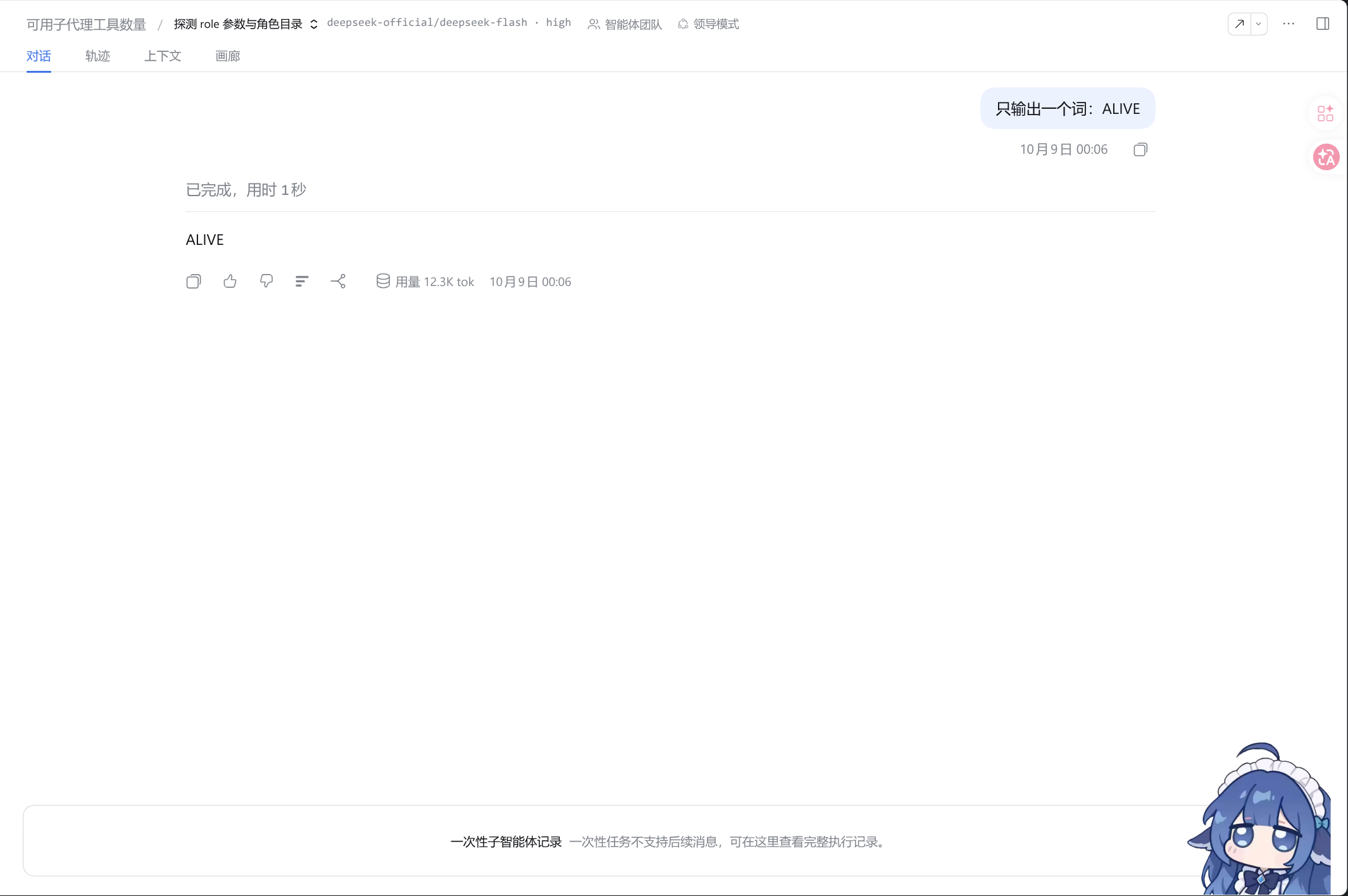
Opening a child session: the full route (deepseek-official/deepseek-flash · high) sits
beside the lineage breadcrumb, in the header, above the read-only one-shot composer notice.
Effect
Two surfaces change, and nothing else:
| surface | before | after |
|---|---|---|
| Parent catalog row | name, then title · one-shot · running on one line |
three lines: name / one-shot running openai/gpt-5.6-sol · medium / title |
| Child session header | breadcrumb switcher only | breadcrumb switcher + openai/gpt-5.6-sol · medium |
A row whose child never issued a request shows no badge. The badge spells out the whole
route — provider/model · reasoningEffort — so the provider and the reasoning effort are
readable without hovering; a route too long for the badge line wraps onto its own line instead
of being clipped. The tooltip repeats the route under its label, and the row's accessible name
carries it too.
Effect, expressed as consequences
Worth reading before installing. This plugin deliberately shadows shipped UI, and that has a price:
- Rows get taller. 44px → 59px, so the dropdown, capped at
min(560px, 100vh - 140px), now shows roughly 9 rows instead of 12 before it scrolls. A route long enough to wrap the badge line pushes a row to 74px and shows fewer still. - You fork that region of the shipped UI. The catalog contract marks this seat
replaceRisk: 'shadows-shipped-ui'. Upstream improvements to those two occupants — including DeepSeek adding a model column themselves — will not reach you; you have to re-vendor and re-apply the two modifications (see PATCH-RECORD.md). - A shipped-UI bug in that region becomes yours. The renderer is a verbatim copy of the shipped one (the copy even reproduces upstream's React duplicate-key warning about the child session id).
- The stylesheet is injected twice. The vendored CSS module is a second copy of the shipped sheet, so the page carries both. It is small, and the hashed class names differ (different file content), so nothing collides.
- The shipped occupants are shadowed, not unregistered. They stay registered and render nothing — a small, inert cost.
- It duplicates the
subagent-directordock if you run both. That plugin draws the route under the composer for an opened child; this one draws it in the header. Expect the route twice in the same view until you drop one of them. - The route is the last request's route. A child that switched models mid-life shows only the most recent one, and "no badge" means "never issued a request", not "unknown".
- Only those two surfaces change. The read-only composer, the Sidebar chat tab, and the
@reference source stay shipped. - Uninstalling reverts everything. Nothing is persisted and no host-side surface changes;
remove the package from the profile's
bundlesand restart. - Activation needs a host restart.
dsh.clientis composition-level config and does not hot-reload.
Why this is a plugin that shadows the shipped UI
The shipped @deepseek-ai/dsh-client-ui-subagent decides what those two surfaces render, and
it cannot be extended additively: conversation.session.header.lineage is a single cell with
no registerOptions and no declared children, and there is no per-row slot at all. Taking the
seats over is the only way to add the route from outside.
The slot registry throws when a second registration lands on an occupied cell at the same
priority and shadows on any different one, so this plugin registers both seats at
priority: -1 (the shipped occupants own the default 0):
| seat | shipped occupant | how this plugin takes it |
|---|---|---|
conversation.session.header.lineage (single) |
SubagentHeaderLineage |
shadow at priority -1 |
conversation.session.header.actions (list) |
SubagentCatalogAction (id subagent-catalog) |
re-register the same id at priority -1 |
The route itself comes from the durable modelSelection projection (recorded on every
request/header), read through the same summary.projectionValues the row already uses for
token usage and timing — so this adds no RPC, no host change, no projection, no new slot.
Mounting
Mount it as a profile bundle, exactly like any other local plugin:
// ~/.dsh/profiles/web/package.json
"dependencies": {
  "dsh-plugin-subagent-model-route": "link:/path/to/dsh-plugin-subagent-model-route"
},
"dsh": { "profile": { "bundles": [
  // ...after @deepseek-ai/dsh-base and @deepseek-ai/dsh-web-app
  "dsh-plugin-subagent-model-route"
] } }
Or install it the supported way, which edits both lists for you:
dsh plugin --profile web add dsh-plugin-subagent-model-route     # from npm
dsh plugin --profile web add ./dsh-plugin-subagent-model-route   # from a checkout
Then restart the host.
Development
node_modules/ in this checkout is a dev-only shim of symlinks into a harness checkout (the
host's own react/react-dom/@deepseek-ai/*, plus the monorepo's tooling), because the
@deepseek-ai/* packages are only published to npm as a 0.0.1-rc.1 placeholder. A normal
npm install against the versions listed in devDependencies replaces it.
npm run check      # typecheck -> build -> headless smoke (16 checks)
npm run build      # tsdown: lib/index.js (host half) + lib/client/index.js (closure factory)
npm run watch
npm run smoke      # renders both seized seats under jsdom
npm run preview    # writes preview.html: the same render, with the theme CSS, for a browser
The out-of-tree build in tsdown.config.ts restates the two contracts the
monorepo's own clientBundle() preset enforces — the
window.__ModuleLoader__.load({ id, factory }) handoff, and the lightningcss pass that turns
*.module.css into a hashed class map plus a tagged <style> injection — because that preset
locates packages by globbing the monorepo and cannot build a package outside it. The build needs
only tsdown + lightningcss: the host-provided packages stay external and are never
resolved, which is what keeps a git install from failing on unpublished @deepseek-ai/*
versions.
scripts/smoke.mjs runs the real artifact through the real handoff and asserts, among other
things, that the bundle's require set is exactly the four platform seed rows (react,
react/jsx-runtime, react-dom, @deepseek-ai/dsh-client-ui-primitives) — a request the host's
module table cannot answer would be a guaranteed runtime throw.
Publishing
See PUBLISHING.md for the full checklist, the DSH-specific traps, and the
catalog-submission steps. The short version: fill in the CHANGE-ME repository fields, publish to
npm with lib/ built at publish time, verify in a clean profile, tag the repo with the
dsh-plugin topic, then submit to the community catalogs.
Maintenance
The vendored renderer is pinned to the shipped one at deepseek-ai/deepseek-harness
master @ 5badb15009. When upstream changes SubagentHeaderLineage.tsx or its stylesheet,
re-vendor and re-apply the two modifications from PATCH-RECORD.md — or, on a
machine that owns the harness checkout, prefer the equivalent upstream patch
(UPSTREAM-PATCH.patch), which needs no shadowing at all.
License
MIT — see LICENSE. The vendored renderer originates from the MIT-licensed
@deepseek-ai/dsh-client-ui-subagent.
No comments yet. Be the first to write one.