SemaRail
A governed semantic layer that helps AI agents understand business data and run safe, inspectable queries.




SemaRail turns database schemas, business definitions, relationships, rules, and reviewed SQL into a semantic context that AI agents can use consistently. It provides a visual Semantic Console for managing that context, a stable MCP interface for agent integration, and a governed query boundary for read-only data access.
SemaRail is agent-neutral. Any MCP-capable client can use its semantic tools. It also provides a dedicated, independently installable DeepSeek Harness plugin that connects Harness to SemaRail Core, turning it into a governed Data Agent with native Chart, Table, and SQL views.
Status: Alpha. APIs, configuration, and storage formats may change before the first stable release. Core and Harness plugin tarballs can be built from source; npm and PyPI packages are not published yet.
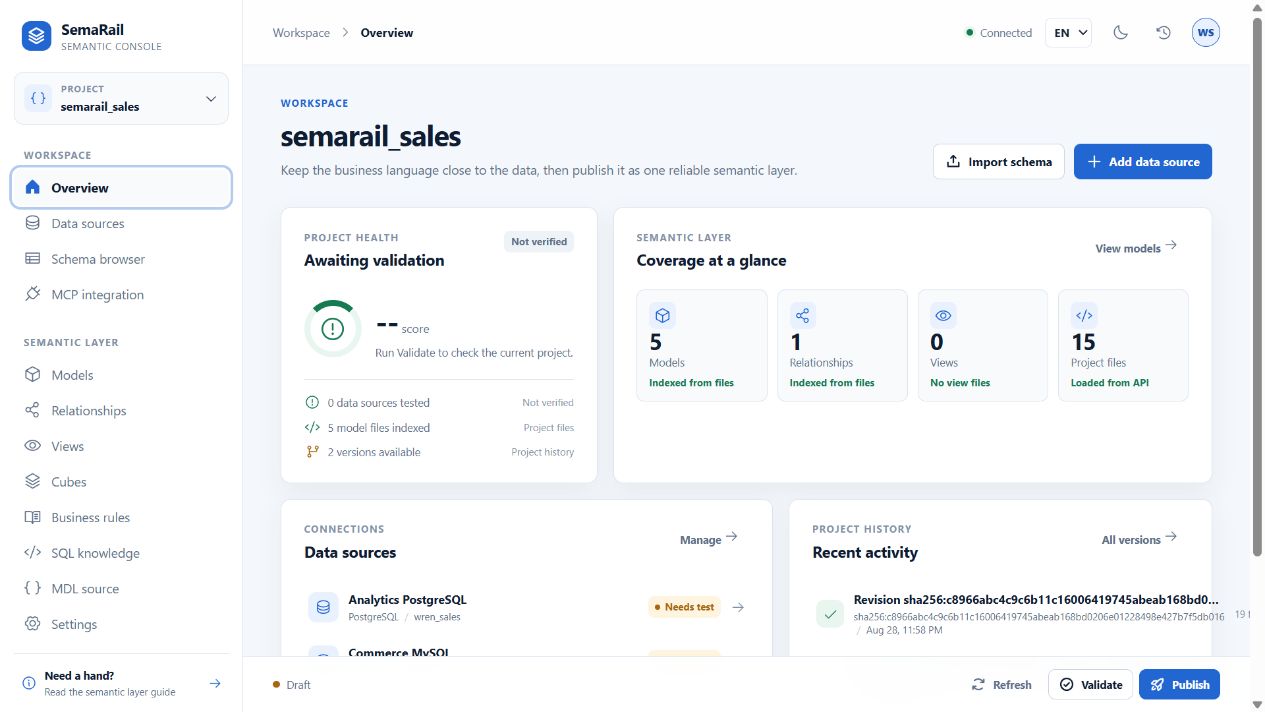
Features
- Visual semantic modeling — import database schemas and manage models, fields, relationships, views, cubes, business rules, and reviewed SQL knowledge.
- Agent-neutral MCP tools — expose semantic context and governed queries through authenticated Streamable HTTP, with an authenticated stdio bridge for clients that require it.
- Governed data access — resolve every request to a current Subject and policy, parse generated PostgreSQL with
sqlglot, enforce table/column/row rules and physical-object allowlists, and apply read-only, timeout, row, byte, and concurrency limits. - Bounded Agent results — return small query results inline, but turn larger results into a short-lived CSV download with only a 20-row preview in the Agent context.
- Enterprise identity and policy — use revocable service-account keys or DingTalk/OIDC employee sessions, change permissions without reinstalling Agents, and audit decisions without storing SQL, result rows, or secrets.
- Common database metadata — test connections, browse schemas, and import models from PostgreSQL, MySQL, SQLite, ClickHouse, and DuckDB.
- Versioned semantic projects — validate drafts, inspect generated source and diffs, publish revisions, and roll back changes.
- Bilingual metadata — maintain English and Simplified Chinese display names without changing stable technical identifiers.
- DeepSeek Harness Data Agent — install the optional thin Host/Client plugin to give Harness SemaRail semantic context, governed querying, cancellation, and durable Chart, Table, and SQL results.
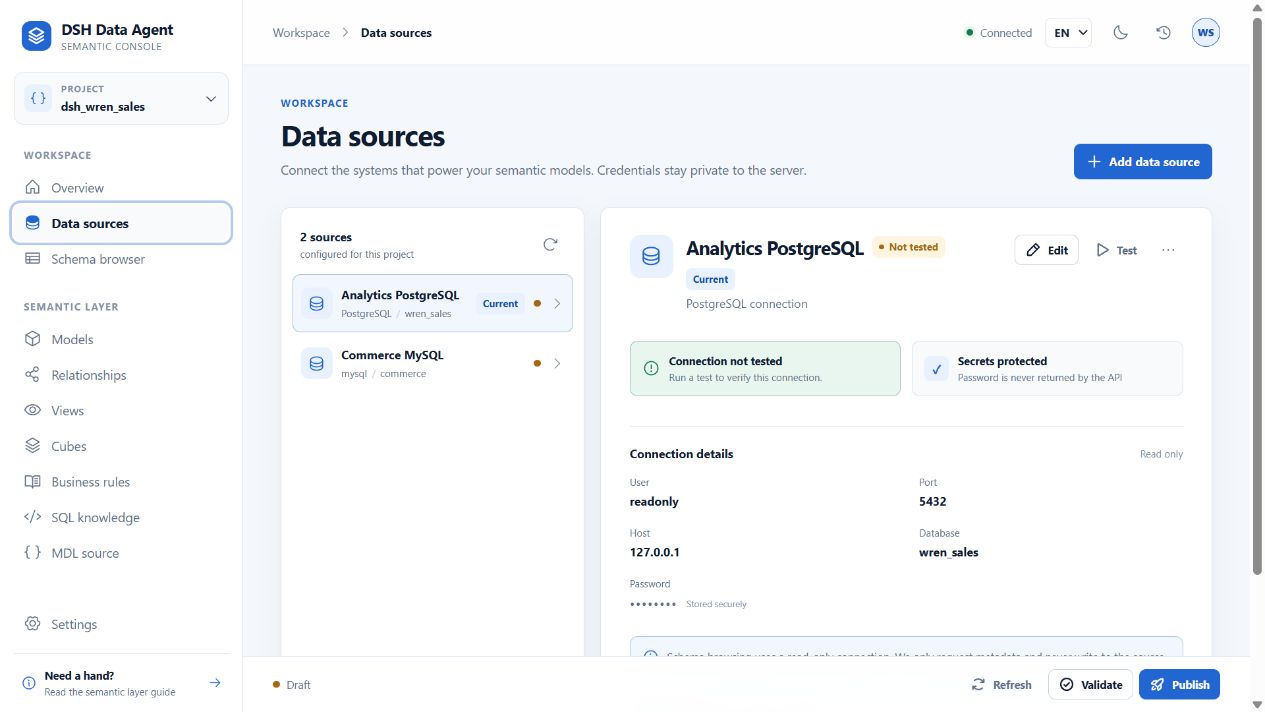
Datasource management
Datasource credentials stay on the server and are redacted from API responses. The standard Console installation includes PostgreSQL, MySQL, SQLite, ClickHouse, and DuckDB drivers for connection testing, schema browsing, and model import. Local SQLite and DuckDB files are opened read-only.
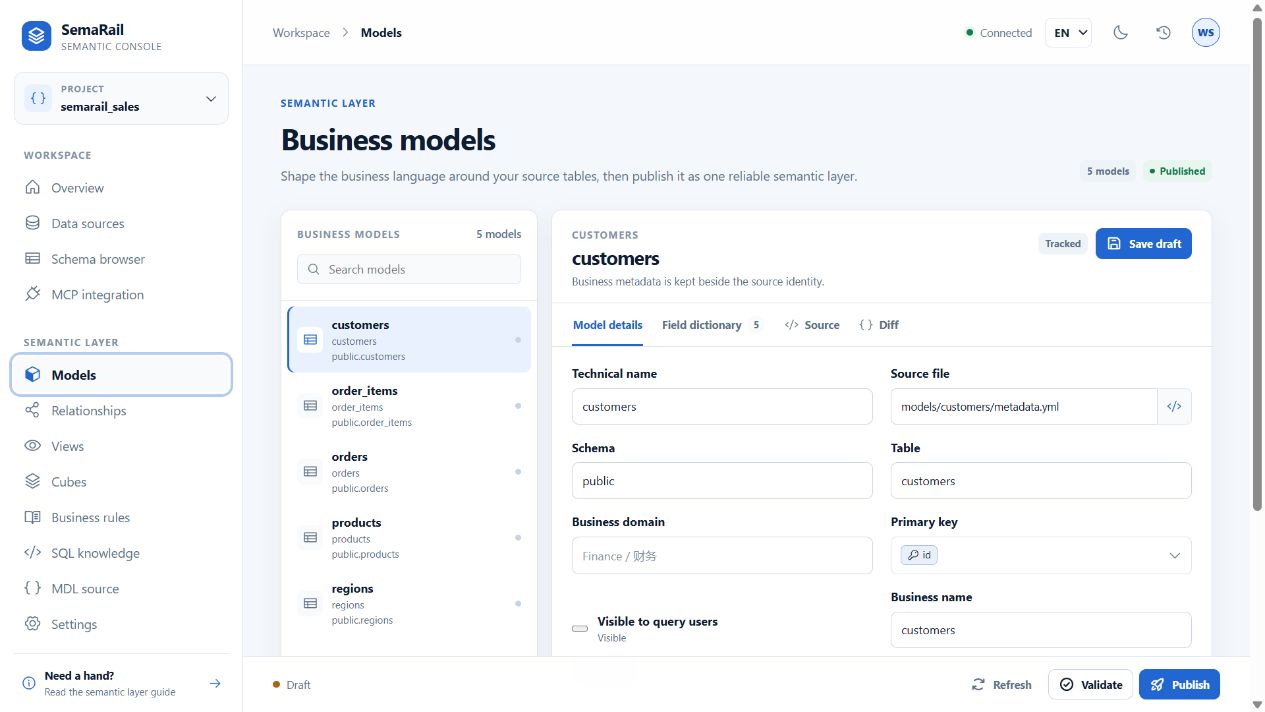
Semantic model workbench
Edit business names, descriptions, visibility, primary keys, and field dictionaries while keeping generated semantic source and a unified diff nearby.
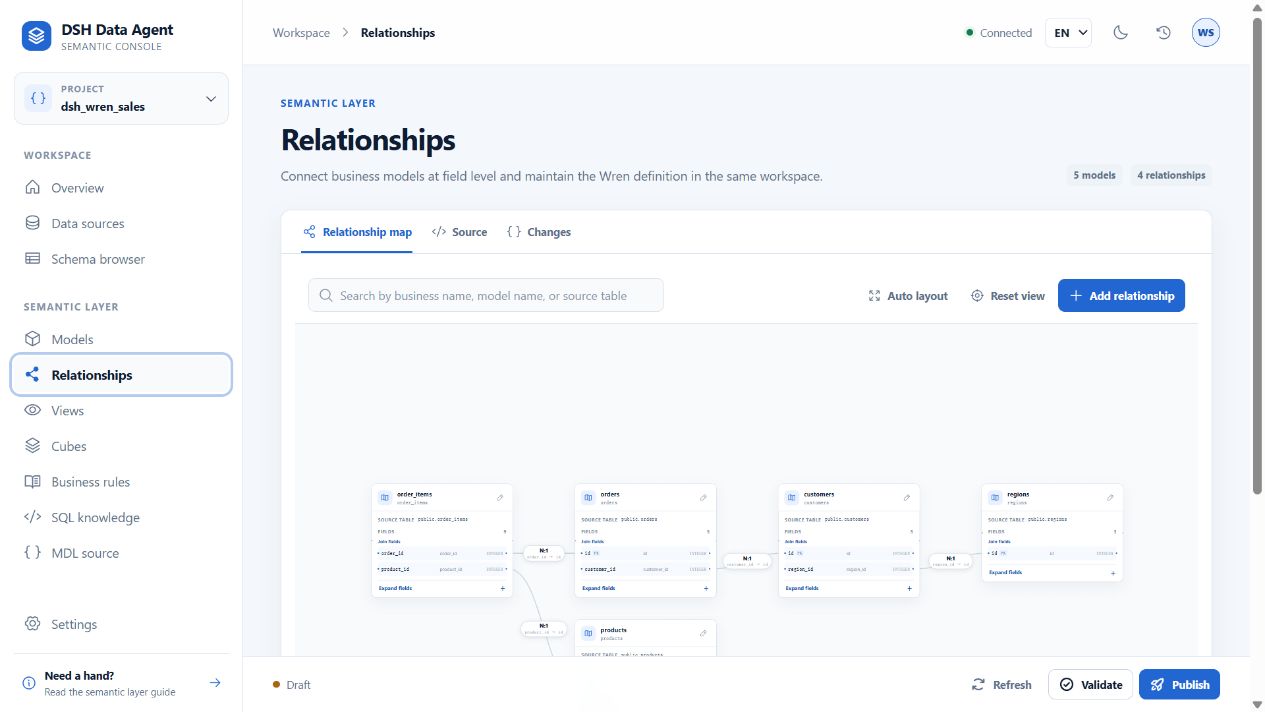
Relationship graph
Explore and maintain field-level model relationships in an interactive graph.
Project roadmap
This roadmap highlights major project milestones. For file-level release notes, see CHANGELOG.md.
| Date | Status | Milestone |
|---|---|---|
| 2026-08-30 | Completed | Established the SemaRail brand, Semantic Console, stable semantic MCP contract, and separate Core/DeepSeek Harness plugin packages. |
| 2026-08-31 | Completed | Added DingTalk and OIDC employee sign-in, revocable sessions, trusted subject attributes, and administrator-managed account access. |
| 2026-09-01 | Completed | Added project-, datasource-, table-, column-, and row-scoped authorization with immediate policy and credential revocation. |
| 2026-09-02 | Completed | Added multi-user authenticated MCP, PostgreSQL-backed access-control storage, transaction-local subject context, and PostgreSQL RLS isolation. |
| 2026-09-03 | Completed | Hardened permission-control acceptance with real PostgreSQL 17 tests, first-request MCP query startup, clean Linux CI builds, and A/B employee row-isolation verification. |
| 2026-09-04 | Completed | Added bounded query-result delivery: up to 50 rows and 128 KiB inline, otherwise a revocable 15-minute CSV artifact with a 20-row Agent preview and 16 MiB ceiling. |
| Next | Planned | Extend governed query execution beyond PostgreSQL while preserving the same policy, limits, audit, and cancellation contract. |
| Next | Planned | Add a managed CSV/Excel ingestion workflow backed by DuckDB, without exposing uploaded files or local paths to Agents. |
| Later | Planned | Publish versioned SemaRail Core and DeepSeek Harness plugin packages after the alpha installation and upgrade flow is stable. |
Tech stack
- Python 3.11+
- TypeScript and Node.js
- React 18 and Vite
- Model Context Protocol (MCP) Python SDK
sqlglotfor structural SQL validation- PostgreSQL for governed query execution
- PostgreSQL, MySQL, SQLite, ClickHouse, and DuckDB drivers for Console metadata workflows
- Apache ECharts for conversation-native charts
Quick start
Install SemaRail Core
Requirements:
- Node.js
^22.19.0 || >=24 - Python
>=3.11
Until the split packages are published, build both local tarballs from the repository:
pnpm install
pnpm package:split
npm install --global .\dist\hejielijob-semarail-core-0.1.0-alpha.3.tgz
$env:SEMARAIL_API_TOKEN = semarail token create
semarail start --project C:\path\to\semantic-project
The Core process owns the semantic project, database credentials, execution limits, Semantic Console, and MCP servers. Open http://127.0.0.1:48763 after it starts. Keep SEMARAIL_API_TOKEN private: it is the local bootstrap-administrator credential used to create narrower, revocable service-account keys.
Optional DeepSeek Harness plugin
In Access Control, create a dedicated Harness service account, bind only the required project/table/row policy, and issue a one-time sr_live_... key. Provide that scoped key—not the bootstrap token—to Harness:
$env:SEMARAIL_HARNESS_TOKEN = "<scoped sr_live_... key>"
dsh plugin --profile web add .\dist\hejielijob-dsh-semarail-plugin-0.1.0-alpha.3.tgz
The plugin connects to http://127.0.0.1:48763 by default. It no longer embeds or starts Python, the Semantic Console, or the semantic runtime.
Run from source
Requirements:
- Git
- Node.js
^22.19.0 || >=24 - pnpm
11.x - Python
>=3.11 - PostgreSQL only if you want to execute governed queries
git clone https://github.com/hejielijob-commits/SemaRail.git
cd SemaRail
pnpm install
pnpm build
For a larger, reproducible local validation against 100,000 synthetic employees and five authorization roles, see the HR enterprise benchmark. It runs separately from CI and requires Docker.
HR enterprise benchmark: overview and results
The benchmark contains 60 fixed questions drawn from enterprise HR scenarios, built on a reproducible dataset of 100,000 employees and 1.9 million PostgreSQL rows. It includes 30 basic reporting questions, 15 cross-model analytical questions, and 15 authorization-boundary questions in Chinese and English across five enterprise roles. Together, they validate the MDL models, relationships, metric rules, SQL knowledge, semantic planning, governed execution, and access control. All 60 questions passed.
The checked-in semantic layer and evaluation evidence include:
- Wren MDL project
- six semantic model definitions
- model relationships
- HR metric and authorization rules
- SQL knowledge examples
- PostgreSQL schema
- 60 evaluation cases
- evaluation process and results
- machine-readable result summary
Create the Python environment and install the semantic runtime, MCP servers, Console, governed PostgreSQL query driver, and Console metadata drivers:
py -3.11 -m venv .venv
& .\.venv\Scripts\python.exe -m pip install `
  -e ".\python\sidecar[wren,mcp]" `
  -e ".\apps\semantic-console[wren]"
Start the Semantic Console
The repository includes a deterministic sales project for a local tour:
$stateDir = Join-Path $env:LOCALAPPDATA "semarail\semantic-console\sales-demo"
& .\.venv\Scripts\python.exe -m server `
  --project-dir .\examples\wren-postgres `
  --state-dir $stateDir `
  --static-dir .\apps\semantic-console\web\dist
Open http://127.0.0.1:48763. The server binds to loopback by default.
Use SemaRail with MCP agents
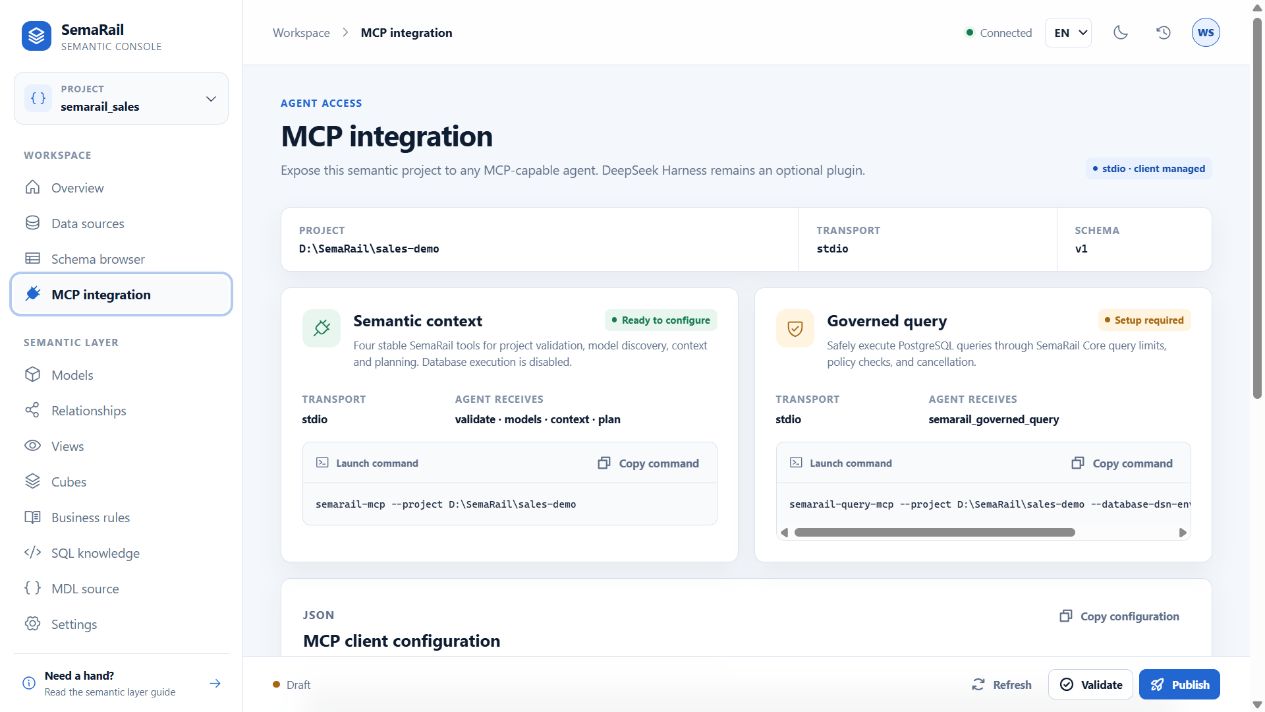
The default multi-user integration is SemaRail's authenticated Streamable HTTP MCP endpoint. It exposes the same five stable tools to any MCP-capable Agent:
semarail_validate_projectsemarail_list_modelssemarail_get_contextsemarail_plan_querysemarail_governed_query
Start authenticated MCP
Start the MCP endpoint against the same project and state directory as Core:
$env:SEMARAIL_API_TOKEN = "<local bootstrap token>"
semarail mcp serve `
  --project C:\path\to\semantic-project `
  --state-dir C:\path\to\semarail-state
The endpoint is http://127.0.0.1:48764/mcp. The bootstrap token initializes
the shared control-plane store but is rejected by remote MCP. In Access
control, create a service account, assign trusted attributes, bind a
project/datasource/table/column/row policy, and issue a one-time key. Configure
that managed key in the Agent's private environment or secret manager:
{
  "mcpServers": {
    "semarail": {
      "url": "http://127.0.0.1:48764/mcp",
      "transport": "streamable-http",
      "headers": {
        "Authorization": "Bearer ${SEMARAIL_TOKEN}"
      }
    }
  }
}
Every call re-authenticates the key or employee session and reads current policy,
so disabling an account, revoking a key, changing attributes, or unbinding a
policy affects the next request. Datasource credentials and project paths remain
inside Core and never enter MCP client configuration. Loopback is the safe
default; a non-loopback bind requires an explicit --allowed-host and a TLS
reverse proxy.
Governed query results use a bounded delivery contract. Results of at most 50
rows whose UTF-8 JSON representation is at most 128 KiB stay inline. Larger
results return at most 20 preview rows plus a temporary CSV download URL; the
full CSV is never inserted into the model context. Downloads expire after 15
minutes and are invalidated immediately when the issuing credential, subject,
datasource, or policy context is no longer current. The alpha query ceiling
remains 500 rows and the CSV ceiling is 16 MiB; this is not a bulk-export API.
Administrators may set SEMARAIL_ARTIFACT_TTL_SECONDS to a value from 60 to
86400 seconds; the default is 900 seconds and MCP callers cannot override it.
Service accounts, employees, and row permissions (alpha)
SemaRail Core includes a local management API for service accounts and externally authenticated employees, one-time API-key issuance, key rotation/revocation, short-lived employee sessions, versioned policy bindings, and audit events. Policies can restrict tool scopes, projects, physical tables, columns, query limits, and rows derived from trusted subject attributes. Mandatory row predicates are injected with bound database parameters before execution; missing or malformed permissions fail closed.
For example, two agents can run the same sales query while account A is restricted to region CN-JIA and account B to CN-YI. Updating the account attributes or policy is effective on the next request. See Access control (alpha) and the architecture decision.
Employees can sign in through a configured DingTalk or generic OIDC provider with semarail auth login --provider <id>. The browser callback never receives a SemaRail bearer token; the initiating CLI exchanges a one-time device code for a bounded session and then enters the same Subject/PolicyEngine path as an API key. New employees have no data policy until an administrator assigns trusted attributes and a policy in Access control. See Access control (alpha) for provider configuration and security boundaries.
Authenticated stdio bridge
For an Agent that only supports stdio, log in once and configure the bridge as its MCP command:
semarail auth login --provider dingtalk --endpoint http://127.0.0.1:48763
semarail mcp bridge --endpoint http://127.0.0.1:48763
The bridge reads the ACL-protected employee session written by semarail auth login and forwards every tool to Core's authenticated runtime. It does not load
Wren, open a database, accept a Subject/policy/DSN argument, or print the token.
For a service account instead, set SEMARAIL_MCP_TOKEN in the bridge process's
private environment. Use --token-env <NAME> to select another environment
variable name.
Trusted local operator compatibility
semarail-mcp and semarail-query-mcp remain available for compatibility and
isolated local evaluation. They directly load the project/Sidecar and therefore
do not provide per-user Subject resolution, immediate policy changes, or
identity audit. Do not use them as a shared employee or multi-tenant boundary.
Use authenticated HTTP MCP or semarail mcp bridge instead.
Run MCP acceptance tests with:
pnpm acceptance:mcp
pnpm acceptance:split
DeepSeek Harness plugin
SemaRail includes an optional thin DeepSeek Harness plugin for users who want the semantic layer in the Harness conversation UI. The plugin connects to an independently running SemaRail Core; the Semantic Console and MCP servers do not require DeepSeek Harness.
The plugin provides:
- A Host plugin that connects to SemaRail Core for semantic context, governed PostgreSQL execution, and cancellation.
- A Client plugin that renders durable Chart, Table, and SQL views from
tool/result.meta. - A shortcut from Harness to the local Semantic Console.
- Compatibility with DeepSeek Harness
>=0.1.0-rc.10 <0.2.0.
Install the Harness plugin from source
The recommended integration is the thin @hejielijob/dsh-semarail-plugin package. It depends on a separately running SemaRail Core through the authenticated, versioned HTTP v1 boundary. Build both unpublished packages locally:
pnpm install
pnpm package:split
Install the generated package with the same one-command Harness flow used by registry plugins:
dsh plugin --profile web add .\dist\hejielijob-dsh-semarail-plugin-0.1.0-alpha.3.tgz
You can also download the .tgz from a future GitHub Release and pass its local path or HTTPS URL to the same command. Once the package is published to npm, installation will reduce to:
dsh plugin --profile web add @hejielijob/dsh-semarail-plugin
The former @hejielijob/dsh-wren-data-agent all-in-one package remains as a legacy compatibility artifact for now. Do not enable both packages in the same Harness profile. See the migration guide.
Verify both package boundaries with:
pnpm --filter @hejielijob/semarail-core test
pnpm --filter @hejielijob/dsh-semarail-plugin test
Configure the Harness Host
The plugin accepts only connection settings; project paths, credentials, and execution limits stay in Core:
- id: semarail-harness-host
  config:
    semarailEndpoint: http://127.0.0.1:48763
    authTokenEnv: SEMARAIL_HARNESS_TOKEN
    timeoutMs: 30000
Set SEMARAIL_DATABASE_URL only in the Core process environment when governed PostgreSQL execution is required. The Harness plugin never receives the DSN. Never expose the Core bootstrap SEMARAIL_API_TOKEN to Harness or another Agent: it is limited to Console administration, recovery, and the read-only Core health check; semantic/query runtime methods and MCP boundaries reject it. Use a managed sr_live_... key or employee session instead.
The Client opens the Semantic Console at http://127.0.0.1:48763 by default. An embedding can pass semanticConsoleUrl to the exported view/link props or set localStorage['semarail.semantic-console-url']; only credential-free absolute HTTP(S) URLs are accepted. The former dsh-wren-data-agent.semantic-console-url key is read only as a migration fallback.
Security model
All model-generated SQL is treated as untrusted input.
- PostgreSQL statements are parsed structurally with
sqlglot. - DML, multi-statement SQL, dangerous functions, and unauthorized objects fail closed.
- Query execution uses a read-only account with row, byte, timeout, concurrency, and cancellation limits.
- PostgreSQL deployments can add transaction-local Subject context and native RLS as a second enforcement layer; see PostgreSQL row-level security.
- Protocol and presentation payloads are JSON-safe and versioned; unknown versions fail closed.
- Sidecar stdout is protocol-only; diagnostics go to stderr.
- Datasource credentials remain server-side and are redacted from Console API responses.
- The Console remains loopback-only in this alpha release. Subject policies, table/column/row authorization, PostgreSQL RLS context, optional PostgreSQL control-plane storage, and metadata-only audit events are implemented. Internet exposure still requires a hardened reverse proxy, TLS, deployment monitoring, backup/restore, and an organization-specific identity configuration.
Repository layout
| Path | Purpose |
|---|---|
apps/semantic-console |
Local Python server and React Semantic Console. |
python/sidecar |
Semantic planning, SQL policy/execution, framed RPC, and MCP servers. |
packages/contract |
Shared Host, Client, and Sidecar contracts. |
packages/host |
Shared Harness Host adapters, tool registration, and legacy bundle support. |
packages/client |
DeepSeek Harness Chart, Table, SQL, and Console views. |
packages/core |
Independently installable SemaRail Core CLI/runtime distribution. |
packages/dsh-plugin |
Thin DeepSeek Harness Host/Client adapter. |
packages/bundle |
Legacy all-in-one DeepSeek Harness compatibility bundle. |
examples/wren-postgres |
Deterministic sales project and golden-question corpus. |
scripts |
Packaging, acceptance, replay, and evaluation gates. |
Development
pnpm typecheck
pnpm test
pnpm build
pnpm acceptance:split
pnpm acceptance:mcp
Additional integration gates:
pnpm acceptance
# Run the real PostgreSQL 17/RLS gate. It requires administrator settings and
# creates, then cleans, isolated test database/role fixtures.
pnpm acceptance:postgres
# Preview the PostgreSQL acceptance prerequisites without changing the database.
& .\.venv\Scripts\python.exe scripts\acceptance-postgres.py --dry-run
pnpm acceptance:replay --dry-run
pnpm evaluate:golden --self-test
See CONTRIBUTING.md before opening a pull request. Report security issues through the private process in SECURITY.md, not through a public issue. User-visible changes are tracked in CHANGELOG.md.
Current scope
- SemaRail's semantic MCP interface can use datasources supported by the configured semantic profile.
- Governed query execution through MCP or DeepSeek Harness is currently PostgreSQL-only.
- The Semantic Console supports PostgreSQL, MySQL, SQLite, ClickHouse, and DuckDB connection testing, schema browsing, and model import.
- The current semantic runtime does not support View-to-View references; nested View dependencies are rejected before execution.
- Browser hard-refresh rendering remains a separate real-Client acceptance step beyond the API-only replay gate.
Upstream foundation
SemaRail is based on and adapted from the WrenAI codebase and Python SDK/Core. It currently uses wrenai==0.13.2 and its public context, validation, build, field-registry, and project-format APIs.
SemaRail is an independent project, not an official WrenAI distribution or Canner product, and is not endorsed by or affiliated with Canner. The SemaRail name and branding are independent of the upstream project.
License
This repository is released under the MIT License, copyright © 2026 hejielijob-commits.
Third-party components retain their own licenses:
wrenai==0.13.2identifies itself as Apache-2.0 and is maintained by the WrenAI project.- The Client bundles Apache ECharts
5.6.0; its Apache-2.0LICENSEandNOTICEare shipped inpackages/client/licenses/echarts.
See THIRD_PARTY_NOTICES.md for the dependency and artifact attribution inventory.
No comments yet. Be the first to write one.