description: "A YAML-driven architecture-diagram engine plus an installable DeepSeek Harness plugin: the zero-graph-library layout and orthogonal-routing engine, the plaintext .drawio exporter, and the Cordis bundle that renders dark preview cards and .drawio downloads inside a dsh conversation." kind: "repository-reference"
dsh-diagram
English | 中文
Summary
dsh-diagram turns a short YAML description of a system — who contains whom, who calls whom — into a dark, card-style architecture diagram. The description carries semantics only: coordinates, line wrapping, layering, orthogonal routing, grouping envelopes, and colors are all computed by the engine, so neither a model nor a human has to think about geometry. The repository ships two things that share one engine: a set of TypeScript workspace packages that validate, lay out, and export diagrams, and an installable DeepSeek Harness (dsh) plugin that registers three tools, renders the preview card inside the conversation, and exports a plaintext .drawio file you can keep editing in draw.io. The layout chain depends on no graph-layout library (ELK and dagre were both evaluated and removed); a 50-node diagram lays out in single-digit milliseconds, and the routing invariants are asserted programmatically rather than judged by eye.
Table of Contents
- What it gives you
- Usage example
- Use this repository
- Understand the implementation
- Further Exploration
- Model Experience
- Known Limitations and Deferred Work
- Dev Note
What it gives you
One YAML description in, three tools out. This is the plugin's whole surface:
| Tool | What it does | Arguments | Returns |
|---|---|---|---|
render_architecture |
the model writes the YAML inline; a preview card appears in the conversation | title (required), yaml_spec (required), save_drawio? (default false) |
groups / nodes / edges / width / height / file_name, plus saved_path when it wrote a file |
yaml_to_drawio |
render a .yaml a human edited — the .drawio is written next to the YAML |
path (required), save_drawio? (default true) |
the same shape as above |
drawio_to_yaml |
the return trip: a .drawio adjusted by hand goes back to semantic YAML |
path (required) |
yaml_spec + warnings[] (geometry, free-hand shapes, custom styles, the three layout knobs) |
What that buys you inside a conversation:
- A dark preview card rendered in the chat — zoomable, with hover-highlighted edges. The card is drawn from tool-result metadata, so even a 50-node diagram costs no extra model context.
- A plaintext
.drawioyou can keep editing in draw.io: uncompressed XML that matches the CLI's output byte for byte apart from the<diagram>id/name, so there is no lock-in. - A round trip —
drawio_to_yamlrecovers titles, descriptions,items, variants and nesting from a hand-edited file, and lists what it could not recover instead of guessing. - One structured failure report — every structural, reference and hierarchy problem at once, each with a path, a code and a did-you-mean candidate (capped at 12 lines), so the model fixes them in a single retry.
Usage example
Nothing below is hand-drawn, and this is the product end to end: a sentence in → one tool call → a card in the conversation. The subject is this repository itself.
1 · Ask in plain language. "Draw the architecture of the dsh-diagram repository." No YAML, no coordinates, no colours — the DSL is the model's job, not the user's.
2 · The model writes a spec. Semantics only: who contains whom, who depends on whom. It never states a position or a hex colour, because the engine computes both. This is the spec it produced for this repository:
YAMLversion: "1.0"
meta:
title: dsh-diagram 仓库关系图
desc: packages/ 引擎 · plugin/ 可安装 bundle · scripts/ 构建与验证
summary: 本图由本仓库自己的引擎渲染:YAML → 校验 → 分层/坐标/走线 → .drawio
guide: 箭头 = 依赖 / 使用方向(A → B:A 依赖、读取或写出 B)
layout:
direction: TB
groups:
- id: g_pkgs
title: packages/ 引擎(pnpm workspace,零图布局依赖)
variant: filled
- id: g_schema
title: schema
parent: g_pkgs
- id: g_layout
title: layout
parent: g_pkgs
- id: g_drawio
title: drawio
parent: g_pkgs
- id: g_core
title: core
parent: g_pkgs
- id: g_plugin
title: plugin/ 可安装 bundle(刻意不是 workspace 成员)
variant: filled
- id: g_scripts
title: scripts/ 构建与验证
- id: g_spec
title: 规格与产物(out/ 已 gitignore)
variant: dashed
nodes:
- id: n_types
title: 类型定义
group: g_schema
desc: ArchSpec / Meta / Group / Node / Edge
variant: primary
- id: n_validate
title: 校验器
group: g_schema
desc: Ajv draft 2020-12 + 语义检查
variant: warning
items:
- 结构 / 引用 / 层级一次报全
- 嵌套 parent 环与深度 ≤ 3
- did-you-mean 候选
- id: n_parse
title: YAML 解析
group: g_schema
desc: js-yaml,错误转同构诊断
items:
- 行号对齐
- 缺省值填充
- id: n_sizing
title: 尺寸预估
group: g_layout
items:
- 固定 240px 宽
- title / desc / items 行高
- id: n_layering
title: 分层
group: g_layout
desc: 单元级 Meta-DAG
items:
- 入度优先破环
- 最长路径分层
- 脊柱-肋骨折叠
- id: n_placement
title: 坐标分配
group: g_layout
items:
- (Rank, Order) 虚拟双轴
- 列槽位对齐矩阵
- 方向逐层交替
- id: n_routing
title: 正交走线
group: g_layout
variant: primary
items:
- 三类型通道
- 长边外绕、绕开无关组
- 交叉全局三轮裁决
- id: n_model
title: mxGraphModel
group: g_drawio
items:
- 画布随 bounds 自适应
- 无压缩明文 mxfile
- id: n_cells
title: cell 生成
group: g_drawio
items:
- 分组容器(可嵌套)
- 卡片 HTML value
- 显式折线 mxPoint
- id: n_serialize
title: 序列化
group: g_drawio
items:
- 父 cell 先于子 cell
- 转义 & < > "
- id: n_parse_drawio
title: 反解 parse-drawio
group: g_drawio
desc: .drawio → YAML
variant: muted
items:
- 明文与压缩页
- 手改降级 + warnings
- id: n_render
title: renderArchitecture()
group: g_core
desc: parse → validate → layout → export
variant: primary
- id: n_cli
title: CLI
group: g_core
desc: validate / build / build-all
- id: n_host
title: 宿主半 index.js
group: g_plugin
variant: primary
desc: esbuild 产物,@deepseek-ai/* 外置
items:
- render_architecture
- yaml_to_drawio
- drawio_to_yaml
- id: n_client
title: 客户端半 client.js
group: g_plugin
variant: primary
desc: 浏览器模块表里的 React 工厂
items:
- tool.call.toolview 卡片
- conversation.chat.turnTail 预览
- 客户端自带引擎(无 Ajv)
- id: n_patch
title: cordis.patch.yml
group: g_plugin
desc: insert 一行 dsh-diagram
variant: muted
- id: n_build_plugin
title: build-plugin.mjs
group: g_scripts
items:
- esbuild 出两半
- client 套 __ModuleLoader__ 信封
- id: n_typecheck
title: typecheck-plugin.mjs
group: g_scripts
desc: 映射 dsh 检出的 .d.ts
- id: n_selfcheck
title: verify-plugin-activation.ps1
group: g_scripts
desc: 隔离 profile 起新进程
items:
- 组合检查(--dump-config)
- 激活检查(stderr 无告警)
- id: n_audit
title: audit-routing.ts
group: g_scripts
desc: 走线质量程序化断言
- id: n_roundtrip
title: roundtrip-check.ts
group: g_scripts
desc: YAML 与 .drawio 幂等
- id: n_examples
title: examples/*.yaml
group: g_spec
items:
- 01–05 合法样例
- 90-invalid 反例
- id: n_out
title: out/*.drawio + PNG
group: g_spec
variant: muted
desc: draw.io 桌面版导出
edges:
- from: n_parse
to: n_types
label: 依赖
- from: n_validate
to: n_types
label: 依赖
- from: n_sizing
to: n_types
label: 依赖
- from: n_layering
to: n_validate
label: 常量导入
- from: n_placement
to: n_layering
label: 消费分层
- from: n_routing
to: n_placement
label: 消费坐标
- from: n_model
to: n_routing
label: 消费折线
- from: n_cells
to: n_model
label: 写 cell
- from: n_serialize
to: n_cells
label: 序列化
- from: n_render
to: n_validate
label: 串联
- from: n_render
to: n_routing
label: 串联
- from: n_render
to: n_serialize
label: 串联
- from: n_cli
to: n_render
label: 调用
- from: n_cli
to: n_examples
label: 读入
- from: n_cli
to: n_out
label: 写出
- from: n_host
to: n_render
label: 内联打包
- from: n_client
to: n_parse
label: 自带引擎
- from: n_client
to: n_routing
label: 布局
- from: n_client
to: n_serialize
label: 导出
- from: n_patch
to: n_host
label: 插入行
- from: n_build_plugin
to: n_host
label: 生成
- from: n_build_plugin
to: n_client
label: 生成
- from: n_typecheck
to: n_client
label: 类型检查
- from: n_selfcheck
to: n_host
label: 激活自检
- from: n_audit
to: n_routing
label: 断言
- from: n_roundtrip
to: n_parse_drawio
label: 往返
- from: n_roundtrip
to: n_examples
label: 读夹具
3 · It calls one tool.
render_architecture(
  title     = "dsh-diagram 仓库关系图",
  yaml_spec = <the YAML above>
)
The call returns a single line in the transcript — never XML:
已生成架构图:8 个分组 / 23 个节点 / 27 条连线,画布 2352×1540;预览卡片已挂在对话中,可导出 dsh-diagram 仓库关系图.drawio。
4 · dsh renders the card. Zoomable, with hover-highlighted edges; the PNG below is that same layout exported through draw.io:
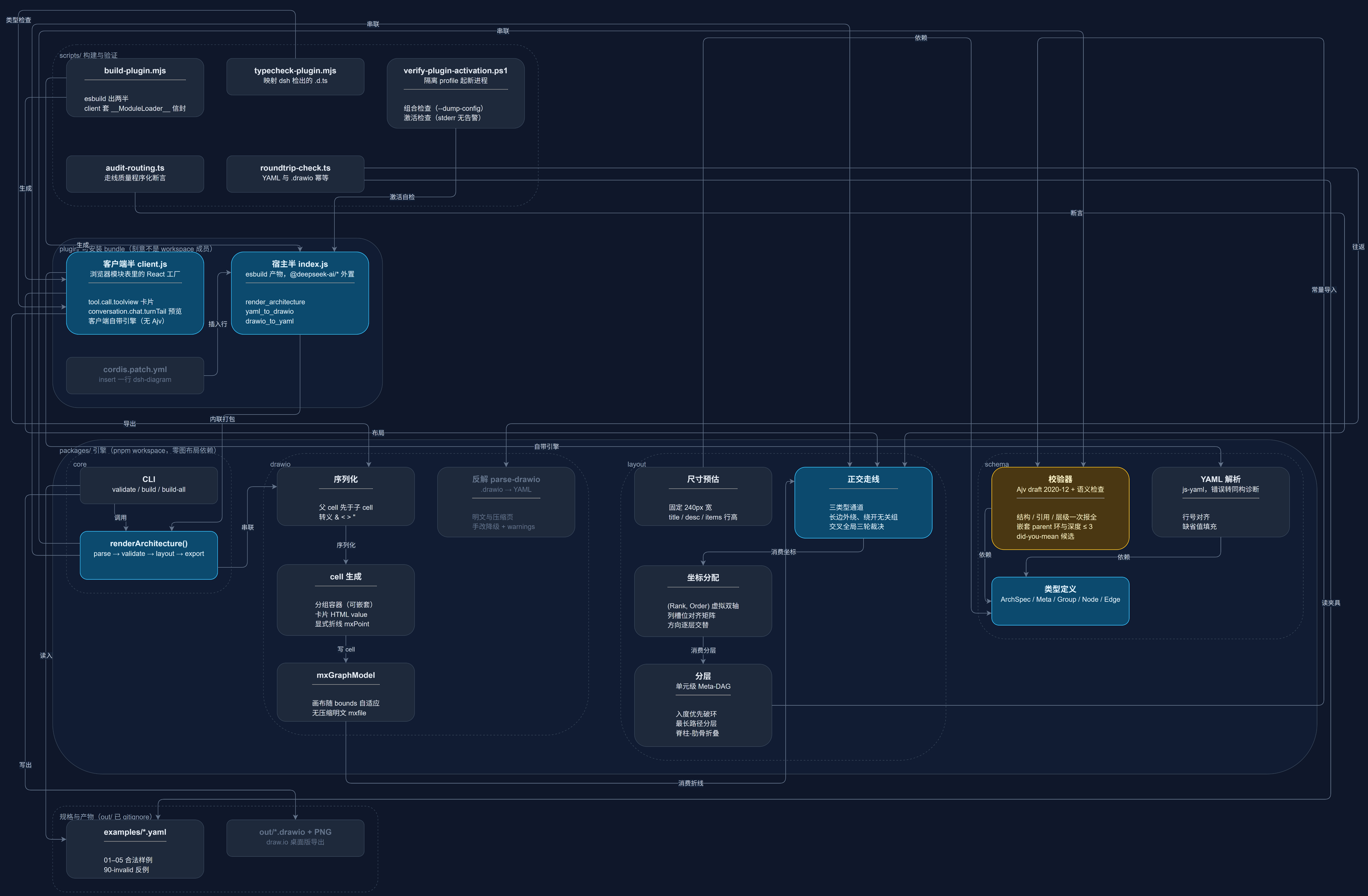
5 · Keep the file, or come back later. save_drawio: true writes the .drawio into the session workspace for further editing in draw.io, and drawio_to_yaml turns a hand-edited diagram back into YAML so the loop can run again. A spec with mistakes comes back the same way — one report listing every problem with its path and a did-you-mean candidate.
Use this repository
Install the plugin
The plugin lives in plugin/ as a self-contained bundle (deliberately not a workspace member). Its committed index.js and client.js are the build output, so a checkout installs as-is — nothing to build or copy first.
Ask dsh to install it. In a dsh conversation:
Install the bundle at
C:\path\to\dsh-diagram\plugininto this profile.
That is one plugin_manager call — a dsh tool, not a shell command — with the plugin directory as its target:
plugin_manager(action: install_bundle, target: C:\path\to\dsh-diagram\plugin)
The Web UI's plugin page exposes the same controls, and is also where dsh asks you to approve package build scripts. Either way dsh edits the profile for you: %USERPROFILE%\.dsh\profiles\<profile>\package.json gains "@gjy_1992/dsh-diagram": "link:C:/path/to/dsh-diagram/plugin", the bundle joins dsh.profile.bundles, and cordis.patch.yml gains its row. Do not edit those three by hand, and do not run pnpm in the profile directory — install_bundle does all of it.
A change to the plugin's host half needs a dsh restart to take effect (Node caches module jobs by URL); the client half reloads on a page refresh. See plugin/README.md for the three tools and the YAML cheat sheet.
Run the engine from the command line
Node ≥ 20 is the only prerequisite, and pnpm needs no npm either: Node ships corepack, and the root packageManager field pins the version. corepack enable wires up pnpm@11.7.0 (fetched on first use); corepack pnpm install works with no shim at all.
corepack enable   # one-off; skip it and use `corepack pnpm` instead
pnpm install
pnpm cli validate examples/03-rpc-items.yaml      # structured diagnostics, exit 0/1
pnpm cli build examples/03-rpc-items.yaml -o out  # -> out/03-rpc-items.drawio
pnpm build:examples                               # every example at once
Verify
Every claim this project makes has a command behind it:
| Command | What it proves |
|---|---|
pnpm build |
the whole workspace type-checks under strict |
pnpm build:examples |
five valid specs render end to end; the invalid one fails with structured errors |
pnpm audit:routing |
non-orthogonal segments, node crossings, unrelated-group crossings, and edge crossings are counted per example (the first three must be 0) |
pnpm verify |
renders every example and exports each .drawio to PNG through the local draw.io desktop CLI |
pnpm build:plugin |
builds both plugin halves with esbuild (deterministic: a clean rebuild produces no diff) |
pnpm verify:activation |
boots an isolated dsh profile in a fresh process and asserts the plugin composes and activates |
pnpm roundtrip |
YAML → .drawio → YAML stays faithful and idempotent |
pnpm typecheck:plugin additionally needs a built dsh source checkout (see Known Limitations).
Understand the implementation
Two halves, one engine
schema  ──►  layout  ──►  drawio  ──►  core        (engine, pnpm workspace)
                                        │
                    plugin/src/host.ts ─┘           (three tools; engine inlined at build time)
                    plugin/src/client.tsx           (preview card; engine runs in the browser)
| Path | Responsibility |
|---|---|
packages/schema |
TypeScript types, a hand-written JSON Schema, Ajv validation, topology and hierarchy checks, js-yaml parsing, structured diagnostics with did-you-mean hints |
packages/layout |
Node sizing and text metrics, unit-level meta-DAG layering, spinal-rib in-line folding, gravity-ordered placement on a virtual two-axis (Rank, Order) model, orthogonal corridor routing |
packages/drawio |
mxGraphModel generation, container/card/edge cells, the dark style map, plaintext serialization — and parse-drawio, the reverse direction |
packages/core |
renderArchitecture(), the host-agnostic orchestrator (parse → validate → layout → export), plus the CLI |
plugin |
The installable dsh bundle: a host half with three tools and a client half with the preview card and the end-of-turn preview |
Why the layout is self-written
The original design called for ELK.js. Two measured dead ends killed it: a single global layering pass pushed parallel chains into diagonal misalignment, and compound layout with SEPARATE_CHILDREN silently dropped every edge crossing a child boundary, so nothing containing a sub-group could be ordered at all. The engine now builds its own unit-level DAG, breaks cycles in-degree-first, layers by longest path, folds companion chains into the same row, sorts layers by gravity barycenter, and routes every edge through typed corridors. The full chain runs in 1–13 ms for 50 nodes (the ELK prototype took 284 ms).
Verification style
The project's rule is that a claim needs a command: routing invariants are asserted in code (pnpm audit:routing), the plugin's activation is asserted by booting a throwaway profile in a fresh process (pnpm verify:activation), and the two export paths are compared byte-for-byte (the CLI .drawio and the tool-written one differ only in the <diagram> id/name).
Further Exploration
prd.md— the requirements specification, including the DSL and the layout algorithm at spec level.PLAN.md— the working plan and decision log: every measurement, every reversed decision, and every known trap (Node module-job caching,pointer captureswallowing clicks, peer-based module routing, PowerShell encoding).design.md— the layout Spec v2.0 (virtual two-axis model, folding gates, corridor types).examples/— five valid specs (minimal, groups, denseitems, three-level nesting, 50-node stress) and one invalid spec that exercises the diagnostics.
Model Experience
What the model sees
Three tools, one line of prose each in the transcript, and structured failures:
render_architecture— the model writes the YAML inline; the tool description carries the whole DSL contract (fields, three enums, the "no coordinates, no hex colors" rule).yaml_to_drawio/drawio_to_yaml— file-level channels for a human-edited spec or a hand-adjusted.drawio.- Success returns one summary line (
N groups / N nodes / N edges, canvas W×H), never the XML: the.drawiostays on the host unless a file is asked for, and the card's data travels through tool-result metadata instead of the model context. - Failure returns every structural, reference, and hierarchy problem at once, each with a path, a code, and a did-you-mean candidate, capped at 12 lines — the model fixes them in one retry instead of one error per turn.
Token effect
The YAML DSL is the only thing the model writes. A nine-node diagram with grouped cards and RPC lists costs a few hundred tokens of YAML; the equivalent raw draw.io XML would cost an order of magnitude more and would still be laid out badly, because models are poor at absolute coordinates.
Known Limitations and Deferred Work
- **Inline
```arch-yamlfence preview (PRD Phase 3) is shelved.** The markdown renderer indsh-client-ui-primitivestakes props only — no code-fence registry, no slot inside it — so a plugin cannot substitute a preview in place of a fenced block without shadowing the whole assistant chat node. A newly found path (a plugin-owned Conversation Definition plus aconversation.chat.nodeview) can add a **row in the flow**, but not replace text inside the message; it awaits a decision. SeePLAN.md§P2.15. pnpm typecheck:pluginneeds a builtdshsource checkout. The installed desktop runtime ships no@deepseek-ai/cordistype declarations, so type checking the plugin halves from the packaged app alone would be a false green.- Pixel-level card regression has not been automated. The workaround (expand the host's collapsed step row before screenshotting) is known, but the check is manual.
- The Windows verification scripts are not portable.
pnpm verifyandpnpm verify:activationdrive the local draw.io desktop CLI and the installed Electron runtime through PowerShell.
Dev Note
PLAN.md is the source of truth for why things are the way they are. Before changing layout or routing behavior, read its decision log (§7 and Phase 2) — several plausible-looking improvements were measured, rejected, and recorded there, including the two ELK dead ends and the global three-round crossing arbitration.
License
MIT — see LICENSE.
还没有评论,来写第一条。