@deepseek-ai/dsh-client-ui-plugin-controls
English | 中文
Plugin control panel, a browser surface plugin over the @deepseek-ai/dsh-host-plugin-inventory Remote. The browser half occupies the conversation-declared conversation.input.plugins single seat (immediately right of the access-mode control in the composer tool row); the node half is an empty apply (the roster row).
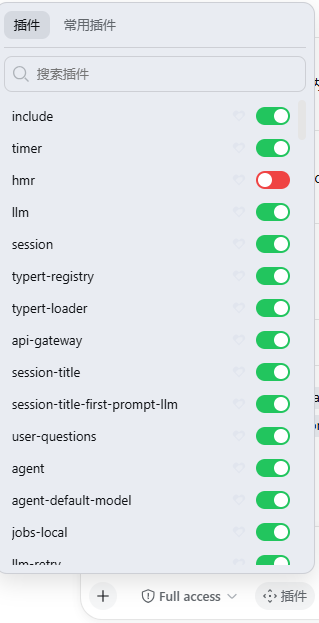
The trigger opens a portal panel that grows upward from the composer and stays inside the viewport (the composer sits at the bottom of the screen, so the panel owns the space above it and scrolls internally when tall). It lists every non-group Loader entry, grouped into all plugins and a user-marked favorites subset, with a name filter. Each row carries an enable/disable switch and a favorite mark button. Both writes ride the pluginInventory Remote: setEnabled writes an id-targeted disabled patch into the profile's user patch layer (cordis.patch.yml), which the launcher's watchUserPatches hot-reloads so the toggle takes effect without a restart and survives one; setFavorite writes the plugin-favorites Settings namespace. The panel holds only view state (open, group, query, optimistic rows) — no client-side business state.
⚠️ Runtime requirement. The
conversation.input.pluginsseat and thepluginInventory.setEnabled/setFavoriteRemotes are not part of any released dsh (as of 0.1.0-rc.8 and 0.1.1-rc.2). This plugin only runs on a dsh build that ships the plugin-control feature — either a source build with it or a future release. Installing it on a stock released dsh will fail at load (the seat is undeclared). Check the upstream PR status before installing.The complete change set (runtime + this plugin) is on the fork branch
feat/plugin-controlsoffishOfOUC/deepseek-harness(47 files: ui-conversation seat, pluginInventorysetEnabled/setFavorite, web-app roster row, this package, tests, agent notes). A machine with a deepseek-harness source checkout can fetch and apply it:git remote add fork https://github.com/fishOfOUC/deepseek-harness.git git fetch fork feat/plugin-controls git checkout -b feat/plugin-controls fork/feat/plugin-controls # or: git merge fork/feat/plugin-controls pnpm install && npm run build node --import tsx/esm apps/cli/src/bin.ts web --port 3188 --no-open # run from source, not the npm-global dshThe upstream pull request (deepseek-ai/deepseek-harness ←
fishOfOUC:feat/plugin-controls) is the path to a future release that ships the feature built-in.
Screenshot
Installation
In the deepseek-harness repository this package is a row of packages/bundle/web-app/cordis.patch.yml, so a web deployment gets the panel from the app build with nothing else to do (once the feature lands upstream).
Standalone via GitHub (the package ships lib/ and its own cordis.patch.yml, so the row auto-inserts — no manual patch edit):
dsh plugin --profile web add github:fishOfOUC/plugin-ui-controls
or add it to the profile's package.json dependencies as "@deepseek-ai/dsh-client-ui-plugin-controls": "github:fishOfOUC/plugin-ui-controls" and run pnpm install in the profile. The bundle patch inserts the ui-plugin-controls row into the profile's composition automatically.
Build from source (optional — lib/ is committed, so installs do not need this):
pnpm install
pnpm build     # tsdown: lib/index.mjs + lib/invariant.mjs (node half), lib/client.js (browser half)
The peer dependencies are resolvable version ranges; at runtime the host supplies them (this is a dsh.client plugin — the browser half injects @deepseek-ai/dsh-client-runtime, @deepseek-ai/dsh-client-ui-slots, @deepseek-ai/dsh-client-ui-conversation and friends from the web app's module registry). tsc --noEmit typechecking additionally needs the un-released seat/favorite/Remote types, so it is not part of pnpm check until the feature ships.
Model Experience
Indirectly, through the plugin-enablement toggles the panel drives; each toggled plugin owns what reaches the model.
KV Cache effect
Toggling a plugin that contributes a prompt section changes the assembled prefix; a plugin that contributes only tools changes the tool-schema token budget, not the prefix.
Known Limitations and Deferred Work
- The toggle is a per-profile user override, not a sandbox boundary — disabling a plugin removes it from the running tree, but a plugin already granted durable state (files, credentials) keeps that state; re-enabling restores its capability.
- The runtime effect rides the patch-layer watcher — the change lands after the watcher's write-settle window, not synchronously with the click; the panel renders optimistically.
- Enable restores the composition default — it removes the user's
disabled: truepatch rather than forcingdisabled: false, so a deployment's platform gate stays authoritative. - No favorite control in the Settings "plugin list" tab — the favorite mark and grouping live only in the composer panel.
No comments yet. Be the first to write one.