dsh-force-compact
Aggressive, local-first context compaction for DeepSeek Harness agents.
A DSH Cordis function plugin that keeps the agent's working context lean by design: serve
Qwen3.8‑27B on a self-hosted llama.cpp with a modest context, and the plugin shrinks the
conversation itself — a large-window feel with no API cost and no data egress.
Why
- Self-hosted inference — the agent talks to a local OpenAI-compatible llama.cpp server through the standard DeepSeek adapter; no separate adapter needed.
- Low context, high signal — instead of fighting a small cap, the plugin shrinks the conversation, so the agent reasons over a tight prompt while keeping deep memory in the compressed head.
- Think off for compactions, passthrough everywhere else —
disableThinking: true(default) turns thinking off on this plugin's own compaction summarization call only; every other model request rides the machine's configuration unchanged. - Private & free — no per-token billing, no egress.
What it does
Two compaction engines coexist behind one facade (resolveCompaction), transparent to callers:
| Engine | Used when | Notes |
|---|---|---|
| Official | the compaction service resolves in the agent realm |
Preferred; delegates to compaction/basic. |
| Builtin | automatic fallback (typical standard preset isolates the service) | Self-contained persistent transaction on ctx.sessions / ctx.llm.stream / ctx.tokenMeter; reuses the official compaction/* event vocabulary, so it replays safely across builds. |
No toggling — official wins when reachable, builtin takes over otherwise.
Trigger points
- Per-request guard (
agent/pre-step) — reads the session's projected context tokens (the exact number the harness renders bottom-right). AtautoThresholdTokensit rejects the outgoing request and compacts the head instead, retaining the latestretainLatestTokensverbatim. Below the threshold the request proceeds. - Turn end / idle (
agent/status→idle) — when the agent quiesces, optionally compacts viacompactNow(gate:turnEndForceCompactionEnabled). - Manual
/force-compact— immediatecompactNowwhen idle; when busy it queues a process-local flag consumed at the next model step. Loaded lazily — see "Command availability" under Install. session/flush— the awaited durability checkpoint.
Every path funnels into the single "compaction result landed in the session" boundary — the same point where the LiveUI signal fires.
Decision key is projectedTokens (provider-anchored, same figure as the UI corner), so the
plugin never drifts from what you see; the threshold-aware shrink gate skips summarizer calls
that provably cannot pull the session below the threshold (kills the low-threshold dead loop).
The builtin transaction bills shadowedTokenCount from the same tokenMeter.measure
per-node prices the official engine uses, so the meter's collapse protocol settles the drop
correctly — the bottom-right counter goes down after compaction.
Thinking control: scoped to compactions
Since the 2026-08 semantics revision, disableThinking controls one thing: whether this
plugin's own summarization call (engine/builtin.js → engine/summarizer.js →
ctx.llm.stream) carries reasoningEffort:'off'. Everything else is untouched:
| Call site | With disableThinking: true |
|---|---|
| Builtin-engine summarization call | Carries reasoningEffort:'off' |
| Every other model request (business, sub-agents, tools, other plugins) | Machine's LlmCallConfig unchanged |
Official compaction service calls |
Not routed through any plugin seam — unaffected |
When the target is a llama.cpp / OpenAI-compatible endpoint, the
thinking: { type: 'disabled' } field the adapter emits is silently ignored there — so the
summarizer ALSO stamps the llama.cpp-native top-level reasoning_effort: "none", gated on
the exact same condition. One options object carries BOTH fields:
| Endpoint family | Reads | Result |
|---|---|---|
| Real DeepSeek API | reasoningEffort:'off' → thinking:{type:'disabled'} |
Thinking off ✅ |
| llama.cpp / OAI-compatible | reasoning_effort:"none" (top-level) |
enable_thinking=false ✅ |
Each family tolerates-and-ignores the foreign key, so emitting both is harmless. The field is
stamped in src/engine/summarizer.js (immediately before llm.stream(options)), NOT in the
llm/stream waterfall — a prior draft injected there but proved ineffective structurally
(middle-layer returns are discarded; in-place seed mutation crashes the host); see the
src/hooks/wire-rewrite.js module header for the write-up. That hook now serves only the
LiveUI watermark role.
Need thinking off on business calls too? Set your provider's reasoningEffort at the
request-header level — the plugin deliberately stays out of that decision.
Observability: per-attempt audit lines
Every summarization attempt logs two lines (visible at the default debug: true) — the
durable proof of the scoping decision and its wire fields, without capturing traffic:
[force-compact] <sessionId>: compaction thinking-policy — settings.disableThinking=true → extra.reasoningEffort='off' (this summarization call carries thinking-OFF)
[force-compact] <sessionId>: summarization wire-fields → <provider>/<model>: reasoningEffort='off' + reasoning_effort="none" (llama.cpp-native wire field)
- Line 1 (
engine/builtin.js) records wheredisableThinkingis read and routed into the call options; with the setting off it records machine default. - Line 2 (
engine/summarizer.js) records both wire fields exactly as they leave the options object, plus resolved provider/model; unstamped fields are labeled(absent…).
Empirically grounded: probed against a local llama.cpp endpoint, a baseline request returned
populated reasoning_content (the model thinks by default), while the same request with
top-level reasoning_effort:"none" returned none at all — the field genuinely disables
thinking there, and business calls (which omit it) keep thinking.
LiveUI status
A tiny host→client messenger (the liveUi settings field mirrored live to the browser) pins a
badge beside the turn:
- Red "compressing" — just before a compaction commits (screen text is Chinese);
- Green "done" — the instant a compaction lands; 3 s later a fresh random working line takes over;
- Blue "working" — otherwise a rotating playful one-liner;
- Cleared at conversation end — when the agent goes
idle(the turn is fully done), an empty text (isImportant) is pushed: the badge text is wiped and the phase color removed, restoring the official look. Replaces the former conversation-START forced working-pair override (removed 2026-09).
Publishers are fail-safe: a messenger glitch can never disturb the actual compaction.
How it works
agent/request(payload, next)              # every model request
    return await next()                  # pure pass-through (thinking-off scopes
                                          # ONLY to the plugin's own summarizer)

agent/pre-step(payload, next)             # before each model step
    projectedTokens >= autoThresholdTokens?
        no  -> next()                     # let the request proceed
        yes -> compactRegion(head-before-retainLatestTokens, signal)
               return { kind: "reject" }  # no model request this step

agent/status({ agent, status })          # lifecycle transition
    status === "idle" && turnEndForceCompactionEnabled?
        -> compactNow(agent, freshSignal) # turn-end compaction

session/flush(session)                   # durability checkpoint
    select region -> project messages -> preview + shrink gate
    -> compaction.compactRegion(start, end, agent, signal)
Supporting modules:
src/hooks/guard.js—agent/requestpure pass-through +pre-stepthreshold gate + process-local force flag (thinkingDisabledsurvives only as a legacy predicate).src/hooks/command.js— the/force-compactcommand (lazily registered).src/hooks/idle.js— turn-end forced compaction.src/hooks/wire-rewrite.js— thellm/streamLiveUI watermark hook (no wire manipulation; historical note in the module header).src/engine/region.js— head/tail-anchored region selection (with the official pairing ledger).src/engine/summarizer.js— the one-shot LLM summarizer, fully aligned with officialcompaction-basic(target resolution, prefix-cache alignment,purpose:'compaction'tag, fail-closed finish classification, usage capture).src/engine/builtin.js— the builtin persistent transaction (officialcompaction/*vocab).src/engine/checkpoint.js— preview + shrink gate + delegation to the compaction service.src/core/projected.js— provider-anchoredprojectedTokens.src/core/ui-signal.js— the LiveUI messenger.
Install
As an installable package (recommended):
# from npm (published):
npm install @falling-ts/dsh-force-compact
# from git:
dsh plugin --profile web add github:falling-ts/dsh-force-compact
# from a local checkout:
dsh plugin --profile web add ./dsh-force-compact
Or, from a local checkout, as a --patch overlay without installing:
dsh web --patch dsh-force-compact/cordis.patch.yml
The plugin is loaded iff ~/.dsh/logs/dsh-force-compact.log gains:
[force-compact] debug logging enabled — writing [force-compact] lines to <absolute path>
Command availability — /force-compact loads lazily
The commands service arrives with the agent-presets plane, after the plugin's boot-time
apply, so registration happens at the first guarded-listener activation
(agent/request / agent/pre-step / agent/status / session/flush), settling
permanently on the first success. Practical effect: after (re)starting the instance, a
fresh session's / picker does NOT show /force-compact until that session makes its first
model request — send any one message, then the command is registered process-wide.
- Success:
[force-compact] /force-compact command registered (deferred) commandspermanently absent: one… still UNREGISTERED 10 min …warn explains the empty picker. Until registered, the rest of the plugin works — degradation, not an install failure.
Verify a compaction happened:
idle compaction (builtin) shadowed N nodes (~M tokens)
builtin compaction OK — replaced span seq[A..B] (N nodes, ~K tokens) with a P-char checkpoint
compaction thinking-policy — settings.disableThinking=true → extra.reasoningEffort='off' (…)
summarization wire-fields → <provider>/<model>: reasoningEffort='off' + reasoning_effort="none" (…)
(The last two lines are the per-attempt audit pair described under "Observability".)
Settings
$DSH_HOME/settings.yaml, namespace falling-ts-force-compact:
| key | type | default | meaning |
|---|---|---|---|
disableThinking |
boolean | true |
Only the plugin's own summarization call carries reasoningEffort:'off'; everything else unchanged. |
autoThresholdTokens |
number ≥ 32000 | 32000 |
Projected-token trigger for the gate. Floor 32000 (clamps back up at read time). |
retainLatestTokens |
positive int ≥ 8000 | 8000 |
Retain the latest N tokens verbatim; older history is summarized in one batch. Floor 8000. Drives both the auto gate and /force-compact. |
turnEndForceCompactionEnabled |
boolean | true |
Compact on the agent's idle transition. |
debug |
boolean | true |
Emit [force-compact] diagnostics to the plugin log. |
logFile |
string | ~/.dsh/logs/dsh-force-compact.log |
Diagnostics destination (~ expands to home dir). |
compactionMode |
'realm' | 'global' |
'realm' |
Official-service resolution strategy (priority-1 path). |
builtinEnabled |
boolean | true |
Gate for the builtin engine fallback. |
maxSummaryTokens |
integer (1024–200000) | 1024 |
Cap on the summarizer LLM maxTokens. |
Example — an aggressive local profile:
falling-ts-force-compact:
  disableThinking: true
  autoThresholdTokens: 40000   # compact sooner ⇒ keep the live prompt small
  retainLatestTokens: 8000
  turnEndForceCompactionEnabled: true
Without the settings service the plugin falls back to the same defaults and still compacts —
the namespace is optional, never a hard dependency.
Tuning for low-context llama.cpp
Keep autoThresholdTokens comfortably below the served context: the live prompt stays
small and latency flat, while the agent keeps deep memory through the compressed head.
Pressure is measured in projected tokens (provider-anchored), so the threshold maps
predictably onto the UI figure.
Behavior notes
- Runtime dependency: the
compactionservice (preset planeagent-presets:compaction-basic), read live viactx.get('compaction'); unreachable → the builtin engine takes over (or the request proceeds). - Optional dependencies:
settings/tokenMeter/commands/llm/agentsare read viactx.get(...)with guards — a missing one degrades gracefully. - Per-request settings read: parameters are read every model request, so edits take effect on the next request without a restart.
- Signals:
agent/*Waterfalls forward the current turn's signal; thesession/flushcheckpoint and theagent/statusidle listener each mint a freshAbortController. - Persistence: durable output is the
compaction/*bracket events + asurfaceOp:replaceuser/messagecheckpoint, replay-safe across builds. - Client half:
web/client.jsadds the settings section "Force Compact" (localized labels), live-editable without restart (uSES-safe mirror). - One intentional timer: the 3 s
publishDonefallback (presentation-only, documented deviation). Otherwise the plugin is pure listeners + a process-localMapforce flag.
Screenshots
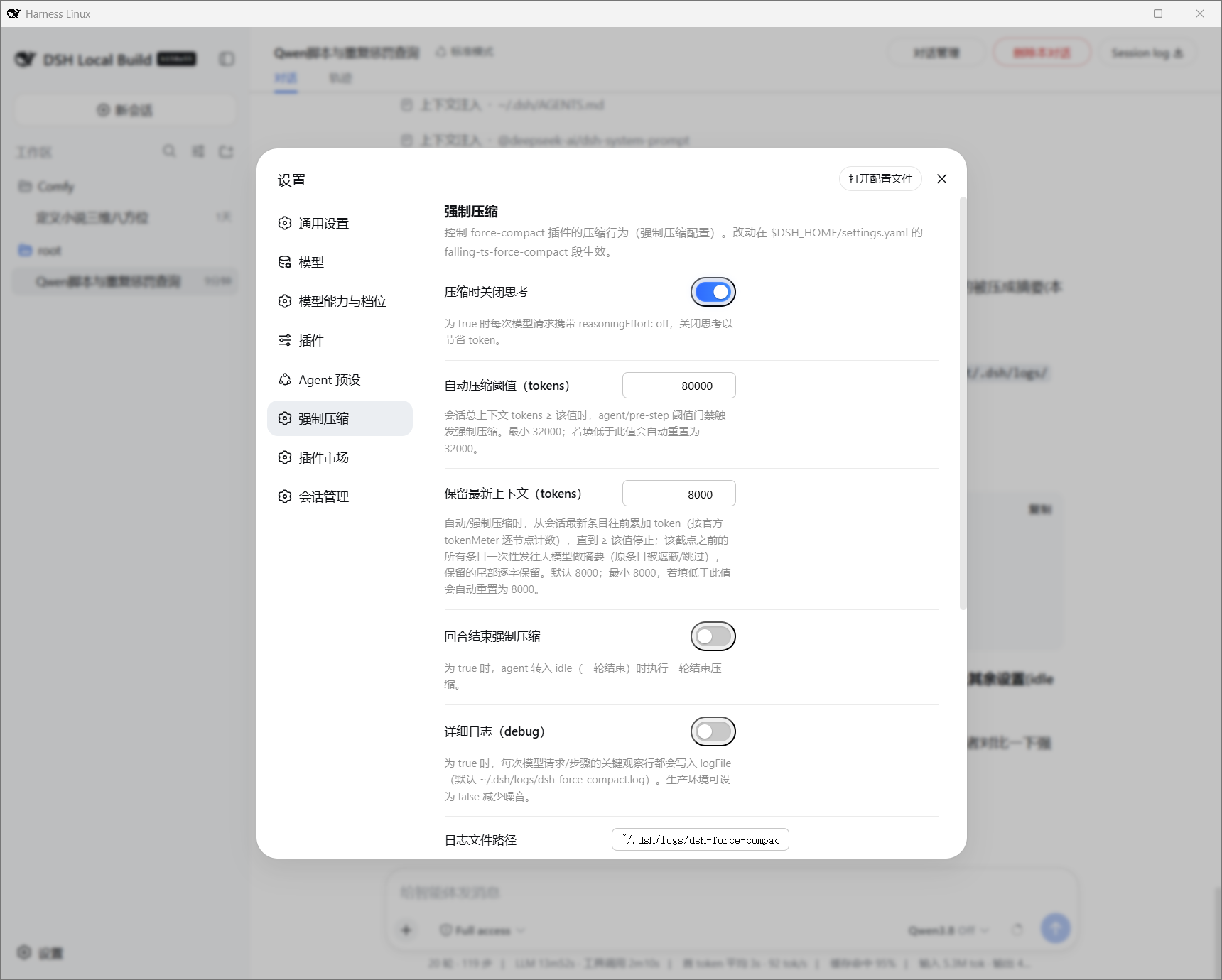
Settings page — the Force Compact section; all nine fields above are editable live without a restart.

Conversation page — the LiveUI signal paints three states (red: compressing / green: done / blue: working); the green banner fades after about 3 s back to a random working line; at conversation end the badge is cleared (empty text) back to the official look.
License
MIT (see LICENSE).
No comments yet. Be the first to write one.