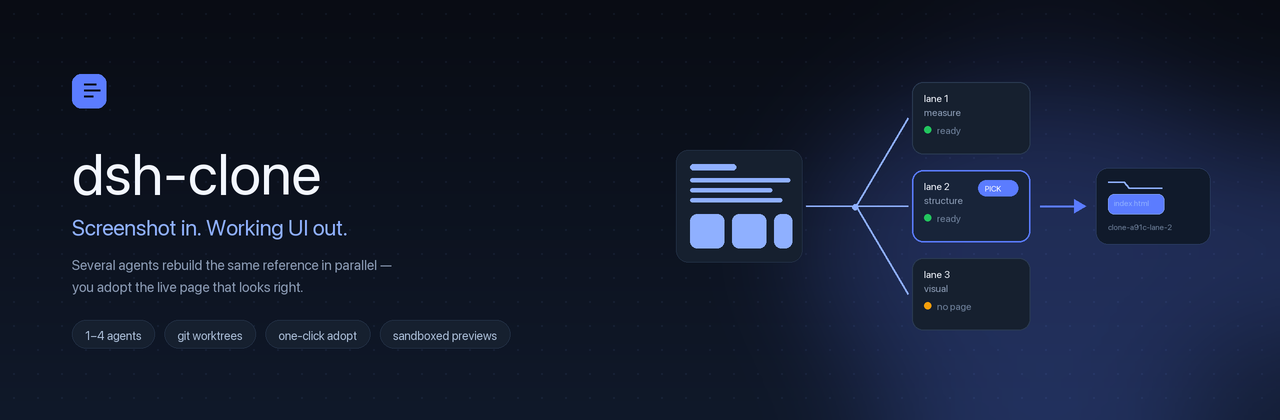




Screenshot in. Working UI out.
Paste a screenshot of any interface. Run /clone 3. Three agents rebuild it in parallel,
each in its own isolated directory. A live panel shows the reference beside every attempt,
rendered and scored. You adopt the page that looks right — and it is already a working page.
→ Open a real clone in the browser
built by this plugin from this screenshot · 92.7% picture match

The 30-second version
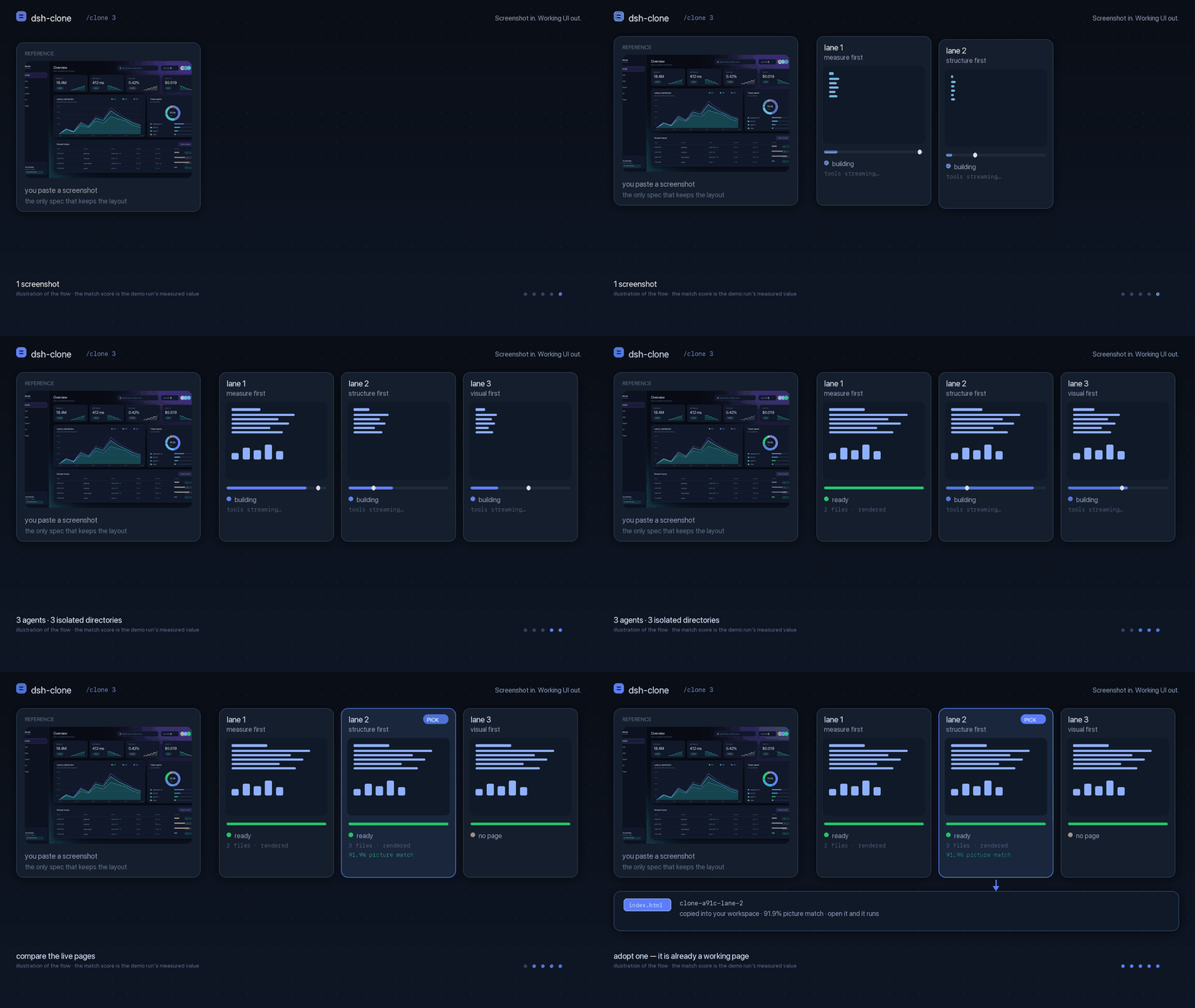
you:  [paste a screenshot]  /clone 3
me:   ▸ three agents, three isolated directories, same reference
      ▸ live panel: reference | lane 1 | lane 2 | lane 3   (rendered + scored)
you:  [Adopt this one]
me:   ▸ ./clone-a91c-lane-2/index.html  ← open it, it runs
No build step, no dependencies, no server. The adopted page is plain HTML, CSS and vanilla JS.
Why this exists
A screenshot is the most precise specification a person can give. Every other input loses information: a paragraph drops the spacing rhythm, the type scale, the alignment of every block; a component list drops the picture.
The usual flow is still: describe it, get one attempt, describe the differences, get another attempt. One attempt is a lottery — you cannot tell whether the model misunderstood you or simply chose a different solution, because you only ever see one.
dsh-clone changes the cost of being wrong. Three or four builders see the same reference and work the same problem from different angles, every delivered page is rendered and compared with the reference, and you keep the best.
| Lane strategy | What that builder is told to do |
|---|---|
| Measure first | write a layout spec — regions, grid, spacing scale, sampled hex palette, type scale — then build strictly to it |
| Structure first | the whole page as semantic HTML first, then style region by region from the outside in |
| Visual first | reproduce the picture first — surfaces, type, spacing, silhouette — then add only the behaviour the image implies |
| Component first | find the 5-8 reused parts, define each once, compose the page from them |
Demo
Real runs, not mocks: one command each, no retries, no hand edits. Every page is a static file — open it and it runs.
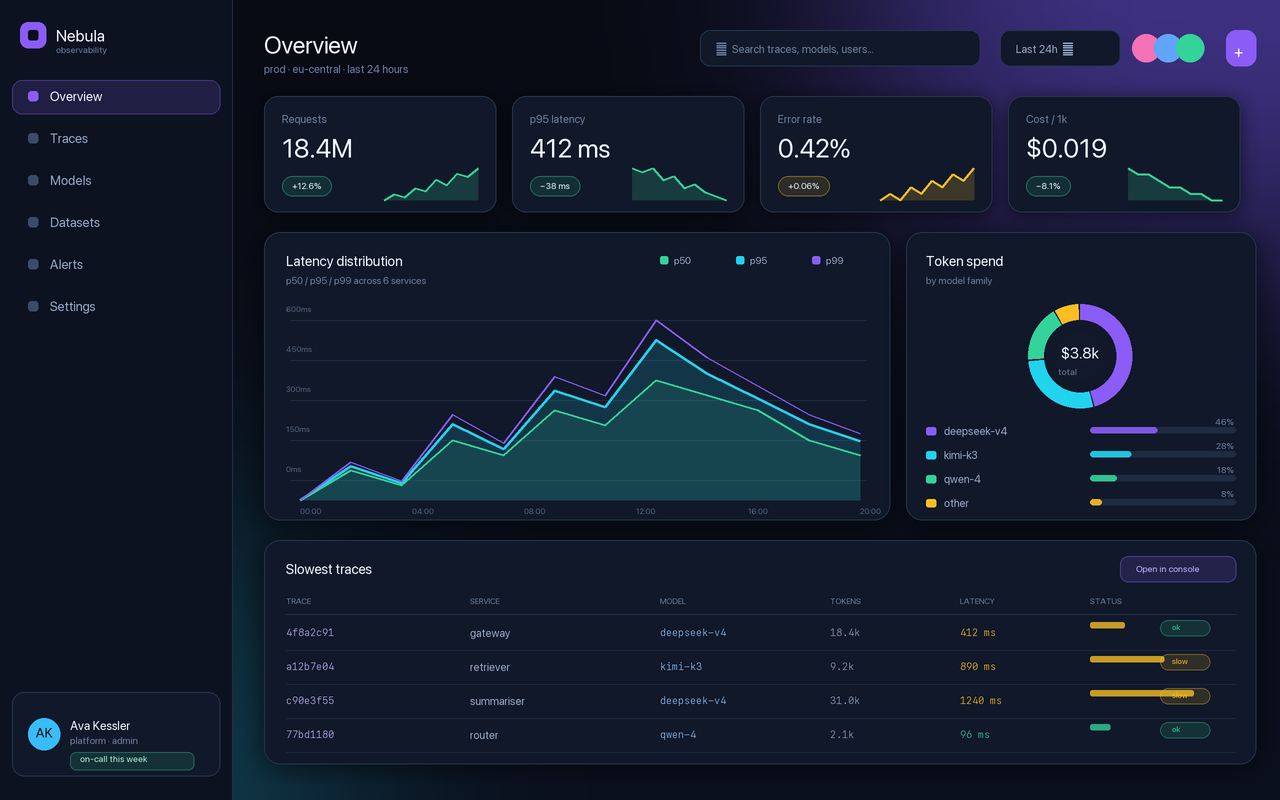
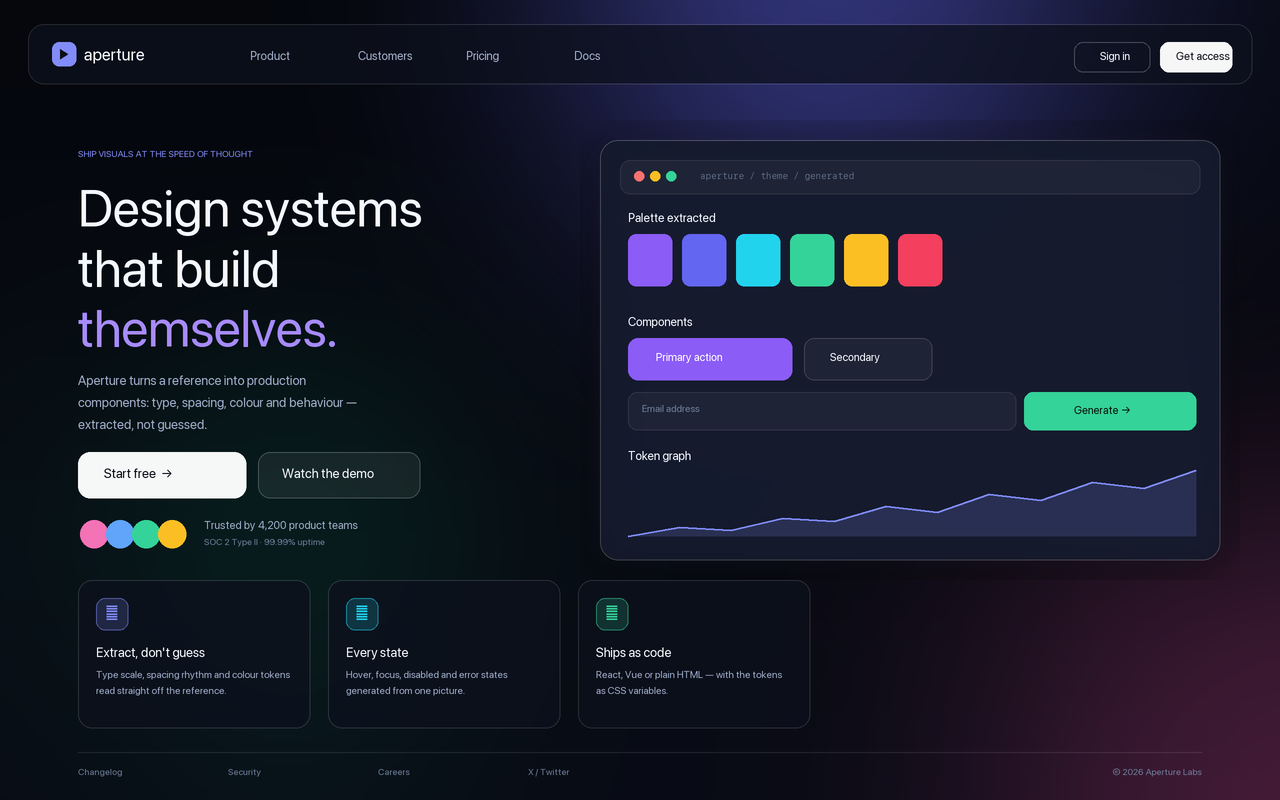
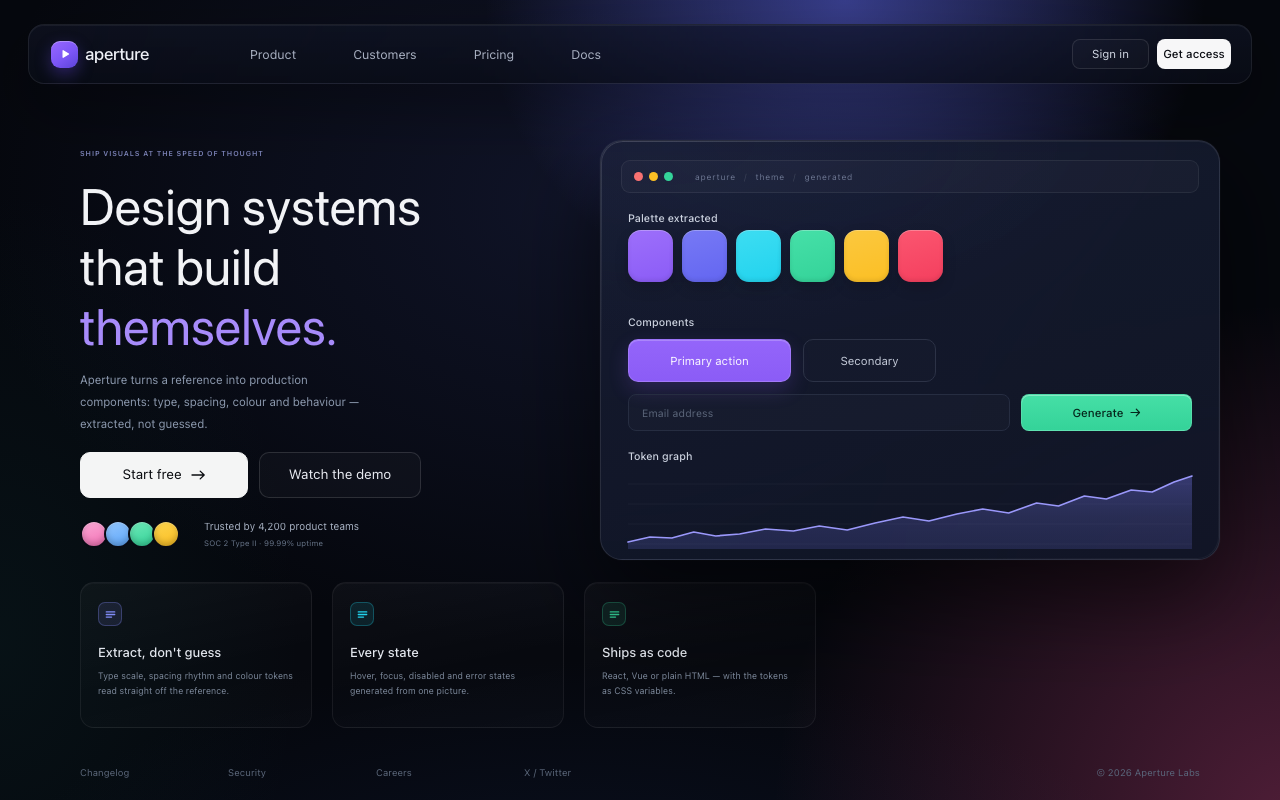
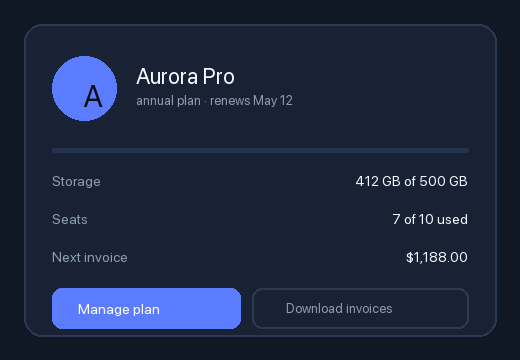
| Reference | The clone, rendered by the plugin | Result |
|---|---|---|
 |
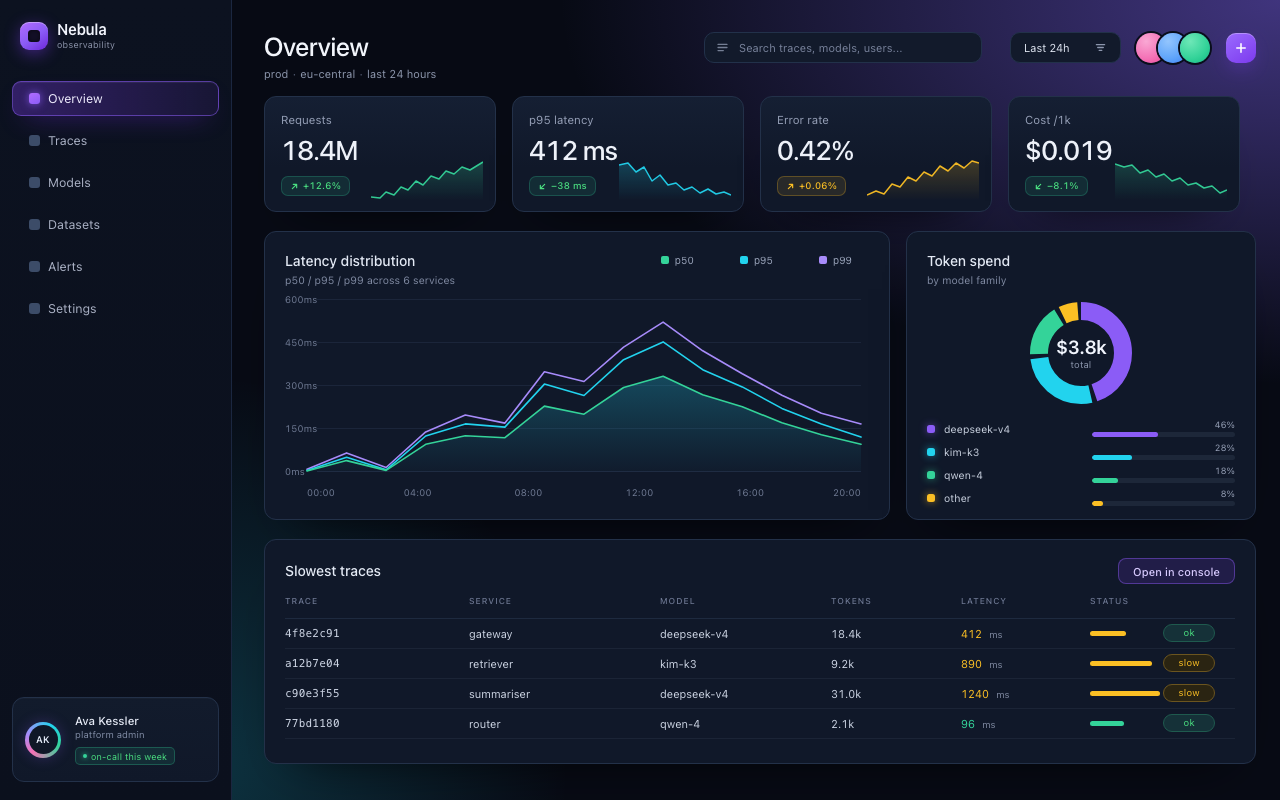 |
91.9% match · 1280×800 · two lanes raced, the better one adopted · open it |
 |
 |
91.9% match · 1280×800 · one lane · open it |
 |
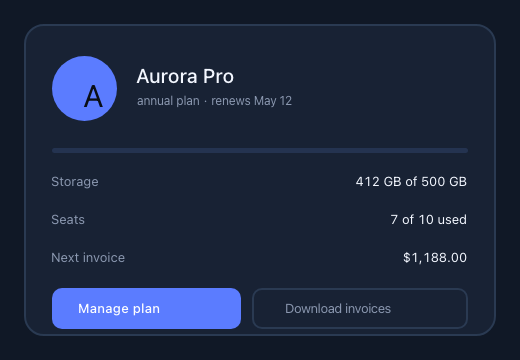 |
97.8% match · 520×360 · one file · open it |
 |
 |
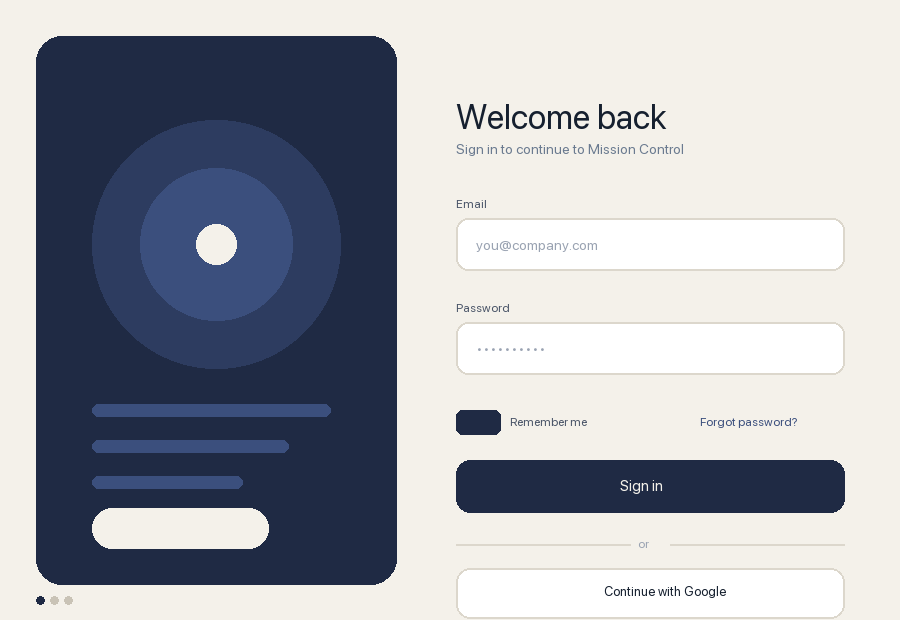
79% match · 900×620 · open it |
The dashboard and the landing page are the interesting ones: a sidebar, KPI cards with sparklines, a layered area chart, a donut, a data table; glass panels over a gradient mesh, a feature grid and a footer. Both were rebuilt from a single screenshot.
The score is the plugin's own, and it has three parts: both images are averaged into a coarse colour grid, the colour comparison forgives a small uniform shift, and a separate structure term compares where the detail sits. The mix measures how much of the picture agrees, not whether the page is correct — two unrelated dark interfaces land around 58%, a faithful rebuild above 90%. See Honest limits.
Install
In the Harness Web UI — Settings → Plugins → Add plugin, then install by package name:
dsh-clone
Published on npm as dsh-clone — npm install dsh-clone also works for a checkout.
Or add this repository's market index under Plugins → Custom plugin indexes, and install dsh-clone from the Discover tab in one click:
https://raw.githubusercontent.com/egorfedorov/dsh-clone/main/index.json
From a checkout (development):
git clone https://github.com/egorfedorov/dsh-clone
# Settings → Plugins → Add plugin → /absolute/path/to/dsh-clone
Updating — the market reports update-available when this repository's index (or npm) lists a newer compatible version. The market format has no in-place upgrade, so an update is a reinstall: your work lives in the workspace (.dsh-clone/, clone-*/), so reinstalling loses nothing. See docs/PUBLISHING.md for the whole distribution story.
Requires a DeepSeek Harness profile with subagents (the dsh-base bundle ships the spawn backend) and Node 20+. Scoring additionally uses a Chromium-family browser if one is installed; without it everything else still works.
Usage
Paste a screenshot into the conversation, then:
| Command | What it does |
|---|---|
/clone |
3 lanes rebuild the last image in this conversation |
/clone 4 |
four lanes — maximal spread of approaches |
/clone 2 darker, mobile-first |
two lanes plus a note every builder must honour |
/clone 3 ./mock.png |
use an explicit image path instead of the conversation image |
/clone status |
lane states, scores, gate results, worst regions, and the local leaderboard |
/clone pick 2 |
adopt lane 2 into the workspace |
/clone refine 2 move the CTA up |
rebuild the adopted page with one change, scored against the same reference |
| drag on the reference | score only that rectangle — every lane re-scored instantly |
/clone region clear |
go back to scoring the whole page |
/clone pick 2 --diff src/components/card |
adopt as a patch into an existing directory instead of a new folder |
/clone cancel |
stop the builders |
/clone discard |
delete the scratch directories and lane branches |
The agent has the same operations as a tool, so you can also just say "rebuild this screenshot, three tries":
clone({ action: "start", lanes: 3, note: "keep the sidebar" })
clone({ action: "status" })
clone({ action: "pick", lane: 2 })
The panel
A Clone tab appears in the conversation view ring while a clone exists:
- the reference screenshot on the left, at the size the lanes are building for;
- one card per lane: a live iframe of the actual page, its strategy, elapsed time, tool calls, file count, token spend, and its picture-match score once rendered;
- the best-scoring lane is marked as suggested, and Adopt this one works on any lane that produced an
index.html.
A small chip under the composer shows clone · 2/3 while builders run, so you can leave the tab.
How it works
The gate comes first. A page is measured only after it passes a deterministic, model-free checklist: every local reference exists (no 404s), nothing fetches from a CDN, no placeholder copy, images carry alt, form controls carry labels, and the document has a language and a title. A lane that fails is kept for inspection, shown with the failing checks, and cannot be adopted — however high it scored.
Isolation. Each lane gets its own directory. Inside a git repository that is a real git worktree on its own branch (dsh-clone/<id>-lane-<n>), so nothing leaks between attempts and nothing touches your working tree. Outside a repository it is a plain directory under .dsh-clone/<id>/lane-<n>/. Existing node_modules, .venv and vendor are symlinked into each lane instead of reinstalled.
The builders. Each lane is a subagent with one job: read the reference image, then ship index.html plus any local CSS/JS/assets. The delivery contract is identical for every lane and non-negotiable:
no build step · no network at runtime · no CDN · no placeholder copy · fill the viewport · approximate every image with CSS/SVG · leave no scratch files
The strategies differ; the contract does not. Every lane also carries an explicit effort budget (≈20-25 tool calls) and a wall-clock limit: a builder that keeps polishing is stopped, and whatever it already wrote is delivered and scored instead of stalling the clone.
The score. When a lane delivers, the plugin finds an installed Chromium-family browser (Chrome, Chromium, Edge, Brave — DSH_CLONE_BROWSER overrides), screenshots the page at the reference's own pixel size, and compares it with the reference: both images are averaged into a 48×32 colour grid and the mean absolute difference becomes a percentage. Highest score suggests the winner; you still choose. No browser, no score — the panel then falls back to completeness and finish order.
Region scoring. Dragging a rectangle on the reference re-scores every lane on that part only — the same attempts, judged on the part that matters. It uses the renders the clone already has, so it is instant and never rebuilds: the background of a screenshot is often most of the picture, and a page can score well on it while the card you actually asked for is wrong.
Runtime checks. The delivered page is opened with a harness injected as its first script, and the answer is read back from the rendered DOM: uncaught exceptions, unhandled rejections, console.error calls, and how far the content spills past the viewport. Uncaught errors and horizontal overflow reject the lane — a page that throws does not work however it looks. strictDynamic: false demotes them to recorded warnings.
The evidence. Alongside the score, each rendered lane gets a diff heatmap: the reference dimmed under the disagreement, cell by cell, plus the worst regions named in words ("lower-middle-centre-left, 40"). A percentage invites argument; a picture that shows where the rebuild drifts ends it.
The memory. Every finished clone records one row per lane — strategy, score, gate result, win — into .dsh-clone/leaderboard.json, in the workspace, never uploaded. Once a strategy has run a few times, /clone stops handing out strategies blindly and picks the ones that have been winning here, saying why: "picked visual-first, measure-first — visual-first has won 3/4 here (mean 92%)".
The preview. Lane pages are served from this page's own origin through /api/dsh-clone/preview/<clone>/<lane>/ — no extra port, no proxy, the same authenticated connection the UI already uses. Because the HTML is model-written, it is served with a sandbox CSP (no allow-same-origin) and mounted in a sandbox="allow-scripts" iframe: a clone can run its own code, but it cannot reach your session, credentials, or the Harness API.
Adoption. pick copies the chosen lane into the workspace as clone-<id>-lane-<n>/, without .git, without the symlinked dependency directories, and without the builder's scratch files. The other lanes stay where they are until you /clone discard.
Adoption into a component library. pick … --diff [dir] is for the case where the result belongs inside files that already exist: new files are written into the target directory, overlapping files become a unified diff written to .dsh-clone/<id>/patch/lane-<n>.patch, and the patch is applied with git apply when the workspace is a repository.
Iteration. refine takes an adopted lane, copies its page into a fresh single-lane clone and asks the builder for the smallest edit that satisfies one change — the reference and the viewport stay the same, so the new score is directly comparable and the clone reports the delta.
Durability. Each clone writes a small state.json next to its work. A plugin reload or a restart does not throw the run away: status and pick rebuild it from disk, and a lane that was mid-build keeps whatever it had already written, labelled as interrupted rather than pretending it finished.
Budgets. Every builder gets an effort budget in the prompt and a wall-clock limit (laneTimeoutMs); whichever is hit first settles the lane with whatever it delivered. laneTokenBudget adds a hard token ceiling and is off by default, because an agent re-sends its context on every step — a small ceiling stops honest builds mid-analysis, so it is a deliberate opt-in backstop rather than a default.
The nudge. Some models answer "measure first" by sampling the screenshot's pixels for their entire budget and then ending with nothing written. If a lane is past nudgeAtTools (12) tool calls with no index.html on disk, the plugin sends it one steering message: stop measuring, write the page now. One message, once per lane.
Configuration
All optional; the defaults are the intended experience.
| Key | Default | Meaning |
|---|---|---|
lanes |
3 |
lane count when the command does not name one |
maxLanes |
4 |
hard cap on lanes per clone |
viewport |
auto |
build and render size; auto uses the reference image's own pixel size |
laneTimeoutMs |
900000 |
wall-clock limit per lane (15 min); the lane is stopped and its output kept |
laneTokenBudget |
0 (off) |
token ceiling per lane. Off by default because an agent re-sends its context every step; 2M+ is a sensible backstop |
nudgeAtTools |
12 |
tool calls after which a lane with no index.html is told to stop analysing and write the page; 0 disables it |
autoStrategies |
true |
let the local leaderboard choose which strategies run; false keeps the configured order for a controlled comparison |
dynamicChecks |
true |
open the delivered page and inspect it (errors, overflow); false skips the run |
strictDynamic |
true |
a runtime failure rejects the lane; false records it as a warning |
provider |
spawn |
ctx.subagents backend used for builders |
pollMs |
900 |
live counter refresh interval |
commandName |
clone |
rename the slash command |
command / tool |
true |
disable either entry point |
- id: dsh-clone
  name: dsh-clone
  config:
    lanes: 4
    laneTimeoutMs: 600000
Safety
- Clones are static pages: no package installs, no network at runtime, no server.
- Lane pages are sandboxed into an opaque origin, so model-written HTML cannot reach your session, credentials, or the Harness API.
- Every write happens inside the workspace:
.dsh-clone/for scratch,clone-*/for adopted results, plus lane branches in your repository (removed by/clone discard). git worktreeis used without touching your checkout: no commit, no checkout, no reset in your working tree.test/git-lane.mjsasserts exactly that.- The scoring renderer is a one-shot headless screenshot of a local file. It loads no remote page.
Honest limits
- Cost is N×. Three builders cost roughly three builds.
lanes: 2is a reasonable everyday setting;lanes: 1makes it a plain "screenshot → page" button. - Runtime checks are shallow on purpose. They catch a page that throws or overflows; they do not click anything. A button that renders but does nothing still passes — that is what the human looking at the render is for.
- The score measures the picture, not the truth. 92% agreement can still hide wrong copy, a missing form action, or broken behaviour. It ranks attempts; it does not certify one.
- The score is coarse by design. A 48×32 grid with shift tolerance is forgiving about a few pixels and strict about a panel on the wrong side; the structure term catches "right colour, wrong picture". Two lanes a few points apart are still a coin flip — open both before adopting.
- Vision is required. The builder must actually see the reference. A text-only model produces a guess; pair dsh-clone with a vision-capable route or a vision bridge plugin.
- Images are approximated. Without image generation, photos and illustrations become CSS/SVG stand-ins with the right silhouette and palette, not the original pixels.
- Static output. No Next.js project, no design system — by design, so the result is always runnable in one click.
- Scoring needs an installed browser. Chrome, Chromium, Edge or Brave on macOS, Windows or Linux;
DSH_CLONE_BROWSERoverrides the probe. No browser means no percentage, and nothing else changes. - A careful builder is a slow builder. Hence the effort budget and the wall-clock limit; tune those, not your patience.
Roadmap
- Region scoring — "clone just this card": compare only the rectangle that matters instead of the whole page.
- Adopt as a diff — when the workspace is a component library, adopt as an edit to an existing file instead of a new folder.
- Multi-reference — several screenshots of the same flow, one page per screen.
- Panel screenshots in the storefront — the four declared images are plugin output, not the panel itself.
Repository layout
index.js            Host half: /clone command, clone tool, web routes, poller
client.js           Client half: the Clone panel and the composer chip
lib/engine.js       Clone state machine (pure, dependency-injected)
lib/prompts.js      The delivery contract, the effort budget, four strategies
lib/render.js       Headless screenshot through an installed Chromium browser
lib/score-lane.js   Render-and-score composition shared by the plugin and its test
lib/score.js        Coarse-grid picture comparison
lib/png.js          Dependency-free PNG decoder
lib/parse.js        /clone grammar
lib/rank.js         Adoptability, score-first ordering, suggestion
lib/preview.js      Static lane serving, media types, sandbox CSP, JSON routes
lib/accept.js       Static acceptance gate (assets, no external fetches, copy, a11y)
lib/checks.js       Runtime harness: errors, rejections, console.error, overflow
lib/diff.js         Diff heatmap and the named worst regions
lib/leaderboard.js  Per-workspace strategy record and recommendation
lib/util.js         Small pure helpers
test/smoke.mjs      62 tests, no Harness required
test/git-lane.mjs   worktree isolation against a real repository
test/render-score.mjs  real render + score through the plugin's own path
index.json          Format-1 plugin market index (Custom plugin indexes)
screenshots.json    Storefront screenshots (read by dsh-market)
tools/make-hero.py  Regenerates docs/assets/hero.png
tools/make-references.py  Regenerates the showcase reference screenshots
tools/make-icon.py  Regenerates the storefront icon
tools/make-demo.py  Regenerates docs/assets/demo.gif
docs/PUBLISHING.md  npm, the awesome list, indexes, the official program
docs/storefront/    Ready-to-submit entry for awesome-dsh-plugin
docs/index.html     GitHub Pages landing page
docs/demo/          Four real clones, served live
docs/ARCHITECTURE.md
ACCEPTABLE-USE.md
Development
npm run check       # syntax-check every shipped file
npm test            # 62 assertions: grammar, regions, gate, runtime, diff, leaderboard
npm run test:git    # the git-worktree isolation model against a real repository
npm run test:score  # a real render + score through the plugin's own code path
npm run test:all    # all three
The engine takes every side effect as a dependency, so the tests drive the real state machine against a temporary directory with fake subagents — no Harness, no network, no model. The pixel tests decode the demo reference and a committed real lane render, so a regression in either the decoder or the scoring curve fails the suite. test/git-lane.mjs builds a throwaway repository to prove that lanes are real worktrees, that your own dirty working tree and branch are untouched, that dependency directories are shared by symlink, and that discard removes worktrees and branches while the adopted copy survives. test/render-score.mjs goes through the plugin's own scoring path with two fake builders — one faithful, one deliberately desaturated — and asserts that both come back scored, that the faithful one wins, and that the snapshot carries the score and the render URL. It skips itself when no browser is installed.
По-русски
Плагин для DeepSeek Harness: скидываешь скриншот интерфейса, пишешь /clone 3 — три агента параллельно собирают его в изолированных папках (в репозитории — через git worktree). В панели «Clone» видно эталон и все попытки рядом; каждая готовая страница рендерится в headless-браузере и получает процент совпадения картинки. Нажимаешь «Adopt this one» — выбранный вариант копируется в рабочую папку как готовая страница. Остальные удаляются командой /clone discard.
Честно: стоимость — примерно N попыток; оценка совпадения меряет картинку, а не правильность (текст и поведение всё равно проверяй глазами); нужна модель, которая видит изображение.
License
MIT — see LICENSE. Use it on interfaces you have the right to rebuild; see ACCEPTABLE-USE.md.
No comments yet. Be the first to write one.