




dsh-pnpm-manager
Control whether the pnpm used by DeepSeek Harness (DSH) goes through a proxy — and inspect / switch its registry and store — from either DSH's settings page or a standalone CLI.
Install
Use the bundled dsh CLI. Replace <profile> with your profile name (desktop for the app, web for dsh web, …).
# 1) git source (main channel)
dsh plugin --profile <profile> add "github:easyzoom/dsh-pnpm-manager#main"

# 2) npm (once published to npm)
dsh plugin --profile <profile> add dsh-pnpm-manager

# 3) local dev (a checkout of this repo)
dsh plugin --profile <profile> add /path/to/dsh-pnpm-manager
Notes:
- The desktop profile is locked by the running app — close DeepSeek Harness before a CLI install, or install from the app's Plugins panel.
- The git source works for a private repo too when your git credentials are set; a public repo needs no auth.
- The npm command requires the package to be published (
npm publish) first.
Why
Node and pnpm do not use the Windows system proxy, so pnpm connects to registry.npmjs.org and GitHub directly. Behind a firewall that is slow or fails with ECONNRESET. Pointing pnpm at a local proxy (e.g. Clash on 127.0.0.1:7897) makes dependency resolution several times faster — but if the proxy is down, installs fail. This tool makes that switch one click (or one command) away.
What it touches
Only the proxy, https-proxy and registry lines of ~/.npmrc. Every other setting is preserved. A backup (*.bak-<timestamp>) is written only when the content actually changes.
As a DSH plugin
package.json declares dsh.bundle.patch, and cordis.patch.yml inserts one host row. The row's Config (schemastery) is rendered by DSH as the plugin's settings form:
| field | values | meaning |
|---|---|---|
mode |
on / off / auto |
force proxy on / force direct / enable only when the proxy port is reachable |
proxyUrl |
URL | proxy address (default http://127.0.0.1:7897) |
noProxy |
hosts (comma-separated) | hosts that bypass the proxy (noproxy; only while the proxy is on) |
strictSsl |
true / false |
strict TLS verification; disable it for SSL-intercepting proxies (e.g. Clash) → strict-ssl=false |
registry |
keep / npmjs / npmmirror |
leave registry alone / official source / China mirror |
Editing the form rewrites ~/.npmrc immediately (the loader re-applies the row).
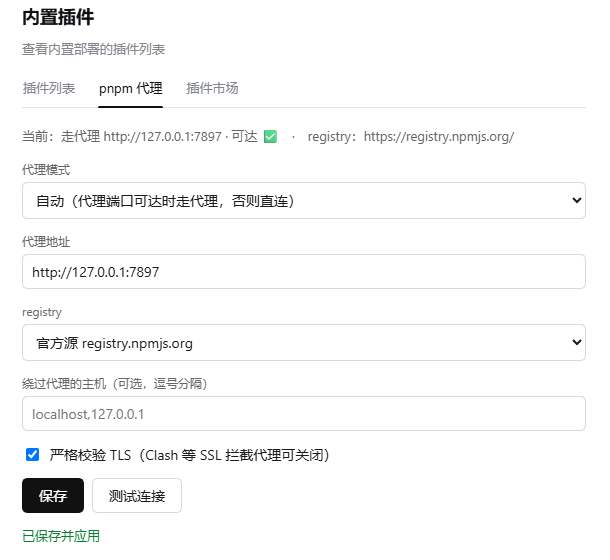
Status: verified in live DSH (isolated web profile and the desktop app): the host routes return live data; the card renders on the plugin's page and as a pnpm 代理 tab under Settings → Built-in plugins, showing the mode status plus 开 / 关 / 自动 / 测试. Host routes are also unit-tested.
Client card (optional)
lib/client.js registers an editable form — mode, proxy URL, registry, no-proxy hosts, and strict-TLS — with a save confirmation (edit → 保存 → 确认保存) and a 测试连接 button, into both the plugin's page (plugins.bundle.config / family seat) and a Settings → Built-in plugins tab (settings.plugins.tab). Registration is guarded and waits for the seat to be declared, so an unavailable seat never breaks the Web boot.
CLI
node bin/dsh-pnpm-manager.mjs status [--json]
node bin/dsh-pnpm-manager.mjs doctor [--json]
node bin/dsh-pnpm-manager.mjs on | off | toggle | auto
node bin/dsh-pnpm-manager.mjs proxy http://127.0.0.1:7890   # or: proxy reset
node bin/dsh-pnpm-manager.mjs registry npmjs | npmmirror
node bin/dsh-pnpm-manager.mjs store
node bin/dsh-pnpm-manager.mjs test
Environment: PNPM_PROXY_URL, DSH_PROFILE_DIR, DSH_PNPM_CJS.
Layout
lib/index.js            host plugin (name / Config / apply + web routes)
lib/npmrc.js            shared .npmrc read/write helpers
lib/client.js           optional client card (__ModuleLoader__ bundle)
bin/dsh-pnpm-manager.mjs   standalone CLI
cordis.patch.yml        bundle patch (inserts the host row)
License
MIT
No comments yet. Be the first to write one.