dsh-restart
English | 简体中文
DeepSeek Harness (DSH) web-GUI plugin that adds a Settings → Restart section: restart the dsh web process in one click, enable/disable installed plugins, and jump straight to the Community plugins tab to install more. Bilingual UI (English / Simplified Chinese) that follows the host's global language setting and switches live.
Features
- Restart dsh web — one button restarts the host web process. The restarter is a detached helper that polls until the port is actually released (up to 20 s) before relaunching, so a slow-shutting-down old process cannot make the new one die with
EADDRINUSE; the new instance inherits the original terminal's stdio and the page reloads itself once the server is back. - Enable / disable installed plugins — lists every third-party plugin of the active profile (union of
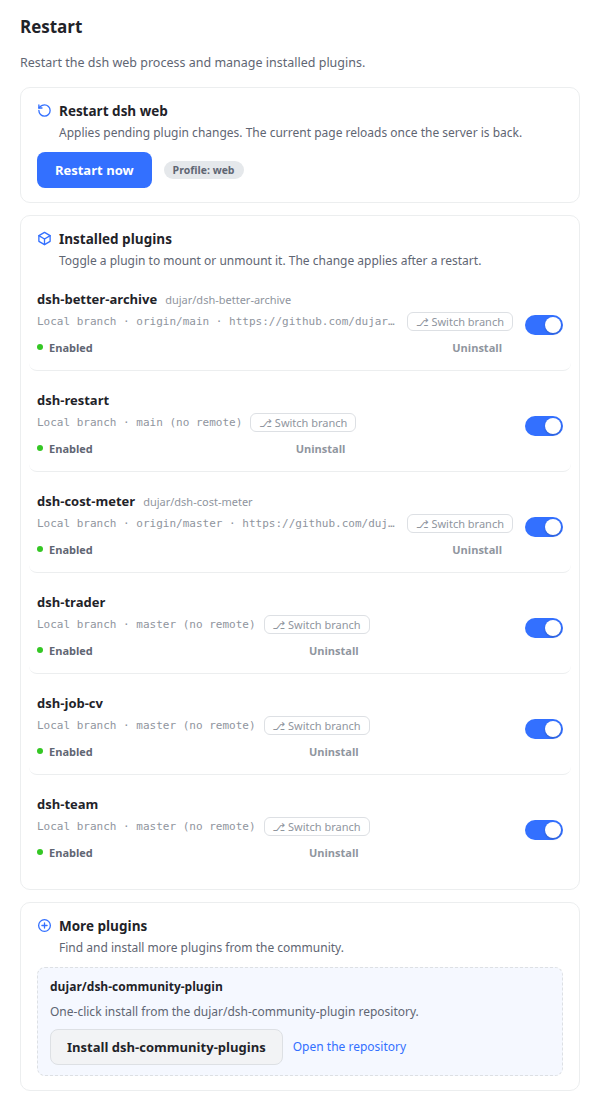
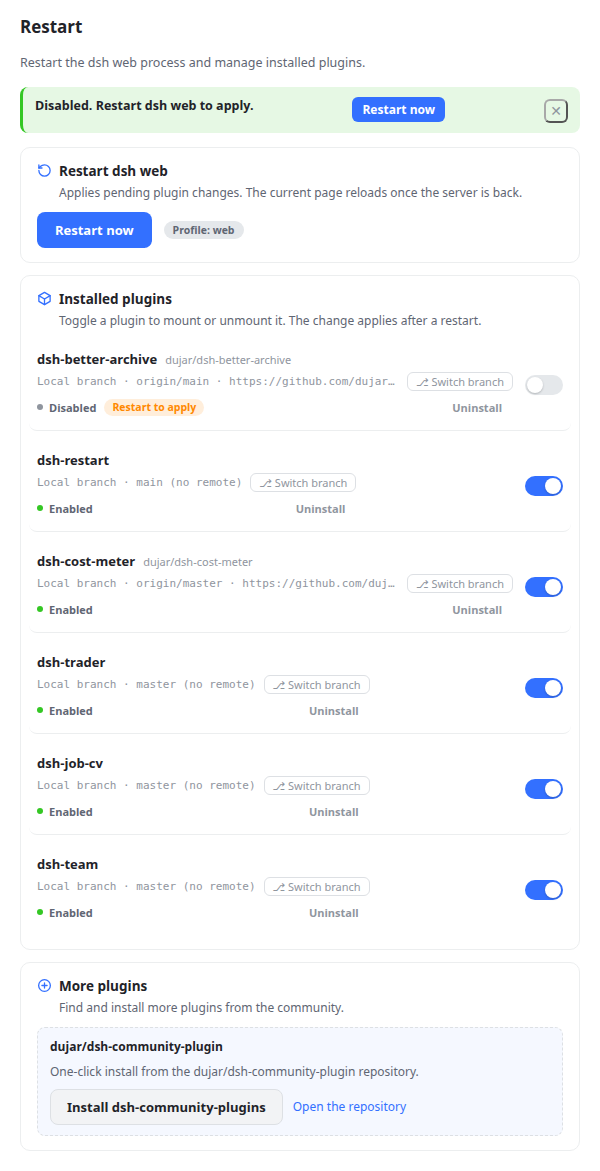
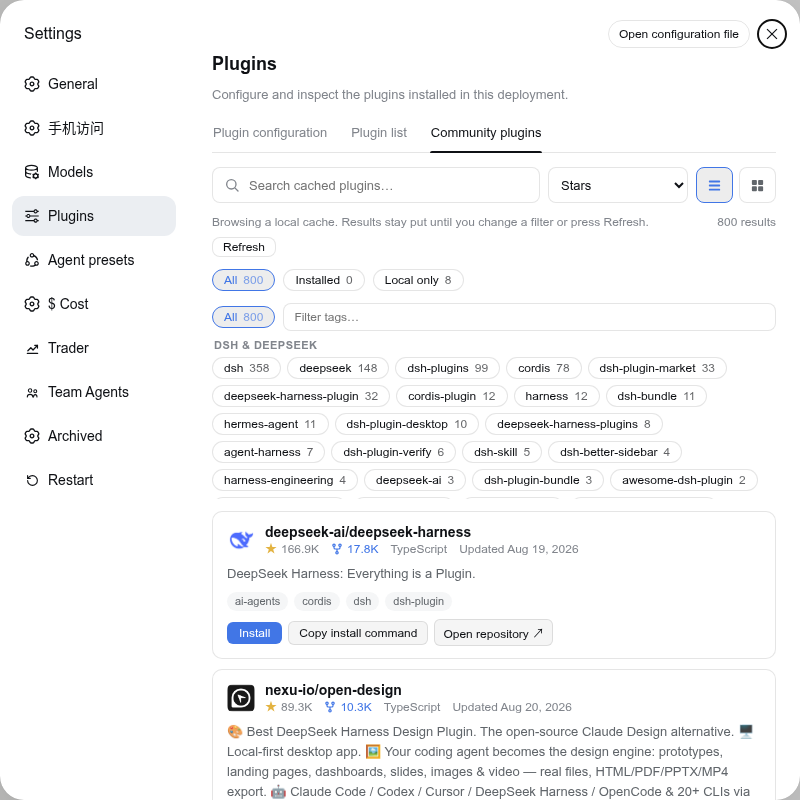
dsh.profile.bundlesanddependencies, excluding@deepseek-ai/*andcordis:*built-ins) with a toggle per plugin that edits the profile manifest (dsh.profile.bundles); changes apply after a restart. Enabled state shows as a status dot (green / gray), and every async action (restart, install, branch switch, uninstall, …) carries a spinner. Rows with a pending change show a Restart to apply chip, and a notice bar offers a one-click restart. Plugins installed from a local checkout (link:/file:specs) additionally show git metadata when it is already present on disk — local build vs local branch, the current branch, the first remote's name/URL (e.g.Local branch · origin/main · https://github.com/dujar/dsh-pocket.git) — read from.gitonly, no network, worktrees included. - More plugins — when dsh-community-plugins is installed and enabled, a button jumps straight to Settings → Plugins → Community plugins; otherwise the card advertises dujar/dsh-community-plugins with a one-click install (runs
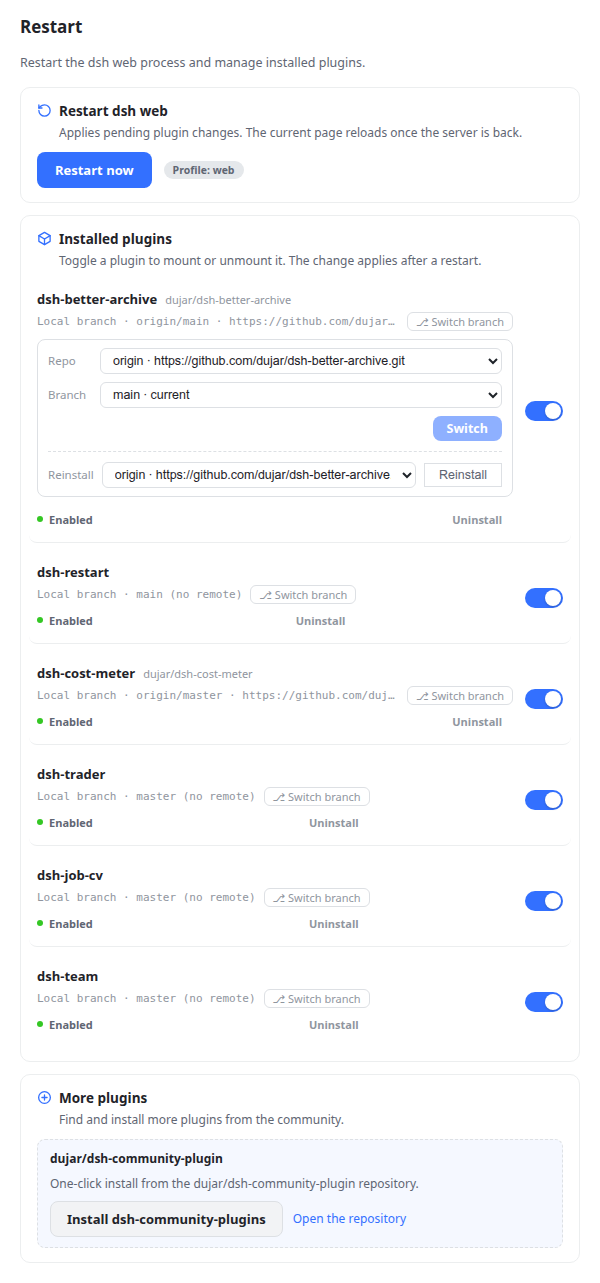
dsh plugin --profile <p> add github:dujar/dsh-community-plugins) and a link to the repository. - Switch branches & reinstall — local git checkouts get a git panel (⎇): switch branch across repos (Local / origin / upstream, with tracking retargeting for same-name branches). Reinstall sits in its own dashed-divider group; the button is neutral until the two-step confirmation, then turns red. Fresh-clean the checkout from one of three sources: Local (
git reset --hard+git clean -fdx), any of its own remotes (fetch+ hard-reset to the default branch), or Plugin (npm) (runsdsh plugin --profile <p> add <name>@latest, replacing thelink:spec — the checkout stays on disk but DSH loads the npm release after a restart; rundsh plugin --profile <p> add link:<path>to go back). Local/remote reinstalls automatically restore the checkout's runtime dependencies (git clean -fdxwipes node_modules; picked by lockfile —package-lock.json→ npm,pnpm-lock.yaml→ pnpm, deps without a lockfile → npm) and auto-repair a broken link. - Link health & one-click repair — state checks
node_modules/<plugin>against itslink:/file:manifest spec: a real directory, a missing entry, or a symlink pointing elsewhere shows a Link broken — DSH is loading a stale copy warning (the typical cause: adsh plugin add github:...replaced the local link with a tarball copy). Repair link runsdsh plugin --profile <p> install, and pnpm re-materializes the symlink from the manifest and rewrites the lockfile. - Uninstall — every plugin row offers a two-step-confirmed removal from
dsh.profile.bundlesanddependencies(builtin packages are refused); files on disk stay untouched. - Fail-closed trust guard — all routes reuse the same-origin/localhost check shared with dsh-trader and dsh-community-plugins.
Screenshots
Settings → Restart section (English):
Toggling a plugin shows the pending state and a restart shortcut:
The More plugins button redirects in-app to the Community plugins tab:
The git panel — switch branch across repos (local / origin / upstream), and reinstall (fresh cleanup) from the same sources:
Install
Requires Node.js 22.19+ and pnpm (
dsh plugininstalls through pnpm under the hood).
# local checkout (development)
dsh plugin --profile web add /path/to/dsh-restart

# from GitHub
dsh plugin --profile web add github:dujar/dsh-restart
Then restart dsh web and refresh the browser page. The install adds dsh-restart to the profile's dsh.profile.bundles automatically; if it is not added, append "dsh-restart" to that array in $DSH_HOME/profiles/web/package.json and restart. A Restart section then appears at the bottom of the Settings sidebar.
Usage
- Open Settings → Restart.
- Restart now restarts the dsh web process; the page reloads once the new instance answers.
- Toggle any plugin to mount/unmount it — the profile manifest is updated immediately, and the change is applied after a restart. The Restart to apply chip and the notice bar's Restart button show you exactly what is pending.
- Browse more plugins opens Settings → Plugins → Community plugins, where you can search and install from the community catalog (via dsh-community-plugins).
- For local checkouts, ⎇ Switch branch opens the git panel: pick a repo (Local / each remote) and a branch — the same branch name from a different repo retargets tracking (
git branch --set-upstream-to/--unset-upstream) instead of being a no-op. The Reinstall row below it is a fresh cleanup from one of three sources (all two-step confirmed): Local discards every local change and untracked file (git reset --hard+git clean -fdx), a remote fetches and hard-resets the checkout to that remote's default branch, and Plugin (npm) reinstalls the latest release from the registry (dsh plugin add <name>@latest— the local checkout stays on disk but stops being loaded). Local/remote reinstalls automatically restore the node_modules thatgit clean -fdxwiped and repair a broken link. Link health shows per row: when the Link broken warning appears, click Repair link to fix it. - Uninstall (row meta) removes the plugin from
dsh.profile.bundlesanddependencies— restart to apply; the checkout files on disk are left untouched.
Host routes
| Method | Path | Purpose |
|---|---|---|
| GET | /dsh-restart/state |
profile, installed plugins (with enabled state, local git metadata, and link health), dsh-community-plugins availability |
| POST | /dsh-restart/plugin |
{ name, enabled } — add/remove a dsh.profile.bundles entry |
| POST | /dsh-restart/community |
one-click install of github:dujar/dsh-community-plugins (DSH_BIN overrides the executable) |
| GET | /dsh-restart/git-refs |
?name=<plugin> — branch + remote refs of a local checkout (no network) |
| POST | /dsh-restart/git-checkout |
{ name, branch, remote } — switch branch (repo-aware tracking) |
| POST | /dsh-restart/uninstall |
{ name } — remove the plugin from bundles + dependencies (builtins refused) |
| POST | /dsh-restart/relink |
{ name } — re-sync the profile install so a clobbered link:/file: dep points at its checkout again |
| POST | /dsh-restart/reinstall |
{ name, remote } — fresh-clean a local checkout (Local, or its own git remote; remote: "plugin" re-adds from the registry and de-links); then restore the checkout's dependencies and repair a broken link |
| POST | /dsh-restart |
schedule a self-restart; responds { ok, restarting }, then the process exits ~400 ms later |
All routes use the fail-closed same-origin/localhost trust check shared with dsh-trader and dsh-community-plugins: a cross-origin or malformed Origin/Referer rejects, a CORS-simple content type rejects, and only then does a localhost host count as trusted.
Configuration
Environment variables (all optional):
| Variable | Default | Purpose |
|---|---|---|
DSH_RESTART_CMD |
original command line | Custom restart command (e.g. systemctl restart dsh-web) for supervised setups. |
DSH_RESTART_PROFILE |
auto-detected | Explicit profile; falls back to DSH_PROFILE, then auto-detection of the profile that mounted this plugin, then web. |
Development
Zero-build plugin (same pattern as dsh-community-plugins / dsh-better-archive):
npm test          # host routes + client contract/dict balance + real-React SSR
node --check lib/index.js && node --check lib/client.js
- Client:
lib/client.js(CJS factory + ModuleLoader; React comes from the host). - Host:
lib/index.js(ctx.webServer.registermounts the routes). - i18n:
ctx.locale.register('restart', { zh, en })— the host enforces zh/en key parity, so every new string must land in both dictionaries.
Structure
dsh-restart/
  package.json         # manifest (dsh.bundle.patch / dsh.client declarations)
  cordis.patch.yml     # host-half mount line (applied by the profile bundle mechanism)
  lib/
    index.js           # host half: restart scheduler + toggle/git-panel routes
    client.js          # browser half: settings section UI (React, zero-build, i18n)
  test/
    host.test.mjs      # routes, trust guard, restart handoff
    client.test.mjs    # bundle contract, dict key parity, pollRestart
    render.test.mjs    # real-React server-side rendering
  LICENSE
  README.md           # English (this file)
  README.zh-CN.md     # Simplified Chinese
Publishing
Before publishing your fork to GitHub: add the dsh-plugin topic to the repository for discoverability in the community catalog (per the DeepSeek Harness README).
No comments yet. Be the first to write one.