dsh-meterEnglish | 中文 DeepSeek bills by time of day now. This is the meter for it.Two peak windows a day, off-peak at half the peak rate. Cost stopped being a number you read afterwards and became a rate you are standing in. One line under the composer: what this session cost, which tariff is running, how long until it flips. Hover it for the tariff clock, the cache economics, and your balance.
|
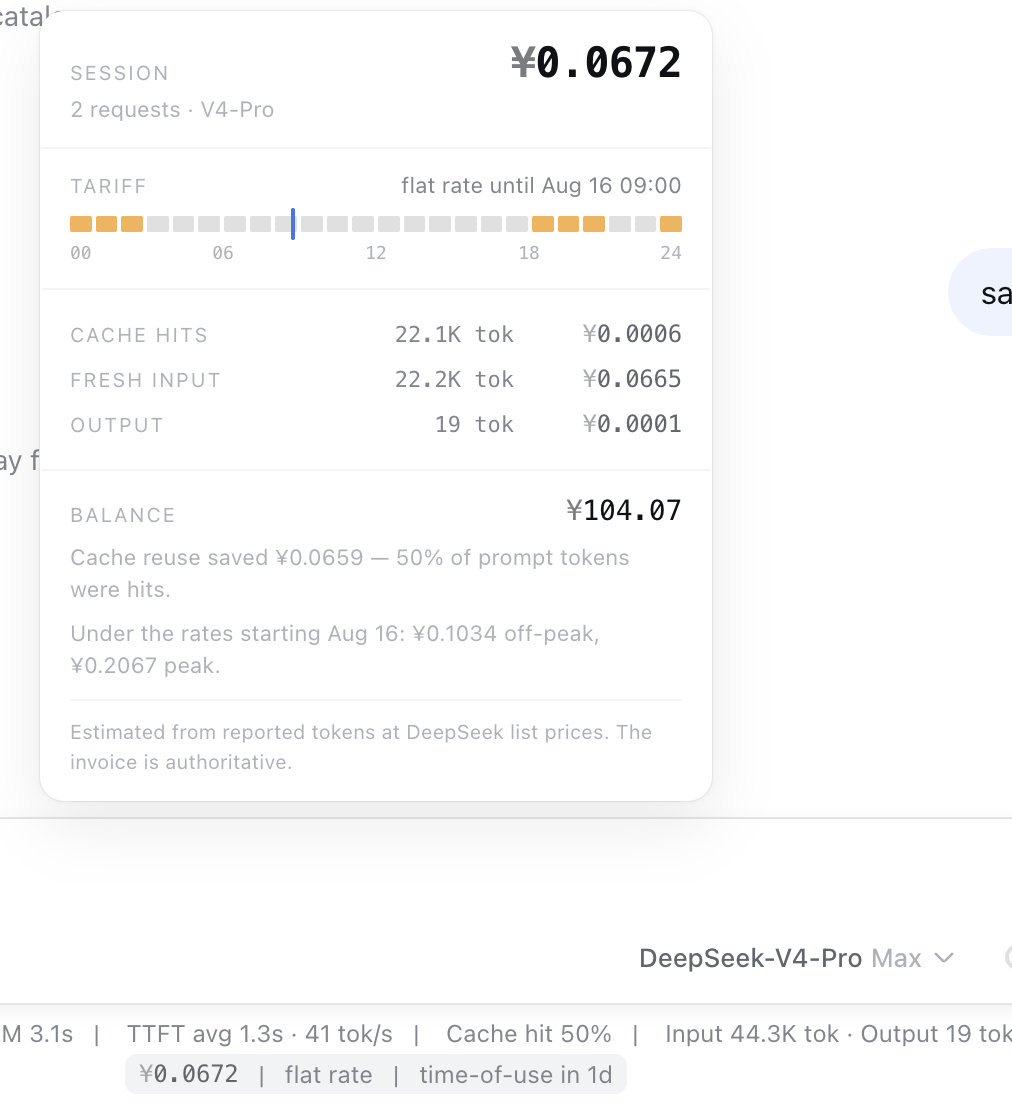 |




Install
dsh plugin --profile web add @dshworks/dsh-meter
dsh --profile web
dsh plugin forwards to pnpm, so pnpm must be on PATH. Nothing else to
configure: the meter appears under the composer as soon as a session bills
its first request.
The line
2 turns · 2 steps | LLM 3.1s | TTFT avg 1.3s · 41 tok/s | Cache hit 50% | Input 44.3K tok
                    ¥0.0672  |  peak  |  off-peak in 48m
The harness's own stats line, untouched, and ours under it. This plugin adds a line — it does not shadow the shipped one, which is what a cost plugin has to do to append to it.
Hover or focus for the card. Inside a peak window the tariff is called out in amber and the countdown runs to the next off-peak hour:
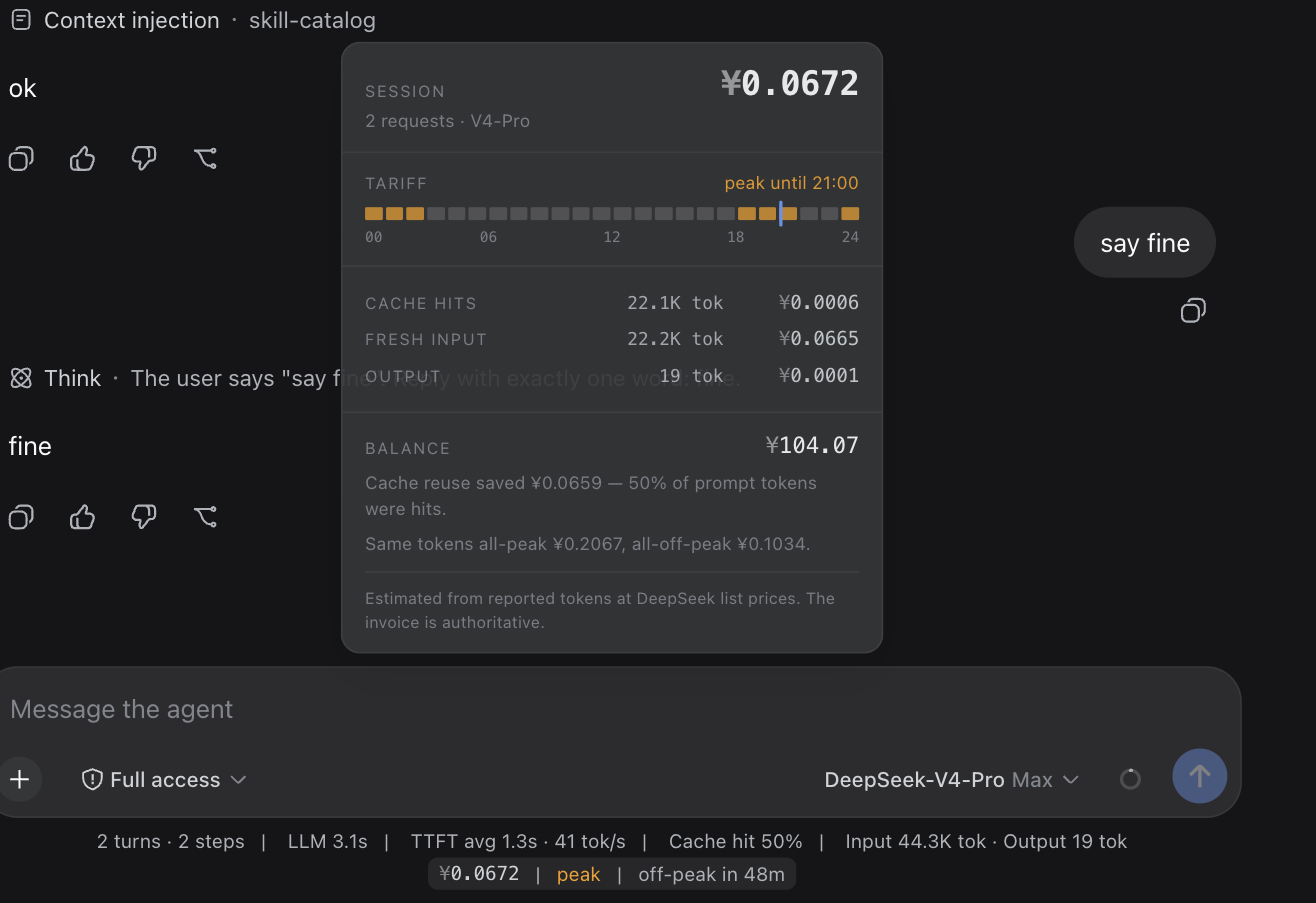
| The card shows | Why it is there |
|---|---|
| The session total, request count, models | The number, once, at full size |
| A 24-hour tariff strip in your local time, with a live now-marker | Peak windows are published in UTC. Reading them off a strip beats doing timezone arithmetic at 11pm |
| cache hits / fresh input / output — tokens and money on each | A cache hit costs 1/30th of a miss. This is the row that shows whether your prompt prefix is stable |
| Your account balance, and how much of it is granted credit | Granted balance expires; topped-up balance does not |
| The same tokens priced under the other tariff | Before the switchover: what the new rates do to this session. After: what waiting for off-peak is worth |
| What the cache saved | The counterfactual where every hit had been a miss |
Proof
Live-verified against dsh 0.1.0-rc.6 on 2026-08-15, in a real web
session on DeepSeek-V4-Pro — not a mock:
| Claim | How it was checked |
|---|---|
| Loads in a stock web profile | dsh --profile web --dump-config lists it; /plugins/@dshworks/dsh-meter/client.js serves 200 |
| The readout is correct | 22.2K cache-miss input on v4-pro at the flat rate = ¥0.0665; the line and the card agree with the harness's own token counts |
| Survives a restart | Server restarted, session reopened cold — the projection replays from the durable log at the same figure |
| Both themes, both tariff states | Light and dark, flat and peak, captured above — this predates the 08-16 switchover, so the flat readout is one a new session no longer reaches |
| Currency detection | A live account returns {"currency":"cny", ...} and the whole surface switches to ¥ with no configuration |
| 50 tests, CI green | pnpm test — the fold, the tariff clock, the rate card, the balance reader, and the generated-bundle sync check |
Two currencies, no conversion
DeepSeek publishes two independent rate cards — USD for the international platform, CNY for the mainland one. An account is billed against exactly one of them, and neither table is a conversion of the other, so a plugin that picks with an exchange rate is wrong twice.
dsh-meter computes both and lets the account decide. GET /user/balance returns the currency the account is denominated in — a
live account lists both rows with only one funded — so the meter reads
the funded row and shows that side. Nothing to configure, nothing to
guess from your interface language.
The balance request runs on the host, keyed by the same credential seam
the LLM adapter uses; the browser gets parsed numbers over
GET /dsh-meter/balance and never the key. It fires when the meter
mounts and when you open the card, not on a schedule — set
balance: false to turn the whole thing off and the meter keeps working.
The rate card
Carried verbatim in lib/core.js, per 1M tokens.
| cache hit | cache miss | output | |
|---|---|---|---|
| v4-flash off-peak | $0.007 / ¥0.05 | $0.22 / ¥1.5 | $0.66 / ¥4.5 |
| v4-flash peak | $0.014 / ¥0.10 | $0.44 / ¥3 | $1.32 / ¥9 |
| v4-pro off-peak | $0.022 / ¥0.15 | $0.66 / ¥4.5 | $1.98 / ¥13.5 |
| v4-pro peak | $0.044 / ¥0.30 | $1.32 / ¥9 | $3.96 / ¥27 |
Peak is 01:00–04:00 and 06:00–10:00 UTC (09:00–12:00 and 14:00–18:00 Beijing). Every other hour is off-peak, including the two-hour gap between the windows. Off-peak is exactly half of peak — and still above the flat rate it replaced, by about 2.3x on output.
The retired flat card, kept to reprice historyBilled at every hour until 2026-08-16 16:00 UTC. Upstream no longer publishes it; the meter keeps it because a session logged before the switchover must still cost what it actually cost.
| cache hit | cache miss | output | |
|---|---|---|---|
| v4-flash flat | $0.0028 / ¥0.02 | $0.14 / ¥1 | $0.28 / ¥2 |
| v4-pro flat | $0.003625 / ¥0.025 | $0.435 / ¥3 | $0.87 / ¥6 |
Against it, pro rose 6x/12x on cached input, 1.5x/3x on cache-miss input and 2.3x/4.6x on output (off-peak/peak). The steepest rise is on the cheapest token, which is the one an agent sends most of.
Source: https://api-docs.deepseek.com/quick_start/pricing, diffed against both locales daily (see below), last confirmed in sync 2026-08-20 — and against a real bill: 188,542 cache-miss tokens on pro, off-peak, settled at ¥0.84, i.e. ¥4.46/1M against the published 4.5.
The card is also a feed
Building your own estimator? Take the card, not the numbers in this table.
https://dsh.works/dsh-meter/pricing.json
Static JSON, no key, no rate limit. Both currencies, both tariffs, the
UTC schedule, the retired flat card for repricing history, and the
bucket definitions — generated from lib/core.js by
scripts/build-feed.mjs, so it cannot
state a price the meter would not charge.
In JavaScript, skip the fetch and call the same module directly:
import { costOf, tariffAt } from '@dshworks/dsh-meter/core'

const tokens = { miss: 188_542, hit: 1_204_880, out: 9_310 }
costOf(tokens, 'deepseek-v4-pro', tariffAt(Date.now()), 'cny')
lib/core.js imports nothing. Rate card, tariff clock, and cost fold are
pure functions of their arguments — no clock reads inside, so history
reprices at the tariff it was actually billed under.
What does it cost right now?
The feed answers this without containing a "now". It publishes the 24-hour schedule; you index it with the current UTC hour. That is why a CDN can cache it for ten minutes, or you can vendor it into a binary, and it still cannot be stale about which tariff is running:
curl -s https://dsh.works/dsh-meter/pricing.json | jq -r '
  (now|gmtime|.[3]) as $h
  | .timeOfUse.scheduleUtc[$h] as $t
  | "\($t) · v4-pro out $\(.models["deepseek-v4-pro"].rates[$t].usd.out)/1M"'
An endpoint that returned the answer instead would be wrong for as long as its cache lives, four times a day, on exactly the boundary where being wrong costs 2x.
Two ways to get this wrong, both silent:
- Local hours.
scheduleUtcis indexed by UTC hour and is not rotated into your timezone.new Date().getHours()returns a plausible tariff that is wrong for most of the planet. - Broken-down time offsets. jq's
gmtimeis[year, month, day, hour, …]— the hour is.[3]. Writing.[2]reads the day of the month, which is a valid index into a 24-hour array. Testing this section at 09:59 UTC,.[2]saidoffpeakwhile the real tariff waspeak. It looked completely reasonable.
The schedule is anchored to Beijing (UTC+8), and China has not observed
daylight saving since 1991 — that fixed offset is the only reason a
table of UTC hours is safe to publish at all. The feed states it under
timeOfUse.anchor, and verify-pricing checks the English page's UTC
sentence and the Chinese page's Beijing sentence separately, then
checks that they still agree.
One caveat no feed can fix: now is your machine's clock. If it has
drifted, so has your tariff.
Why not use an existing price feed? Because none of them are right. Checked 2026-08-20, four days after the switchover, both of the sources an estimator usually reaches for still published DeepSeek's retired flat card as current:
| Source | v4-pro cache-miss input | Understates the real bill by |
|---|---|---|
| models.dev | $0.435 | 1.5x off-peak, 3.0x peak |
| LiteLLM | $0.435 | 1.5x off-peak, 3.0x peak |
| this feed | $0.66 off-peak / $1.32 peak | — |
On cached input, the bucket an agent sends most of, models.dev is off by 12x at peak. And this is not a staleness bug they can patch: both schemas hold one flat price per model per bucket, with nowhere to put a tariff. A number that is wrong for seven hours of every UTC day cannot be represented correctly in either.
OpenRouter's /api/v1/models is accurate, but for a different question —
it quotes what OpenRouter charges to resell the model, not what DeepSeek
bills your account.
Nobody types these numbers
Not us, and ideally not you. A hand-maintained rate card rots, and the
vendor is the proof: DeepSeek's own pi integration guide
ships a cost block where v4-flash's cache-read rate is a 10x decimal
slip (0.028 for a rate of 0.0028) and the v4-pro figures are exactly
4x the card — they are Azure's resale prices, pasted into DeepSeek's
documentation, on a page people copy into their agent config.
So the card is written by machine and reviewed by human:
| read | scripts/verify-pricing.mjs |
scrapes both locales — prices, peak windows, model list — and diffs them against the card |
| write | scripts/apply-pricing.mjs |
splices the scraped values back into lib/core.js, then re-runs the verifier against its own output and reverts if that second read disagrees |
| ship | npm run build |
regenerates the bundle, the site and the feed from the rewritten card |
| judge | you | the job opens a PR; it never merges one |
A daily job runs all four. Locally
it is npm run verify:pricing to look and npm run sync:pricing to
rewrite.
Why it opens a PR instead of merging. Every invariant CI can check is structural — off-peak is half of peak, output costs more than a cache miss, a live request never prices at the retired card — and a wrong-but-plausible parse satisfies all of them. No test can tell a right price from a believable one. A human looking at a diff can.
The last price change arrived with no announcement in any channel we watch. That is the argument for the alarm; the vendor's own 10x typo is the argument for taking the keyboard away from all of us.
How the money is counted
| Behavior | Detail |
|---|---|
| Source of truth | Provider-reported token counts in the durable session log. Nothing is sampled or inferred |
| Tariff per request | Decided by dispatch time (step/start), not by when the answer finished. A request sent at 00:59 UTC is billed off-peak even if it streams into the peak window, and a session that spans a boundary is billed correctly on both sides |
| Billed buckets | inputTokens at the cache-MISS rate, cacheReadTokens at the cache-HIT rate, outputTokens at the output rate. The harness reports these disjoint (the DeepSeek adapter subtracts hits out of prompt_tokens), and reasoning tokens are already inside output |
| Cache writes | Folded into the miss bucket. DeepSeek publishes no separate write price and bills a first-time prompt at the miss rate; the DeepSeek adapter never reports one |
| Failed requests | A step's usage chunk is counted even when the request then fails; the finalized message REPLACES that sample rather than adding to it, including when the message names a different model than the request header did |
| Unknown models | Counted and named, never priced. A model with no published rate contributes tokens and requests to the readout and zero money, and the card says so |
| Durability | One session projection (costMeter), folded from the log. It survives paging, compaction, a reload, and a server restart, and rides the standard projection cache |
Model Experience
None. dsh-meter adds no tool, no system-prompt section, no message, and
no model call; it does not touch the request. Cost belongs to the person
paying, not to the agent's context window.
KV Cache effect
None — the plugin never participates in a request.
Configuration
Everything below is a validated config field, set in your profile's
cordis.patch.yml:
- id: dsh-meter
  config:
    currency: cny        # pin a rate card instead of detecting it
    balance: false       # never call /user/balance
| Key | Default | Meaning |
|---|---|---|
currency |
auto |
Which rate card to show: auto (the account's own balance currency, then the interface language), usd, or cny |
balance |
true |
Serve the account balance to the Web UI |
apiKeyEnv |
DEEPSEEK_API_KEY |
Credential reference holding the API key |
baseUrl |
https://api.deepseek.com |
Origin the balance is read from |
balanceTtlMs |
300000 |
Minimum age before a card opening refetches the balance |
balanceTimeoutMs |
4000 |
Per-request timeout for the balance read |
Development
pnpm install
pnpm test                        # generated-artifact checks, then vitest
pnpm run build                   # regenerate all three artifacts after editing core/ui
pnpm run verify:pricing          # diff the card against DeepSeek's own pages (network)
lib/core.js holds the rate card, the tariff clock, and the fold.
lib/balance.js is the account reader. src/ui.js is the browser
surface. Three artifacts are generated from that one card —
lib/client.js (the bundle the harness serves), docs/index.html (the
site) and docs/pricing.json (the feed) — so the price table exists in
exactly one file, and pnpm test fails if any of them drifts from it.
verify:pricing is the only script that touches the network, and it is
deliberately outside pnpm test: a unit suite must not fail because a
documentation site is slow, and a price alarm must not stay silent
because nobody opened a PR this week. It runs on its own daily schedule.
Known limitations
- It is an estimate, not the invoice. List prices times reported tokens. Promotional pricing and any relay in front of the API are invisible to it.
- Tariff is inferred from the dispatch timestamp, which is the harness's clock. A request DeepSeek receives on the far side of a boundary can bill differently by a second or two.
- Non-DeepSeek routes are not priced. Their tokens are counted and their model named; the card reports them as unpriced instead of quietly applying DeepSeek's rates to someone else's API.
- The rate card is compiled in. DeepSeek changes prices; this plugin ships the time-of-use card as re-checked on 2026-08-17 and needs a release to follow the next change.
- Web only. The projection is available to any surface, but the readout is built for the Web UI. There is no TUI line.
Prior art
The dsh registry lists ~50 cost and usage
plugins;
several arrived the same week DeepSeek dated the switchover, and reading
them shaped this one. The cache-savings framing comes from
deepseek-cli's local
usage ledger.
License
MIT
No comments yet. Be the first to write one.