dsh-context-compression-improved
An improved fork of dsh-context-compression-selector — an auditable tool-result context-compression selector for DeepSeek Harness — adding an orthogonal code-skeleton compression gate.
中文说明 · 日本語 · 한국어 · Changelog · Installation guide
[!NOTE] What this fork adds on top of upstream 0.1.0:
- An orthogonal code-skeleton compression gate (
codeSkeleton.enabled, default off): the first exposure of an oversized fresh source-code tool result can keep a skeleton of imports and declarations — bodies elided, error lines kept — before the regular reducers run.- A settings toggle for that gate in the same selector settings section, independent of every compression profile.
- An ESLint baseline wired into CI, a
test:watchTDD loop, and documentation in English, Simplified Chinese, Japanese, and Korean.
[!IMPORTANT] This project supports DeepSeek models only. Lossless measurement and lossy compression depend on the bundled official DeepSeek tokenizers (
deepseek-v4-flash,deepseek-v4-pro,deepseek-v4-flash-vision-exp). Everything else fails open and keeps original tool results. See the upstream README for the full safety model.
What it is
Long-running agent tasks accumulate a large amount of tool output. This community plugin adds selectable, auditable policies for reducing that tool-result context without modifying DeepSeek Harness core:
- Fresh pre-compresses a newly oversized tool-result segment before the model receives it.
- Aggregate pre-compresses fresh material again when it still grows beyond its budget.
- History / micro-compact replaces eligible old tool results while preserving recent working context.
- TailTrim is an optional Custom-only tail reduction path.
- Native preserves the Harness-style head/middle/tail trimming as one explicit profile.
- Code skeleton (new, orthogonal gate) — see below.
Every decision is recorded: stage, reducer, trigger, skip reason, and exact token counts where available.
Code skeleton gate (new)
When the gate is enabled, an oversized fresh source-code tool result (for example a large read_file) first tries a skeleton reduction: imports and type/function/class declarations are kept, function bodies are elided with a marker, and error lines inside elided bodies are preserved. If the skeleton cannot be produced or verified, the result falls back to the original head pruning — the gate can never make context worse.
Properties:
- Orthogonal: independent of the selected profile (
balanced,savings,cache-strict,adaptive,custom,off,native). All profiles get the gate. - Off by default:
codeSkeleton: { enabled: false }until you turn it on. - Measurement-gated: requires the exact DeepSeek tokenizer; without it the plugin fails open.
- Session-frozen: like all selector settings, changes affect newly observed sessions only.
- Strictly parsed:
codeSkeletonmust be exactly{ enabled: boolean }; malformed values throw on the runtime side and show as unreadable in the browser UI.
Provenance, and whose numbers these are
The skeletonization approach is borrowed from Headroom
(Apache-2.0) — a context-compression layer for AI agents that routes JSON, source code and prose
through separate compressors (SmartCrusher for JSON, CodeCompressor for code), with its
skeleton transform living in crates/headroom-core/src/transforms/live_zone.rs and
smart_crusher/planning.rs.
The reduction figures are Headroom's, not this plugin's. Headroom's published claim, verbatim:
20% fewer tokens for coding agents, 60–95% fewer tokens for JSON, same answers.
The headline — up to 95% fewer tokens — comes from that sentence: JSON payloads, measured by Headroom's own compressors on Headroom's own benchmarks. That is the same source this gate draws its mechanism from. This repository ships no benchmark of its own, so it claims no reduction percentage of its own; read the measurements at the source.
Settings UI
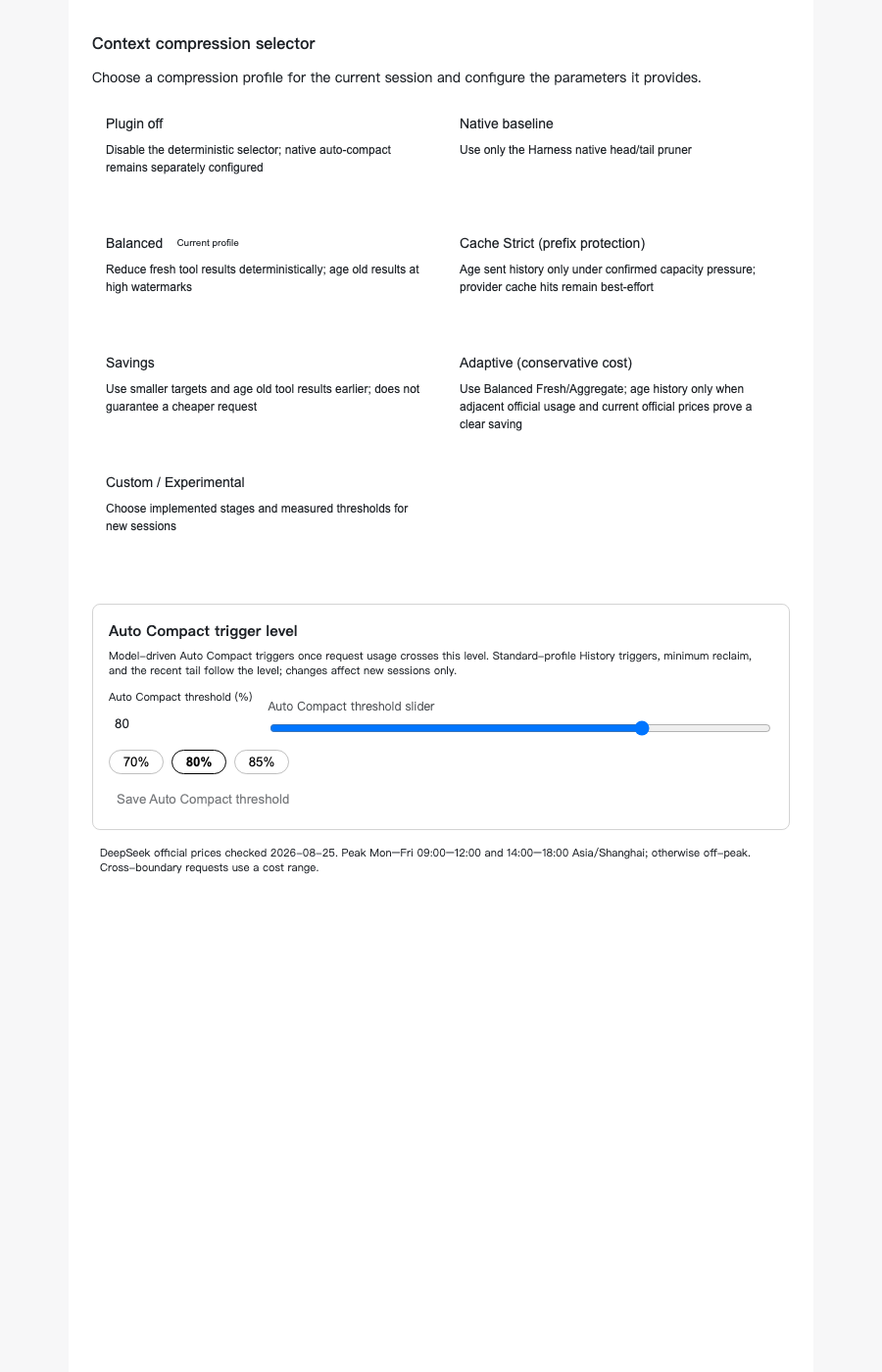
Choose a compression profile, set the Auto Compact trigger level, and toggle code-skeleton compression in the same settings section. The toggle saves on change and shows the saved state on reload.
Install
Build and install from source (this fork is not yet published to npm; the internal package names intentionally stay upstream's):
git clone https://github.com/drscrewdriver/dsh-context-compression-improved.git
cd dsh-context-compression-improved
pnpm install --frozen-lockfile
pnpm build
Then pack the selector package and add it to a Harness profile — the full walkthrough, including verification and uninstall steps, is in the installation guide.
Development
pnpm install --frozen-lockfile
pnpm lint          # ESLint baseline (also enforced in CI)
pnpm typecheck     # runtime + selector + tests tsc, plus the bundle step
pnpm test          # full vitest suite
pnpm test:watch    # TDD loop: write the failing regression first, then make it pass
pnpm build
pnpm verify:release
Contributions follow the upstream discipline: add the failing regression first, keep every production change inside this repository, and explain “triggered”, “enabled but skipped”, and fail-open evidence separately. See CONTRIBUTING.md.
Compatibility
- Verified against DeepSeek Harness
dsh-v0.1.1-rc.2using public plugin and profile APIs only; compatible with the officialdsh-v0.1.2-alpha.5release. - Requires Node
^22.19.0 || >=24and pnpm11.7.0. - The plugin uses only public Harness extension APIs and does not modify Harness core code. Unofficial community project, not affiliated with or endorsed by DeepSeek.
Credits and license
- Upstream project and all prior work: WilliamShi666/dsh-context-compression-selector by WilliamShi666 (MIT).
- Fork additions (code-skeleton gate, tooling, localized docs): drscrewdriver.
- Code-skeleton mechanism: Headroom (Apache-2.0) — see "Provenance, and whose numbers these are" above.
- MIT — see LICENSE (upstream copyright notice retained) and THIRD_PARTY_NOTICES.md for bundled tokenizer provenance.
No comments yet. Be the first to write one.