dsh-logo-golden
A polished-gold rendition of the DeepSeek Harness sidebar brand lockup — the whale
mark, the deepseek wordmark and the HARNESS plate — drawn from the original
vectors, with a diagonal metal sweep that crosses the whole lockup every five
seconds.
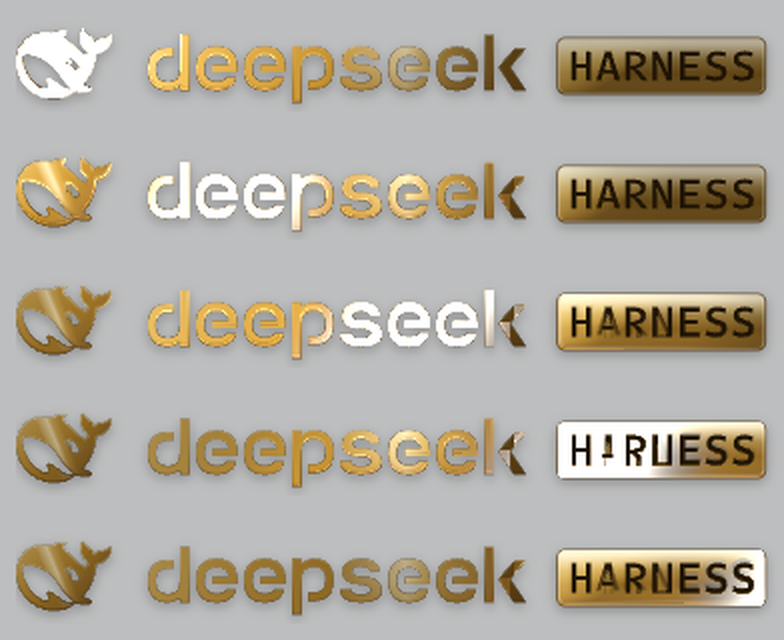
Five frames of one cycle, captured from a live DSH host: the beam enters at the whale, crosses the wordmark, reaches the HARNESS plate, and the lockup returns to the resting gold.
This repository is the standalone distribution of the plugin
dsh-logo-golden. It carries the full source, the test
suite and the build preset it needs, so pnpm install && pnpm build works in a
fresh clone with nothing else checked out.
What it does
The brand, in gold. The whale silhouette, every wordmark stroke and the HARNESS plate are the original paths. The material is layered inside them: a warm ramp with the key light upper left, a counter-light from the lower right, a contact shadow, a softbox reflection and an inner bevel. Nothing grows the outline, every layer is clipped to the original geometry, and the HARNESS lettering stays dark.
A sweep, not a flash. One diagonal beam travels the whole lockup at once, leaning 25 degrees off vertical, with a 0.55 W wide gold band and a narrow champagne core. The deformation (1.08x local magnification, 0.8 px lift) moves the same material the light moves over, and it returns to the identity mapping at rest.
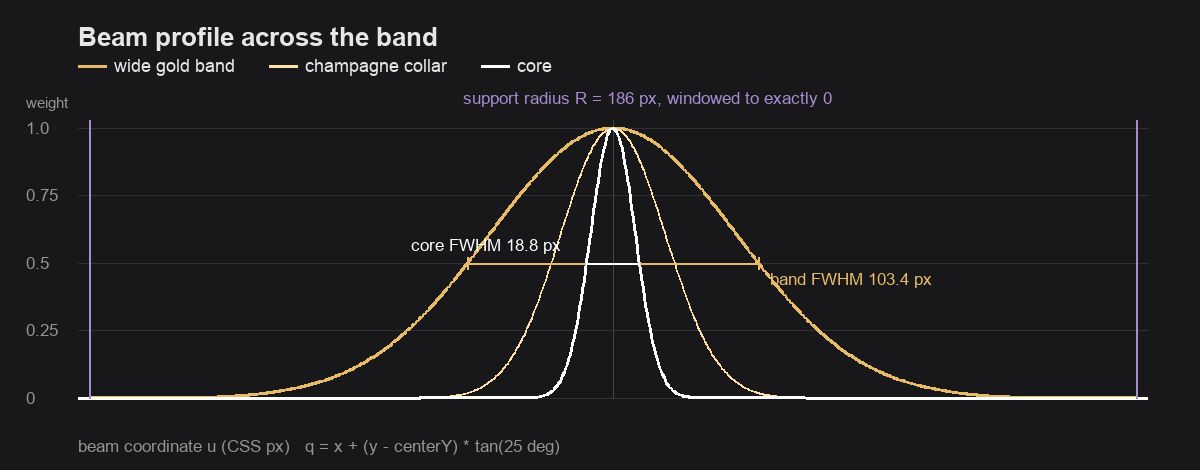
The delivered profile on the shipped 188 px lockup, plotted from the same arithmetic the shader runs: a 103.4 px band at half maximum, an 18.8 px core, and a finite support radius of 186 px where the light is exactly zero — which is what makes "the band has left" a provable statement rather than a fade.
Every metal surface, including the dark ones. A geometric mask built from the original vectors decides what counts as metal. The whale's fill, every solid stroke and the plate are lit; the plate lettering, the counters, the gaps between strokes and the background never are. A shadowed gold stroke at 8% luminance is lit; the dark HARNESS ink at the same luminance is not.
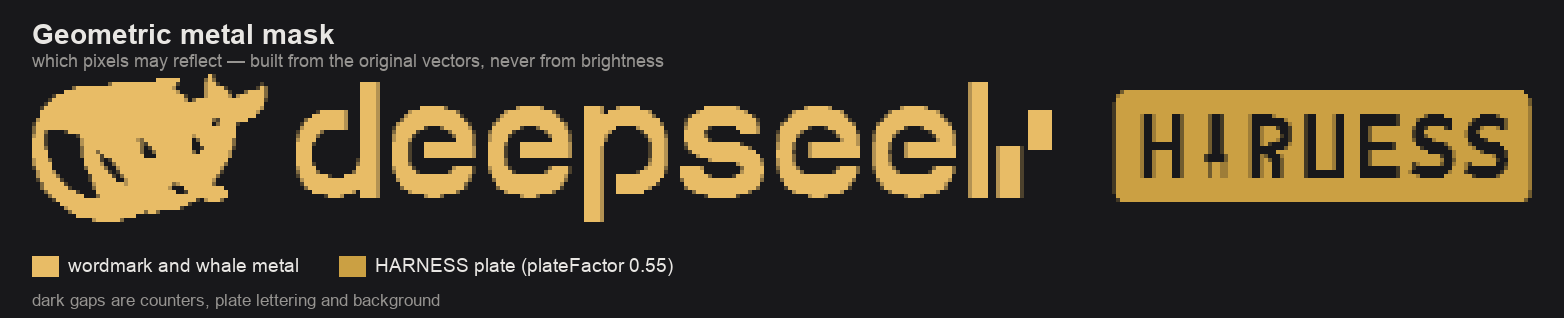
The mask the shader uploads, straight from the shipped vectors: gold is wordmark and whale metal, the deeper tone is the plate, and the dark gaps are the counters, the plate lettering and the background. No brightness threshold takes part in this decision.
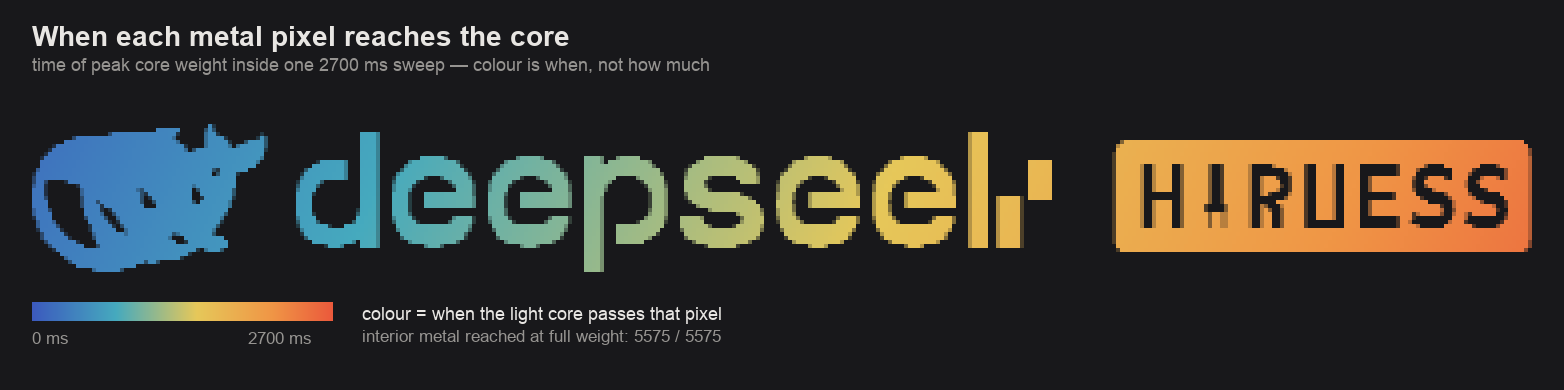
Measured over one full cycle, and coloured by when rather than by how much: the whale is reached first, the wordmark in the middle, the plate last — one band, one pass. Every interior metal pixel is reached at full weight (5575 of 5575 at DPR 2); only the antialiased contour stays partly lit, which is what a half-covered edge should do.
The mask is the geometry, not a bounding box. Each pixel of a stroke is covered by an S x S sample grid computed from the stroke's own edges — the crossing is the point where the scanline meets the edge, interpolated between its endpoints — so a slanted stroke (the diagonal of the "k") is lit across its whole interior instead of clipped to an endpoint's column. The whale's counters, the gaps between strokes and the punched HARNESS lettering stay dark.
Leaving and coming back is not a restart. Hiding the page drops the loop, the timer and the highlight in one step and keeps the time base. Coming back re-enters the window the clock is in and paints it before the overlay is revealed again, so the first frame after a restore is already correct: no cycle is replayed and no first delay is added. Focus, resize and intersection callbacks are idempotent, and a rebuild that measured the same lockup repaints nothing and does not interrupt a running sweep.
Three-second cadence. A cycle starts every 3000 ms: 250 ms entry, 2200 ms across the metal, 250 ms exit, 300 ms at rest. The start times sit on an absolute grid, so a slow frame cannot drift them and a missed cycle is skipped rather than replayed. "Every three seconds" is start-to-start — it is never 2700 ms of sweep followed by another three-second wait.
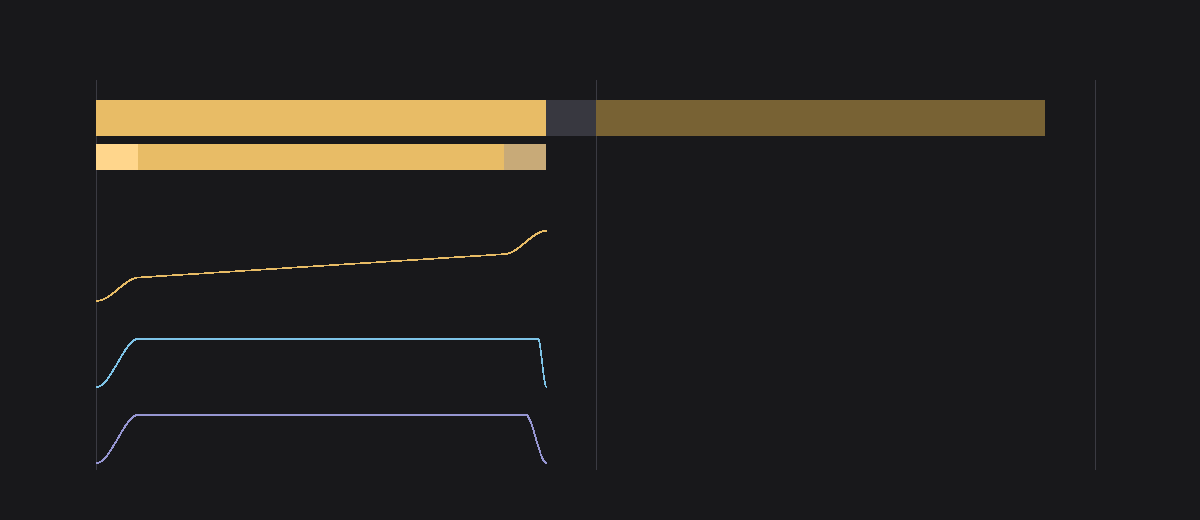
One cycle in the four tracks the controller actually runs: the visible window against the rest, the three stages, the beam centre crossing from the first to the last metal surface, and the two amplitudes that travel with it. The light envelope stays at full until the tail has left the metal, so no surface is dimmed by a fade.
The cadence survives a busy page. Scrolling or resizing re-places the overlay instead of re-uploading it, and a pending timer whose grid has not moved is never re-armed, so a streaming session that scrolls continuously cannot delay the next sweep.
Extended range, honestly reported. The canvas asks for
rgba16floatwithtoneMapping: 'extended'behind transparency and targets a 1600 nit short-time peak at the core against the display's reference white. A value read back offscreen proves the shader produced over-unity light; the diagnostic never claims a screen measurement it did not take.A fallback that is still the brand. Without WebGPU, without the popover API, or under
prefers-reduced-motion: reduce, the static gold lockup stands alone — same vectors, same geometry, no motion.
Install
The plugin mounts as a Cordis bundle row. In a DSH profile:
dsh plugin --profile desktop add dsh-logo-golden
or add the row by hand to the profile's cordis.patch.yml:
- insert:
    - id: ui-brand-gold
      name: "dsh-logo-golden"
The row id must not collide with an official row (the loader keeps one winner per
id and does not warn), and name must be exactly the package name: the client
module loader attaches the browser half only to the row whose specifier matches.
Build and test
pnpm install
pnpm test        # 140 unit tests
pnpm typecheck
pnpm build       # tsdown bundle + tsc declarations into lib/
build/tsdown.client.ts is the shared client-bundle preset, vendored here so the
repository builds on its own; it is the same file the dsh-web monorepo uses for
every plugin.
How the sweep works
sweep.ts       ← the dials: period, stages, widths, gains, peak
trajectory.ts  ← one monotone curve through the four stage boundaries
timeline.ts    ← the absolute cycle grid, one timer, one animation loop
layout.ts      ← rendered boxes → one canvas; the band's travel
beam.ts        ← the profile: FWHM, tilt, finite support, the warp
geometry-mask.ts ← the original vectors → which pixels are metal
surface.ts     ← eligibility (mask) vs shading (luminance, albedo floor)
raster.ts      ← the live SVG, serialized with its computed paints
material.ts    ← the composite the shader samples
renderer.ts    ← WebGPU: mask, inverse warp, light, extended output
overlay.ts     ← the controller that owns all of the above
Everything the animation depends on is a dial in src/client/sweep.ts; the
shader mirrors the CPU arithmetic term for term, and the tests assert the
delivered result (band width, core width, peak luminance, which pixels lit
up) rather than the input values.
Two rules keep the cadence honest, and both are covered by
tests/cadence.spec.ts:
- a pending timer is never cleared while the grid is unchanged — its target is an absolute grid point, not "in N milliseconds from now";
- the cycle that runs is the grid point the timer was armed for, as long as its window is still open, so a callback that arrives a few milliseconds early or late cannot be mistaken for a missed cycle.
Package layout
| Path | What it is |
|---|---|
src/index.ts |
host half: registers the bundle, carries no behavior |
src/client/ |
browser half: the components, the controller, the shader |
tests/ |
vitest suites, jsdom where the DOM is involved |
build/ |
the vendored client-bundle preset |
locale/ |
plugin list metadata (en / zh) |
cordis.patch.yml |
the bundle row |
License
Apache-2.0. See LICENSE.
No comments yet. Be the first to write one.