dsh-billing-badge


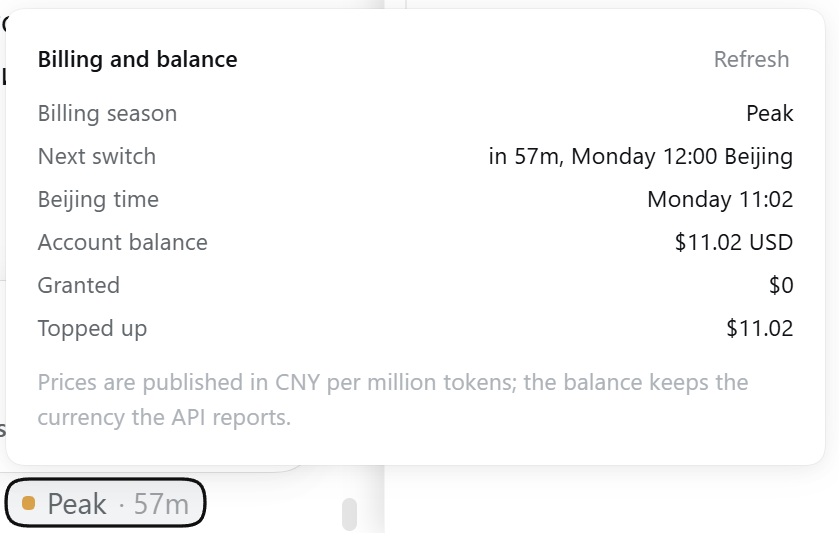
Billing season and account balance for the DeepSeek Harness web GUI. A pill in the composer's statistics row, immediately after the native Cache hit reading, that opens a small panel with the full picture.
2288M tok · Cache hit 99.8% · ● Off-peak · 2h13m
What it shows
| Where | What |
|---|---|
| The pill | a coloured dot (amber for peak, green for off-peak), the season, and the time until it flips |
| The panel (click) | billing season, next switch with the Beijing wall clock, current Beijing time, account balance with its currency, granted and topped-up split, and a refresh button |
The season rule is the published one: peak is Beijing time, Monday to Friday, 09:00-12:00 and 14:00-18:00. Everything else, including all of Saturday and Sunday, is off-peak at half price.
The balance
The numbers come from the official GET /user/balance endpoint, and the three of them
mean different things:
total_balance = granted_balance + topped_up_balance
total_balance, shown as Account balance, is everything you can spend.granted_balance, shown as Granted, is credit DeepSeek gave you. The endpoint reports only the part that has not expired, so a lapsed grant disappears from this row on its own.topped_up_balance, shown as Topped up, is money you paid in.
When the two upper rows are equal there is no grant on the account. is_available
is a top-level field of the response and answers one question: is the balance enough
for API calls. The panel adds a warning row when the answer is no, and stays quiet
otherwise, because the flag is true for every funded account.
The currency is taken from the response, never assumed: an account reporting USD is not labelled with a CNY sign.
Why another one
Two community plugins cover parts of this, and both taught something:
- dsh-price-phase shows the season. Its countdown once pointed at Saturday 09:00 after Friday close, an event that does not happen, and it centres its badge on a hashed CSS class, which collides with the model chip when the model name is long. This plugin compares each candidate boundary with the instant before it and only counts a real state flip, and its chip is an ordinary flex child in the native statistics row.
- dsh-usage-monitor shows the balance, but formats it as CNY whatever the API reports.
This plugin deliberately does not do cost or token accounting.
Install
From npm:
dsh plugin --profile web add dsh-billing-badge
or straight from the repository:
dsh plugin --profile web add github:devacc8/dsh-billing-badge
then restart dsh web. The package declares dsh.bundle.patch, so the host half is
reconciled into the profile's bundle list automatically.
Working on the plugin itself, install the checkout by path instead:
dsh plugin --profile web add link:/absolute/path/to/dsh-billing-badge
Security
A balance is a small surface, so it stays small:
- the API key is resolved in the host through the DSH credentials seam
(
ctx.credentials.resolve('DEEPSEEK_API_KEY'), environment fallback) and never reaches the browser; - the single route requires the
x-dsh-billing-badge: 1header and rejects a cross-originOrigin, so a cross-site page cannot reach it; - nothing is written to disk, and no endpoint other than
api.deepseek.comis contacted; - a missing key, an HTTP error or a network failure all degrade to a state the panel renders, never to a throw.
Development
The season logic lives in lib/season.js as a plain ESM module so it can be tested
directly. A browser bundle cannot import a sibling file (the loader resolves only
platform seeds, materialized packages and registered factories, and a self-subpath
require throws "missed the module table"), so scripts/inline-season.mjs copies the
module into lib/client.js between two markers with export stripped, and
test/client-sync.test.mjs fails if the copy drifts.
npm test          # 30 tests: season rule, countdown invariant, host route, bundle
npm run sync      # re-inline season.js into the bundle
npm run check     # sync check plus a syntax check of both halves
The countdown has an invariant test rather than fixtures: every 13 minutes across nine days, the reported target must be in the future, must change the season, and the season must not change before it.
Layout
lib/season.js    season rule, countdown, formatting (source of truth, tested)
lib/index.js     host half: the balance route
lib/client.js    browser half: the pill and its panel, with season.js inlined
cordis.patch.yml mounts the host half into the profile
scripts/         the inliner
test/            season, sync, host and bundle tests
GitHub Actions runs npm test and npm run check on Node 20 and 22.
中文说明
DeepSeek Harness 网页界面的计费时段与账户余额插件。它在输入框下方的统计行里、原生 Cache hit 之后加一个小胶囊,点击后展开一个小面板。
2288M tok · Cache hit 99.8% · ● Off-peak · 2h13m
- 胶囊:一个圆点(高峰为琥珀色,非高峰为绿色)、当前时段,以及距离切换的倒计时。
- 面板(点击展开):计费时段、下次切换时间与北京时间、当前北京时间、账户余额及其货币、赠送额度与充值额度的拆分,以及刷新按钮。
计费时段采用官方公布的规则:高峰为北京时间周一至周五 09:00-12:00 与 14:00-18:00,其余时间(含整个周六与周日)均为非高峰,价格为半价。
余额来自官方 GET /user/balance 接口,其中三个数字含义不同:
total_balance = granted_balance + topped_up_balance
total_balance(Account balance):可用总额。granted_balance(Granted):官方赠送的额度,接口只返回尚未过期的部分,过期的赠送额度会自动从这一行消失。topped_up_balance(Topped up):你自己充值的金额。
前两行数值相等时,说明账户没有赠送额度。is_available 是响应顶层的字段,回答一个问题:余额是否足够调用接口。只有接口报告余额不足时,面板才会加一行警告;该字段对任何有余额的账户都是 true,因此平时不显示。货币一律取自接口返回值,不做假设:返回 USD 的账户不会被标上人民币符号。
安装
从 npm 安装:
dsh plugin --profile web add dsh-billing-badge
或直接从仓库安装:
dsh plugin --profile web add github:devacc8/dsh-billing-badge
然后重启 dsh web。包内声明了 dsh.bundle.patch,宿主部分会自动写入 profile 的 bundle 列表。
安全
- API key 只在宿主进程中通过 DSH credentials 接口读取(
ctx.credentials.resolve('DEEPSEEK_API_KEY'),环境变量兜底),不会进入浏览器; - 唯一的路由要求请求头
x-dsh-billing-badge: 1,并拒绝跨站Origin; - 不写任何文件,除
api.deepseek.com外不访问其他地址; - 缺少 key、HTTP 错误或网络故障都会降级为面板可显示的状态,不会抛异常。
MIT.
No comments yet. Be the first to write one.