dsh-browser



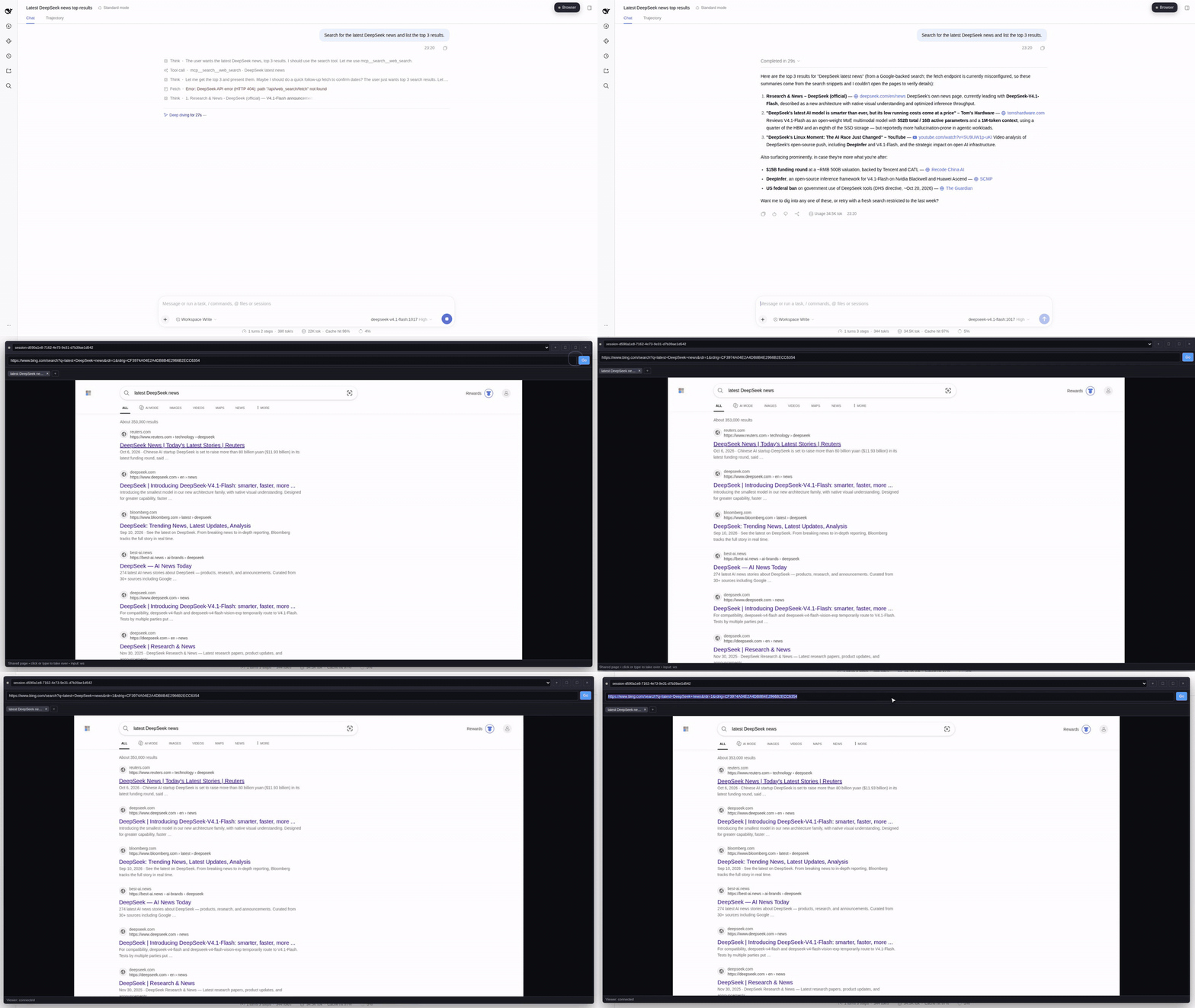
Give your DeepSeek Harness agent a real browser — and watch it work.
A live Chromium for every DSH session: the agent drives it, you watch it in a panel inside the UI, and you can take over with your own mouse and keyboard at any time. Backed by a ranked search gateway (SearXNG, Google CSE, Gemini, Brave, Vertex, DuckDuckGo) with whole-web Google results.
How it fits together
flowchart LR
  subgraph UI["DSH web UI"]
    Panel["Browser panel<br/>screencast · WS input · tabs"]
    Settings["Search settings<br/>ranking · keys · stack address"]
  end
  Host["Host plugin<br/>/dsh-browser/* proxy · browser_* tools"]
  Browser["Browser service<br/>internal :8790"]
  Viewer["Viewer<br/>internal :8791"]
  Gateway["Gateway :8787<br/>/browser /viewer<br/>/mcp /config /test"]
  Chrome["Dedicated Chromium<br/>one profile per session"]
  Chain["Providers (ranked)<br/>searxng → cse → gemini → brave → vertex → ddg"]

  Panel --> Host
  Settings --> Host
  Host --> Gateway
  Gateway --> Browser
  Gateway --> Viewer
  Browser --> Chrome
  Viewer -->|"same page, live"| Chrome
  Gateway --> Chain
What you get
- Live panel — every page the agent opens, as it happens; take over instantly (your clicks and keys go to the same tab). Resizable card, tabs strip, address bar, maximize mode.
- Ranked search — whole-web Google results via Gemini grounding; Brave, SearXNG, Vertex, DuckDuckGo reorderable; first provider that answers wins, the rest are fallback. Keys live in one settings page, never shown again.
- One session, one browser — the browser session id is the DSH session id, created on first use; isolated profile, cookies and tabs per session; idle sessions close themselves, and deleting a workspace closes the browser sessions attached to it.
17 agent tools: navigate, snapshot, click, type, press, scroll, tabs, screenshot, search, wait_for, find, batch, console, network. CAPTCHA or consent page? The agent pauses and asks — you finish it in the panel, by design, never automated.
Try it
git clone https://github.com/codeadeel/dsh-browser.git && cd dsh-browser
cp .env.example .env              # optional; defaults are fine
docker compose up -d --build     # one command, whole backend

curl -s http://127.0.0.1:8787/health          # gateway
curl -s http://127.0.0.1:8787/browser/health  # browser, internal
curl -s http://127.0.0.1:8787/viewer/health   # viewer, internal

dsh --profile web --no-open --host 127.0.0.1 --port 3000
Only the gateway port (8787) is published. The browser, viewer, SearXNG, and Brave MCP stay on the compose network. For a remote DSH host, bind the gateway to a private/VPN address (or use an SSH tunnel) and enter its URL in the plugin page.
Configuration
| Where | Setting | Default | Notes |
|---|---|---|---|
Stack .env |
GATEWAY_BIND |
127.0.0.1 |
Host interface for the only published backend port. Use a private/VPN IP for a remote DSH; 0.0.0.0 only behind a firewall. |
Stack .env |
GATEWAY_PORT |
8787 |
Host gateway port. |
Stack .env |
search/browser settings | see .env.example |
Optional stack/host-dev knobs. Search keys can be set in the plugin UI. |
| DSH UI | Stack gateway address | http://127.0.0.1:8787 |
One URL only; persisted. Use the local URL when the backend is on this host, otherwise the backend’s reachable URL. |
| DSH env (optional) | DSH_BROWSER_GATEWAY_URL |
unset | First-run seed only. Normal setups use the UI. |
For Cloudflare Tunnel or a reverse proxy, keep GATEWAY_BIND=127.0.0.1 and
point the tunnel at http://127.0.0.1:8787. The public HTTPS URL goes in the
plugin UI; no stack port needs to be exposed.
From the DSH UI — open the ?token= URL DSH printed:
- Plugins in the sidebar
- Add plugin
- paste
github:codeadeel/dsh-browser#path:panelinto the package field (leave Registry on the default npm registry — its custom address is for private registries, not plugin specs) - Install → Enable now
The panel registers the ranked search tool natively. There is no separate
MCP client, DSH patch, or --patch flag to add.
From the CLI:
dsh plugin --profile web add "github:codeadeel/dsh-browser#path:panel"
For a local dev link, run pnpm install in the repo first so the panel's
ws dependency resolves.
flowchart LR
  P["dsh-browser-panel"] --> A["UI: Plugins → Add plugin<br/>paste the GitHub URL"]
  P --> B["CLI: dsh plugin add<br/>github:codeadeel/dsh-browser#…&path=panel"]
  P --> C["dev: link:/path/panel"]
Click the Browser button. In Plugins → dsh-browser-panel set the
Stack gateway address (default http://127.0.0.1:8787; a remote stack
uses its public/private gateway URL), choose your provider order, save, and
run Test search.
Then ask the agent: "search for the DeepSeek R2 release date, open the top result, and summarize it" — and watch it happen in the panel.
How a search works
flowchart LR
  A["mcp__search__web_search"] --> G["gateway /search"]
  G --> C{"ranked chain"}
  C -->|"first hit wins"| R["results"]
  C -->|"brave 422 / idle?"| F["falls to gemini → … → duckduckgo"]
- Gemini = whole-web Google grounding, AI Studio key, billing required. Move Gemini above earlier providers to force it; the first provider that answers wins.
- Brave = a UI key uses Brave REST immediately. The optional brave-mcp service uses
BRAVE_API_KEYfrom the stack.envat startup. - SearXNG = free, self-hosted, no key. Vertex = site-scoped app search.
- One gateway address for everything, set in the plugin page: search at the
root, browser at
/browser, viewer at/viewer.DSH_BROWSER_GATEWAY_URLis only a first-run seed. The stack can live on another machine. Plain HTTP end to end unless you put it behind TLS.
How the browser works
flowchart LR
  Agent["agent browser_* tools"] --> Chrome["Chromium<br/>(session = DSH session id)"]
  Human["human in the panel"] -->|"watch · click · type"| Chrome
Why it exists
- Trust through visibility — you see exactly what the agent is doing, no more blind tool calls.
- Human in the loop, not in the way — same browser for both drivers, no VNC, no extension, no screen-recording hacks.
- Search that keeps up — Gemini grounding gives current whole-web results; SearXNG and Brave cover privacy and cost.
- No private registry, zero accounts — first-party services build from source; SearXNG runs from its official image.
flowchart TB
  subgraph base["docker compose up -d --build"]
    S["searxng"]
    B["brave-mcp"]
    G["gateway :8787 — only published port<br/>search + /browser + /viewer"]
    BR["browser (internal) :8790/:8791"]
  end
  D["dsh (--profile web)"]
  P["playwright-mcp (--profile extra)"]
panel/           what you see in DSH (panel UI, settings, host bridge)
src/search/      the gateway + ranked search
src/browser/     Chromium sessions + the live viewer
docs/demo/       the 35s product demo + preview
docker-compose.yml + Dockerfile    the whole backend, one command
Docs: docs/README.md — the full first-run guide.
docs/walkthrough.md — the 10-minute tour.
Architecture for contributors: docs/architecture.md.
MIT license.
No comments yet. Be the first to write one.