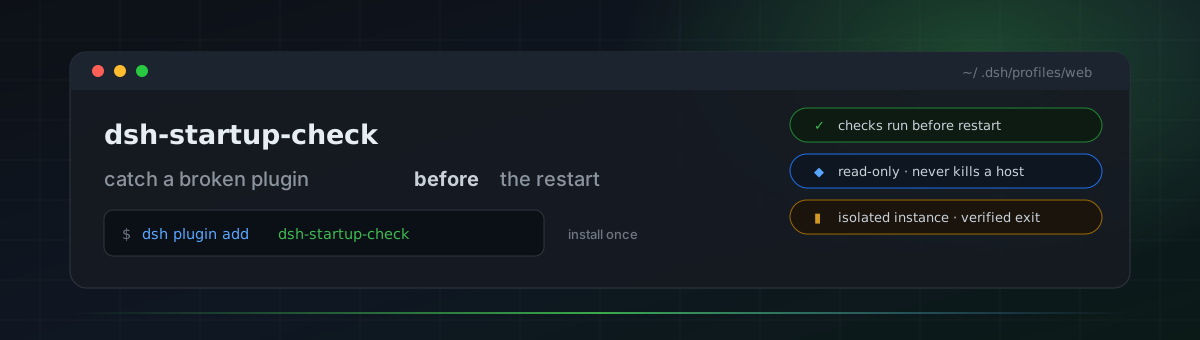
dsh-startup-check
Catch a broken plugin before the restart.
One tool — plugin_check — for the moment between "I installed a plugin" and "the harness won't open".






简体中文 · English
The problem
Every DSH plugin install is a leap of faith:
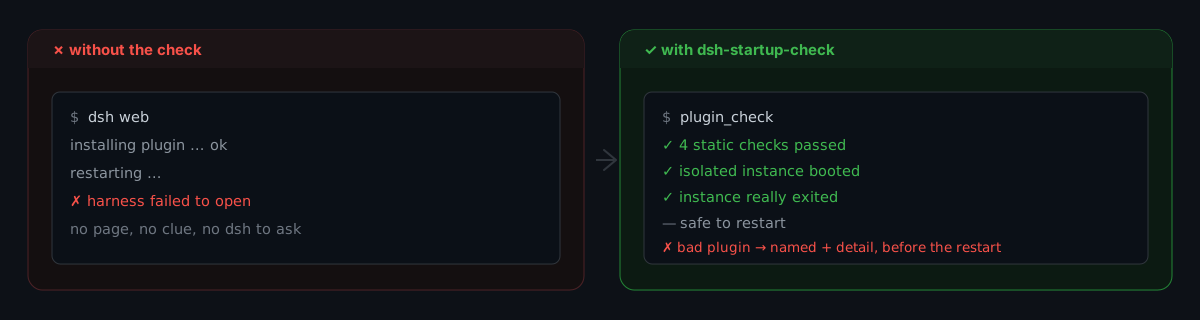
install a plugin → restart → find out the hard way
When the leap fails you are left with a harness that will not open, no page to ask, and a plugin tree you have to bisect by hand. By then the agent that could have read the code is gone.
plugin_check moves that discovery in front of the restart: the model inspects the tree
— and, if you want, boots a real isolated instance to prove it comes up — while it can still
fix what it finds.
What a failure looks like
Broken syntax in one plugin, caught before any restart, with the file named:
// plugin_check { "target": "dsh-oauth" }
{
  "ok": false,
  "checks": [
    { "name": "语法检查", "ok": false,
      "detail": "dsh-oauth/lib/index.js: Unexpected token '}' (node --check exit 1)" },
    { "name": "package.json 结构", "ok": true, "detail": "1 个插件结构一致" },
    { "name": "配置树组装", "ok": true, "detail": "配置树组装成功 (162 行)" }
  ]
}
The model reads that, fixes the file, re-runs the check, and only then do you restart. When
the verdict is a real failure, the bundled plugin-fault-diagnosis skill takes over: read
the verdict → locate the file → classify the error → fix, disable, or roll back.
What it checks
| # | Check | Catches |
|---|---|---|
| 1 | Syntax | a plugin lib/*.js that fails node --check (typos, TypeScript/JSX in a plain-JS plugin) |
| 2 | Package structure | missing main target, dsh.client declared without an exports["./client"] entry, wrong name prefix |
| 3 | Patch references | cordis.patch.yml pointing at a plugin directory that no longer exists |
| 4 | Config-tree assembly | dsh --profile <p> --dump-config failing — the loader cannot compose the tree at all |
| 5 | Real-boot smoke live: true |
the isolated instance never prints its dsh web: <url> |
| 6 | Page-side smoke page: true |
the page throws, logs errors, or renders nothing — client-side failures the host never sees |
| 7 | Instance shutdown (with live) |
the isolated instance did not actually exit, verified against the process table |
| 8 | Stray-instance audit sweep: true |
leftover smoke instances, plus a report of live hosts — report only unless you ask |
🛡️ Read-only by design
It never restarts or touches the harness you are using.
Smoke instances run on --port 0 with --no-open and a hard timeout;
cleanup kills only isolated smoke instances, by exact PID — a resident host is never killed.
Install
dsh plugin --profile web add dsh-startup-check
Then restart the harness — installing a plugin changes dsh.profile.bundles, which is read
at boot. That is the last leap of faith you take.
The npm package is published by GitHub Actions with a signed provenance attestation, so anyone who installs it can verify that this tarball was built from this repository at a particular commit, rather than uploaded by hand from someone's machine:
npm view dsh-startup-check dist.attestations
plugin_check                          # static checks (fast)
plugin_check { live: true }           # + boot an isolated instance        (~12s)
plugin_check { page: true }           # + headless-browser page check      (~30–45s, implies live)
plugin_check { sweep: true }          # + audit live DSH processes         (~1–2s)
plugin_check { live: true, killStray: true }   # and clean up this run's leftovers
Reading the verdict
ok: truemeans the checks that ran passed. A static-only run says nothing about runtime behaviour; onlyliveproves the tree boots.- "Not measured" is not "failed." No browser, unreadable process table — the affected check
says why and is treated as untested (
tested: false) instead of being blamed on your plugins. - Checks 1–3 walk
~/.dsh/profiles/web/plugins/**, the@locallayout. Plugins installed from npm into the profile'snode_modulesare covered by checks 4–8 instead. - The profile is currently fixed to
web; other profiles are open work.
Requirements
| Harness | DeepSeek Harness with a web profile |
| OS | Windows — the instance audit uses PowerShell/WMI, the page half drives Edge/Chrome over CDP |
| Node | ≥ 22 (the harness's own engine) |
| Browser | Edge or Chrome, only if you want the page-side check |
Development
git clone https://github.com/cningan/dsh-startup-check.git
cd dsh-startup-check
npm test
npm test runs node --check over every lib/ file and then
test/tool-body-selftest.mjs, which drives apply() and the
tool's execute() in a fresh Node process against a stubbed context. That is the layer neither
node --check nor a boot smoke can see: a running harness keeps serving the code it booted
with, so a broken tool body stays green until the next restart.
Full design, per-object lifecycle and known limitations: docs/architecture.md.
Contributions welcome — see CONTRIBUTING.md and CHANGELOG.md.
MIT © cningan · built for DeepSeek Harness
No comments yet. Be the first to write one.