
English | 简体中文





dsh-TUI
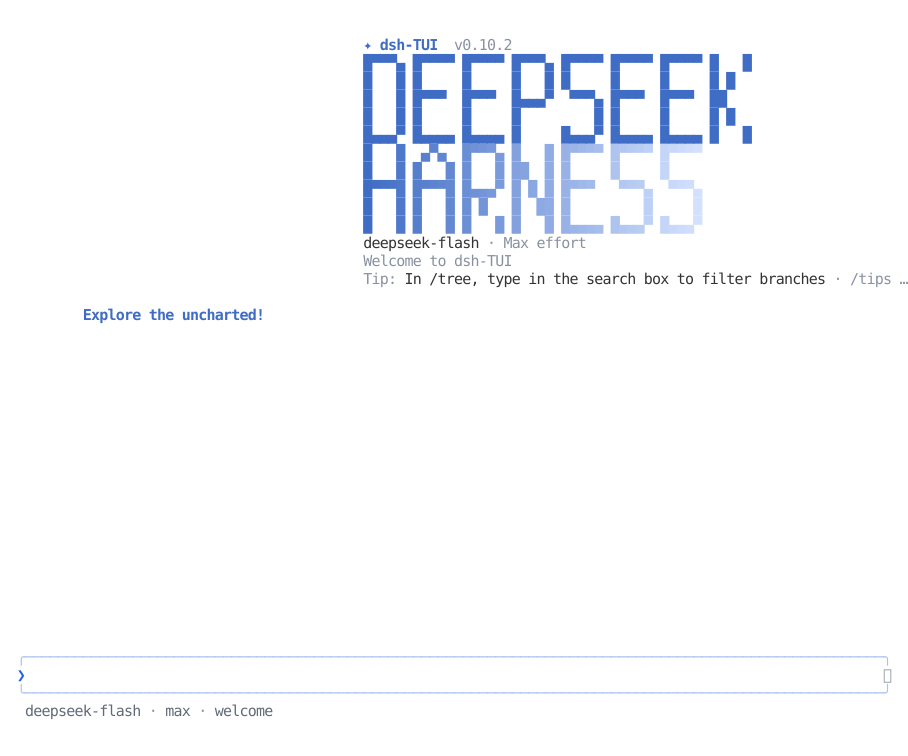
An interactive terminal UI plugin for DeepSeek Harness. It ships a pixel-whale header, live work status, streaming thinking, double-Esc time rewind, a context progress bar, and a TPS gauge. It mounts as a pure plugin, with no core changes. Install to enable; uninstall leaves no patches behind.
Highlights
- Pixel whale pet — three startup intros, click to wake; freezes after the first task.
- Terminal-native UI — streaming Markdown, tool cards,
/and@completion,#L12-14ranges, history search, zh/en UI. - Images — Kitty/Sixel thumbnails, centered preview with zoom and pan, paste-time fitting, text fallback.
- Mermaid diagrams —
mermaidfences drawn as Unicode diagrams. - LaTeX math —
$…$and$$…$$formulas as Unicode text, fractions and limits stacked in display blocks;mathRendering: imagetypesets block and one-row inline formulas as terminal images on graphics terminals. - Timeline rail — every turn clickable; timeline / scrollbar / hidden gutter.
- Live state — activity animation, context bar, TPS, cache hit rate, effort, tokens, session cost estimate (main + subagents), Git and session metadata.
- One session manager —
/resume/home/agentview/bg⌸. - Session workflow —
/new/compact/export/btw, model hot-switch, fork, rewind, vim, fullscreen draft editor. - IDE selection channel — a VS Code selection lands in the prompt.
- DSH integrations — presets, skills, MCP, goals, todos, subagents, questionnaires.
- Extensions — browser interaction, computer use and more.
- Built for long sessions — event-driven projection, virtualization, bounded caches.
Keys and commands: Interaction and commands. Everything else: documentation index.
Preview
Featured & Listed
Featured by the DeepSeek Harness official WeChat account, listed in the dshfind plugin directory, and ranked #7 on GitHub Trending daily (TypeScript).
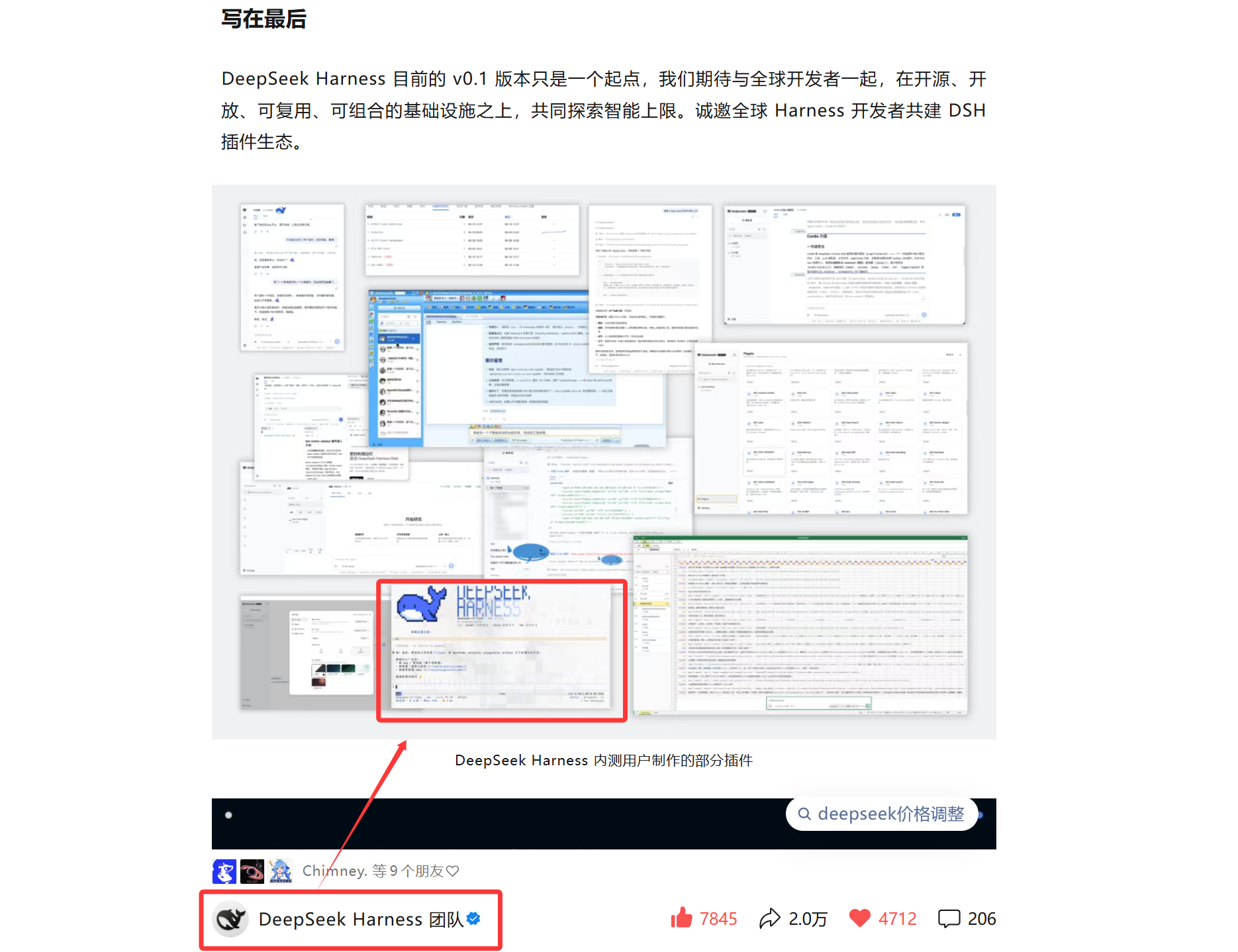
Featured by the official WeChat account |
Listed in the dshfind directory GitHub Trending Daily #7 |
Quick Start
Prerequisites: Node.js and
deepseek-harness, with
DEEPSEEK_API_KEY configured.
The primary compatibility target is DSH 0.2.0-rc.1. This adapter supports its
Shell API, V4 session messages, declarative presets, and profile-backed settings;
older supported hosts retain their compatibility paths. See configuration.
On DSH 0.1.7, /settings uses the TUI's actual Loader entry ID, including custom
IDs. It requires matching profile dependencies with @deepseek-ai/schemastery
3.18.3 or newer; an incompatible schema stops TUI startup with repair guidance
instead of showing an uneditable settings page. Older hosts keep their legacy settings scope.
# Install the CLI and this plugin globally (ships the dsh-tui command)
npm install -g @deepseek-ai/dsh @deepseek-harness-tui/dsh-tui

# Start (first run auto-initializes the profile; needs pnpm)
dsh-tui
# Both `dsh-tui` and the short `dst` alias start the same TUI.
dst
Manual alternative: dsh plugin --profile dsh-tui add @deepseek-harness-tui/dsh-tui.
The repo's sh install.sh runs that step and checks the required commands.
Afterwards dsh-tui and dsh --profile dsh-tui are equivalent.
New-user note: pnpm ≥11 blocks dependencies with install scripts by default and reports
ERR_PNPM_IGNORED_BUILDS. Updates skip foreign-platform@img/sharp-*native packages, saving about 200MB of downloads./updateanddsh-tui updatewrite both settings automatically. No manual step needed. Details: Getting started.
After startup the TUI checks for newer versions in the background. It never
blocks the first frame. Type /update for a one-shot upgrade. It restarts
automatically and resumes the current session. See
Getting started for the profile lifecycle,
source builds, and troubleshooting, including migration from the former
dsh-cc-tui package.
CLI
| Command | Purpose |
|---|---|
dsh-tui / dst |
Start the TUI; dst is a short alias for the same program |
dsh-tui --resume [id] · dsh-tui update · dsh-tui doctor |
Resume a session · update the profile and align the launcher · pre-flight environment checks |
dsh-tui safe |
Read-only diagnostics, plugin inventory and repair guidance; safe --rescue builds a clean rescue profile |
dsh-tui version · dsh-tui help |
Launcher and profile versions and usage; both work even without a dsh install |
Leading DSH options such as --dump-config and --patch <path> are forwarded
unchanged; other arguments go to the app in dsh --profile dsh-tui. Use
dsh-tui -- --resume=sid-1 ./notes to send --resume=sid-1 ./notes as literal
prompt text, without selecting a session or workspace. When invoking DSH
directly, use dsh --profile dsh-tui -- -- --resume=sid-1 ./notes: the first
-- belongs to DSH, the second to the app. Host options can precede a literal
prompt: dsh-tui --patch ./overlay.yml -- --resume=sid-1 applies the overlay
and sends --resume=sid-1 as prompt text without resuming that session.
Safe mode: Getting started.
Importing conversations from other agents (dsh-tui migrate)
Bring Claude Code, Codex, OMP, zcode, or Grok Build conversation histories into the DSH session store, then browse and resume them by their original working directory via /resume:
dsh-tui migrate                # list importable counts per agent (writes nothing)
dsh-tui migrate claude-code    # import every Claude Code conversation (likewise codex / omp / zcode / grok-build)
dsh-tui migrate codex --dry-run  # preview what would land, write nothing
Read-only source: migration only reads the foreign agent's local store; artifacts are written through the official
JsonlSessionPersistencebackend, so imported sessions are first-class (openable, continuable).Idempotent: one deterministic UUID per source conversation — re-importing skips what is already present instead of stacking duplicates.
Structure preserved: user/assistant messages, reasoning traces, tool calls with their results, and the source's context compactions (as native compaction checkpoints) are rebuilt turn by turn; harness-injected machine text opens no turn. An imported session can pick the work straight up. In-TUI browsing: the session screen (
/resume) shows a tab per agent that has conversations; picking one imports just that conversation and opens it. In-TUI:/migrate(optionally/migrate <agent> [--dry-run]) runs the same import in a child process and reports through the notification flow. CLI alternative:dsh-tui migrate ...from any shell runs the same import. Full guide: Session migration.More agents (pi, opencode, …) extend the adapter registry as adapters land; grok-build reads
GROK_HOMEwhen set.
VS Code: use the integrated terminal or the dsh-tui-vscode extension. See VS Code guide. Herdr: run dsh-tui in a Herdr pane; idle / working / blocked are reported through its local integration API.
Keybindings & Mouse
Enter send · Tab complete · Ctrl+Enter interrupt and send · Alt+Up recall the last message · Esc dismiss, double-Esc rewinds · Ctrl+O details · Ctrl+R history · Ctrl+V paste · Ctrl+Shift+E fullscreen draft editor · ? shortcuts · ← background the session.
While the model is working: Enter steers, Tab queues a follow-up, Ctrl+Enter interrupts and sends.
On native Windows, fragmented Win32 input records are reassembled across short input delays instead of appearing as numeric protocol text. The platform check only reports that this machine might run the private mode (win32-input-mode); a bare ESC[ fragment is held only after one record has actually been decoded, while a fragment whose own shape is already record-specific holds on its own (which is how even the first record can survive a split). Windows terminals that never enter the mode (mintty, GitBash) therefore keep the classic VT path: a lone Esc keeps its normal response time, and a letter typed after a timed-out ESC[ is not swallowed.
Incomplete records are held for a bounded recovery window (1 second from first capture, never extended by later input; 64 bytes max); past either bound the hold ends and input is handled as before. Unrecognized complete CSI sequences are not inserted as text; after a damaged CSI prefix, a bare ASCII letter can be consumed as its terminator, while normal Win32 key records and bracketed-paste text retain their own boundaries.
A session's very first record can still leave residue if it is split before its record-specific shape forms; once any record has been decoded, every split position is covered. Inside the recovery window, literal input starting with [digit;… cannot be told apart from a protocol prefix — it may be held, or re-joined to a preceding Esc. To type it, wait for the window to close, or avoid that shape right after Esc.
Mouse (fullscreen): drag to select and copy, double/triple click to select a word or line, click tool cards, timeline ticks and [Image #N] previews.
Pasting: native and bracketed paste keeps ordinary text and newlines, and never submits itself on arrival. On Windows terminals that deliver a paste as win32-input-mode key records, the residue is stripped at the entry point (a multi-line paste no longer leaves stray _) and pasted CRLF collapses to a single newline; genuine underscores and bracketed-paste text are untouched.
Full reference: Interaction and commands.
Built-in Commands
/resume · /home · /agentview · /bg · ⌸ open the same session manager: workspace rail, live state, filter, ★ pins. Also /model /new /compact /export /btw /tree /fork /rewind /settings /status /cost /jobs /skills /mcp /login /update.
The session manager paints the last successful list immediately while it checks the persistence store for changes. Titles that require a deeper log scan appear first with a fallback name and update in place when recovery finishes.
Background sessions: /bg or ← on an empty prompt; Esc returns. They run in this process and stop when the TUI exits. Logs survive.
Full commands: Interaction and commands.
Configuration & Extensions
Agent presets, themes, MCP servers, environment variables: Configuration · Themes.
How It Works
dsh profile → dsh-base → dsh-TUI Cordis patch → agent preset + DSH services
  → session/event → Channel projection → React components → Ink/Yoga renderer → terminal
The TUI handles interaction and presentation. The session log is the source of truth. DSH services own models, tools, and persistence. Long sessions render in O(visible window).
Runtime path, module boundaries, performance notes and persistence locations: Architecture and limitations.
Known Limitations
- Injected plugin context has no standalone display; it counts into the context segments.
/modelswitches by forking the session; the old session stays in/resume(a session nobody has typed into records no branch, so your first prompt there still gets a generated title).Ctrl+Vneeds platform clipboard tools; unsupported bitmap formats are rejected.- A background session lives inside this process and stops when the TUI exits.
/thinkingis not persisted;/compactis unavailable under theminimalpreset;/updateneeds adsh --profilelaunch and is refused while a turn is running.- The status-bar
≈¥and/costare session estimates that include subagent usage (priced per each agent's model × peak/idle × cache components); unofficial or unlisted models show tokens only and are marked unpriced. The platform bill is authoritative.
Full list: Architecture and limitations → Known limitations.
Development
CI uses Node 24 and pnpm 11. The package supports Node ^22.19 || >=24.
pnpm install --frozen-lockfile
pnpm build
pnpm smoke
lib/types/ is ignored generated output. pnpm build recompiles it from a
clean output directory and runs the build gates. Git URL installs are not
supported. The source manifest keeps @dsh-std/* as workspace deps and
vendor/dsh-std as a submodule. pnpm ≥11 also refuses git-hosted prepare
scripts by default. Install the registry package instead:
dsh plugin --profile dsh-tui add @deepseek-harness-tui/dsh-tui. Rendering,
questionnaire, or tool-card changes also need the matching regression scripts.
Plugin Ecosystem
Plugin development: admission & development guide · plugin-template · dsh-tui-ecosystem. Reference implementation: dsh-working-activity.
Seam grading and API notes: Plugin development. The organization maintains the listing only; it does not endorse community plugins.
Documentation
- Start — Getting started · VS Code
- Use — Keys and commands · User guide · Themes
- Configure — Configuration
- Internals — Architecture and limitations · Session mounting
- Plugins — Admission and development · Seams
- Contribute — Contributing · Roadmap · Community
Everything, bilingual: docs/README.md.
Community
- Ecosystem organization: dsh-tui-ecosystem hosts community plugins, templates, and the curated list. Come ship a plugin, pitch an idea, or just hang out 🐋
- Chat groups (Chinese-language): usage questions, plugin ideas, and feature wishes are all welcome.
- Code of conduct: please read the Contributor Covenant Code of Conduct before taking part.
| WeChat group (dsh-TUI community 4) | QQ group (ID 572549239) |
|---|---|
 |
 |
The WeChat QR code expires roughly every 7 days; if it stops working, use the QQ group (572549239) or open an issue to nudge us for a refresh.
Permissions and Security Boundary
Windows security warning: the Windows profile defaults to
danger-full-accesswith approval set tonever, so tools have unrestricted access. Inspect and tighten the profile before starting next to sensitive credentials or in an untrusted repository.
No sandbox of its own: dsh-TUI uses the active DSH profile's filesystem, shell, sandbox and approval policies. Permission presets come from the DSH permissionPresets registry.
Details: Permissions and security boundary.
Acknowledgments
- The pixel whale's 22 hand-drawn frames and its idle behaviors are ported from dsh-ui-whale. The frames were drawn cell by cell in Excel. The idle behaviors are fin flutters, tail thumps, sleep Z's, and click hearts. dsh-ui-whale is the DeepSeek Harness web whale-pet plugin by @lhh010, BSD-3-Clause. Thank you for the art and the inspiration 🐋💜
Friends' Links
Community, related projects, and companion tools built by friends: see the links page
Stars
No comments yet. Be the first to write one.