Orderzx
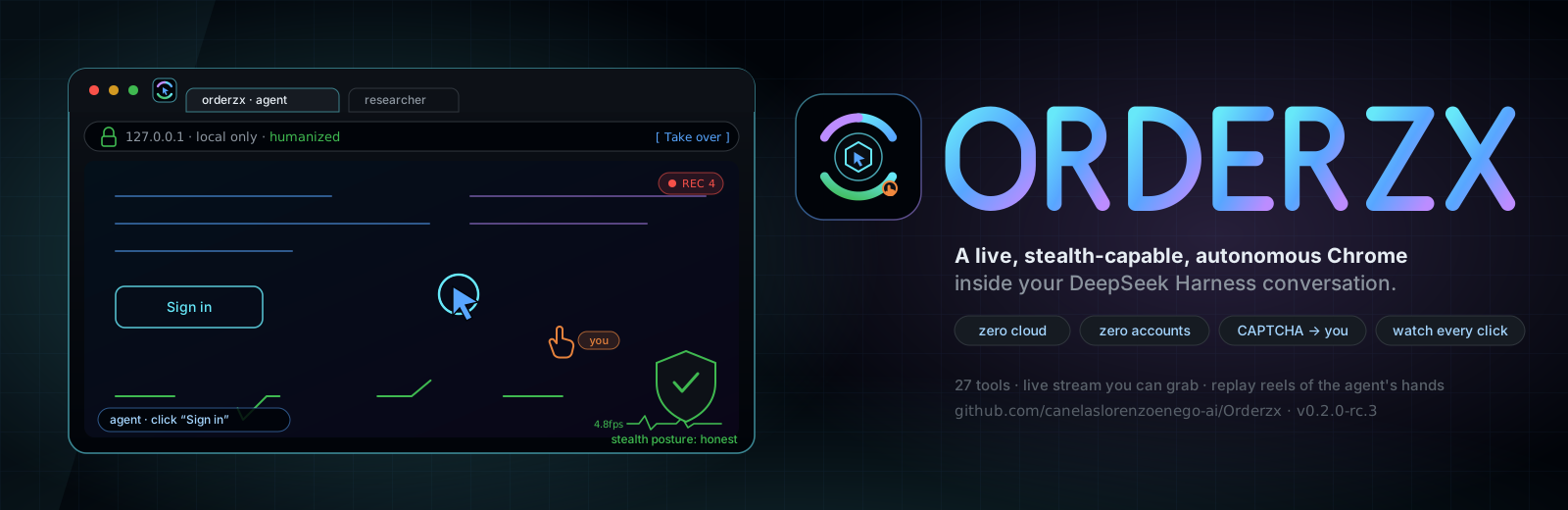
A live, stealth-capable, autonomous Chrome inside your DeepSeek Harness conversation — the dsh-browser plugin.




The agent drives a real browser with humanized input. You watch every click, scroll and keystroke live in a docked dashboard — and you can grab the mouse anytime. CAPTCHAs pause the agent and hand the widget to you, in-session, with your own fingerprint and IP: the one solve that always works.
Zero cloud. Zero accounts. Everything runs on 127.0.0.1.
Ready to install — one command:
curl -fsSL https://github.com/canelaslorenzoenego-ai/Orderzx/releases/download/v0.2.0-rc.24/install.sh | bash
It clones to ~/.orderzx/dsh-browser, installs, builds, and prints the exact
line to add dsh-browser to your harness plugin list. Details: Install.
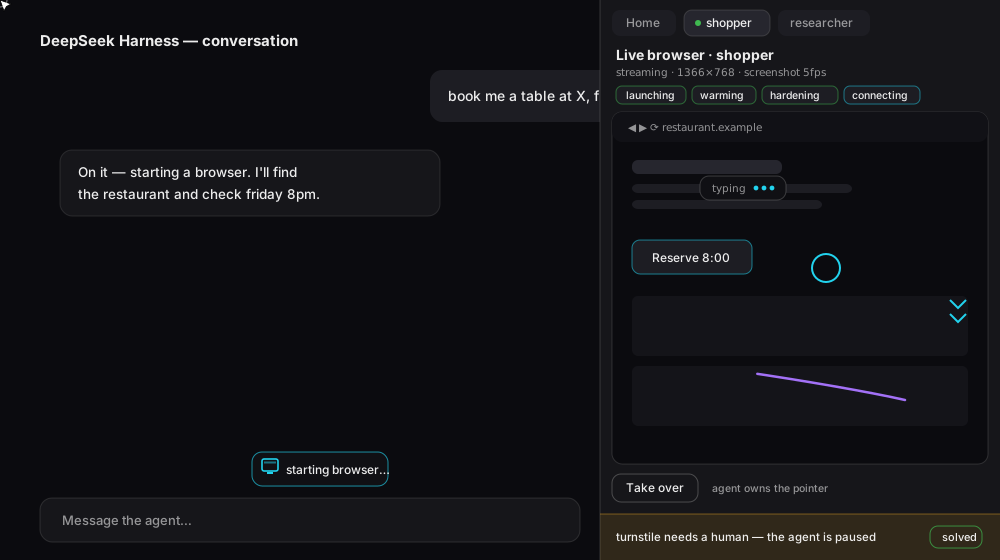
you:  "book me a table at X"
   chatbar   🖥 ▸ starting browser…            ← capsule monitor animation
   dashboard extends ────────────────────────────────────────┐
   │ Home │ shopper │ researcher      [screenshot ▾] [×]     │ ← tab per sub-agent
   │  ◀ ▶ ⟳  https://restaurant.example                      │
   │     live frames + the agent's ghost cursor clicking      │
   │  ▸ timeline (every action, newest first)                 │
   │  [ Take over ]   1366×768 · humanized                    │ ← your mouse, on request
   └──────────────────────────────────────────────────────────┘
See it think
- Live stream you can grab — on-demand screenshots by default, CDP screencast by flag, DOM fallback when capture is blocked. Takeover swaps the ghost cursor for an amber "you" hand; gestures stay actor-tagged forever.
- Gesture captions — a chip on the stream narrates intent in words:
click "Sign in",scroll down 480px,you · type 12 chars. - Ask for the video, get the video —
browser_clipsamples real frames and delivers them to the session and hands the model achatLineit pastes verbatim into chat. Replays draw the model's hand back over the frames. browser_reel— one call → one standalone HTML artifact: frames + gesture track + scrubber, zero dependencies, signed URL, sandbox CSP.- Video-aware boost — a playing
<video>tightens the stream to ~3 fps so motion reads as motion;browser_transcriptreads what a video says. - Extend-only dashboard, hardened — the dock lease now pushes the
DEEPEST viewport-covering shell (fixed/100vw harness layouts included)
with an
!importantsheet plus a MutationObserver watchdog that heals harness re-render wipes; the Android harness dashboard lost its modal overlay fallback entirely (phone split at every width). - See the model act — every gesture repaints the stream immediately and opens a 4 s burst window at the 200 ms poll floor; sub-agent activity counts as activity, so auto-follow no longer folds mid-search; a vendor challenge auto-focuses its session the moment it is detected.
- Every browser at once — when sub-agents spawn their own sessions the side
dashboard becomes a tile grid: one live tile per browser (stream, fps, url,
challenge dot), tap a tile to focus it with the full control card, ▦ returns
to the grid. The whole surface wears the DeepSeek harness design tokens —
frosted glass cards, mist gradient, slate type,
#4d6bfeaccent.
/start — one command to launch
Type /start (optionally /start https://example.com) in the composer.
The command starts the browser immediately: the chatbar capsule pops its
monitor boot animation, the dashboard extends to the right, and the live view
connects — the whole boot sequence plays by itself, with no clarifying
questions and no model-side peeks at the page (the panel is already showing
it). Refusals come back as one quoted line.
Sub-agents each get their own browser. Every browser_start opens an
independent session (up to 4 concurrent, LRU-evicted when idle). A session
sees, drives and closes only its OWN tabs: on an attached CDP browser your
personal tabs — and other agents' tabs — are never hijacked, listed, or
closable, and popups stay owned by the session that opened them. Stopping one
agent's session never disturbs another's.
What it does
- 27 tools — observe/act/type/press/scroll/navigate/tabs/extract, forms, evaluations behind a policy gate, workflows (record a human demo → replay), background jobs with live progress, cookies (metadata only), fenced files.
- Stealth that reports honestly — Patchright by default (suppressed CDP tells), CloakBrowser fork optional, humanized input, per-session fingerprints. The posture endpoint says what the engine actually does.
- CAPTCHA = handoff, not solving — challenge detected → agent pauses → widget renders in your session → you solve → agent resumes with context.
- Self-heal — refs killed by a reload re-resolve from element identity; coordinates are the last resort, never the first.
- Workflows & jobs — record your mouse, replay it humanized; password-shaped
fields become required
{{variables}}, so secrets never touch disk.
Android phone
dsh-android ships the same dashboard over ADB/WireGuard: the phone renders
frames and gestures from your desktop session. Watch-only by design.
Compatibility contract
Built to survive any dsh-web / Cordis generation, past or future:
- Structural, not nominal — type-checks against both
cordisand@deepseek-ai/cordis; optional services (approval, vision) are feature-detected viactx.inject([...]), never required. - Additive-only wire changes — fields appear, never disappear or retype. Readers ignore unknown fields, so old payloads always parse in new builds.
- Versioned protocol —
status.compatcarries{protocol, plugin, guarantees}. A newer harness degrades the panel to a visible banner, never a blank screen. - Three surfaces only —
mountRoutes,ctx.effecttool registration and the signed-route fence: the contract the harness has never had to change. - Node ≥ 20, no native deps, no pinned harness version.
Enforced by smoke steps that feed the suites yesterday's manifests, tomorrow's unknown fields and mismatched protocol numbers.
DeepSeek Harness — native extend track
On the real deepseek-harness dashboard the panel doesn't lease margins at all: it extends the layout as a first-class grid track.
harness/deepseek-harness-dashboard.patchmodifies the harness's ownpackages/client/ui-layout(AppFrame + columns): a 4th external track the plugin feeds via the--dsh-external-side-trackCSS variable +dsh-external-side-trackwindow event, clamped to the viewport (narrow floors keep phones honest: a real ≥140 px track, never an overlay), with the granted width published back (--dsh-external-side-track-granted) so the panel sizes to exactly what the frame reserved.node scripts/patch-harness-dashboard.mjs --web-target <checkout>applies it (idempotent; also patches a dsh-android checkout when one is found).- The client feature-detects the patched frame (
data-dsh-external-track) and uses the native channel; unpatched harnesses fall back to the rc.20 margin lease — same extend guarantee, two mechanisms.
Verified end-to-end
706 checks, all runnable from this checkout:
| suite | checks | proves |
|---|---|---|
| tools | 207 | every tool against an emulated engine, refusals, scoring |
| routes | 85 | fence-before-capability, token scopes, capture containment, compat, mid-stream teardown |
| frames | 72 | transports, tiers, suppression, boost cadence |
| panel | 246 | the real client bundle SSR'd: capsule, overlay, drawers, players |
| mcp | 18 | the bridge over a real spawned child's stdio, hostile JSON-RPC |
| mount | 8 | the REAL harness path: cordis loader + include + cordis.yml entry mounts us, tools and both skills (/browser-automation, /start) land, dispose unregisters |
| live | 31 | real Chromium over CDP: start → stream → click → heal → clips → reels |
| dock-hostile | 24 | hostile harness shell (fixed + 100vw) with a 700 ms lease wiper: extend at 1280/390, heal, × release, plus a patched-harness native external track (granted-width sizing, no margin lease) |
| e2e | 15 | real host + real routes + real bundle, end to end |
| dispatch | 123 | every tool through the real dispatch path: schemas honest, refusals typed |
| workflow | 23 | record → secrets → replay → background jobs on a real browser |
| tools-live | 20 | files fence + upload/download, tabs, desktop_view, transcript, screencast — real browser |
| challenge-live | 13 | live DOM detection, adapter solve with page-effect proof, handoff, domain gates |
| stream-teardown | 10 | an open frame stream terminates cleanly when its session dies |
| subagent-live | 9 | concurrent sessions isolated: own tabs only, popup ownership, independent stop |
pnpm test                    # 573 static assertions, no browser needed
node scripts/dev-host-mount-smoke.mjs   # 8: real cordis loader mount
pnpm run test:live           # 31 against a real Chrome (opt-in)
pnpm run test:e2e            # 15: host + routes + client bundle + Chrome
pnpm run test:dispatch       # 123 dispatch-path schema/refusal checks
pnpm run test:workflow       # 23 record/replay/job steps
pnpm run test:tools-live     # 20 files/tabs/desktop_view/transcript/screencast
pnpm run test:challenge-live # 13 challenge pipeline steps
pnpm run test:stream-teardown # 10 mid-stream teardown steps
pnpm run test:subagent-live  # 9 multi-session isolation steps
Install
curl -fsSL https://github.com/canelaslorenzoenego-ai/Orderzx/releases/download/v0.2.0-rc.24/install.sh | bash
Prefer source? Clone and pnpm install && pnpm run build, then wire the built
entry into your harness. The script above does exactly this into
~/.orderzx/dsh-browser and prints the exact YAML for you.
Release assets: install.sh + a sample replay reel.
Wire it in — the harness loader (@deepseek-ai/cordis-plugin-loader +
cordis-plugin-include) reads cordis.yml as a bare list of entries; each
entry imports its name as a module specifier. Mount both sides — the node
plugin (tools, engine, routes) and the client bundle (capsule, cards,
dashboard):
# node profile
- id: dsh-browser
  name: file:///home/you/.orderzx/dsh-browser/lib/index.js
  config:
    engine:
      provider: patchright

# web/client profile — the dsh.client.inject manifest in package.json lists
# the host packages dsh-web injects alongside the bundle (react, dsh-client-*)
- id: dsh-browser-client
  name: '@dsh-community/dsh-browser/client'
Not plugins: [- path: …] — the loader has no path key and no wrapper; a
wrong-shaped entry silently never mounts. playwright-core is a runtime
dependency (every provider needs it, CDP attach included); patchright — the
default stealth engine — is an optional dependency, and the posture endpoint
reports which driver is actually live. Config keys:
Configuration.
| Symptom | Cause | Fix |
|---|---|---|
| No capsule at all | client bundle not mounted | mount the dsh-browser-client entry above; check the DSH devtools console for dsh-browser-client and that the dsh.client.inject packages resolved |
Capsule sits at spinning-up |
no engine available | npm i patchright in the profile directory, or set engine.provider: cdp + engine.cdpEndpoint and launch Chrome yourself with --remote-debugging-port=9222 |
| Capsule fine, panel never opens | another plugin owns the dock | the panel auto-falls back to an overlay — if even that is missing, check browser_status in the conversation for the phase it is stuck on |
/panel route answers 501 |
standalone bundle not built | run npm run build:standalone in the checkout (works on Node ≥ 20) |
Configuration
Everything is YAML with defaults; nothing security-relevant is a tool argument.
| key | default | meaning |
|---|---|---|
engine.provider |
patchright |
patchright · cloakbrowser · cdp (attach your own) |
engine.humanize |
true |
bezier pointers, jittered keys, honest posture |
frames.source |
screenshot |
screenshot · screencast · dom |
frames.maxFps |
5 |
capture cadence = detection surface; boost tightens only for playing video |
policy.approvalForSensitiveActions |
true |
harness approval prompts for sensitive verbs |
policy.allowEvaluate |
false |
arbitrary page JS is a config gate, not a model right |
Security posture
- Loopback-only routes, origin-fenced, capability tokens with TTLs and scopes.
- Captures and reels are
0o600; cookie values never leave the browser; typed text never reaches the timeline; reels serve behinddefault-src 'none'. - Takeover is monotonic-guarded; tools refuse with
pointer-ownedwhile you drive. - No telemetry, no phone-home, no accounts — audit the whole surface in
src/routes.ts.
Demo & development
pnpm run demo          # standalone HTML dashboard, no Chrome required
pnpm run build         # server + client + standalone artifact
pnpm test              # static suites
Smoke suites import the compiled lib/ — build first. Live suites need a
--remote-debugging-port=9222 Chrome or use the bundled fixture.
Credits & license
Patterns borrowed with gratitude from dsh-android, browser-use, Stagehand and
Patchright research. MIT — see LICENSE.
Dual use — read this
Autonomous browsing can violate site terms and local law. This plugin defaults to handoff-over-solving, metadata-over-values and honesty-over-stealth for a reason: run it on systems you own, against sites that allow automation.
No comments yet. Be the first to write one.