deepseek-harness-memory-core
A zero-dependency memory core for AI agents — pointer/core preloading, resident indexing with a hard budget, BM25/hybrid retrieval, daily-first writes, session-boundary extraction, superseding edits, auditable consolidation, and cloud-tier classification. Ships as a plugin for VanWork (DeepSeek Harness), but the memory engine itself is host-agnostic.




Category: 记忆 / Long-term memory · Install:
dsh plugin --profile web add vanwork-memory-core
What problem this solves
Long-running agents forget. Naive memory systems either inject everything every turn (killing prompt-cache hits and blowing context) or rely on the model to "remember on its own" (unreliable and unauditable). This library fills four gaps:
| Gap | Status quo | What this does |
|---|---|---|
| Index is not a first-class citizen | Key memories injected on demand, no global index with a budget | Injects a dual-budget resident index each turn; body expands on pointer |
| No entry-level retrieval | Filename / content-level file search only | mem_search: CJK bigram + FTS5 BM25, optional vector + RRF fusion |
| Consolidation left to discipline | Model-driven "consolidate" skill | mem_consolidate: recomputable plan + fingerprint check + backup rollback — computation and mutation separated |
| No cloud boundary | Git sync, but no "which entry may leave the machine" judgment | classifyEntry / redactForCloud: two axes + three gates (v0.1 judges only, no network) |
The core idea: it does not own the memory content. Memory remains plain Markdown on disk. This library owns only derived indexes (deletable & rebuildable at any time) plus audit artifacts (ledger, revisions, backups).
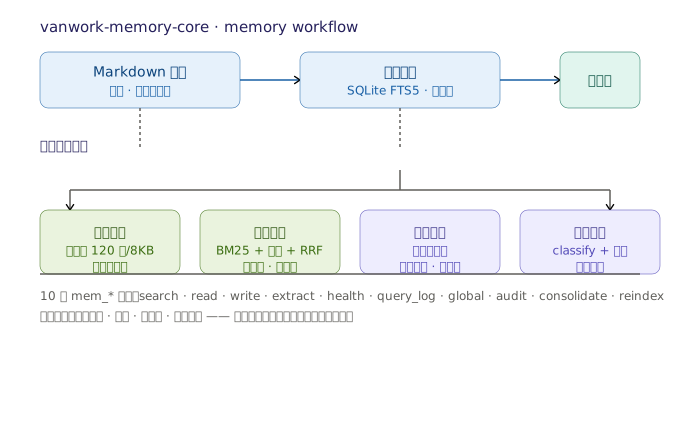
Why it's different
- Zero runtime dependencies. Pure ESM, only
node:built-ins. No build step, no transpilation — the bytes you publish are the bytes you audit. - Correctness over cleverness. Superseding edits instead of destructive deletes (L1 archive / L2 supersede / L3 destroy). Cross-process file locks with staleness recovery. Atomic writes (temp → fsync → rename). Every mutation backs up first.
- Recomputable, not "smart". Consolidation produces a plan with a content-derived fingerprint; if memory changes after the plan,
applyrefuses. You always execute the plan you actually reviewed. - Prompt-cache aware. Index entries are slot-stable (append-only, content-addressed) so the injected block keeps a stable prefix across turns — a measured jump from 11% to 78% reusable characters.
- Cloud tiering by default offline. No network, no keys, no hidden per-query cost unless you explicitly opt in.
Quick start
Install (DeepSeek Harness / VanWork)
# From npm (recommended)
dsh plugin --profile web add vanwork-memory-core
Or from a local tarball / git checkout:
dsh plugin --profile web add <path-to-vanwork-memory-core-0.8.1.tgz>
After install, restart and run mem_audit — you should see the 10 mem_* tools registered.
Run the tests
# Node >= 22.5.0
npm test                          # 476 tests
node --test "tests/*.test.js"
The ten tools
| Tool | Purpose |
|---|---|
mem_search |
Retrieve over memory entries; returns pointers (path#id) + snippets + source |
mem_read |
Read full body by pointer/id, with staleness + cloud-tier verdict |
mem_write |
Append / replace / remove / supersede, with escalating confirm gates |
mem_extract |
Session-boundary extraction → writes QUEUE.md candidates |
mem_health |
Budget / staleness / consolidation / dupe / supersede / cloud / ledger |
mem_query_log |
Query log — what got retrieved, when, and how it scored |
mem_global |
Global (cross-project) memory management |
mem_audit |
Recomputable "who manages the store" report (read-only) |
mem_consolidate |
Plan (zero side effect) and apply (fingerprint-checked) |
mem_reindex |
Rebuild the derived index (always safe) |
Key concepts
- Three-level memory correction — archive (out of attention, recoverable) → supersede (mark
[superseded-by:<id>], recoverable) → destroy (not yet implemented). Never silent-delete by default. - Suspicious-memory marking — silently flag low-evidence entries (
fragment/inferred/contested/lowconfidence), speak only when they resurface. Protected content (allergies / credentials / legal) is never flagged. - Tiered compaction — hot (30d daily) / warm (monthly digest) / cold (monthly archive pack). Idempotent, never deletes originals.
- Zero-token consolidation by default — near-dupe merge, cold archiving, and log distillation are all deterministic local computations; the model only enters if you explicitly ask it to rewrite summaries.
Configuration
See the full annotated defaults in lib/config.js (every default documents what was adopted and what was rejected). Highlights:
- id: vanwork-memory-core
  config:
    indexMaxLines: 120        # resident index budget (lines)
    indexMaxChars: 8000       # resident index budget (chars)
    searchMode: auto          # auto | bm25 | hybrid
    embedding:
      enabled: false          # offline by default
    supersedeEnabled: true    # propose (not auto-apply) supersedes
    monthlyPackEnabled: true  # tiered compaction
    backend: auto             # auto | sqlite | json
Verification
All reproducible, no network:
$node = "$env:LOCALAPPDATA\Programs\VanWork\resources\runtime\node.exe"

node --test "tests/*.test.js"        # 476 unit tests
node scripts/verify.mjs              # end-to-end (13 steps)
node scripts/mount-probe.mjs         # real cordis tree + real services
node scripts/profile-probe.mjs       # real profile composition (dsh --dump-config)
node scripts/archive-contract.mjs    # cross-plugin archive format contract
Directory layout
├── lib/            # pure ESM source (the audited bytes)
│   ├── index.js    # plugin entry
│   ├── scanner.js  # multi-root scan + § entry parsing + CJK tokenization
│   ├── indexdb.js  # SQLite FTS5 / pure-JS dual backend
│   ├── retrieve.js # hybrid retrieval + RRF + explainable scoring
│   ├── memfile.js  # safe read/write: lock + backup + atomic write
│   ├── consolidate.js
│   ├── cloud.js    # tiering + redaction
│   ├── inject.js   # resident index injection (budget + self-repair)
│   ├── audit.js    # "who manages the store" report
│   └── tools.js    # ten mem_* tools
├── scripts/        # reproducible verification probes
├── tests/          # 476 tests
└── docs/           # full technical documentation (Chinese)
Documentation
Full technical documentation (in Chinese, written against the actual code):
- How memory is stored / managed / retrieved —
docs/记忆插件技术文档.md - Installation notes —
docs/安装说明.md
Roadmap / honest limits
node:sqliteis still experimental (oneExperimentalWarningon startup; setbackend: jsonto avoid it).- Vector retrieval is off by default — no embedding service on-device, and default-on would add hidden cost + privacy egress per query.
- Locks are single-machine; cross-device concurrency is resolved by the Git layer.
- The full Chinese README (with the detailed VanWork/DSH boundary discussion, decision records, and version history) lives in the git history and the technical doc.
No comments yet. Be the first to write one.