dsh-superagent multi-channel
A DSH plugin that wires Feishu, GitHub, WeChat, WeCom, DingTalk and Alibaba Cloud Yunxiao Projex into one assess → ticket → execute → reply loop.
Version 2.4.0 · 102 test files / 1,624 passing · MIT · installs beside the official dsh-superagent
An extension of the official open-source superagent: the two official sources (Feishu, GitHub) stay as they are, and WeChat, WeCom, DingTalk and Yunxiao Projex are added and aligned to the same capability surface (reception scope, authorization list, thread context, worker reads, search, label refresh, reply and status write-back). See the capability matrix.
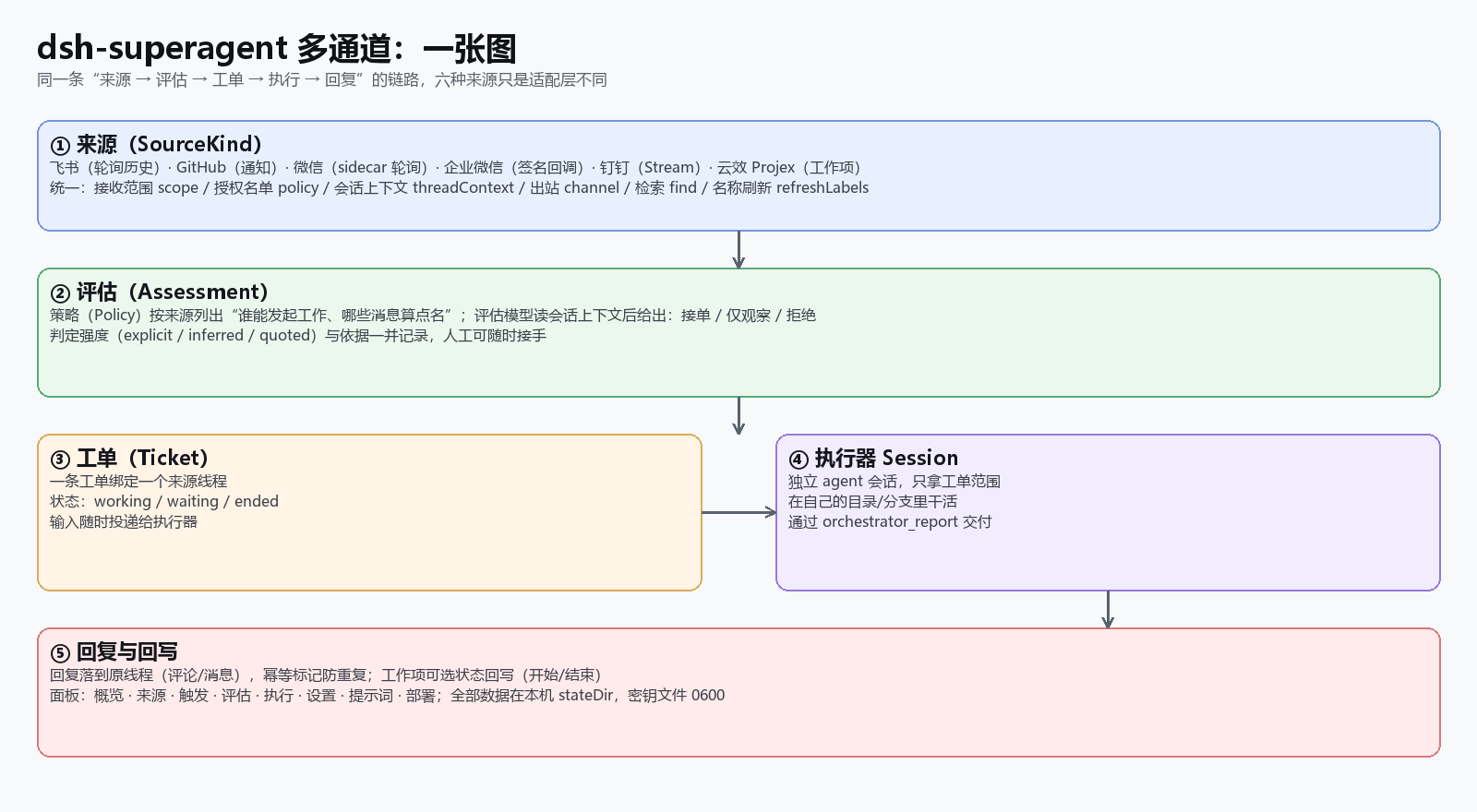
In one sentence
Someone mentions the bot or messages it on any of six channels → the plugin reads the context under the policy and decides whether to take it → an isolated executor session works in its own directory → the result goes back to the same thread, and a work item's board status can follow along.
The life of one message
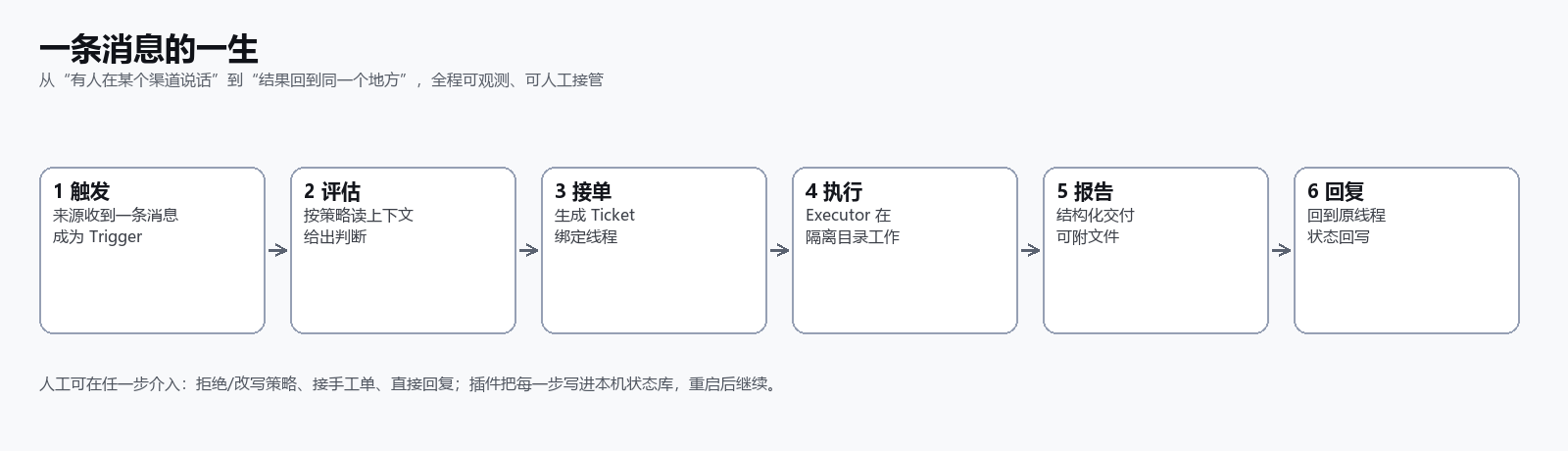
- Trigger — all six sources produce one
Triggershape (thread, sender, structured@, native id). - Assess — the policy names "who may originate work" and "what counts as addressed"; the model reads the thread and answers accept / observe / refuse, recording the evidence strength.
- Ticket — one ticket binds one source thread; later messages arrive as inputs for the executor.
- Execute — the executor session sees only its ticket's scope, works in its own directory/branch, delivers with
orchestrator_report. - Reply & write back — the reply lands in the original thread (comment/message, idempotency-marked); a work item's status
can move to "in progress" and "done". Everything is in the local
stateDir; a person can take over at any step.
Three real scenarios
- A Yunxiao defect — someone @-mentions the bot on a work item ("login 502 intermittently") → the assessment reads the item and its comments → a ticket opens → the executor fixes it in an isolated directory → the result is a comment, and the board moves from "in progress" to "to test".
- A WeChat ops group — "@bot can you check the expiring certificate?" → the reply goes only into that thread.
- A WeCom direct message — "change this copy" → the reply returns to the same conversation, split into ordered parts, with a file delivered as a comment/link when needed.
What decides it becomes work?
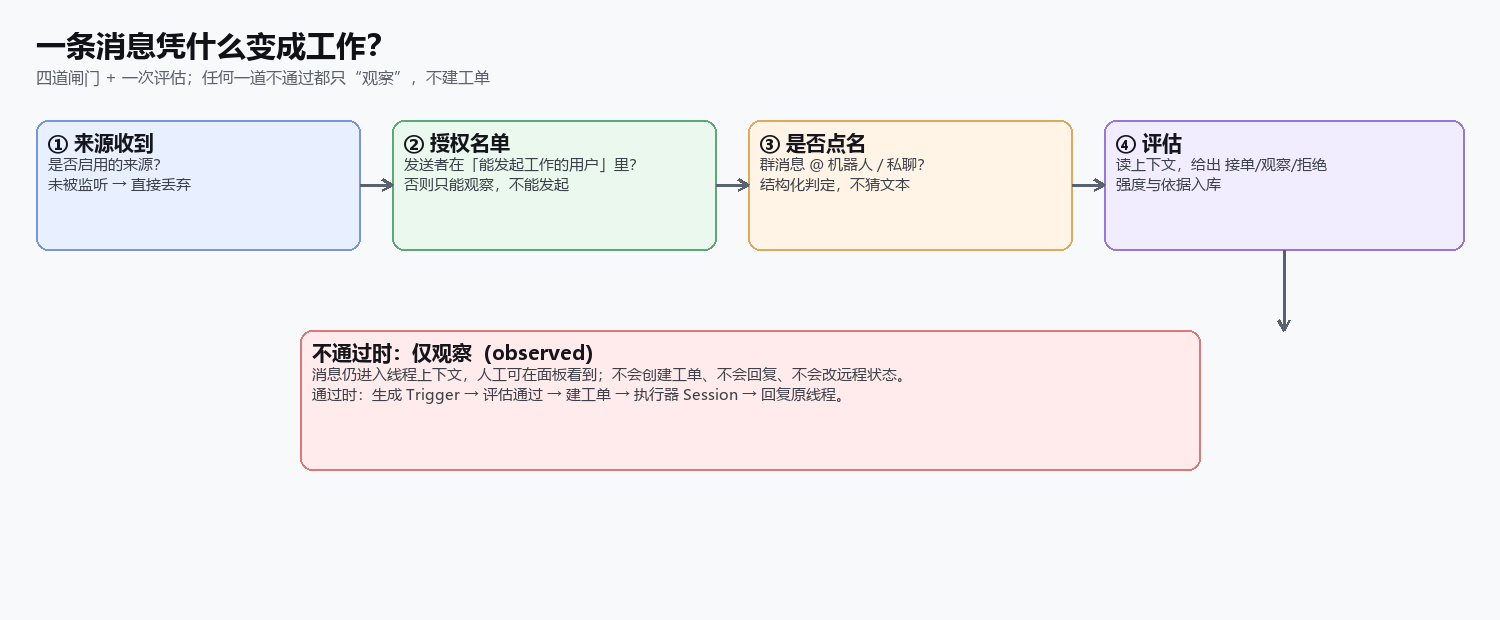
Four gates (enabled source → allowed list → structured mention → assessment). Failing any one only observes the message: no ticket, no reply, no remote change.
Feature checklist
| Stage | What exists |
|---|---|
| Receive | six sources normalised to one Trigger; groups/DMs; structured @; optional images; dedupe by platform id |
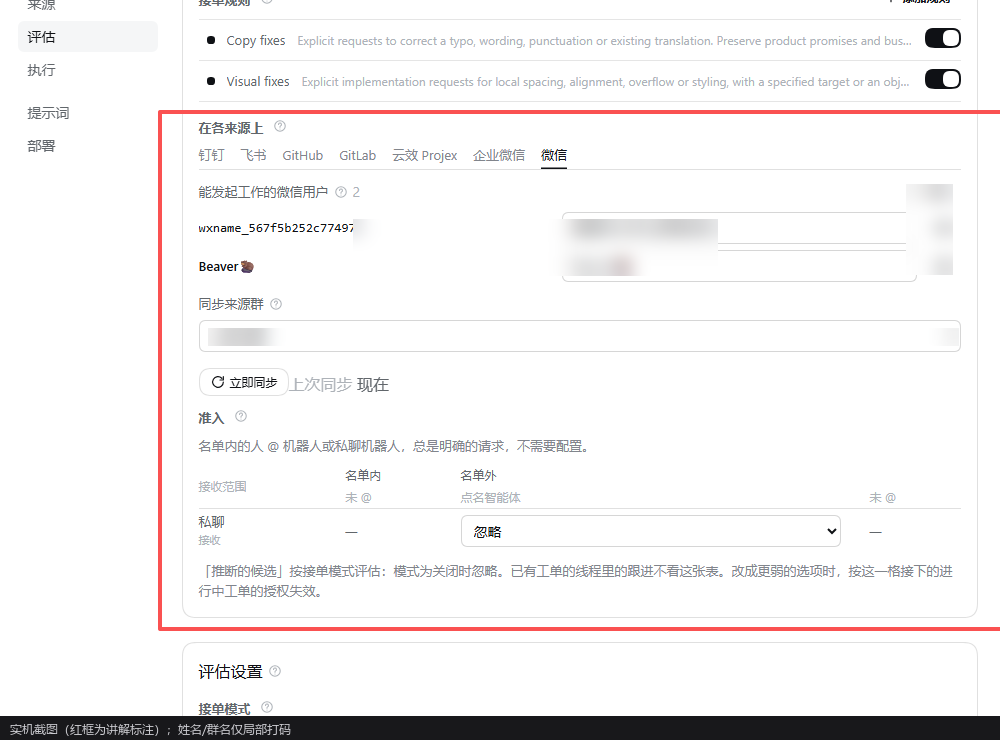
| Authorize | per-source "who may originate work" + admission table (listed/unlisted × @/un-@/DM) |
| Assess | rule switches, mode (off/observe/auto), deadline, model and effort; every decision records strength and evidence |
| Ticket | one ticket per thread; inputs delivered any time; interruptible, supplementable, human-takeover |
| Execute | isolated executor session and directory/branch; structured report; files returned |
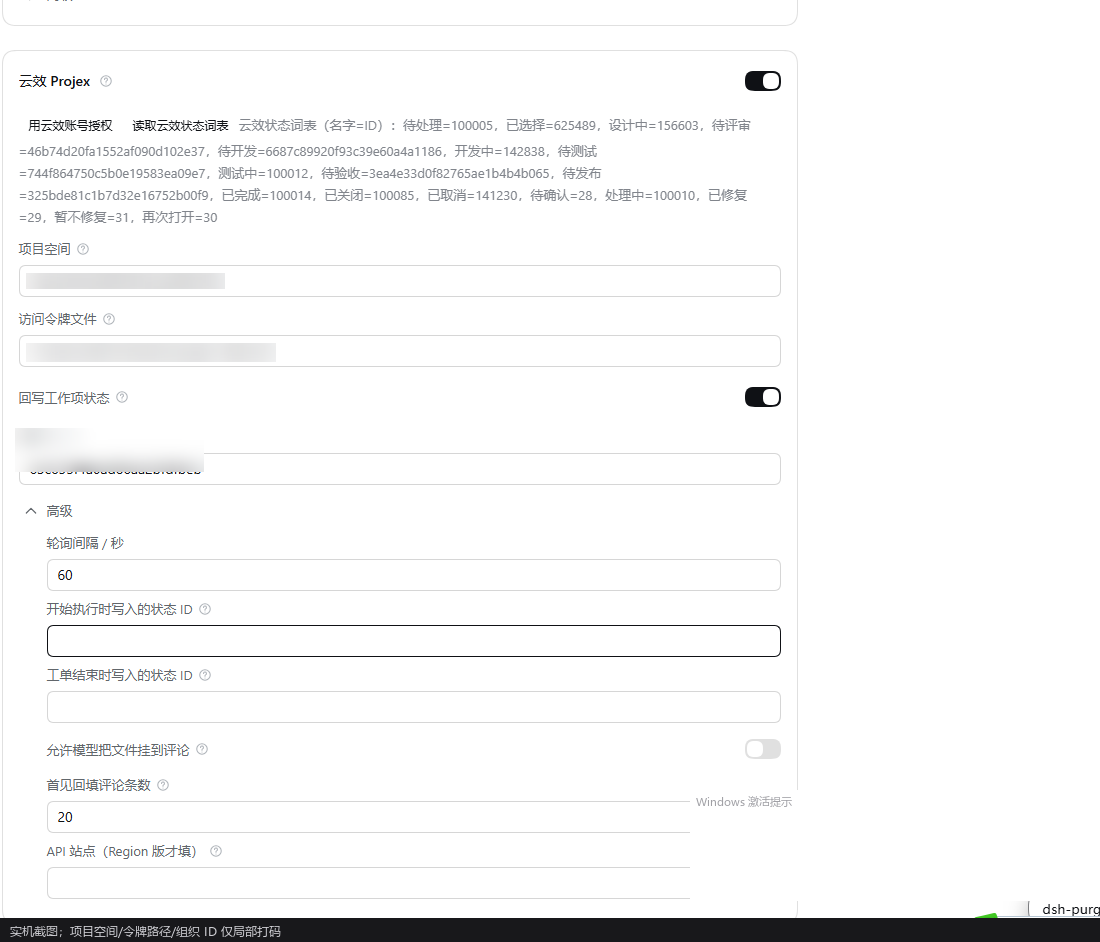
| Reply | back to the original thread; idempotent marker; optional work-item status write-back; visible retries |
| Read originals | per-source worker resources, read-only |
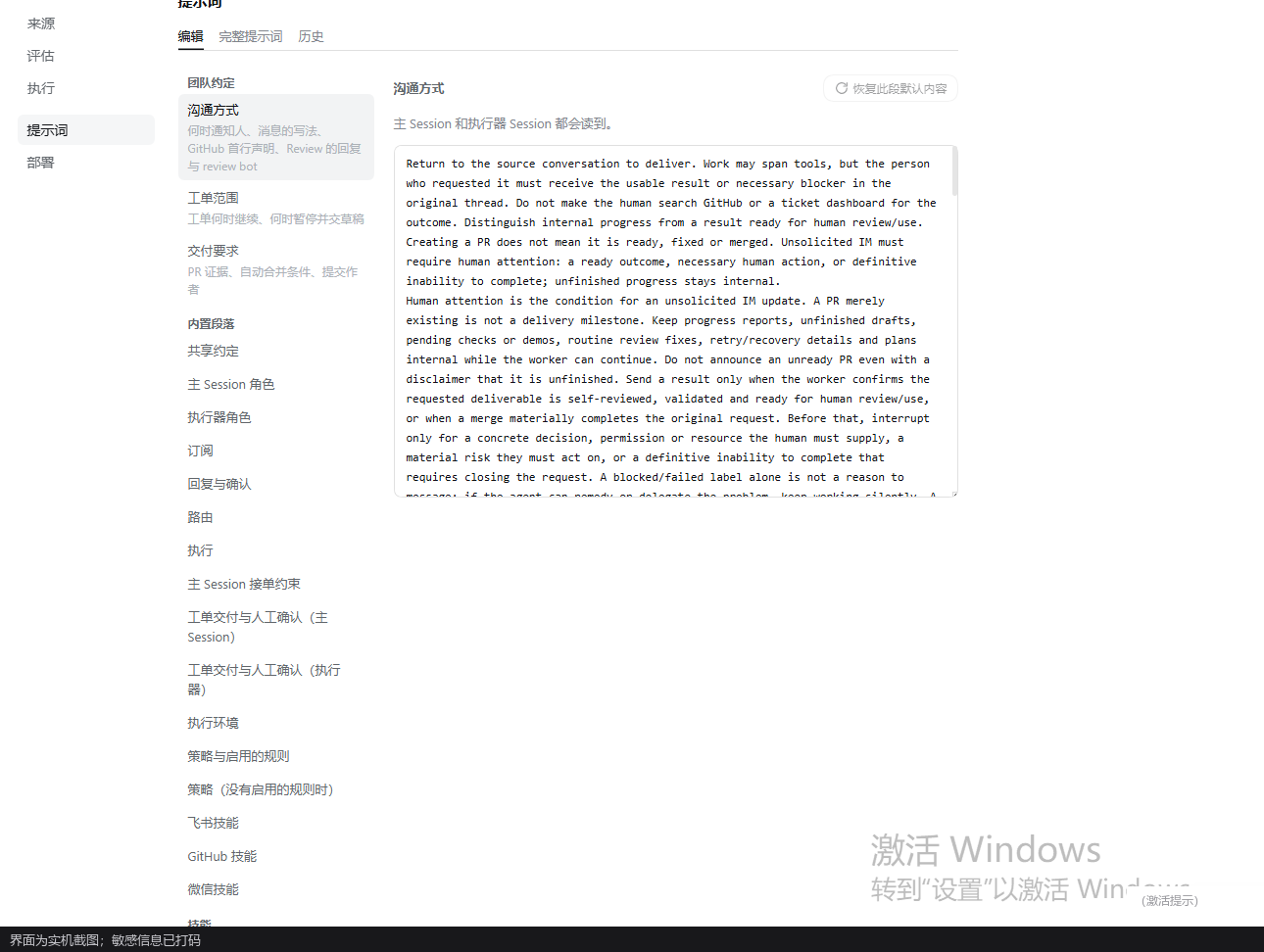
| Panel | overview/sources/triggers/assessment/execution/settings/prompts/deployment; prompts and six skills overridable |
| Security | local state, 0600 secrets, reply-only, platform limits stated |
Six sources, one panel
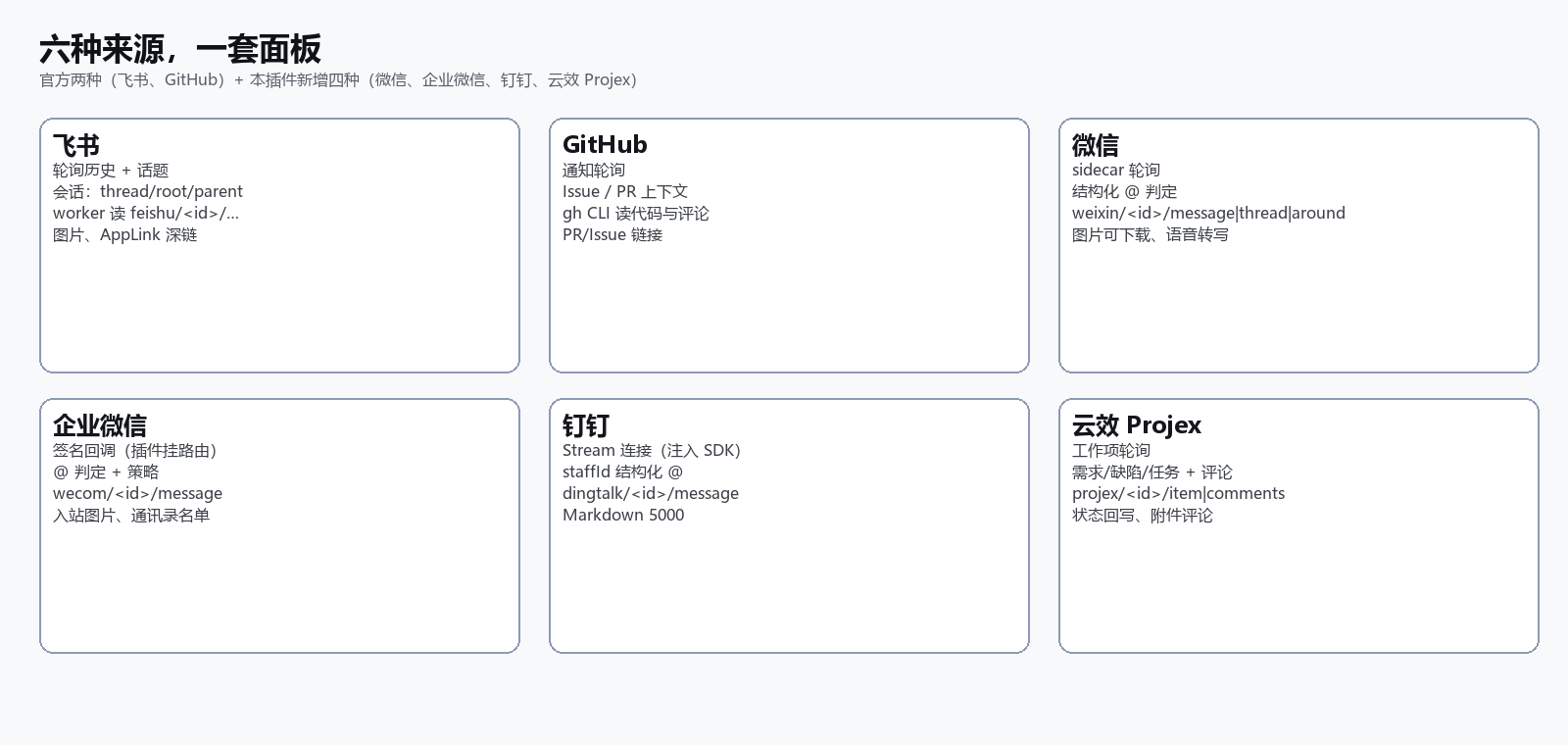
| Source | Reception | Highlights |
|---|---|---|
| Feishu (official) | history polling | topic/reply chains, AppLink deep links, images, worker reads feishu/<id>/… |
| GitHub (official) | notification polling | issue/PR context, gh for code, PR/issue links |
| WeChat (added) | sidecar polling | structured @, voice transcripts, downloadable images, worker reads weixin/<id>/message·thread·around, post-reattach catch-up |
| WeCom (added) | signed callback (plugin mounts /wecom/<instance>) |
@ judgement, inbound images, contact-list names, worker reads wecom/<id>/message |
| DingTalk (added) | Stream (deployment injects the SDK connection) | staffId @, Markdown 5000, worker reads dingtalk/<id>/message |
| Yunxiao Projex (added) | work-item polling | requirement/bug/task + comments, status write-back, attachment comments, worker reads projex/<id>/item·comments |
Capability comparison (against Feishu and GitHub)
Feishu and GitHub are the two Sources the upstream superagent ships; the other four are this bundle's additions. ✅ present · ➖ not applicable · ❌ impossible on the backend (stated, never faked).
| Capability | Feishu (official) | GitHub (official) | WeCom | DingTalk | Yunxiao Projex | |
|---|---|---|---|---|---|---|
| Receive messages | ✅ poll history + events | ✅ poll notifications | ✅ sidecar poll | ✅ signed callback (plugin mounts /wecom/<instance>) |
✅ stream (needs a connect injected; no SDK shipped) |
✅ poll work items/comments |
| Assess / decide / execute / reply loop | ✅ | ✅ | ✅ | ✅ | ✅ | ✅ |
Structured @ judgement |
✅ open_id | ➖ | ✅ ats (markup fallback, strength in facts) |
✅ mentionsAgent |
✅ ats staffId |
➖ |
| Direct messages | ✅ | ➖ | ✅ | ✅ | ✅ | ➖ |
| Outbound text | ✅ markdown | ✅ comment | ✅ + mention-back | ✅ plain 2048 | ✅ markdown 5000 | ✅ RICHTEXT/Markdown comment |
| Outbound files | ➖ (CLI) | ➖ | ✅ sendFiles |
❌ API text only | ➖ (webhook) | ✅ attachments |
| Idempotent send | ✅ keyed | ✅ marker | ✅ keyed | ❌ none (stated) | ❌ none (stated) | ✅ marker |
| Thread context for the assessment | ✅ thread/root/parent | ✅ PR/issue | ✅ thread/parent; root→no_root |
✅ thread; root/parent→no_* |
✅ thread; root/parent→no_* |
✅ item body + comments |
| Worker reads of the original | ✅ feishu/<t>/… |
✅ github/<t>/… |
✅ weixin/<t>/… |
✅ wecom/<t>/message |
✅ dingtalk/<t>/message |
✅ projex/<t>/item, /comments |
| Inbound images for the assessment | ✅ | ➖ | ✅ [image:<id>], /media |
✅ MediaId, /cgi-bin/media/get |
➖ (text stream) | ✅ item/comment images archived |
| Panel search | ✅ message id | ✅ issue/PR number | ✅ native id | ✅ decimal MsgId |
✅ msgId |
✅ serial or page URL |
| Reply→parent mapping | ✅ | ✅ | ✅ (quote id) | ➖ no quote in callback | ➖ | ➖ |
| Display-name refresh | ✅ chat names | ✅ repo names | ✅ rooms/members | ✅ department users (refreshLabels) |
❌ needs contact permission API, not offered | ✅ status vocabulary |
| Member/roster sync into Policy | ✅ chat members | ✅ collaborators | ✅ group members | ❌ group members unreadable; user list only fills names | ❌ same | ✅ project members |
| Health entries | feishu + history |
github |
weixin |
wecom |
dingtalk |
projex |
| History backfill | ✅ chat history | ✅ notifications | ✅ post re-attach catch-up (marked historical) |
❌ callback only | ❌ stream only | ✅ first-sight comments |
| Message deep link | ✅ AppLink | ✅ issue/PR URL | ❌ | ❌ | ❌ | ✅ item page |
| Multiple instances | ✅ | ✅ | ✅ | ✅ | ✅ | ✅ |
Platform limits, not bugs: WeChat/WeCom/DingTalk have no per-message deep link; WeCom and DingTalk have no history to backfill (callback/stream only); DingTalk needs an injected connect() (src/sources/dingtalk-watch.ts); WeCom/DingTalk cannot enumerate chat members; DingTalk stream events carry text, so no image is claimed.
Full background and the "why" live in the capability matrix.
Panel tour
The plugin has its own sidebar entry, "Superagent multi-channel", beside the official one. The screenshots below are real captures; project IDs, token paths, organisation IDs, names and chat names are masked.
Install and first run
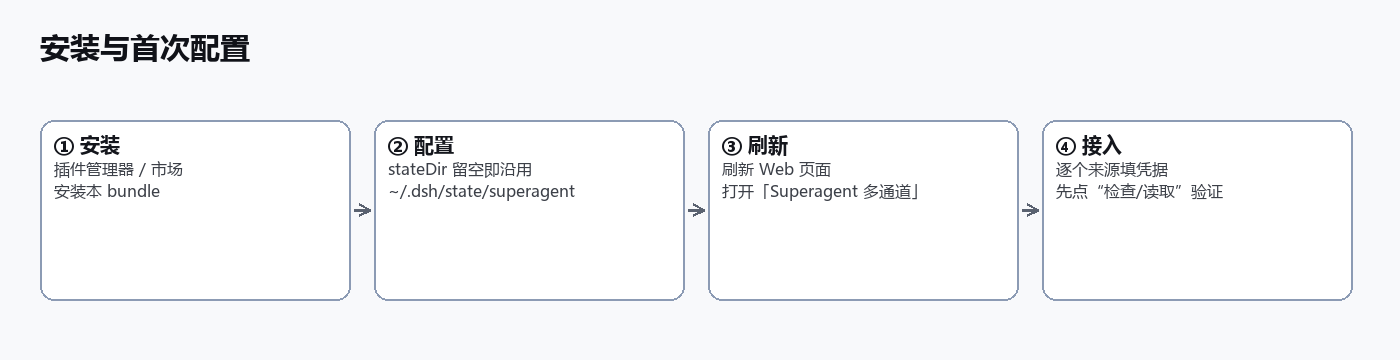
- Install the bundle from the plugin manager (directory, npm package or tarball), or from the market once listed.
- Configure: leave
stateDirempty to adopt an existing~/.dsh/state/superagent(no migration); two superagent installs each need their own directory. - Refresh the web page and open "Superagent multi-channel".
- Connect a source: fill its card and use the card's Check / Read action before enabling it.
More in deployment; per-channel steps in EXTENSIONS.md.
Security and boundaries
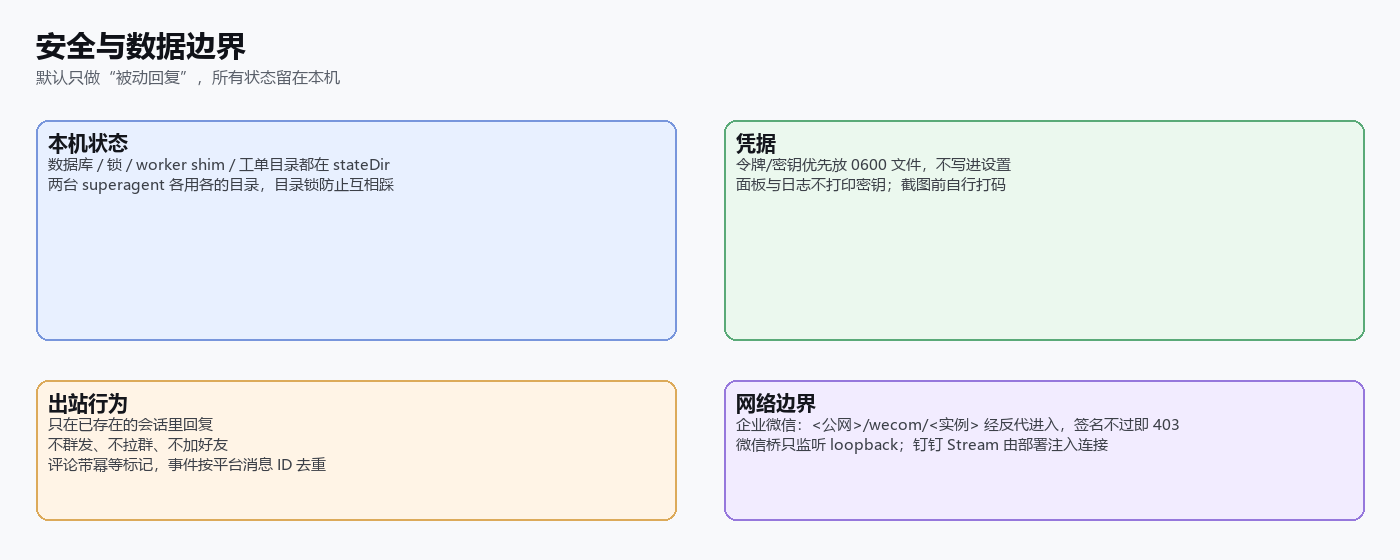
- Reply only: no broadcasts, no group invites, no friend requests.
- Secrets stay local: tokens/keys live in 0600 files rather than settings; screenshots and logs never print them.
- Idempotency and dedupe: comments carry a marker, callbacks dedupe by platform message id; WeCom and DingTalk have no
server-side idempotency key and say so in
facts. - No faked platform behaviour: WeChat/WeCom/DingTalk have no message deep link, the two push backends have no history to page, and DingTalk's stream needs an injected SDK connection. See the capability matrix.
FAQ
Does it auto-reply to everyone? No. Only threads the assessment accepted get a reply; a message from an unlisted person is
observed at most.
Where does data go? Everything stays in the local stateDir; data reaches a platform only when the plugin calls that
platform's API to read or reply.
Can it run beside the official superagent? Install both, but enable one at a time (a Host accepts one Source kind per id);
each keeps its own stateDir.
Does upgrading lose data? No. stateDir is unchanged and, since 2.3.0, the agent presets keep the shared ids so old
sessions resume.
A source receives nothing? See the troubleshooting table in docs/008-cookbook.md: WeCom callback
URL and token, DingTalk's injected stream connection, the WeChat bridge /health.
Documentation map
| Document | What it covers | Length / Audience |
|---|---|---|
| docs/README.en-US.md | Reading order and the full map (中文:docs/README.md) | 46 lines · start here |
| docs/000-philosophy.md | Why assess → ticket → execute | 35 lines · everyone, ~10 min |
| docs/001-domain.md | Trigger / Thread / Ticket / Assignment | 114 lines · developers, integrators |
| docs/002-authorization.md | Policy, allowed lists, addressed detection | 157 lines · admins, security review |
| docs/003-execution.md | Executor sessions, directories, delivery | 205 lines · developers, operators |
| docs/004-prompts.md | Prompts and skills | 98 lines · prompt maintainers |
| docs/005-panel.en-US.md | The panel page by page (with screenshots) | 60 lines · everyday users |
| docs/006-deployment.md | Deployment, settings, upgrades, coexistence | 298 lines · deployers, operators |
| docs/007-architecture.md | Architecture, module and test tables | 713 lines · maintainers, contributors (as an index) |
| docs/008-cookbook.en-US.md | Recipes and troubleshooting | 51 lines · on-call, troubleshooting |
| docs/extensions/capability-matrix.md | Six-source comparison and platform limits | 42 lines · selection, review |
| docs/extensions/ | ADR-005 … ADR-012 (each in English and Chinese) | 40–356 lines each · decision history |
| docs/gallery.en.html | Illustrated preview (中文:docs/gallery.html) | image pages · demo, review |
Develop and test
pnpm typecheck   # tsc --noEmit
pnpm test        # vitest run --maxWorkers=2
pnpm build       # tsdown, eight entries
Latest full regression (2026-11-14, 2.4.0): tsc 0; 102 files passed / 5 skipped, 1,624 passed / 41 skipped, 0 failed;
tsdown build complete.
License
MIT, with the upstream dsh-superagent notices kept. WeChat UI automation is a third-party tool without Tencent's
authorization and may break at any time; use it within ADR-005's boundary (reply
only when mentioned, no broadcasts, no bulk friend requests, one account online at a time).
Screenshots are real captures with sensitive fields (project/organisation IDs, token paths, names, chat names, session titles) masked; the architecture and lifecycle images are diagrams drawn from the current implementation.
No comments yet. Be the first to write one.